
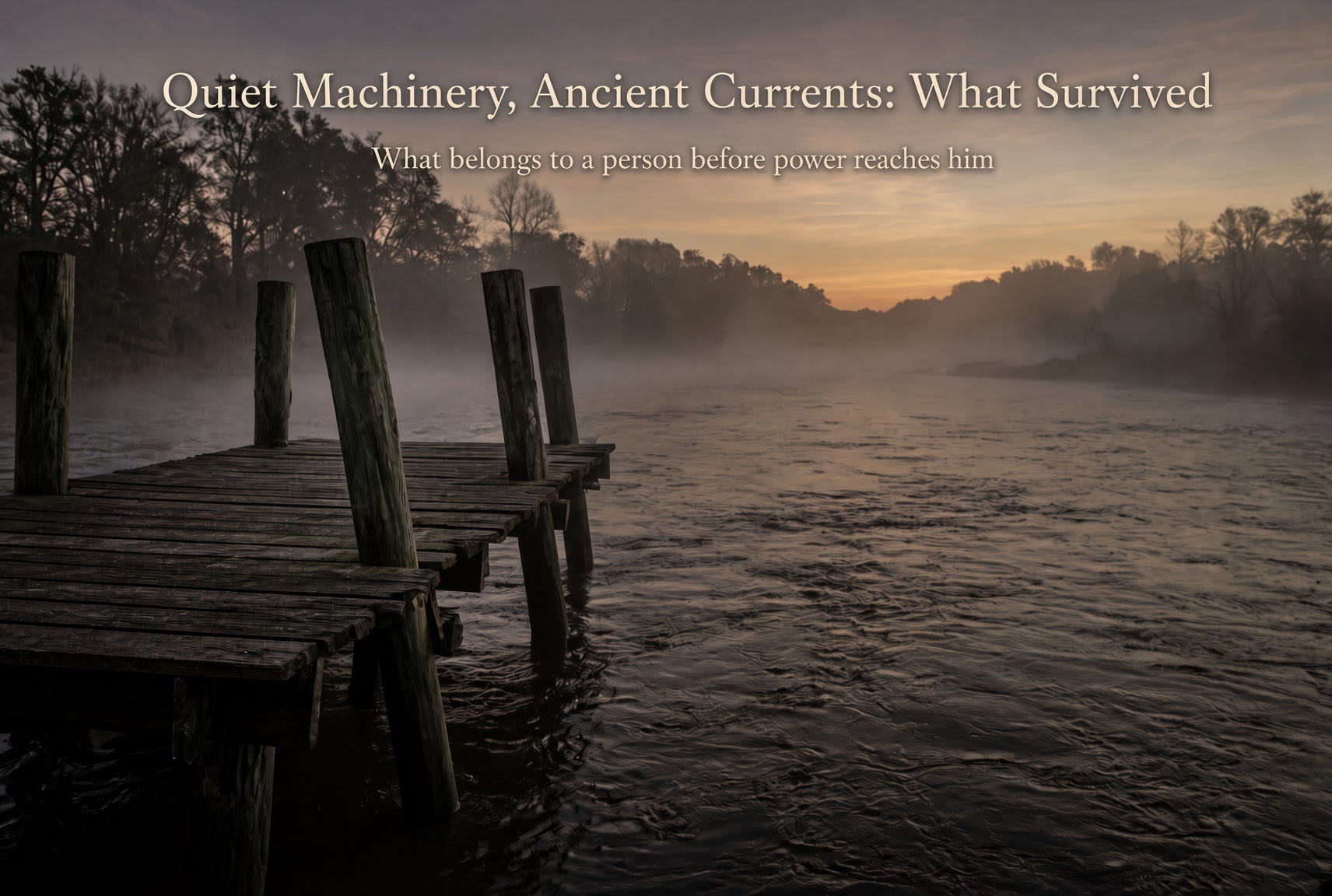
The current still carries what came before.
It carries Antigone’s older law, the one she chose when the city’s decree demanded obedience. It carries Cato’s refusal, the conviction that some things are worth fighting for and some limits worth dying rather than surrendering. Cicero gave that limit words: “True law is right reason in agreement with nature, universal, unchanging, everlasting.”
The Republic died. The current did not.
What disappeared was not only a form of government. It was the memory that a person could stand before power and still be something more than subject, servant, or body.
Inside the machinery, Seneca carried it differently. He lived close to the throne and knew what power could give and what it could take. He wrote that,“we suffer more often in imagination than in reality,” and that “it is not that we have a short time to live, but that we waste a great deal of it.” When the machinery finally required his silence, the body stopped. The words kept traveling.
Another current had entered beside it. Older scrolls of law and covenant already carried the conviction that the highest authority did not begin with an earthly throne. Jesus Christ carried it farther. No legion marked the arrival. No office protected the words. They moved through ordinary voices and ordinary hands, through letters, accounts, teachings, arguments, warnings. Twenty-seven writings gathered beside the older books. Power hunted the hands that carried them. The current carried them anyway. It reached the throne itself.
Marcus Aurelius ruled from the center of the Roman world and still looked beyond the power of his own office for the measure. “If intellect is common then reason is common. If reason is common then law is common. If law is common, then from that follows a citizenship larger than Rome.” The emperor could sit on the throne. The law did not begin there.
By the time the old center weakened, the current was carrying all of it. Antigone’s older law. Cato’s refusal. Cicero’s limit. Seneca’s words. The older scrolls and the newer ones. The conviction carried by Jesus Christ and kept alive in ordinary hands. Marcus Aurelius looking beyond Rome while sitting at its center. Not whole. Not clean. But carried.
The roads remained when the authority that built them began to disappear. Stone beside timber. Walls broken or held. Roads vanish into forest and return.
Order had not returned. It had only changed hands.
The loss was not abstract. It entered through the door before dawn. It came as a summons nailed to wood, as a levy counted against a field already failing, as a child kneeling beside his mother and shaking her shoulder after plague had taken the warmth from the room.
No magistrate came. No physician arrived by road. No grain office opened. No order moved toward the house. There was only the room, the body, the child, the silence where help should have been.
And when help did come, it did not always come as help. Sometimes it came as command. Sometimes it came as penance. Sometimes the living were told to search themselves for the sin that had brought death through the door.
The body suffered. The soul was accused. The child was still alone.
A field could be taken. A village could be taxed until hunger did the rest. A man could be called to fight for a lord whose name he barely knew. A family could live beneath a power that demanded obedience but owed them nothing.
And among them stood quieter buildings. Behind their walls, men gathered words. Some were prayers. Some were law. Some were fragments of a world already disappearing from memory. A hand copied what another had carried. Not from freedom. From fear of what would be lost.
Even there, the current did not move through clean hands. The walls had their own authority. A man could be bound from without and within, the body claimed by one power and the conscience pressed by another.
Outside, power changed hands. Inside, the current waited.
Here it hears the words of the writer who died near the end of that century:
“How dismal the necessity of birth! How miserable the necessity of living! How hard the necessity of death! These are the men whom even they fear who are themselves feared.”
Outside, armed men divide what the legions left behind. Inside, the words remain. Not loudly. Not safely. But moving.
It finds another spark in a prison cell around five twenty-four. Facing execution, he writes:
“Nothing is miserable unless you think it so.”
And:
“Who can give law to lovers?”
Even beneath the sword, the conviction speaks. Authority may hold the body, but it cannot command reason or the heart. The words from the prison cell do not fade. They travel. They move through quieter buildings, through copied pages, through hands that do not need to know where the words will go next.
The land stays hard because the man who tills it never gets to keep what he grows. He breaks the soil at first light, his back already burning before the sun clears the trees, and by evening the lord’s reeve has taken the best of it. What’s left is just enough to keep him standing for another season of the same. Kings rise. Armed houses gather. The poor bend beneath hunger, levy, oath, and fear. The language of Rome fades from the road, but the weight of command remains.
What survives gathers quietly. A sentence. A prayer. A piece of law. A memory of Rome. It waits near the water.
Then it hears the voices describing what is being left behind. One writes of cities in ruins, fields untilled, the poor ground down by hunger while the rich devour each other with greed and violence. Another speaks of the land laid waste, the people slaughtered or enslaved, the very air heavy with the cries of the dying. A third says the poor flee to the invaders because their own rulers have become unbearable. The world above feels as if it is ending.
It slips toward the water carrying what the old world could not entirely destroy. Not a kingdom. Not a church. Not an army. A limit. A question. A memory that the person is not property.
The current crosses the water. It moves across the narrow sea toward the land the Romans once held. The voices behind it begin to fade. Ahead, the land waits. It comes ashore with the tide. It moves inland, slipping through broken roads, disappearing into forests before rising again.
It travels for generations through the quieter places while the land hardens above it.
Centuries pass, but the room does not become freer. A man is born to a field he did not choose, under a lord he did not choose, beneath prayers spoken in a language he cannot read. The road is still dangerous. The law is still distant. The book is closed to him unless another mouth opens it.
He knows the seasons, the hunger, the summons, the bell. He knows when to bow. He knows when to keep silent.
What he does not know is how to say that something in him belongs to no king, no bishop, no hunger, no grave.
Kingdoms gather around men strong enough to hold them. Bishops stand beside kings, oppose them, bargain with them, or join them.
Between both stands the ordinary person. He tills the field, pays the tax, answers the summons, kneels when told. A boundary changes. The man above him changes. The field remains.
It watches.
The unknown of what tomorrow would bring presses through the land. A village empties. A road become even more unsafe. A body disappears into ground that will never carry its name. Fear makes obedience easier to demand.
Those who claim authority offer order. Those who claim heaven offer certainty. Sometimes they struggle against one another. Sometimes they stand close enough that the person beneath them cannot see the space between.
It moves lower. What survives is dangerous, inconvenient, sometimes nearly forgotten. It remains because enough of it escapes destruction.
“Split a piece of wood, and I am there.”
The words do not come from a throne. They do not require a palace. They do not ask permission from the machinery above.
Years gather. Kings die and other kings take their places. Borders move. Churches rise from stone. Monasteries keep their hours. Fields are planted over graves whose names have disappeared. Children inherit obligations they did not choose from fathers who inherited them from men before them. The machinery changes its face. The pressure remains.
Yet the conviction is not spoken loudly. It has learned the danger of being heard. So it moves beneath the surface. Through a sentence copied because the page must be copied. Through an argument whose author is nearly forgotten. Through a prayer remembered by someone who cannot read it. Through law carried as custom after the language that first wrote it has faded. It does not require perfect hands. It requires only that something survive.
Another generation passes. Then another. The land above begins to gather itself differently. Power becomes steadier in places. Kings reach farther. Bishops hold their own ground. The quieter buildings remain, keeping pieces of worlds that no longer exist outside their walls.
It feels the weight of something beyond the shore. Not yet seen. Not yet named. Only pressure moving somewhere beyond the water.
“Lift up the stone, and you will find me there.”
The words have survived the throne, the sword, the prison cell, the broken road, the frightened hand, the copied page. Not whole. Not clean. But carried.
The river does not rush. It carries what it carries. Some things sink. Some things travel. Some things wait beneath the surface until the current decides they are ready to rise.
The tide presses against the pilings. The water rises and falls with the same rhythm it has kept for centuries, indifferent to who rules the land above it. We stand here at the dock by the Wando, and the old question still moves beneath the surface. What belongs to a person before power reaches him? What can the throne command, and what can it never command? For centuries, the common person has had little language with which to make that claim against the powers above him. Still, the older conviction survived: authority is not absolute, and something in the person exists before the command.
Throne Steady. Kingdom Vigilant. Unbroken 🔥
King of Cainhoy 🇺🇸 🔥
No posts
Comments
Nothing yet. Say the first thing.
Sign in to join the conversation.