
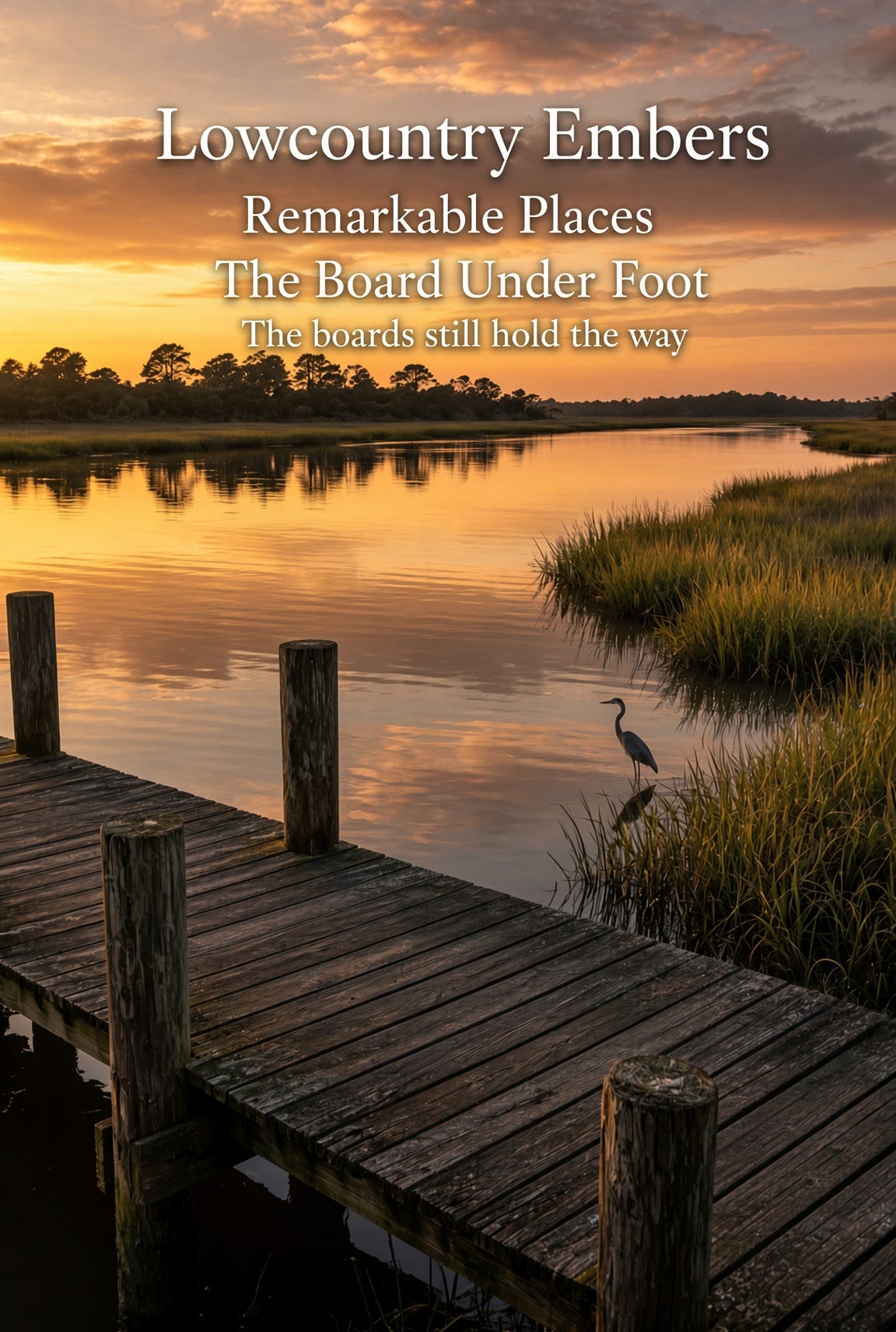
The chair sits empty at the end of the dock.
Late sun lies warm across the Wando, breaking gold where the tide turns around the pilings. The river moves slow and dark beyond it. Spartina bends along the bank. Somewhere in the shallows, a great blue heron stands so still it could have been there all afternoon.
The cedar boards are hot under bare feet.
A cooler comes down packed with ice. Beers on one side. Sweet tea on the other. A fresh bottle of hibiscus tea tucked down between them, already cold enough to sweat in the heat.
The lid drops shut.
Somebody pulls the extra chair a little closer.
That is usually how it starts.
No invitation worth remembering. No plan made three weeks ago and put on everybody’s calendar.
Somebody just shows up.
A drink gets handed over. The cooler gets shoved aside with a foot. Somebody takes the empty seat. Somebody else leans against a piling.
And the afternoon begins to get away from us.
Conversation wanders wherever it wants. Work gets mentioned once and then loses the argument. Somebody tells a story everybody has heard before and gets corrected by three people who were there. The correction is probably less accurate than the story.
Nobody cares.
The tide keeps coming. It doesn’t wait for stories to finish or arguments to settle. It just keeps moving, patient as ever.
That chair has been around a long time.
Not that exact one. They get bent. Left in the rain. Forgotten in boat lockers and truck beds. One hinge always seems to stick. But there has always been one somewhere close.
One more place to sit.
They get pulled up beside oyster tables when the shells are hot and the evening is cold. They sink into sand at the edge of the water. They end up beside bonfires, around grills, on porches and in garages with the door rolled open to the night.
Nobody plans those evenings particularly well.
That’s probably why they’re so good.
Too much food shows up, something important gets forgotten, ice runs low while a dog makes off with whatever’s left unguarded. Kids vanish into the yard and come back filthy. Music drifts until one song catches everyone at once, and then somebody laughs, not the polite kind, but the helpless kind that pulls the rest in until nobody remembers what was so damn funny.
For a minute there’s nothing else. No glowing screen on a table, no argument waiting to be won, no headline crawling across the bottom of anything, no little red number demanding attention.
Just this.
Sunburnt shoulders, wet footprints, smoke caught in somebody’s shirt, ice knocking around the bottom of a cooler, a river coming in, and people.
Just people.
Somewhere along the way, growing up teaches us to become very serious about being alive. There are bills to pay and people to answer and places to be. We learn to measure a day by what got finished. We carry calendars in our pockets and the rest of the world right beside them. Something is always ringing, buzzing, breaking, happening.
And because we can know about all of it, we start believing maybe we should.
So we carry it.
All of it.
Until an ordinary afternoon comes along and reminds us that we don’t have to.
Not all the time.
Sometimes the best thing you can do with an hour is lose it.
Go outside.
Feel the sun hit your face.
Let your shoes stay wherever you kicked them off.
Take the boat out without needing a destination. Sit on the porch until the mosquitoes finally win. Build a fire bigger than necessary. Stay long enough for somebody to say, “Well, hell, I guess we’re eating.”
Remember what it felt like when an afternoon didn’t need a reason.
We knew how to do that once.
As kids, nobody had to explain it to us.
A bicycle lying in somebody’s yard was enough. A creek was enough. A ball and three people and rules invented as we went were enough. The streetlights came on before we remembered there was somewhere else we were supposed to be.
Nobody called it presence.
Nobody called it self-care.
We were just outside.
Living.
Maybe we didn’t outgrow that.
Maybe we just got busy enough to forget.
Because it doesn’t take much to bring it back.
One person walks down to the dock, then another, and the cooler opens without anyone needing to say why. A boat fires up. Someone says they can stay for one, but the sun keeps dropping and nobody wants to be first to leave, so wood gets found for a fire and food appears from somewhere, the music comes up just enough, and before long the world that felt so enormous an hour ago has shrunk to this water, these people, this evening, right here.
Maybe that’s as big as the world needs to be for a while.
Because tomorrow morning the world will still be there.
So will the work.
So will the things we disagree about and the things we don’t understand and the thousand problems none of us knows how to fix.
They’ll wait.
Tonight, the fire burns down.
Conversation softens with it.
A few people have gone home. Somebody is rinsing glasses. Someone else is staring across the water, perfectly content not to say anything.
There are nights when solitude feels good.
There are nights when footsteps coming down the dock feel better.
You learn to leave room for both.
The tide has covered most of the mud now. The last light catches high in the oaks, and somewhere out over the river an eagle turns once before disappearing toward the trees.
The cedar has cooled beneath your feet.
The cooler is nearly empty.
And there it is again.
That extra chair.
Maybe somebody will fill it tomorrow.
Maybe they won’t.
Either way, we’ll keep one ready.
Throne steady.
King of Cainhoy 🇺🇸 🔥
No posts
Comments
Nothing yet. Say the first thing.
Sign in to join the conversation.