
I have been writing since I was three. An AI detector said, with a great deal of confidence, that I hadn’t written this.
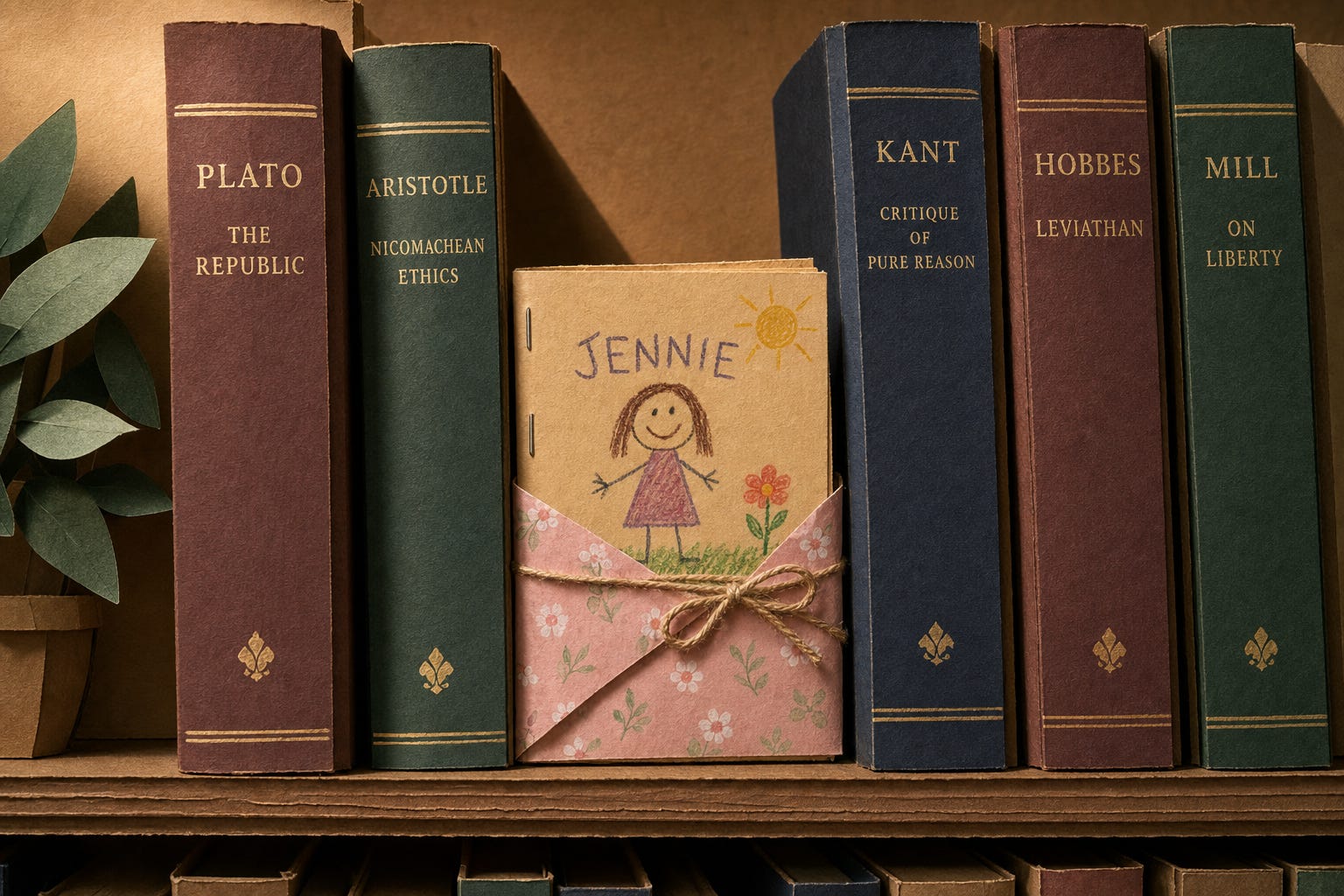
Starting at three or four years old, I used to take sheets of manila paper, fold them in half, staple the crease, and write and illustrate small books to give as gifts to my family on holidays. There was, for many years, a series. It was called the Jennie Series, and it followed a girl named Jennie through the major set pieces of her life: Jennie Goes to School, Jennie Goes to the Park, Jennie Has a Playdate, Jennie Eats Pizza, and — the seasonal special — Jennie’s Christmas, which featured guest appearances by Santa, Mrs. Claus, Rudolph, and the elves, and which contained an illustration of Mrs. Claus rubbing Rudolph’s belly that I have to describe, in retrospect, as the thing of nightmares. Then, without warning, I released Mimsy Goes to Witch School, which was a standalone in a different genre with a different lead, and which suggests that even at four I understood the appeal of pivoting to something weirder when the realism started to feel constraining.
I wrapped them in gift wrap before I gave them out, because a book is a serious object and it deserved the ceremony. Then I would sit next to the recipient — could be my mother, my father, a family friend — and I would ask them to read it out loud. They would try. In fairness to them, my spelling at three was best described as aspirational, and my punctuation was a personal art form. The, for instance, is not actually a “sound it out” kind of word. The th is doing something a preschooler applying phonetic rules cannot reasonably be expected to produce, and so what I would produce, with total confidence, was teh. Which is now, several decades later, one of the most common typos in the English language. I was ahead of my time.
Anyway. My parents were doing what any reasonable adult would do, which is guess. And when they guessed wrong, I would interrupt them immediately. No, that’s not what it says.
My father, who has an extensive library, still finds these occasionally, decades later, shoved between his volumes of Plato and whatever other intellectual project he was working through the year I was four. Small stapled books, wedged into the philosophy section. The child version of my byline.
I mention all of this because last week I finished an article for my Substack. I was pleased with it. I had labored over it. I had, in the way of writers, moved the same three commas around for an afternoon. Before I clicked to post it, I noticed a new feature to run it through one of those AI-detection tools. So I did it, mostly out of curiosity, the way you sometimes step on a scale you don’t need to be on.
The tool said the essay was 97% AI-generated.
I want to tell you what I felt, in order, because I think the order matters. First: a small hot rush of indignation. I wrote that. I was an English major. I wrote a 100 page honors thesis on Toni Morrison in college (with a 20 page bibliography, mind you — brutal). I scored an 800 on the writing section in the SATs. I still have for whatever reason a paper I wrote in third grade on Mesopotamia where my teacher scrawled “EXCELLENT” across the top.
Second: a slower, more embarrassing feeling, which was doubt. Had I? Had I really? What percentage of an essay do you have to write before it counts as yours? Third, and this is the one I want to sit with: a quiet, uncomfortable suspicion that the machine, in its way, was noticing something real.
But here’s what I’ve been a bit more than alluding to:
The year I took the SATs was, I believe, the first year they included a writing section. My prompt was about something I knew absolutely nothing about. I can no longer remember what, which tells you how much I had to say about it at the time. What I did know was the shape. Opening paragraph with a thesis. Three body paragraphs, each anchored by a piece of evidence supporting said thesis. A conclusion that resisted, with great difficulty, the urge to simply restate the opening. I had been taught this structure the way most schoolkids get taught it, and I applied it to a prompt I had no business answering, and I got an 800. And reader, it was a terrible, boring, fluffy, generic essay. That much I remember.
I want you to hold that fact in your mind for a second, because it is the whole essay.
I was taught to write in a way that a machine has now learned to imitate. Not by accident. On purpose. The five-paragraph essay is the technology of English composition, refined over generations, drilled into millions of schoolkids because it is the most efficient known method of producing legible, gradable, competent prose about a topic you may not care about. The parallel construction. The list of three (just enough to prove a pattern and no more). The topic sentence followed by the supporting evidence followed by the transition. All of it is machinery. All of it predates AI by, at minimum, a century. Some of it predates the printing press.
The em dash, since we are on the subject, at least adjacently, was in use in English by the early 1700s. We — the humans — invented it, because we needed a punctuation mark that could hold a pause slightly longer than a comma and slightly shorter than a full stop, and none of the existing options were doing the job. It is a load-bearing piece of the language. I love it. I use it constantly. When I try to substitute a parenthesis or comma for one, the sentence goes limp in a way I can feel physically, viscerally, and I usually put the em dash back within about fifteen seconds. AI now uses the em dash because we did, because it was trained on centuries of prose in which the em dash was doing exactly what it is supposed to do. The detectors have decided, on the basis of this, that the em dash is a sign of the machine.
Reader, the em dash is a sign of an eighteenth-century printer.
So here is how I actually work, because I like transparency. I write about AI. I also write. And there are ways I use AI in my writing, and ways I don’t.
I have been the kind of person who is obsessive about language since I was old enough to be too opinionated about it. I was an English major. I studied linguistics. I listen to linguistics podcasts the way other people listen to true crime (okay, I also listen to true crime — I am human after all). I think about the structure of humor the way other people think about the structure of a good workout — how the setup carries the load, where the beat lands, the rule of threes, why the same joke works in one order and dies in another. I get Genius on Spelling Bee every day, which I recognize is a humble brag but, if you really think about it, is kind of a lame brag, all things considered. I come from a family of readers. I enter creative writing competitions for fun. I have not, so far, won, and I would absolutely have told you if I had. I write privately every day because writing is how I think, and my phone contains a running document of half-quotes, stray ideas, and lines I overheard on the train, which is where many of these pieces actually start.
By the time an essay gets to the polish stage, it has been sitting in me for a while. The anecdotes are mine. The jokes are mine. The views, the perspective, the argument — all mine. What I’m looking for at the end of a draft is not a co-author. It’s a second pair of eyes to tell me whether the joke I’ve built is landing or whether I’ve constructed something so convoluted that a reasonable person, somewhere, is trying to escape it. Whether the piece is in a logical order that won’t give loved ones concerns I’ve gone mad. Whether I am — and this is always, always yes — being way too wordy. I already know most of the answers. What I want is permission to cut.
That second pair of eyes is sometimes an AI editor. It is sometimes my partner Jay, with whom I recently had a long conversation about a trench coat metaphor that I ended up discarding anyway, though not before it produced a genuinely embarrassing number of laughs. It is sometimes a friend who will read a draft at ten at night and tell me the truth about it. Sometimes I take their notes, but I don’t always. What I do is always ask — someone or something.
AI, specifically, is useful for two things. One is fact-checking, which is where the collaboration gets its teeth. It produces a link; I check the link; sometimes the link supports my point and sometimes it dismantles it. Dismantling is annoying. It means I have to start over. This has happened. It has, in fact, happened on finished pieces where I was sure I was right and turned out, in the specific way that stings, to have been sure about something that was not true. The other is that it does not get tired and does not have feelings about being overruled, which is either a feature or a small tragedy, depending on the day. It will go rounds and rounds with me on a single word choice in one sentence of a 2,000-word essay, in a way a human — even one who loves me — may strangle me for.
Here is what the detectors are actually looking for. Not “AI,” which they cannot see. They are looking for a stylistic fingerprint: sentences of varied but controlled length, em dashes deployed with purpose, parallel constructions, lists of three, metaphors stacked on metaphors, rhetorical questions followed by structured answers. Colons introducing lists. Balanced clauses. No typos, no false starts, no fragments that aren’t there on purpose.
Every one of those features is also the fingerprint of a fifteen-year-old who has been drilled on the five-paragraph essay, or a college student in a workshop, or Nora Ephron, or Joan Didion, or the staff of The New Yorker on deadline since 1925. The detectors have been trained on a corpus in which “sounds like AI” and “sounds like a well-taught writer” have collapsed into the same category, because on the page they are, in fact, hard to tell apart. The machine learned it from us. It could not have learned it from anywhere else.
The essay you’re reading has been edited too, in the way I edit. I wrote it, I asked for input where I got stuck, I checked the facts (although most were personal or opinions, so less fact-checking than normal), I moved the commas around a whole bunch. Probably a detector will flag this piece as AI-generated in part, which will be mostly wrong, but it will also be catching something true, which is that I have been trained, by workshops and by editors and by Jay and by the SAT and now, apparently, by an AI, to write in a voice that is legible as writing rather than as speech. That voice is mine.
I also realized that I don’t have to guess what an AI detector would rank this piece. We can find out together right now! Please hold…
Pangram believes it is 93% AI-generated. Hehe.
It gets better.
It flagged plagiarism. What? I was shocked.
The offending sentence? “I was an English major.” That’s it. That’s the whole allegedly plagiarized bit.
As substantiating evidence, Pangram elaborates: “The highlighted sentence appears to match content from: The Decline and Fall of the English Major | Parents & Families.”
So: an essay in which I claim to have been an English major has been flagged as plagiarized from an article about English majors ceasing to exist. I want that on my tombstone.
What shocks me most is that it only found evidence of these five words in one other source.
And yes, the chatbots will get better at imitation, and the detectors will get better at whatever it is they do, both sides sharpening. But the real question is not “did a human write this” but “is there anyone in here.” And that one, I’m afraid, no machine is going to answer for us.
I have been showing people what my writing means since before I could reliably produce the letters.
A machine can now read my sentences with far greater fluency than my mother could read the word elephant rendered in the handwriting of a preschooler. The machine can score them, categorize them, produce a confidence percentage about whether a person made them. What the machine cannot do is tell you about their lived experiences, their personal perspectives informed by experience, the things that make them laugh, that make them cry, that are worth saying, that are truly original.
I am here. I have been here the whole time. AI has helped, Jay has helped, family and friends have helped, teachers have helped, and none of them could have told you what this essay was supposed to say, because none of them were the ones who meant it.
That part, still, is only me.
How do you use (or not use) AI in your writing and editing processes?
Comments are open.
Thanks for reading Opinions & Conditions May Apply!
Comments
Nothing yet. Say the first thing.
Sign in to join the conversation.