
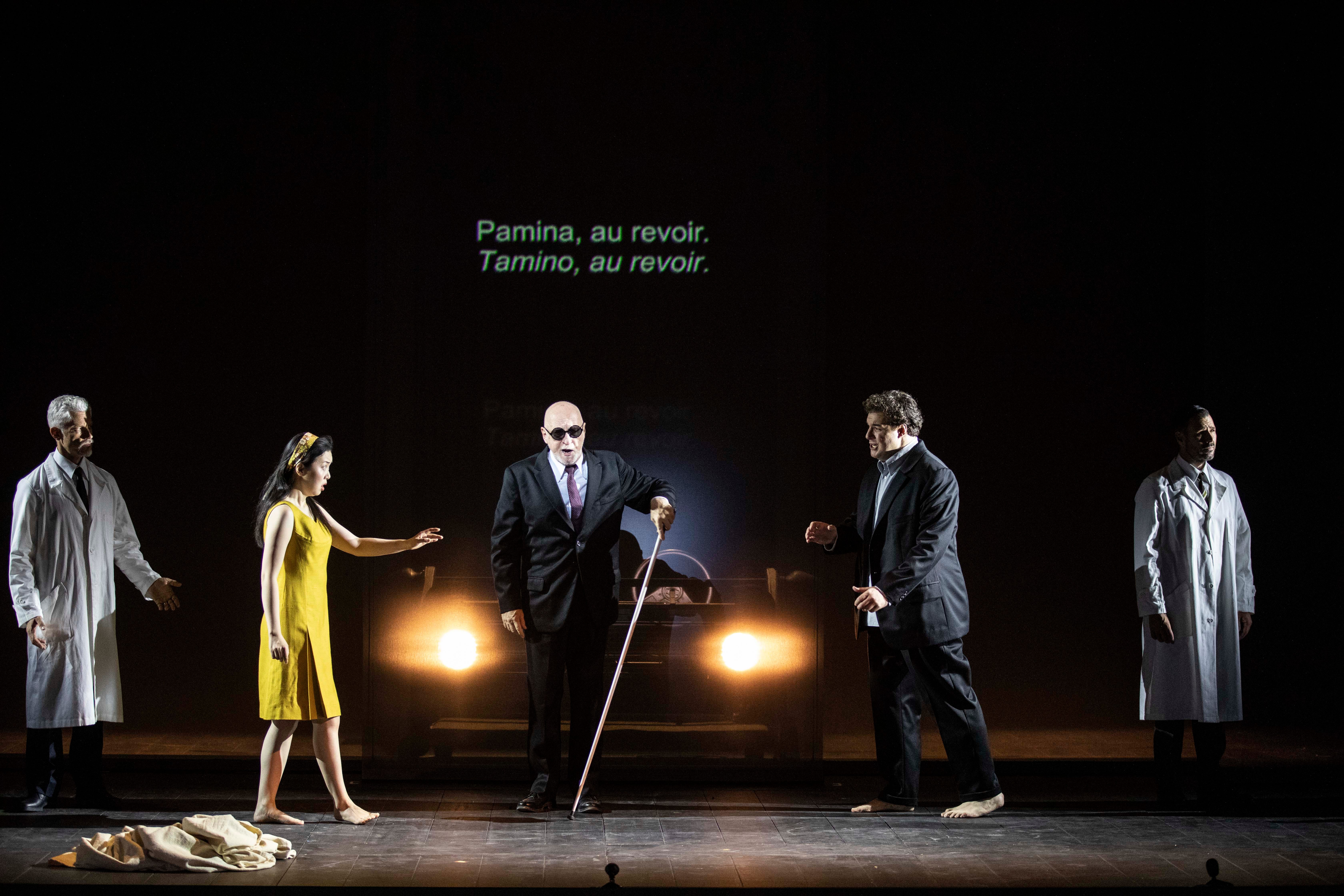
Goodbye Mozart: Ying Fang (Pamina), Brindley Sherratt (Sarastro), Mauro Peter (Tamino) flanked by Edwin Crossley-Mercer (Speaker) and Damien Pass (Priest) Picture © Jean-Louis Fernandez
Despite an impression that, by recent standards anyway, this year’s programme is relatively thin, the 2026 Aix festival opened with two works that share some themes: Die Zauberflöte and Die Frau ohne Schatten.
During the crisply played overture to Mozart’s Singspiel, it was hard to avoid the link with Strauss’s post-World-War-One fantasy (see separate review). The stage production showed us (Second-World) wartime images of women and children coming to terms with the destruction of European cities - confounding expectations of an opera which, more than two centuries after its premiere, still defies categorisation. Is The Magic Flute pantomime, philosophical journey from Ancien Regime darkness to enlightenment, or coming-of-age rite of passage? Or is it a metaphor for the life-cycle, encouraging audiences to ‘go forth and multiply’? Of course, it is all these and more. So where does an interpreter begin with this eternal puzzle?
To be fair to the French film-maker and installation artist Clément Cogitore, the performance had remarkable consistency for such a multifarious work. Alban Ho Van’s simple sets were mainly screens onto which Cogitore’s videos and archive footage could be projected. Twi-lit by Sylvain Verdet, with predominantly grey costumes by Wojciech Dziedzic, the show had a single-mindedness that ran its course from the misery of the ruins of Europe to its conclusion in the anything-but-brave new world of 1960s America.
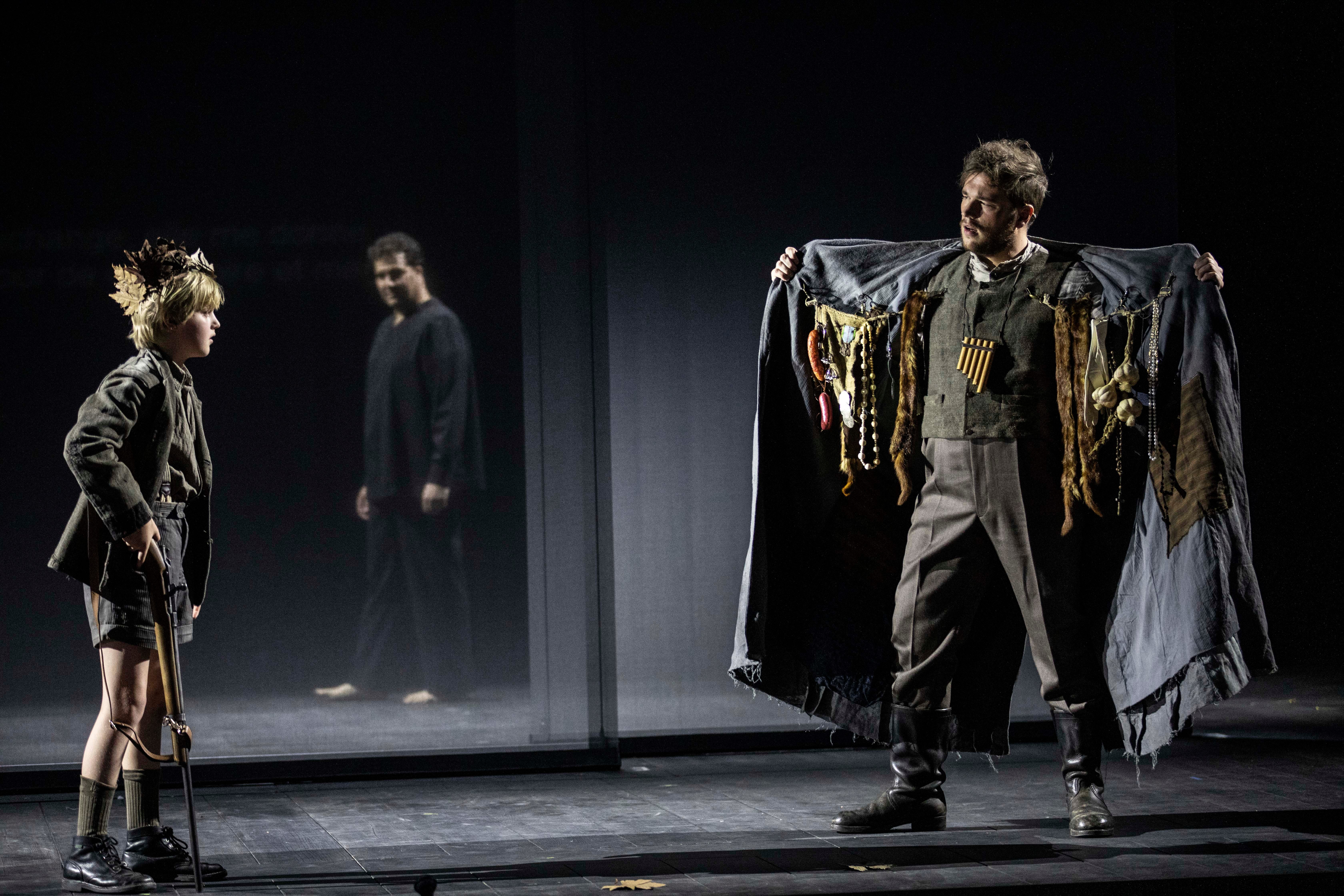
“Young Tamino” (child actor) confronts Pagageno (Sean Michael Plumb) with Mauro Peter (Tamino) lurking in the background Picture © Jean-Louis Fernandez
If Cogitore intended this as some kind of ‘warning’, Flute is an odd vehicle for such messaging. Given that Mozart and Schikaneder conceived their Singspiel as an entertainment for middle-class, suburban Viennese audiences, you couldn’t help sympathising with the booers and whistlers in Aix’s first-night audience when humour, glamour, above all sheer joie de vivre were in short supply.
Nevertheless this Aix staging had a bleak, even dismal coherence. Cogitore’s interpretation zoned in on children, requiring the use of child ‘doubles’: Tamino, for example, was a lost child (“un enfant perdu”), and so while tenor Mauro Peter - a ghost-like apparition behind one of Ho Van’s screens - was singing Mozart’s music, Schikaneder’s words were spoken by a child actor. And though Cogitore made clear he understands the contradictions inherent in Die Zauberflöte’s authoritarian anti-poles (Sarastro and the Queen of Night), his production took sides against both. The High Priest, who preaches Enlightenment yet keeps slaves, came across as a sinister éminence grise, as blind as the Grand Inquisitor in Don Carlos and led by his “deputy”, the Speaker. Similarly the Queen of Night was portrayed from the outset as a spiteful dowager in widow’s weeds.
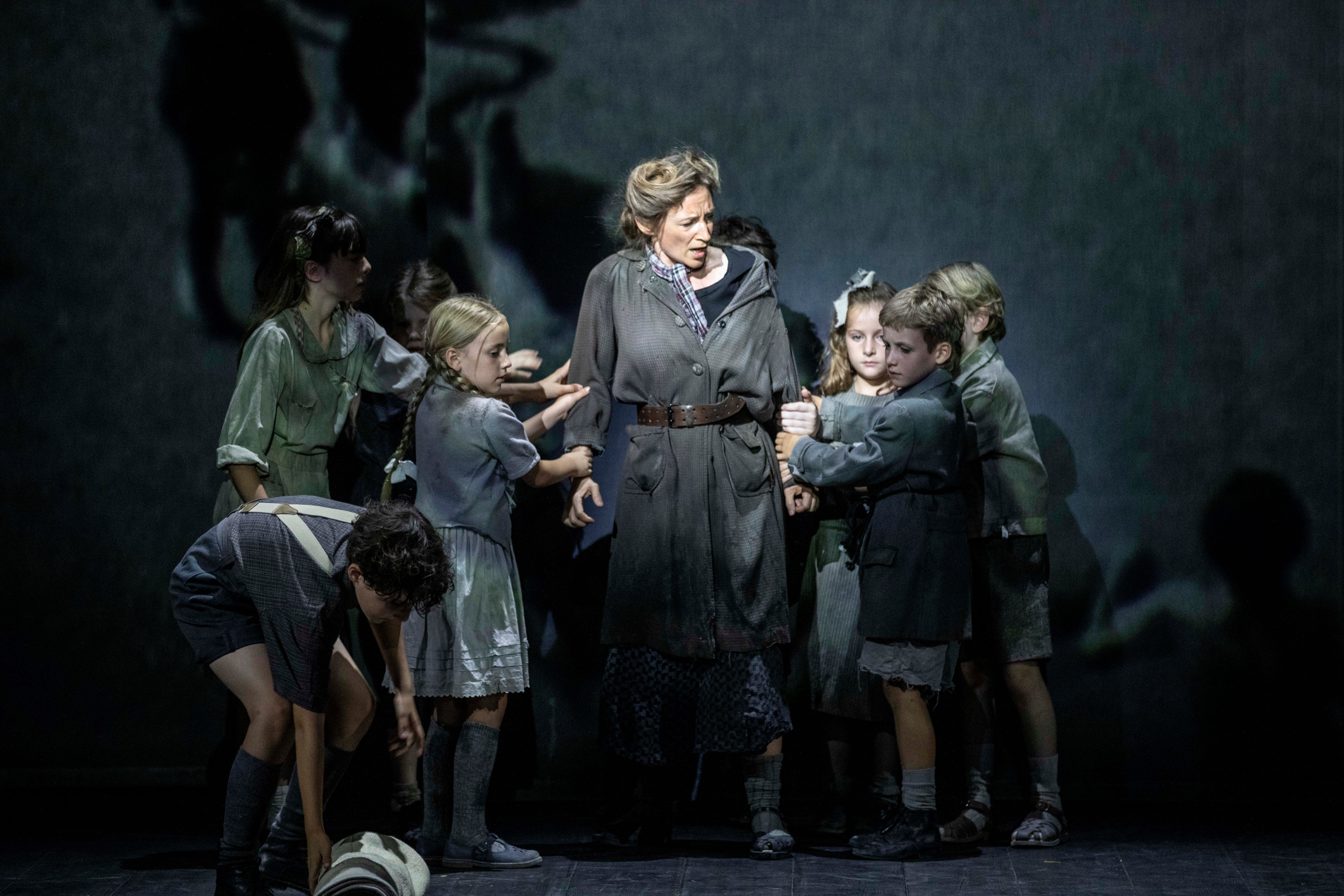
Spiteful dowager surrounded by kids: Sabine Devieilhe (Queen of Night) Picture © Jean-Louis Fernandez
In the first Act the audience seemed in a state of shock - Tamino’s ‘Bildnis’ aria went unapplauded, and the Queen’s first scene drew a muted response - but Sabine Devielhe’s blindingly accurate ‘Der Hölle Rache’ in Act 2 was more enthusiastically received.
Ironically, Die Zauberflöte’s most child-like character, the bird-catcher Papageno, came off the worst from Cogitore’s child-obsession. Sean Michael Plumb tried to bring some comic energy to the evening, but the production defeated him on all fronts. The character was robbed of charm, and cuteness was banished even from duet with Papagena (Emma Fekete). Cogitore’s artistic coherence came with a heavy price tag in Aix, and clearly some of the public felt short-changed.
They could hardly complain about the quality of music-making under Leonardo García-Alarcón, whose Capella Mediterranea rules the roost in France among an elite of European period instrument ensembles. Already in the overture, its bright timbres and textures brought a luminous quality to Mozart’s most turbulent music, drawing our ears to the journey Mozart takes us on, out of darkness into light, even when Cogitore’s staging was disinclined to do the same.
The principal singers, all known for their roles in international houses, offered Aix’s audience a line-up to match some of the great Flutes of the past. Like Peter’s Tamino, Ying Fang’s Pamina is an impeccable stylist with a beautiful voice. Plumb was as vocally ingratiating as possible in the context of this production, while Devieilhe and Brindley Sherratt exuded authority from extremes of the vocal spectrum.
Mozart lavished some of his most genial musical ideas on the Three Ladies: Alix Le Saux, Ashley Dixon and Adriana Bignani Lesca blended as a team and shone individually, complemented by a trio of boys from the Knabenchor of Dortmund’s Chorakademie. Rodolphe Briand’s bullying Monostatos, dressed as a 1950s New York cop, is top-notch comprimario casting for any French house, as are Edwin Crossley-Mercer (Speaker) and Damien Pass and Jonghyun Park (Priests dressed as ‘men in white coats’ from a mental health facility).
The high musical standard of this Zauberflöte was maintained by the Chamber Chorus of Namur, who will presumably continue to participate when the production moves to Antwerp, Ghent and Luxembourg. It will certainly be intriguing to see how Cogitore’s ‘festival’ production goes down in everyday theatres such as these.
Die Zauberflöte - Mozart - Théâtre de l’Archevêché, Aix-en-Provence
Conductor Leonardo García-Alarcón Director/Video Clément Cogitore Sets Alban Ho Van Costumes Wojciech Dziedzic Lighting Sylvain Verdet Choreography Evelin Facchini Dramaturgy Simon Hatab Chorus Master Thibaut Lenaerts
Performance attended 2 July, 2026 (first night)
Tamino Mauro Peter Pamina Ying Fang Papageno Sean Michael Plumb Sarastro Brindley Sherratt Queen of Night Sabine Devieilhe Speaker Edwin Crossley-Mercer Three Ladies Alix Le Saux, Ashley Dixon, Adriana Bignani Lesca Monastatos Rodolphe Briand Priests/Armed Men Damien Pass, Junghyon Park Papagena Emma Fekete Three Boys Members of the Boys Choir of Chorakademie Dortmund Julian Mahnke Tamino as Child/Adolescent, Pamina as Child/Adolescent (actors)
Capella Mediterranea Choeur de Chambre de Namur
Further performances 11, 13, 15, 17, 19, 21 June, 2026
Website festival-aix.com
No posts
Comments
Nothing yet. Say the first thing.
Sign in to join the conversation.