

It’s been fifty years since the Supreme Court case Gregg v. Georgia brought the death penalty back to life, after a brief moratorium created by the Furman ruling. On the anniversary of the reinstatement of the death penalty, it remains an emotional and polarizing topic — so this week, we bring you a re-release of an enlightening and civil discussion about the issue.
Here is the state of play now:
The federal government and 27 states permit capital punishment.
Sixteen prisoners were executed through January 1 and June 30 this year in the United States.
State executions worldwide increased by 78% in 2025, with 2,707 people executed across 17 countries — up from 1,518 people executed in 2024, according to Amnesty International.
Take a listen on Apple Podcasts, Spotify, and YouTube. Views on this issue are complicated. We’d love to hear your thoughts.
Diann Rust-Tierney, Former Executive Director of the National Coalition to Abolish the Death Penalty
”I've met and talked to the people that the death penalty harms and traumatizes — prison workers, defense counsel, prosecutors, judges, the condemned, and families of the condemned, jurors, and survivors of homicide. Regardless of whether a victim supports or opposes the death penalty, if you listen carefully to their voices, one message comes through: ‘It hurts.’ The death penalty process by its very nature hurts. It is the nature of the beast; therefore, it must be abolished.”
Barry Scheck, Co-Director of the Innocence Project and Professor at Cardozo Law School
“Don't tell me that there isn't an unacceptable risk of executing the innocent. It's been demonstrated — the Innocence Movement has demonstrated it. It's not just the 326 DNA exonerations that they can't refute. It's not just the over 1,500 exonerations from the [National Registry of Exonerations], including non-DNA cases. We now know that our system is riddled with error.”
Robert Blecker, Professor at New York Law School
“The reality of life without parole, given the way that prison is administered, given the television sets, given the first-run movies in many cases, given recreation, given the hours and hours outside of the cell daily, the reality is it's nobody's job to punish and there is no punishment going on. The closest we come to serious punishment left in this society is the death penalty. So, when you consider the question, you can't consider it in isolation. You have to consider it in context, that we are a society that is increasingly disavowing punishment itself.”
Kent Scheidegger, Legal Director of the Criminal Justice Legal Foundation
“Life in prison is justice. But for a very few, for the worst of the worst, no, it isn't. It's not for the [Boston] Marathon bomber. It wasn't for Charles Manson. He's grinning at us to this day, because we temporarily abolished the death penalty, networking with his fan base on his smuggled cell phone, and he just has not been sufficiently punished and will not be sufficiently punished.”
Since we first had this debate in 2015, here’s what our debaters have to say on the subject now:
Robert Blecker has a book coming out in April 2027 called “ITCHY,” an autobiography of who Robert describes as the most extraordinary inmate he’s met over decades of interviewing. He hopes it gives a “brief but clearer sense of my long-standing commitment to listen to and learn from otherwise neglected voices and figure out who really deserves what.” His team is also planning to air a two-part audio commemoration of Martin Luther King Jr.’s birthday that includes a 1993 keynote given by Jesse Jackson inside Lorton Central, along with original and early rap music composed and recorded by inmates. Robert said on the inmates he recorded for it, “the prisoners’ insights and accounts of their own lives, the racism they confronted from childhood and a criminal justice system rife with hypocrisy and bias constitute the spine of this commemoration and a podcast… to follow.”
Barry Scheck has recommended a recent New York Times article, published in partnership with ProPublica, which spotlights the current state of death row in Florida and the Floridians who interact with the system both in and outside of the ward.
Kent Scheidegger said, “Time has confirmed that the alternative of life without possibility of parole does not provide finality, because as soon as the death penalty is blocked the assault on life without parole begins. California’s parole board has just created a huge new program to get murderers sentenced to life without parole resentenced so that they can be paroled.”
Since the debate first aired, Diann Rust-Tierney is now an associate professor at the University of the District of Columbia David A. Clarke School of Law and a distinguished fellow of the Georgetown Human Rights Institute. She offers our audience some notes from the Death Penalty Information Center, and below are some of her comments on recent developments (Note: edited for brevity):
“The biggest update since 2015 is that the abolition argument continues to gain support. In 2015, 61% of the public favored the death penalty and 37% opposed it. According to a Gallup poll released in October 2025, slightly more than half (52%) of the public currently supports the death penalty. This percentage represents a 5-decade low.
Racial Bias And Mistakes Continue To Be A Problem
Of the 47 people executed in 2025 (32%), 13 were Black, Latino, or identified as mixed-race people. Only 7 of the 47 people killed in 2025 were executed for killing victims of the global majority. Decades of studies of the administration of the death penalty have found that race, especially the race of the victim, is the single most important determinant of whether a person is sentenced to death—not the severity of the crime; not the criminal record and history of the defendant; or even whether a weapon is used. Race determines the outcomes in death-eligible cases.
Innocent People Continue To Be Sentenced To Die
Since 1973, 202 people have been exonerated. Thirty people have been exonerated since the debate in 2015. This does not mean that the system is working. It demonstrates the magnitude of the risk that an innocent person will be executed. When states have abolished the death penalty, murder rates have not significantly changed.
At the end of the day, the question we must ask ourselves is whether we want our government to have the nearly unreviewable power to decide who lives and who dies and in what manner, without accountability?
Justice Blackmun’s observations [in his dissent in Callins v. Collins, 510 U.S. 1142 (1994)] are no less true today. If anything, they are even more urgent. If we are wise and cognizant of our current surroundings, the answer to the question whether the death penalty should continue will and should be a resounding no.”
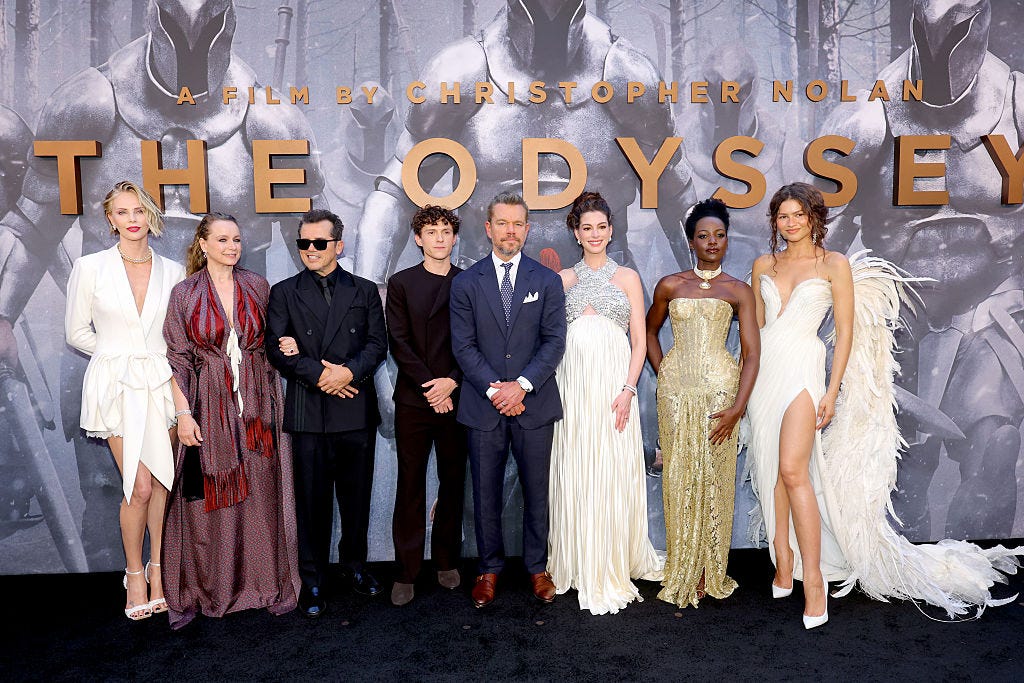
After much anticipation, Christopher Nolan’s adaptation of the Greek epic The Odyssey is 2026’s summer blockbuster, having made $124.5 million during its opening weekend in the domestic box office and $264 million globally. It’s an impressive result for a film made on a $250 million budget, and audiences have been scouring showtime lists for the perfect premium format to view it, such as IMAX 70 mm, 70 mm, IMAX digital, 35 mm, and Dolby Cinema.
This also comes as streaming services have been having their own hurdles in maintaining subscriptions, subscriber fatigue, and “streamflation” concerns. Netflix in particular has been exploring Live TV and implementing bundles as it lost 10% of its shares last week, and its stock has lost 44% since hitting an all-time high in June 2025.
Earlier this year, we debated “The Future of Film: Big Screen or Stream?” Watch the debate now.
Though the U.S. and Iran had initially come close to making a deal, the Iran War is back in full swing after the ceasefire deal collapsed. Around eighteen U.S. soldiers have been killed since February, traffic has slowed in the Strait of Hormuz, and President Trump has been threatening Iran and the Houthis with "major military punishment" if the Houthis launch more attacks on Saudi vessels in the Red Sea. However, earlier this week, Saudi Arabia signed a commercial nuclear deal that could allow Saudi Arabia to have a civilian nuclear program on its soil in cooperation with American companies, but it is dependent on whether or not the kingdom joins the Abraham Accords.
In the past, we’ve debated the question “Can America and Its Allies Tolerate A Nuclear Iran, or Is It Time to Stop Them Now?” Watch the debate now.
‘Turning Up the Heat on the Streets’
Hanna Rosin interviewing Nick Miroff | July 20, 2026
Watch Hanna’s debate on whether men are finished and we should help them
The Real Cause of J.D. Vance’s Failure in Iran
Batya Ungar-Sargon | July 16, 2026
Watch Batya’s debate on whether the New York Times has lost its way
The U.S. wants to contain China’s AI. Silicon Valley keeps using it
Paul Triolo | July 22, 2026
Watch Paul’s debate on whether the U.S. can outpace China in AI through chip controls
If he’d tried to arrest Netanyahu, Mamdani would be the one in jail
Marc. A Thiessen | July 22, 2026
Watch Marc’s debate on whether we should treat terrorists like enemy combatants, not criminals
Jacob Sullum | July 23, 2026
Watch Jacob’s debate on the two-party system
What Humanity Needs To Flourish In The Next Decade
E. Glen Weyl, James Evans, and Chris White | July 21, 2026
Watch Glen debate whether the U.S. should be ruled by a CEO dictator
No posts
Comments
Nothing yet. Say the first thing.
Sign in to join the conversation.