

This story continues Open the Books’ ongoing series on the Cost of Fraud, tallying the hidden fees on American tax returns.
Taxpayers are unknowingly paying private consultants a cut of the Medicaid money the consultants help states claim for school-based health services.
Federal auditors have flagged more than $1.5 billion of those claims as improper or unsupported across four states, and the consultant was the same in every one: Boston-based Public Consulting Group (PCG). New Jersey’s audit states the firm was hired “on a contingency fee basis,” and the Government Accountability Office has found consultants building school Medicaid claims collected fees of 3 to 25 percent of the federal reimbursement. The more school-staff time coded as “Medicaid,” the bigger the check.
While that money moves between consultants, state agencies, and Washington, Americans are waiting for paychecks to hit to buy groceries and pay rent or hoping for a tax return to help cover the rising costs of daily life.
Two decades after the federal government was warned about the arrangement in writing, the same failures repeat across states and almost none of the flagged money has come back.
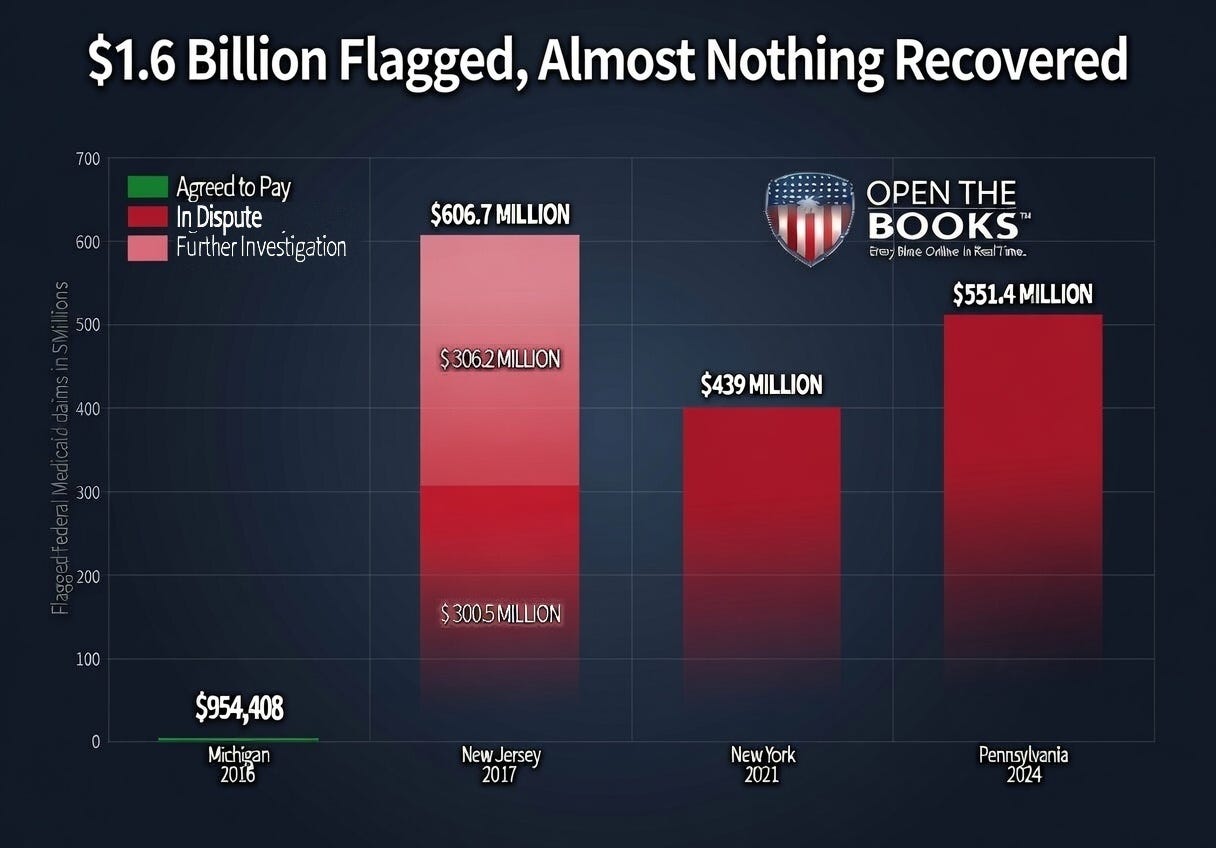
The documented scope of the hidden Medicaid fees are established via auditing practices: $551.4 million flagged in Pennsylvania, $439 million in New York, $606.7 million in New Jersey, and $954,408 in Michigan. That amounts to $12.16 for every household in the United States, according to Federal Reserve data.
Divided among taxpayers in the audited states, that translates to $104.79 per Pennsylvania household, $57.63 in New York, $172.50 in New Jersey, and 24 cents in Michigan.
Open the Books investigative reporting documents the contingency-fee arrangement behind the claims; the findings of five audits by the Department of Health and Human Services Inspector General; and the recommended refunds that, years later, remain unpaid.
Schools can bill Medicaid for health services delivered to eligible children, such as speech therapy, nursing, and counseling. To decide how much school payroll counts as Medicaid work, states poll employees at random moments and code each answer as Medicaid or not. The coded percentages are then applied to hundreds of millions of dollars in salaries.
In Pennsylvania, New York, New Jersey, and Michigan, the company doing the coding was PCG. And in New Jersey, where the audit documents the firm’s contingency arrangement, PCG’s pay rose with the federal money the claims brought in.
New Jersey went further. Each school had to hit 90 percent of the Medicaid revenue PCG budgeted for it each year or risk losing state education aid, according to the audit. The revenue targets came from the contractor, not the legislature.
The sharp conduct finding in the record came out of New Jersey in 2017.
Auditors determined that PCG “improperly altered school employees’ responses” to the time studies, recoding 235 answers. A school social worker would log a parent phone call as social services. The response would then be recoded as a Medicaid health service.
Under the prior contractor, the studies showed school staff spending 16 percent of their time on direct health services. After PCG’s changes, the figure rose to 62 percent. The accompanying payment rate for a student evaluation rose from $552 to $1,451.
SIDENOTE: The report also found the payment rates included $435 million owed to the school employees’ pension fund, even though the state hadn’t made scheduled payments to the fund in nearly 20 years. And it states plainly that New Jersey’s Treasury hired PCG “on a contingency fee basis.”
In other words, when services were recoded to Medicaid, the cost of that labor increased. Thus, the theorietical dollar-amount to be contributed to New Jersey’s pension fund also rose. PCG’s fees, then, were calculated after a two-step padding process: once by inflating the underlying costs, and then again by invoicing pension costs that state hadn’t been paying lately. Each in turn made the consulting fee rise.
PCG disputed the findings in a memorandum printed with the report, asserting its coding followed CMS’s own claiming guide. The agency watchdog responded that PCG provided no supporting documentation.
In September 2022, PCG agreed to pay $2.5 million to the United States to resolve a whistleblower lawsuit alleging it caused New Jersey school districts to submit claims for evaluation services it “knew or should have known were not covered by Medicaid.” The settlement resolved common-law claims for payment by mistake and, by its terms, is neither an admission of liability by PCG nor a concession by the government that its claims lacked merit.
NOTE: This was not PCG’s first or last appearance in New Jersey’s audit record. A 2010 inspector general review examined the state’s school-Medicaid claims “submitted by Public Consulting Group, Inc.” by name, and a 2022 report warned that New Jersey’s school-based cost-settlement process could still produce claims that don’t meet federal requirements.
But New Jersey was just one state. In March 2024, the biggest finding in the series landed in Pennsylvania. An audit found a total of $551.4 million in improperly claimed federal funds. Auditors sampled the moments PCG coded as Medicaid-eligible and found the state couldn’t support them. In 135 sampled cases, “PCG did not ask enough questions to ascertain whether an employee performed a Medicaid-eligible health care service.” One example from the report: a speech-language pathologist working on English Language Arts curriculum goals was coded as delivering Medicaid services. Another $368.9 million rested on cost-allocation ratios the state could not verify.
New York’s audit (A-02-18-01019) found $439 million the state couldn’t support, including $309 million riding on unverifiable ratios. When New York disputed the findings, it hired a coding expert to re-review the flagged moments. The expert? PCG, of course!
The inspector general’s response, printed in the report: “PCG originally coded the moments and was therefore reviewing its own work.”
Michigan’s audit (A-05-13-00056) found $954,408 in unallowable reimbursement under a program that included portions managed by PCG. Michigan, alone in the series, agreed with the auditors and promised to repay.
Then in 2018, the inspector general reviewed the method itself (A-07-18-04107). Of 10 state agencies examined, all 10 had built their random-moment methodologies incorrectly, with $435.4 million claimed out of compliance. The audits keep finding the same failures across states, suggesting the problem is structural to the program, not isolated misconduct.
NOTE: Improper payments are overpayments, underpayments, or payments where insufficient information was provided under program rules. It doesn’t equate to proven fraud, and no fraud has been alleged against PCG in any of these audits. The states dispute the findings. Every figure here is an auditor-questioned cost or a recommended refund, not an adjudicated loss.
The inspector general recommended that Pennsylvania return $182.6 million outright. For another $368.9 million, it gave the state a choice: produce documentation proving the claims were valid, or refund that too. Pennsylvania disagreed, arguing it wasn’t required to keep documentation beyond what time-study participants provided. Every recommendation sits in the federal tracker marked Open Unimplemented, with the next update expected in October 2026.
New York was told to refund $98 million and support or refund $341 million more. It disagreed with most findings, and all five recommendations remain “Open Unimplemented.” New Jersey was told to refund $300.5 million. Nine years later, that recommendation is still “Open Unimplemented.” The companion recommendation, to determine how much of another $306.2 million was allowable, was marked “Closed Unimplemented” in September 2024. The file was closed without the amount ever being determined.
So far, no state has refunded the major recommended amounts, totaling $1.6 billion.
The warning came early. In June 2005, the Government Accountability Office reported that, as of 2004, 34 states had used contingency-fee consultants to maximize federal Medicaid reimbursement, up from 10 states two years earlier, and that the arrangement “highlights need for improved federal oversight”. Georgia alone had paid its consultant more than $82 million in fees on an estimated $1.5 billion in additional federal reimbursement. CMS did respond. After the 2018 systemic report, it concurred with the recommendations and issued updated guidance, and those recommendations were closed as “implemented” in November 2023. Less than four months later came the largest unsupported-claims finding in the series’ history: Pennsylvania’s $551 million.
What PCG has earned from the flagged claiming work has never been publicly tallied. The audits don’t say. The Pennsylvania report documents one small fee term, for administrative claiming, under which PCG collected 50 percent of each school district’s share, capped at $500 per district per quarter. New Jersey’s audit says PCG was paid on contingency but never states how much.
Explore the full audit findings, recommendation statuses, and per-state figures here.
Across the line, the school-based Medicaid claiming program was found vulnerable to improper payments for the same reason: the entity coding the claims was paid a percentage of the result, and nobody with an incentive to check did so before the money went out. The states kept a share of every federal dollar. The schools chased revenue targets the consultant set. CMS approved methodologies it later couldn’t verify.
Twenty years after the GAO named the risk, the refunds sit unpaid in an open federal file, the consultant’s fees remain unpublished, and taxpayers are getting the short end of the stick.
Sources: HHS-OIG audit reports A-02-21-01011 (PA, 2024), A-02-18-01019 (NY, 2021), A-02-15-01010 (NJ, 2017), A-05-13-00056 (MI, 2016), A-07-18-04107 (systemic, 2018); OIG Recommendation Tracker (retrieved July 1, 2026); GAO-05-748 (2005); DOJ, U.S. Attorney’s Office for the District of New Jersey (Sept. 27, 2022); HHS-OIG Work Plan W-00-24-31529; OpenSecrets, Public Consulting Group profile.
Comments
Nothing yet. Say the first thing.
Sign in to join the conversation.