
Few figures in medical history are as “established” as Edward Jenner—described as the “father of vaccination.” The familiar account is simple: in 1796, Jenner used cowpox material to protect against smallpox, laying the foundation for a preventive approach that allegedly ultimately contributed to the eradication of a disease.
When this narrative is examined alongside a wide range of publications—from the World Health Organization eradication reports to other works such as Dissolving Illusions—a more layered and contested picture emerges. The question is not whether Jenner mattered, but whether the true story is complete.
Institutional sources (WHO, CDC/EMA, UKHSA) present a broadly consistent account:
Jenner demonstrated that exposure to cowpox conferred protection against smallpox
This marked the beginning of vaccination as a deliberate preventive strategy
Vaccination programmes expanded over the 19th and 20th centuries
The global eradication of smallpox in 1980 is seen as the culmination of this trajectory
Within this framing, Jenner’s importance lies in initiating a powerful idea—that disease could be prevented through controlled biological exposure.
A number of the listed publications—including Dissolving Illusions, The Poisoned Needle, and works by Coleman—offer a different interpretation.
They argue that Jenner was not working in isolation:
Cowpox protection was already observed in rural communities
Jenner formalised / promoted an existing idea rather than discovering it outright
By modern standards:
Very small sample sizes
No controlled trials
No germ theory
This raises questions about how confidently early conclusions could be drawn.
The most important point of divergence is what actually drove the decline in smallpox.
Below is an integrated visualisation of long-term historical trends (based on European mortality data, public health developments, and vaccination uptake timelines):
It is important to acknowledge the recorded risks. Early vaccination—particularly arm-to-arm methods—was associated with complications including secondary infections (such as syphilis transmission in rare documented cases), severe skin reactions, and neurological events. As vaccines became more widespread during the 20th century, surveillance data illustrated serious adverse events such as post-vaccinal encephalitis and progressive vaccinia occurred at measurable rates, with mortality estimates often cited in mainstream at 1–2 deaths per million vaccinations. Earlier data are less complete and likely under-recorded by modern standards, making precise historical quantification difficult. Risks formed part of the ongoing risk–benefit assessment: while smallpox itself carried a higher fatality rate, once global transmission declared eradication in 1980, routine vaccination was phased out in the 1980s suggesting that vaccine risk outweighed the disease risk. This transition marks a critical endpoint in Jenner’s legacy—demonstrating that vaccination was not a permanent intervention, but one applied within a changing public health context.
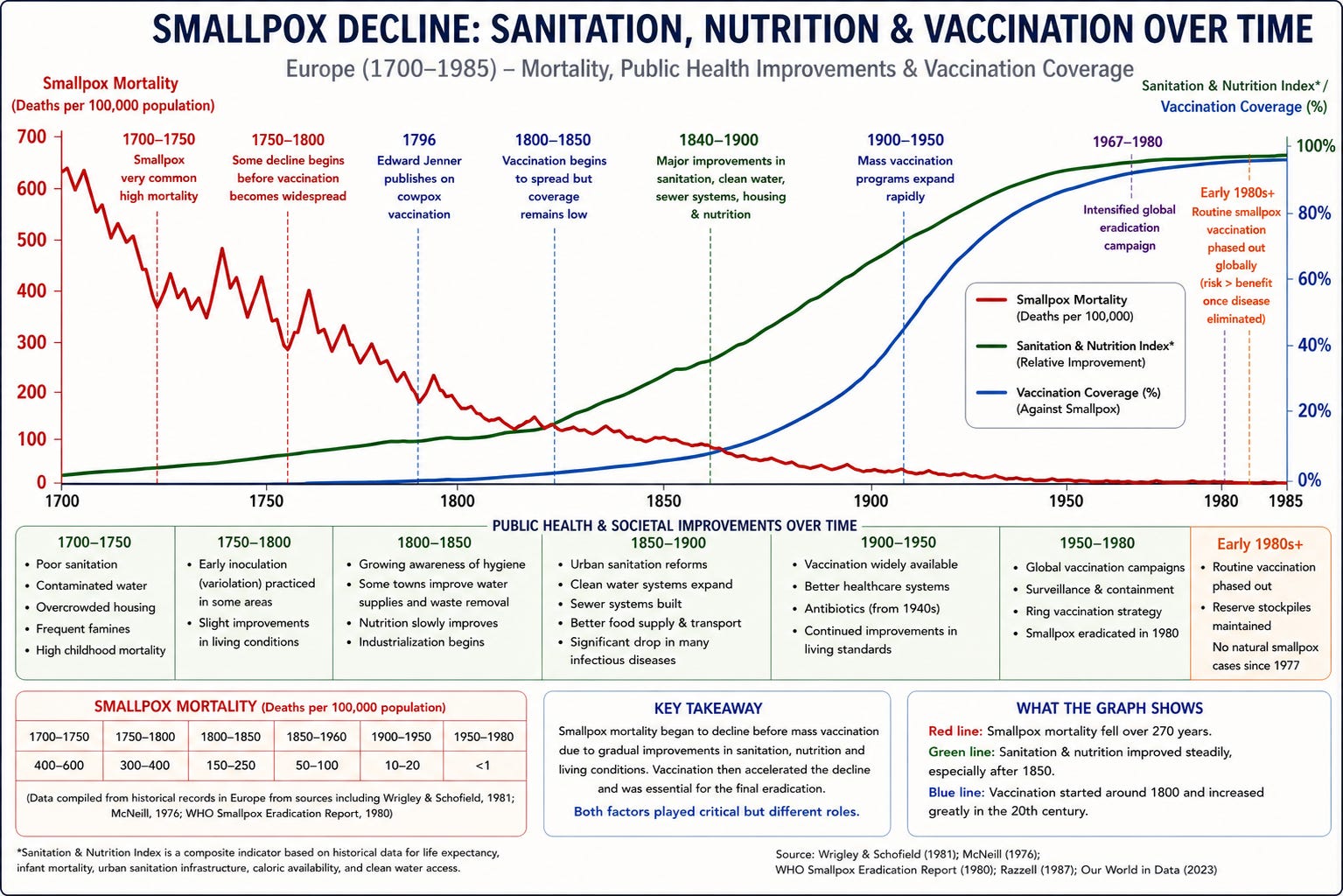
Historical records (e.g. London mortality data) show:
Smallpox mortality begins to decline gradually in the late 18th century
This occurs before widespread vaccination coverage
This is a key point emphasised in Dissolving Illusions.
From the early to mid-19th century:
Clean water systems
Sewer infrastructure
Improved housing
Better food supply
These changes correlate with declines in multiple infectious diseases, not just smallpox.
This supports arguments made by The Role of Medicine that broader societal improvements play a major role in health outcomes.
Jenner’s work begins in 1796
Large-scale vaccination expands mainly in the 19th and especially 20th century
When all sources are considered together, three interpretations emerge:
Vaccination is the primary driver
Jenner is the foundational figure
Decline was already underway due to environment and living conditions
Jenner’s role is overstated
Revisionist sources highlight that early vaccination:
Used arm-to-arm transfer
Could transmit other infections
Was inconsistently applied
Mainstream accounts acknowledge these issues but view them as limitations of the era, later resolved through improved medical practice.
Also there were many recorded and debated adverse effects associated with early smallpox vaccination. Historical accounts document complications ranging from local infections and severe skin reactions to more serious outcomes such as post-vaccinal encephalitis and, in rare cases, death. Arm-to-arm vaccination practices in the 19th century also carried a risk of transmitting other infections, including syphilis, though this was uncommon. As surveillance systems improved in the 20th century, serious adverse events were more systematically recorded, but like all passive reporting systems, they were subject to underreporting—although the exact proportion is uncertain and widely debated rather than definitively quantified.
Alongside safety concerns, ethical controversy surrounds the work of Edward Jenner, who tested his hypothesis on James Phipps, a young boy, and later on his own son—practices that would not meet modern ethical standards of consent and research governance. While such methods reflected the norms of the time, they contribute to ongoing discussion about how Jenner’s legacy should be understood within both its scientific and ethical context.
Later sources (UKHSA, MHRA, Cochrane, CDC/EMA) shape how Jenner’s legacy is viewed:
Vaccination today is monitored (but the belief system stands regardless of adverse events)
Benefits and risks are quantified rather than assumed
Effectiveness varies depending on context
Less than 10% of all adverse reactions are actually recorded - usually self reported (which raises other questions amongst the “belief-pro-vac” camps - again not a straightforward system whichever way you look at it)
There is little financial incentive to pursue all adverse reactions
Other sources (Wakefield, Hulscher, Dalgleish, Coleman) question broader vaccine paradigms. (see article on Wakefield and how his research was skewed within mainstream reporting)
Edward Jenner played a key role in advancing vaccination (how did he garner such public widespread coverage?)
His work is said to have influenced preventive medicine
Vaccination made a minor contribution to smallpox eradication
He was not working alone
His methods were rudimentary
Disease decline involved multiple factors beyond vaccination
The relative weight of sanitation vs vaccination
The consistency of early vaccine effectiveness
The extent to which Jenner’s story has been streamlined into a clear historical narrative - serving financial institutions
Edward Jenner sits at the centre of a much larger debate—not just about one man, but about how health improves over time.
The mainstream account does not take into account the bigger picture and revisionist accounts push back, strongly, highlighting gaps and alternative explanations.
The most evidence-aligned position is that:
Smallpox decline was multi-factorial, but eradication required targeted intervention, with vaccination playing a role.
Jenner is thus described as a pivotal, imperfect figure whose legacy has been shaped as much by interpretation, suiting a wider mainstream picture.
Alongside the data, there is another layer worth acknowledging. Vaccination gets positioned as a medical “saviour,” yet historical trends across multiple diseases show declines occurring alongside improvements in nutrition, sanitation, housing, and education. Public confidence in vaccination functions as a belief system as much as a strictly evidence-driven conclusion. The early history reinforces this tension: Edward Jenner advanced the cowpox hypothesis but also tested it on his own child and other young subjects—practices that would be ethically unacceptable today and were not without controversy even at the time. This raises an enduring question: to what extent are its benefits consistently demonstrated across contexts, and to what extent has its narrative been shaped by assumption, interpretation, and historical momentum?
World Health Organisation, Smallpox Eradication Report (1980)
Thomas McKeown, The Role of Medicine (1979)
Suzanne Humphries & Roman Bystrianyk, Dissolving Illusions (2013)
Eleanor McBean, The Poisoned Needle (1957)
Vernon Coleman, Anyone Who Tells You Vaccines Are Safe and Effective Is Lying (2020)
UKHSA Vaccine Safety Surveillance Reports (2018–2024)
MHRA Yellow Card Scheme Annual Report (2023)
Cochrane Collaboration, Influenza Vaccines in Healthy Adults (2021)
WHO Poliomyelitis Fact Sheets (2020)
WHO/UNICEF Kenya Tetanus Vaccine Investigation Summary (2014)
CDC & EMA Post-Marketing Safety Evaluations of COVID-19 Vaccines (2023)
Nicholas Hulscher et al., McCullough Foundation Report (2024)
Andrew Wakefield, The Wakefield Case Re-Examined (2024)
Angus Dalgleish, Oncologist Observations (2023)
Thomas Seyfried, Cancer as a Metabolic Disease (2012)
Patrick Day, Cancer: Why We’re Still Dying to Know the Truth (2016)
Gates Foundation, Polio Eradication Financial Report (2023)
Author note:
Are vaccines really based on fully accurate and complete data, or has the pro-vaccine position become something that is repeated so often that it is simply accepted as fact? Is protection against illness being presented in a way that downplays or minimises adverse reactions, including serious outcomes and death?
Are people genuinely living longer, or are we simply extending the length of time people live with illness? It can feel as though documentaries such as An Inconvenient Study and Vaxxed 1 and 2 are among the few places where real-world adverse reactions are openly discussed. Many books that raise similar concerns—Turtles All the Way Down (anonymous), Dissolving Illusions by Dr Suzanne Humphries, The Unfortunate Truth About Vaccines by Leon Canerot, Vax-Unvax: Let the Science Speak by Robert F. Kennedy Jr. and Brian Hooker, The Poisoned Needle by Eleanor McBean, Vaccines: Mythology, Ideology, and Reality by Dr Peter McCullough, Spiked by Dr Clare Craig, Vaccines, Amen by Aaron Siri, and Forbidden Facts.
Also the apparent rise in autoimmune conditions, neurodivergence, and concerns around possible neurological injury, which moot that something broader may be unfolding. Compensation schemes require proof of significant disability (60%) and offer a blanket payment of £120K, while manufacturers carry zero liability with little incentive to establish clear causation, this raises further questions. This gives the impression that the vaccination landscape is complex, unsettled, based on a flimsy belief system, with doctors and perhaps under greater strain than is publicly acknowledged.
Clinical training vaccination - Approx. 10–25 total hours across a medical degree (often within infectious disease, paediatrics, and public health modules). “Vaccines stimulate immune protection, reduce disease spread, and are recommended by schedules balancing benefits, risks, population health, and safety monitoring.”
Clinical training on nutrition - Approx. 15–30 total hours (sometimes reported higher, but often fragmented and not clinically applied): “Nutrition supports health and disease prevention; focus on balanced diets, deficiencies, chronic disease links, and brief lifestyle advice within clinical practice.”
One is dismissive and only supports a single perspective; nutrition, far reaching for everyone - historically emphasised low fat, since the 1970s, influenced by Ancel Keys, teaching emphasised low fat, especially saturated fat, to reduce heart disease risk. Yet Ancel Keys’ early work used limited country data, raising selection bias concerns; later Seven Countries Study was broader, yet debates persist over data selection and saturated fat’s role in heart disease.
Beach in 1973

Beach in 2026

What changed? Nutrition guidance shifted, more ultra processed foods are available and easy to source and people are now struggling to eat healthily.
Heart disease is best understood as a build-up of damage over time, driven by a mix of factors (including the most recent vaccination). Insulin resistance and high blood sugar, inflammation, blood pressure, smoking, poor sleep, stress, inactivity. Diet matters: patterns high in ultra-processed foods and refined carbohydrates tend to worsen these risks, while whole, real foods, and healthy fats support metabolic health. Cholesterol and fats are essential for brain and body function.
This article was developed through a collaborative process in which the author inputs information, themes, and draft phrasing into ChatGPT, which then assists with research, structuring, and synthesis. The final piece is reviewed, edited, and refined by the author to ensure clarity, tone, and a more human-centred narrative.
Buy me a coffee: https://buymeacoffee.com/yi4kcpgjtu
Comments
Nothing yet. Say the first thing.
Sign in to join the conversation.