

This article examines anti-white racial aggression as an understudied phenomenon with significant implications for clinical psychology. While discrimination affecting other identity groups has been widely researched, aggression directed at white individuals remains largely absent from scholarly work and clinical training. Limited database findings, combined with academic discourse that portrays “whiteness” as pathological or morally suspect, may normalize hostility and obscure potential harms.
The article describes manifestations of anti-white aggression, including harassment, exclusion in workplaces and schools, institutional practices tied to diversity initiatives, and occasional violent incidents. It argues that such experiences can contribute to trauma, shame, anxiety, depression, hypervigilance, or reactive radicalization. Regulatory guidance that reframes these reports as “white fragility” is critiqued for discouraging validation and placing patients in a destructive double bind.
The author calls for systematic research, policy review, clinician education, and compassionate therapeutic services that recognize anti-white aggression alongside other forms of bias to support ethical practice and social cohesion.
Keywords: Anti-white aggression, racial discrimination, anti-racist abuse, whiteness discourse, clinical psychology, racial trauma
Racial discrimination, bias, or aggression toward people of any race is unethical. These experiences can affect people’s lives, leave lasting wounds, and negatively affect mental health. However, one form of racial aggression is often overlooked, namely, aggression directed against people for being white. Although many clinicians have reported observing this phenomenon in their patients, training and clinical services addressing this issue are almost entirely nonexistent.
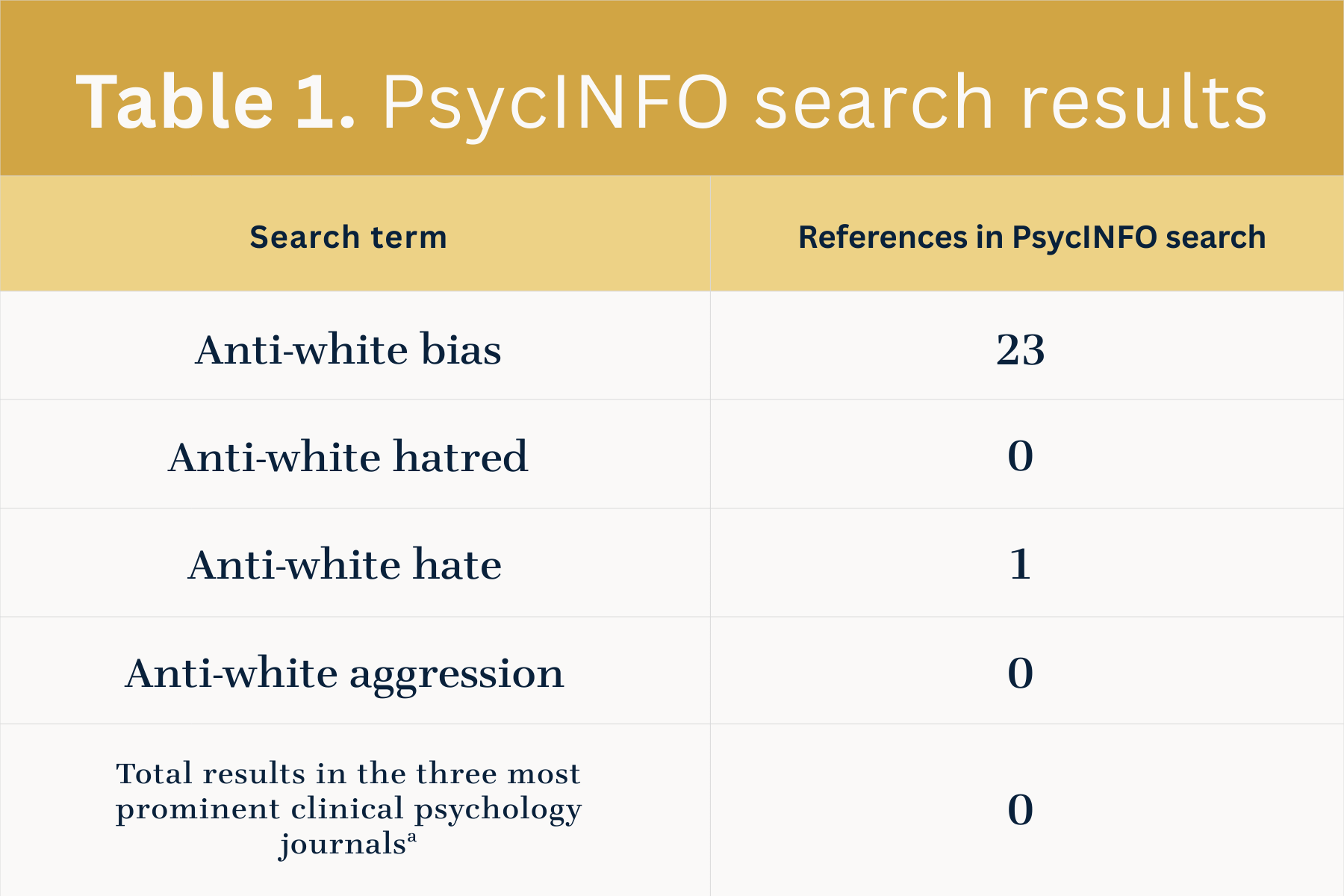
A search of existing papers on this topic in the most common psychology database, PsycINFO, yields alarmingly few results, none of which appear in prominent clinical psychology journals (see Table 1 below). While academic research has focused on the prevalence, effects, and interventions related to discrimination based on race, gender, and sexual orientation affecting other identity groups, there is hardly any research available in which the group in question is white.
What can be found, however, are academic papers that advocate in favor of anti-white discrimination, diminish concerns about anti-white bias, and use language that is hostile or demeaning toward white people. Anti-racist authors often argue that race is a social construct and that whiteness is a malignant identity or a way of thinking that needs to be eradicated.1 Because whiteness as an identity construct exists in the minds of people, and it is assumed that white people can never be free from whiteness, they often become the targets of moral condemnation.2 These theorists argue that white people are inherently racist,3 ignorant,4 fragile,2 or privileged5 oppressors whose social structures and institutions need to be dismantled.6
For example, one academic paper describes white racial identity as a “malignant, parasitic-like condition” without a “permanent cure.” Such “parasitic whiteness renders its hosts’ appetites voracious, insatiable, and perverse.”7(p355) Similarly, Noel Ignatiev8(p30) wrote that “the goal of abolishing the white race is on its face so desirable that some may find it hard to believe that it could incur any opposition other than from committed white supremacists.” Carter J. Carter9(p258) links whiteness to character pathology and even mass shootings. A widely circulated paper describes people with a white group identity as having “forms of pathological narcissism.”10(p93) Another author11(para 2) writes, “toxic whiteness keeps me bogged down in hesitation, fear, second-guessing, needs to get it right, and more.” These articles are full of language that communicates racial hostility and contempt.
Elsewhere, concerns about anti-white discrimination and its possible harm are framed as “whitelash.”12 These concerns are therefore trivialized as a threat of status loss, where the mere expression of such concerns can be seen as a risk factor for delinquency.13 In most cases, this literature draws on a range of theories, such as critical race theory, decolonial theory, and whiteness studies, as theoretical lenses. Similar language and sentiments have made their way into multiple domains of civil society, including entertainment,14 news media,15 education,16 the corporate world,17 and politics.18-19 The proliferation of anti-white animus has been rationalized and even moralized by claims that aggression directed at historically dominant or privileged groups is necessary for radical anti-racist activism.20
We can imagine how anti-white aggression and bias can take many forms. At its most extreme, this may include recent crimes that were racially motivated and perpetrated against vulnerable working-class underage girls.21 Accounts of serial sexual assaults against underage girls in the United Kingdom have emerged for many years, but only in recent months have they gained mainstream media attention and prompted some appropriate response by law enforcement. Estimates suggest that between 250,000 and 1 million victims were subjected to racially targeted sexual brutality. Exact numbers remain unknown due to investigative shortcomings by law enforcement, including fear of being deemed white supremacist or racist.22 As recorded in the Casey Report,21(p135) “[P]olice and local authorities failed to investigate allegations of child abuse and rape because the victims were perceived as unreliable witnesses and through fear of being accused of racism.”
Other forms of anti-white bias and aggression include workplace and school bullying, verbal insults and harassment, hiring and selection discrimination, and training programs that deliberately or inadvertently humiliate23 participants for being white.24 Less obvious forms of anti-white bias may include neglect of the elderly, patients, children in foster care, and victims of crime. Some may also be aware of diversity, equity, and inclusion (DEI) initiatives in which white people, white males in particular, are excluded25 from workplace hiring, promotion consideration, and training selection.
In February 2023, a group of Black elementary school students in Ohio assaulted white students and ordered them to say, “Black Lives Matter.”26 Likely, the vast majority of incidents such as these never make the news. All this is to say that examples of the various types of anti-white aggression and bias are numerous.
Though empirical studies are lacking, it is clear that these incidents adversely affect mental health. For instance, in July 2023, a highly respected principal in Toronto, Canada, took his own life after he was falsely accused of racism during a DEI training course in 2021.27 Information about similar cases is underrepresented, likely due to research exclusion.
As some may be aware, such anti-white sentiments and racially motivated discrimination have also reached the therapy room. Increasingly, clinicians and counselors report clients struggling with institutionalized discrimination and systemic indifference toward anti-white racism.28
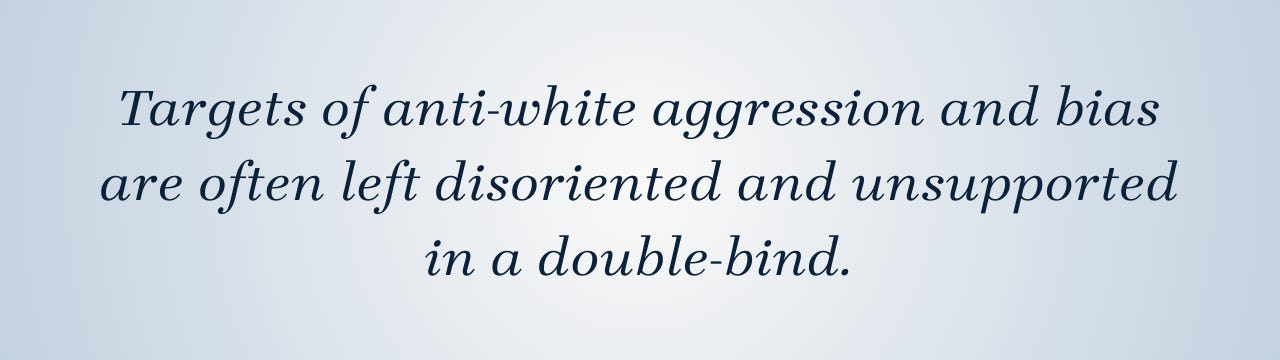
The standard guidance from British (e.g., see here29 and here30) and American regulatory bodies (e.g., see here31) has been to redirect and reframe the experiences of targets and bystanders of anti-white injustice as white fragility.2,32 Targets of anti-white aggression and bias are often left disoriented and unsupported in a double bind: if they accept attacks against them, they are guilty, but if they challenge them, they are considered even guiltier. Understandably, such anti-white bias may have significant social and mental health implications.
Depending on the form of anti-white aggression they experience, recipients of such action could:
develop clinical post-traumatic stress disorder following violent physical attacks perpetrated against them for being white;
experience shame and disorientation resulting from unfair hostility and discrimination, either directly or vicariously;
be burdened by a confusing double bind, feeling resentful about unfair discrimination while simultaneously feeling guilty for such resentment;
experience hypervigilance,33 chronic stress, depression, and anxiety resulting from constant stigmatization at school, in the workplace, or in the media;
resort to racial radicalization or violent retaliation in response to racialized abuse; or
engage in self-destructive behavior or attempt to appease attackers through self-denigration, imagining that allyship and self-hatred might appease them.
Strikingly, none of these forms of anti-white racial aggression receives attention in mainstream civil society. Perhaps these experiences are dissociated, or individuals have been conditioned to accept them as normal. Yet for society at large, the normalization of anti-white aggression and bias could lead to significant problems, such as:
social fragmentation, eroding social cohesion and trust, as individuals in socially fragmented communities tend to become suspicious, withdrawn, and noncooperative;
relational deterioration among members of different groups, as individuals are reduced to group avatars;
heightened risk of escalating violence and retaliation among fragmented communities;
perceptual blindness and reduced empathy toward vulnerable individuals, such as victims of crime, the injured, the infirm and elderly, patients, and children; and
younger generations potentially experiencing identity confusion and diminished self-worth.
Anti-white aggression ought to be addressed in policy, research, and practice like every other form of aggression. From a multifaceted perspective, this may include:
research into the prevalence, effects, and treatment of anti-white aggression and bias;
policy changes to eliminate systemic discrimination arising from ideologies such as critical social justice;
clinical services (individual and group therapy) that are free from divisive ideology, where clinicians genuinely empathize with the experiences of affected individuals and populations;
public education highlighting the harm of race-based essentialism and the demonization of all identities, including white individuals;
curriculum development and training for mental health professionals to adequately meet the needs of those who have experienced anti-white aggression and bias; and
protection and support for individuals who have experienced anti-white aggression and bias.
Racial discrimination, bias, or aggression toward people of any race is unethical. Being targets of such treatment can be painful, disorienting, and, in some cases, tragic. When these experiences are ignored, bias and aggression can become normalized. Popular discourse and anecdotal evidence suggest an increase in the incidence of anti-white aggression and bias, as well as apathy and perceptual blindness toward victims of such abuse.
Clinical attention and high-quality mental health services for this population are of utmost importance. These patients need therapists who are knowledgeable, open, and understanding, not those who judge, attack, or invalidate them. Additionally, research is crucial for determining the extent and impact of such events. This would improve understanding of the mental health effects of these experiences, which is necessary for developing effective interventions and promoting recovery in individuals and societies affected by bias and aggression directed against white individuals and communities.
Comments
Nothing yet. Say the first thing.
Sign in to join the conversation.