
November has felt unusually chaotic.
My body and mind have been carrying a heavier weight than they have in months.
It’s as if I’m moving through a quiet emotional low, yet I’m impatient, desperate to climb my way out of it as quickly as I can.
That urgency exhausts me.
I keep forcing myself to think about things far beyond my control.
Old fears return like a catalyst, warning me that with just a bit more misstep, I’ll fall back into a version of myself I thought I had left behind.
Sometimes it feels like I’m clinging to a cliff with one hand, staring into an endless abyss below, unable to summon the strength to pull myself back up.
And in that moment, all I want is for someone to throw down a rope.
But in the middle of that panic, whatever clarity I still have reminds me of something simple but important:
I have walked through so much already.
I have survived moments I once believed I could never get through.
I am no longer the person I used to be.
Even when I face similar fears or situations, I now have more resources, more tools, and a different level of understanding.
Yet when something triggers me, my brain still reacts too quickly—the stimulus travels down an old, familiar, but inaccurate pathway:
Stimulus → perceived as threat → fight/flight/freeze → “I can’t handle this.”
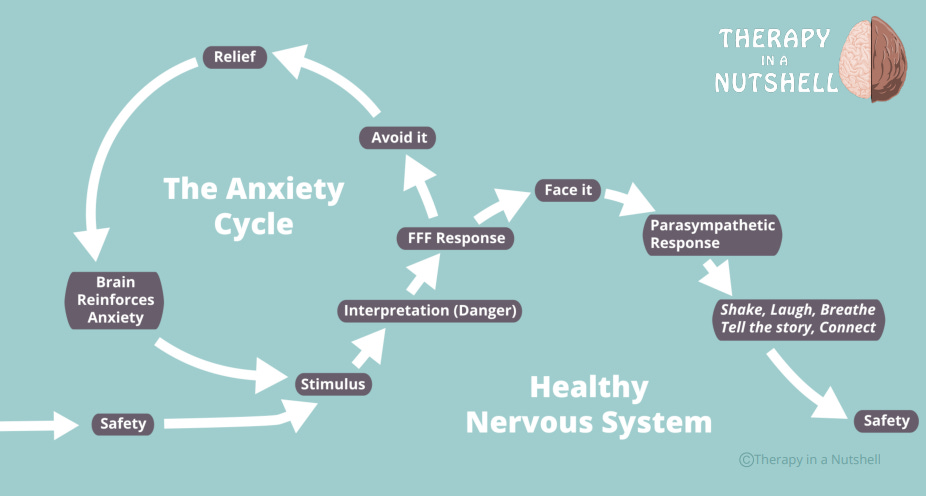
Breaking that loop is difficult.
It’s not something that can be fixed through willpower or shortcuts. I’ve tried. Every attempt to force myself out of discomfort only dragged me deeper into it.
What helps me instead is slowing down, giving myself enough patience for a new pathway to form.
I’ve been wrestling with anxiety for nearly a decade now. Looking back at the earlier years, I honestly had no idea what was happening to me.
Just nights of catastrophizing, stretches of insomnia, and moments of crying because everything felt too heavy.
My only strategy back then was endurance.
“Just hold on,” I told myself.
Sometimes I managed it, and the anxiety passed.
Sometimes I ran away, and shame followed.
Sometimes everything collapsed, and I broke down completely.
But even through all of that, a voice inside me kept whispering:
“Help comes to those who help themselves.”
I don’t follow a specific religion, but this belief that I would eventually find a way out—carried me through many dark seasons.
When I entered university, my life finally had space.
Six years of endlessly pushing through school came to an end.
The pandemic, in its own complicated way, gave me even more time with myself.
I read countless books, watched endless videos, listened to so many podcasts.
And still, in my third year, I broke down again.
But this time, I had knowledge.
I had language for what I was feeling.
With proper treatment, support from my family, and changes in my environment, it took me only two months to halve my medication and return to campus.
Two more years have passed.
I still have days—like now—when I feel cracked open.
But compared to the person I was ten years ago, this is extraordinary progress.
I can sit with the broken parts of myself now.
I can gather them, slowly, gently, using what I’ve learned, and accepting help when I need it.
I can remind myself:
I am no longer powerless.
And in the future, whenever I go through another low point, I want to come back to this piece.
To remember the people who held me up, who made it safe for me to be vulnerable:
My dad, my aunt, my counselor.
my friend L, Y, N in Japan, and those in Taiwan.
my pen-pals whom I’ve never met
Podcasters like Mark and Drew
Emma on YouTube
All these people—near and far, known and unknown—have been part of my quiet rescue.
I want to hold that gratitude close and trust, once again, that I will make it through.
And with empathy, I hope these words reach someone else out there—
someone caught in their own emotional storm.
A reminder that you’re not alone in trying to find your way back to yourself.
Comments
Nothing yet. Say the first thing.
Sign in to join the conversation.