
On the morning of July 13, maritime trackers in Dubai and Singapore watched a number so small it seemed like a data error: fourteen. Fourteen cargo vessels had transited the Strait of Hormuz in a single day, down from the hundreds that normally thread the narrow waterway carrying roughly one-fifth of the world’s crude oil. Some of those ships had done something equally striking: they switched off their AIS transponders, the automatic identification systems that broadcast a vessel’s name, position, and destination to anyone listening, and went dark. On tracking screens they simply vanished, becoming ghosts drifting through one of the most contested stretches of water on Earth.
The strait was not officially closed. Iran said it was. Donald Trump said it was not. The truth, as is so often the case in this conflict, lived in the grey zone between those two declarations, a zone where international shipping law, naval brinkmanship, and the raw physics of a chokepoint just twenty-one nautical miles wide at its narrowest all converged. Trump had reinstated a naval blockade of Iranian ships and, in a move that legal scholars almost uniformly described as a violation of international law, demanded a twenty percent toll on every other vessel transiting the strait, a fee of roughly thirty-two million dollars per very large crude carrier. Tehran called twenty percent “too much.” The negotiation, such as it was, was being conducted with Tomahawk missiles.
Over the weekend, U.S. Central Command launched consecutive nights of strikes on Iranian targets. Iranian state media claimed Tehran had hit American positions in Jordan, Kuwait, Bahrain, and Oman. For the first time in this four-and-a-half-month-old war, the United States deployed unmanned boats in an offensive operation against an Iranian naval base, a technological milestone that barely registered against the backdrop of missile exchanges. Meanwhile, Trump announced that he had left standing instructions for the U.S. military to destroy Iran if he were assassinated, following reports of an IRGC-directed plot against him. The personal and the geopolitical had become indistinguishable.
Brent crude climbed 9.5 percent to $83.25 a barrel. WTI rose 9.4 percent to approximately $78. But the price of oil told only the surface-level story. Beneath it, as John Authers noted in his Bloomberg Points of Return column, El Niño and the Iran war were converging into something more insidious: a food squeeze. Fertilizer prices, tied to natural gas and disrupted supply chains, had spiked in mid-April and remained elevated. The Strait of Hormuz does not merely carry oil; it carries the energy that makes fertilizer, and fertilizer that makes food, and food that keeps governments stable. Newsweek warned that the cycle of escalation and grey-zone ambiguity risked producing a “forever war” in the Gulf, a conflict that would settle into the landscape of global logistics the way the Cold War settled into the landscape of ideology: permanent, ambient, and expensive.
The week’s other stories kept circling back to that narrow channel. Ukraine’s attacks on Russian refineries raised the spectre of a second energy shock compounding the first. In London, Britain accused an arm of Iran’s Islamic Revolutionary Guard Corps of “almost certainly” directing attacks against Jewish communities across Europe, dragging the conflict onto the continent’s streets. In Beirut, American diplomats scrambled to shore up an Israel-Hizbollah ceasefire that looked increasingly fragile. The war was no longer an event; it was a condition.
Six thousand eight hundred personnel marched down the Champs-Élysées on the morning of Bastille Day. Five hundred of them were allied troops, drawn from the thirty-seven nations that now make up what is called the Coalition of the Willing. Thirty percent more aircraft and armored vehicles rolled past the presidential reviewing stand than in a normal year. The temperature in Paris was thirty-five degrees Celsius. Firefighters were battling “very virulent” wildfires on the city’s outskirts. It was, as one French commentator put it, the symbol of Europe waking up, though the question that lingered was what, exactly, Europe was waking up to.
Inside a gilded hall near the parade route, the leaders of those thirty-seven nations were meeting to formalize the expansion of a military alliance that did not officially exist. The Coalition of the Willing, launched by Emmanuel Macron, Keir Starmer, and Volodymyr Zelensky in March 2025, had grown from twenty-five members to thirty-seven. A new subsidiary coalition for ballistic missile defense was announced, comprising Ukraine, France, Denmark, Italy, Spain, the Netherlands, the United Kingdom, Norway, and Sweden. The United Kingdom, in what Starmer clearly intended as his parting gift to European diplomacy before leaving Downing Street, signed up to a ninety-billion-euro EU defense loan for Ukraine and a separate sixty-billion-euro defense loan scheme, drawing Britain closer to the European bloc than at any point since Brexit.
Yet for all the martial pageantry and financial commitment, the contradictions of Europe’s position were almost painful to observe. In the first half of 2026, the European Union had purchased almost all of the liquefied natural gas produced by Russia’s Yamal Arctic facility, a record volume, ahead of a scheduled 2027 import ban. Fatih Birol, the head of the International Energy Agency, had publicly called Europe’s slow electrification a “major mistake,” arguing that the bloc should have moved far faster after the 2022 gas crisis. Meanwhile, more than ten thousand excess deaths were attributed to June’s heatwave alone. In England, temperatures had exceeded thirty-five degrees in May, June, and July for the first time since records began, and more than 2,700 deaths had been linked to heatwaves. In Spain, thirteen people died in wildfires.
Parents in Madrid were rewriting the routines of daily life around heat, timing park visits for the early morning, memorizing shaded routes, carrying spray bottles. The Financial Times ran a piece about “tropical nights” coming to Europe, noting that the biggest temperature increases were not happening during the day but at night, depriving bodies of the physiological recovery that even hot climates depend on. Paris Haute Couture Week proceeded in temperatures above forty degrees, the fashion system’s obliviousness to the physical world serving as its own kind of metaphor. And all of this was the context in which Europe was simultaneously trying to rearm itself, reconcile with its largest energy supplier, and hold together a political consensus about a war on its eastern border that shows no sign of ending. The parade was impressive. The strategic picture was incoherent.
Somewhere in Cupertino, a team of Apple engineers discovered that their colleagues were disappearing. Not in the dramatic sense but in the steady, attritional way that matters in the technology industry: one by one, they were leaving for OpenAI. OpenAI had hired Jony Ive, the legendary designer who had defined the iPhone’s physical identity, along with hundreds of former Apple engineers, many from the very teams that built the hardware OpenAI was now preparing to compete against. Apple’s response, filed in a federal court, alleged systematic theft of top-secret intellectual property. The company said it had been forced to rebuild entire engineering teams. OpenAI was, the lawsuit argued, positioning itself as Apple’s “most formidable hardware competitor,” using Apple’s own people to do it.
The lawsuit was a single skirmish in a much larger war, one that was being fought on at least three fronts simultaneously. On the first front, American AI companies were battling each other for talent, data, and market position in a zero-sum competition that had already produced staggering valuations and no clear path to sustainable revenue. On the second front, the United States and China were locked in an AI arms race that was reshaping semiconductor supply chains, defence spending, and diplomatic alignments. On the third front, the technology itself was generating consequences that none of its creators had fully anticipated, and those consequences were beginning to look less like opportunities and more like liabilities.
Anthropic raised the alarm about “adversarial distillation,” the practice of systematically querying a leading AI model, logging its responses, and using those responses to train a rival model. The technique was not theoretically new, but its scale had become industrial. Elon Musk admitted that his company xAI had “partly” used distillation on ChatGPT. Chinese companies were suspected of doing it at an even larger scale. China’s leader, Xi Jinping, was scheduled to debut at the country’s flagship AI summit, a signal of strategic priority. A Chinese optical chip breakthrough promised a hundred-fold increase in AI processing speed. The gap between American and Chinese AI capability, which had seemed insurmountable eighteen months ago, was narrowing.
And yet the mood in Silicon Valley was anything but triumphant. The Financial Times asked who would clean up after the “vibe-coding party,” pointing out that AI code-writing tools were overwhelming the human maintainers of the internet’s infrastructure. Employers who had pushed staff to use AI were discovering that the cost savings they had projected were not materializing. Two-fifths of long-form LinkedIn posts were AI-generated, according to research by Pangram, a statistic that managed to be both unsurprising and deeply unsettling. The Atlantic published a piece called “The End of Reading Is Here,” which became its most popular article of the week. Semafor reported that the next generation of Silicon Valley engineers was suffering from what was being called the “AI blues,” a pervasive anxiety about the value of human expertise in a world that could generate competent prose, passable code, and photorealistic images in seconds. The technology was delivering on its promises. The people who had built it were beginning to wonder what those promises were worth.
Lindsey Graham returned from his tenth trip to Ukraine on a Friday. He had visited a drone production facility outside Kyiv, posed for photographs with soldiers, and delivered remarks about the importance of American resolve. Two days later, on July 11, he was dead. The official cause was aortic dissection due to arteriosclerotic cardiovascular disease; he was seventy-one. Conspiracy theories about a Russian assassination circulated online, but the medical finding was broadly accepted. What was not in dispute was the political vacuum his death created. Graham had been, as Newsweek put it, “the last remaining true believer neocon,” a senator who had once told Donald Trump to “go to hell” in 2015 and then become one of his most loyal surrogates. He was also one of the few figures in Washington who could credibly claim to be both a Trump ally and a Ukraine advocate, a “Trump whisperer” who could translate European security concerns into language the president might actually heed.
His departure from the scene was symbolic of a broader erosion. In the same week that Graham died, the Department of Homeland Security acknowledged that at least nine people, including American citizens, had been killed by its agents during immigration enforcement operations. There were no body camera recordings. No federal employees had been charged. In Maine, a resident of Biddeford was killed; in Houston, another. The administration turned over evidence in two Minnesota cases only after sustained public pressure. Simultaneously, DHS was withholding anti-terrorism funding from states that refused to adopt Trump-backed election rule changes, a weaponization of the budgetary process that had no recent precedent. Temporary Protected Status holders from Haiti were about to lose work authorization on July 24; those from Ethiopia, Myanmar, Somalia, South Sudan, Syria, and Yemen would follow on July 17. The Supreme Court’s partisan squabbles had spilled into public view.
Shoshana Zuboff, the Harvard Business School professor whose work on surveillance capitalism defined a generation of tech criticism, published a new essay with a title that read like an indictment: “The moral catastrophe of totalitarian technocrats: they steal our data, they steal our democracy.” She noted that in 2025, for the first time since 2002, autocracies outnumbered democracies worldwide, and that the United States itself had fallen off the democracy index. In the United Kingdom, Andy Burnham was expected to become prime minister by Friday, backed by 322 of 403 Labour MPs, though his policy platform looked strikingly similar to the one that had just failed under Keir Starmer. In Germany, cities were going broke, crumbling schools and empty coffers feeding, as one analyst put it, the far right’s electoral chances. In South Africa, more than fifty-three thousand foreigners had been deported following mass anti-immigration protests. In Venezuela, twin earthquakes had killed nearly five thousand people, with thousands more missing.
What connected these otherwise disparate events was a common thread of institutional stress: the mechanisms that democracies use to mediate conflict, distribute resources, and protect citizens were being tested in ways that exposed their fragility. Graham’s vacated chair was not just a Senate seat. It was a metaphor for the space that moderate, bridge-building politics once occupied, a space that was shrinking everywhere you looked.
On Friday, SK Hynix debuted on the Nasdaq at $149 a share and immediately surged thirteen percent to $177, a roaring welcome for the South Korean memory-chip maker that reflected the enormous appetite among American investors for anything connected to artificial intelligence. On Monday, the stock plunged 9.3 percent. South Korea’s Kospi index triggered its circuit breakers and halted trading. Samsung led a broader chip-sector decline across Asia. “Everybody’s really confused about what’s going to happen to the memory demand and where the fair price is,” said Daniel Yoo, a global strategist at Yuanta Securities, on CNBC’s Squawk Box Asia. The confusion was not confined to Seoul.
The semiconductor industry is the physical substrate on which the AI revolution is being built, and its fortunes now oscillate with a violence that reflects the fundamental uncertainty about whether that revolution will pay for itself. TSMC, SK Hynix, and Samsung together account for twenty-nine percent of the MSCI Emerging Markets index, a concentration that makes emerging-market investors involuntary participants in the AI gamble. Michael Burry, the investor famous for predicting the 2008 housing crash, had publicly argued that there was no memory-chip supercycle. Parmy Olson, writing in Bloomberg, suggested that AI was actually breaking the memory-chip business model, as the economics of training ever-larger models consumed more chips than the revenue they generated could justify. ASML, the Dutch company that makes the machines that print the most advanced chips, was reporting earnings on Wednesday. TSMC followed on Thursday. The numbers would be parsed for signals about whether the boom was real or speculative.
The ripple effects of semiconductor volatility extended far beyond the stock market. In Tokyo, Finance Minister Satsuki Katayama announced measures to prod Japan’s $1.6 trillion government pension fund, the GPIF, and other large institutional investors to bring money home, a response to a yen that traders were positioning against with a bearishness not seen since 2022. Meta committed an additional forty billion dollars to a Louisiana data center campus, pushing its total investment there to over $250 billion and its planned computing capacity to five gigawatts, a figure that would have seemed science-fictional five years ago. In Japan, Prime Minister Sanae Takaichi was reversing decades of pacifist constitutional interpretation, centralizing intelligence operations, lifting arms export bans, and deploying long-range missiles with the range to strike China. Analysts noted that Japan’s “destructive potential” in the South China Sea might soon eclipse America’s. The chip was not just a product. It was a geopolitical weapon, a financial instrument, and a thermodynamic proposition, all at once.
Julian Álvarez scored in the 112th minute of extra time to put Argentina ahead of Switzerland, and Lautaro Martínez added a late third. Lionel Messi now had eight goals in the tournament. In the other quarterfinal, Jude Bellingham scored twice in extra time to send England past Norway 2–1, and the headline writers reached for the familiar refrain: “It’s coming home.” The semifinals were set. Argentina would play England on Wednesday. France would face Spain. This World Cup was breaking television viewership records across the globe.
There was something surreal about the juxtaposition, the spectacle of the world’s most popular sporting tournament unfolding against the backdrop of a shooting war in the Gulf, a European heatwave that was killing thousands, and a democratic recession that was reshaping the political map. Tourists from abroad were flooding American cities, visiting Walmarts and Buc-ee’s and Bass Pro Shops with the enthusiasm of Tocqueville, documenting their discoveries on TikTok. Ranch dressing was being heralded, with only partial irony, as “America’s greatest food export.” The Atlantic and the New York Times both ran features on this phenomenon, the World Cup as a vehicle for a kind of instant cultural diplomacy, a reminder that the world was still capable of gathering in joy.
But the week’s other stories kept pulling the frame wider. Sam Neill, the New Zealand actor best known for Jurassic Park, died at seventy-eight. In Venezuela, the death toll from twin earthquakes was approaching five thousand, with thousands more missing and the Pan American Health Organization warning of a “critical” emergency. In eastern China, typhoon Bavi had forced the evacuation of nearly two million people. In the Democratic Republic of Congo, an Ebola epidemic was spreading to its fifth province and threatening to cross into South Sudan. The World Cup and the earthquakes, Messi’s goals and the stricken cities of Caracas, existed in the same news cycle, the same scrolling feed, the same distracted attention span. The coexistence was not hypocrisy. It was the defining condition of the present moment: the simultaneous awareness of everything, the inability to look away from any of it, and the growing suspicion that no single mind could hold it all.
What connects a strait through which fourteen ships pass, a Bastille Day parade in thirty-five-degree heat, a lawsuit between two of the world’s most valuable companies, and the empty chair of a dead senator? The answer is not that these events are part of a single grand narrative. They are not. The world is not a novel with a plot. But they are connected by something more structural: a narrowing corridor of choice, a sense that the options available to governments, corporations, and individuals are being squeezed by the convergence of crises that feed on each other.
The Iran war raises oil prices, which raise fertilizer costs, which threaten food security, which destabilizes governments, which weakens the diplomatic capacity needed to end the war. Europe’s defense awakening is real, but it is financed by the same fiscal resources that must also address climate adaptation, energy transition, and the social costs of austerity. AI promises productivity gains that could offset all of these pressures, but it also displaces workers, concentrates power, and creates new vectors of geopolitical competition. Democratic institutions, already strained by polarization and distrust, are being asked to manage problems of a scale and complexity that they were not designed to handle. The result is not collapse, at least not yet. The result is friction, a grinding, ambient difficulty that makes every policy decision harder, every compromise more expensive, and every crisis slightly less tractable than the last.
Lindsey Graham understood this intuitively, which is why he kept flying to Kyiv. The Coalition of the Willing understands it, which is why thirty-seven nations showed up in Paris. The engineers at Apple understand it, which is why they went to court. What remains unclear is whether understanding is enough, or whether the corridor will keep narrowing until the only options left are the ones no one wants to choose. That question will not be answered this week. But it was the question that hung over every story in it.
[Written, Researched, and Edited by Pablo Markin. Some parts of the text have been produced with the aid of GLM, Zhipu, [and, Gemini, Google,] tools (July 18, 2026). The newsletters were sourced from ARTNews, Artforum, The Atlantic, Bloomberg, CNBC, Deutsche Welle, The Economist, The Financial Times, Le Monde, Monocle, The New York Times, Newsweek, Nikkei Asia, Noema Magazine, El País, Rest of World, Radio Free Europe/Radio Liberty, Semafor, The South China Morning Post, The Sydney Morning Herald, and The Wall Street Journal.]
Ammon, Philipp. Georgien zwischen Eigenstaatlichkeit und russischer Okkupation. Die Wurzeln des Konflikts vom 18. Jh. bis 1924. Mit einem Nachwort von Uwe Halbach. Klostermann Rote Reihe 117, Vittorio Klostermann Verlag, 2020. 238 pp. ISBN 978-3-465-04407-9.
Few conflicts in the post-Soviet space have proven as enduring, or as emotionally charged, as the one between the Russian Federation and the Republic of Georgia. To an outside observer, the August 2008 Russo-Georgian War, the unresolved status of Abkhazia and South Ossetia, and the recurring diplomatic freezes between Tbilisi and Moscow can appear as a series of post-Cold War accidents. Philipp Ammon’s Georgien zwischen Eigenstaatlichkeit und russischer Okkupation (Georgia Between Statehood and Russian Occupation) argues, to the contrary, that these events are the latest chapter in a much older story — one in which two Orthodox neighbors have cycled through alliance, protection, betrayal, and resentment for more than two centuries. First published in Klagenfurt in 2015, the book appeared in a new Klostermann edition in 2020 with an afterword by the Caucasus expert Uwe Halbach, and it remains the most ambitious German-language synthesis of the topic to date (Tinikashvili).
Ammon, a Berlin-based historian and Slavist who also lives in Tbilisi, sets himself a deliberately focused task: to “lay bare the roots of the Russian-Georgian conflict” (Ammon 9, as cited in Cwipperfuerth). The publisher’s blurb frames the central question with characteristic elegance: “How did an estrangement come about between Russia and Georgia, two countries of the same Chalcedonian confession whose ties reach back to the early Middle Ages?” (”Wie kam es zu einer Entfremdung zwischen Russland und Georgien, zweier Länder desselben chalkedonensischen Glaubensbekenntnisses, deren Verbindungen bis ins Frühmittelalter zurückreichen?”) (Ammon, cover text). Georgian influences, the text reminds us, can be detected already in the ninth-century Glagolitic alphabet and the twelfth-century Nestor Chronicle; the Russian longing for a Georgian “paradise garden” (Vyrïj-sad) is at least as old, as John Steinbeck wryly observed in his Russian Journal of 1948 — “Indeed, we began to believe that most Russians hope that if they live good and virtuous lives, they will not go to heaven, but to Georgia, when they die” (qtd. in Ammon, cover text).
The narrative is organized chronologically and proceeds in five broad movements. After an introductory sketch of Russo-Georgian tensions since 1991, Ammon establishes the medieval baseline: the Christianization of the Iberian and Colchian lands, the early Byzantine connections, the blood-witness of Georgian Christians under foreign empires, and the rise of the Bagratid kingdom (Ammon, summary in Tinikashvili). He then traces the kingdom’s apogee under David the Builder (r. 1089–1125) and Queen Tamar (r. 1184–1213) — the so-called “Golden Age” — before following its decline through the Mongol conquests of the thirteenth century (Ammon, summary in Tinikashvili).
The book’s analytical core begins with the diplomatic overtures of the Georgian kings to the Tsardom of Muscovy from 1483, the moment when, in Ammon’s words, “for the Georgians the sun began to rise in the north” after the fall of Constantinople — though, he adds, the Georgians “missed the secularization of the ‘Holy Rus’,” which had ceased to be guided by eschatological mission and had come instead to be led by raison d’état (Ammon, cover text). Ammon treats the 1783 Treaty of Georgievsk between Catherine II and King Heraclius II of Georgia as the hinge of the entire story. The promised Russian troops failed to appear at the Battle of Krtsanisi in 1795, when the Qajar ruler Agha Mohammad Khan sacked Tbilisi; the Georgians felt abandoned by their own ally. The Russian annexation of 1801, presented as protection, was therefore read in Tbilisi as the confirmation of a long-standing betrayal (Ammon, summary in Tinikashvili; Tabularasa Magazin).
What follows is the dense middle section of the book. Ammon characterizes the long nineteenth century as “ambivalent” (ambivalent): modernization, demographic growth, and economic development coexisted with the abolition of the Bagratid dynasty, the forcible suspension of the autocephaly of the Georgian Apostolic Church, and Russification measures that openly violated the 1783 treaty. These policies triggered recurrent peasant revolts and the aristocratic conspiracy of 1832. At the same time, Georgian nobles — plus russes que les Russes, “more Russian than the Russians” — rose to the highest ranks of imperial service, while Russian Romantic poets from Pushkin to Lermontov continued to imagine the Caucasus, and especially its Georgian heartland, as a “paradise lost” (Ammon, summary in Tinikashvili).
The book devotes particular attention to the late-imperial tergdaleulni (literally, “those who drank from the Tergdaleuli river”), the Western-educated generation of the 1860s and 1870s — Ilia Chavchavadze, Akaki Tsereteli, Niko Nikoladze, Iakob Gogebashvili — whose cultural nationalism was broader and more practical than that of their Romantic fathers. They founded literacy societies, established banks to save the estates of the gentry, and, in the upheavals of 1905, witnessed the brief Gurian peasant republic. Ammon underscores the symbolic resonance of the 1907 assassination of Chavchavadze, the “uncrowned king of Georgia,” by Georgian Bolsheviks (Ammon, summary in Tinikashvili).
The narrative then turns to the Great War, the brief and precarious independence of the Democratic Republic of Georgia (1918–1921), the German-sponsored Georgian Legion, the Soviet invasion of February 1921, and the bloody suppression of the August 1924 Uprising — the chronological terminus of the book. Ammon does not, however, allow the reader to forget the post-1921 history: the reluctant Soviet modernization that nonetheless produced Georgian schools, a university, an academy, and elaborate structures of national-cultural autonomy; the trauma of the 1991 independence that was, in Ammon’s pointed formulation, “paid for with the loss of two provinces” (Ammon, summary in Tinikashvili); and the eight-day war of August 2008, after which “those frozen conflicts stepped into war with Russia” (Ammon, summary in Tinikashvili). Halbach’s afterword brings the story up to 2020, contextualizing the book in light of the 2008 war, the subsequent Russian recognition of Abkhazia and South Ossetia, and the still-frozen diplomatic relations.
Ammon’s monograph is, in the technical sense, a work of secondary synthesis. He draws on the available Georgian, Russian, German, and other Western-language scholarship, and the Tabularasa reviewer rightly notes that the book “is based exclusively on published sources and a rich secondary literature” (”Ammons Monographie basiert ausschliesslich auf publizierten Quellen und einer reichen Sekundärliteratur”) (Tabularasa Magazin). Halbach makes the same point more carefully in his Osteuropa review: “Ammon’s contribution uses secondary sources and introduces the reader to the Georgian, Russian, German, and other Western-language works available on his subject” (”Ammons Beitrag nutzt Sekundärquellen und macht den Leser mit den zu seinem Thema verfügbaren georgischen, russischen, deutschen und anderen westsprachlichen Arbeiten bekannt”) (Halbach 159). Halbach compares Ammon’s project to Jeronim Perović’s parallel synthesis of the North Caucasus, observing that Perović’s volume — running to more than five hundred pages — incorporates the Soviet period, whereas Ammon deliberately restricts himself to the pre-Soviet period and the turbulent years 1918 to 1921 (Halbach 153–59).
This methodological choice has clear consequences. On the positive side, the book is brisk, readable, and remarkably even-handed for a topic on which Russian and Georgian historiography have spent the last three decades accusing each other of “mythologizing” the past (cf. Hou Aijun). Ammon’s sympathetic narration of both the Russian and Georgian points of view is precisely what Uwe Halbach, in the Neue Zürcher Zeitung quotation cited on the book’s cover, commends as the volume’s “stimulating contribution” to understanding the “highly ambivalent relationship” (”höchst ambivalenten Verhältnisses”) (Ammon, cover text). On the more critical side, the absence of archival work means that specialists will find little that is new in the way of empirical evidence. Ammon is not breaking fresh ground; he is mapping and re-stating an old field in a language — German — where it had not been systematically mapped before (Tabularasa Magazin).
The book’s principal strength, and the reason it remains worth reading five years after its first appearance, is precisely the synoptic, balanced quality that the German-language reviews have emphasized. A reviewer in Tabularasa writes that the German-speaking public had previously lacked “a coherent account of Georgian history in the nineteenth century and up to 1921” (”eine zusammenhängende Darstellung der georgischen Geschichte im 19. Jahrhundert und bis 1921”), and that Ammon’s monograph has now filled this gap (”Diese Lücke hat nun der Berliner Historiker und Slawist Philipp Ammon mit seiner Monographie geschlossen”) (Tabularasa Magazin). The 2017 review at the trafo blog likewise notes that Ammon’s stated aim is “to place a highly topical geopolitical conflict in its historical context” (”einen hochaktuellen geopolitischen Konflikt in seinen historischen Kontext zu stellen”), and the reviewer credits him with succeeding in this aim (trafo 26374).
The new 2020 Klostermann edition is, technically, a re-issue rather than a revision; the text of the 2015 monograph is reprinted with a fresh afterword by Uwe Halbach. Halbach’s contribution is short but pointed: in roughly twenty pages he brings the chronology forward, situates Ammon’s argument in the post-2008 context, and identifies the 2008 war as the moment at which the “still-frozen conflicts” that have structured Russo-Georgian relations since 1991 turned hot (Ammon, afterword, summarized in Halbach 153–63). His contribution, like Perović’s, is a model of careful regional expertise, and his decision to contribute a separate afterword — rather than a co-authored revision — respects the integrity of Ammon’s text.
If the book has weaknesses, they are the predictable weaknesses of a synthesis. The sheer chronological span — from the late Georgian kingdoms to the August 1924 Uprising — means that individual episodes are sometimes treated in a somewhat compressed manner. The treatment of the Russian literary reception of Georgia, for instance, is suggestive rather than exhaustive; the reader will not find here the kind of close philological work that scholars such as Donald Rayfield have brought to the subject. The book’s claim to a “balanced” reading of both sides is also, in practice, more easily achieved for the eighteenth and nineteenth centuries — where Russian imperial archives and Western scholarship are reasonably plentiful — than for the early Soviet period, where Russian and Georgian historians have produced largely incompatible narratives and the underlying archival evidence remains inaccessible to most Western scholars. Ammon is aware of this asymmetry, but the reader looking for a definitive resolution of contested questions will not find it here.
A second, smaller quibble concerns the choice to extend the narrative to 1924. The 1924 Uprising, the last major armed resistance to Soviet rule in Georgia, makes for a dramatically satisfying conclusion, and it is true that the Soviet–Georgian compact of the 1920s marks a real historical caesura. Yet by ending in 1924, the monograph does not engage directly with the long Soviet period — Stalin’s Georgia, the Beria years, the anti-cosmopolitan campaigns, the dissident movements of the 1970s, the April 1989 tragedy, and the long, complicated Soviet collapse — all of which, in different ways, also fed the post-1991 estrangement that the book takes as its starting point. Halbach’s afterword compensates for this to some extent, but it is fair to say that a fully satisfying account of the “roots” of the present conflict would need to integrate at least a synthetic chapter on the late-Soviet period. (For an English-language overview of that period, see, for instance, Cornell’s Georgia and the Georgians and the relevant chapters of Suny.)
Finally, the question of “myth” deserves explicit attention. Both Russian and Georgian national historiographies have, since 1991, produced powerful competing accounts of the 1783 treaty, the 1801 annexation, and the events of 1918–1921. Chinese historian Hou Aijun, in his 2011 article in Russian Studies (Eluosi Xuekan), has called this the “Georgian way” (Geluqiya fangshi) and has shown how the same documentary record is read in diametrically opposite ways in Moscow and Tbilisi. Ammon is sensitive to this problem — his repeated use of the word ambivalent is not a rhetorical tic but a deliberate analytical posture — and his willingness to quote Russian poets, Georgian nationalists, and Western missionaries in roughly equal measure is, by the standards of the field, genuinely unusual. It does not, of course, settle the underlying disputes; but it does, as the cwipperfuerth review observes, open up a “differentiated insight” (”aufschlussreiche Einsichten”) into the psychological economy of both sides (Cwipperfuerth).
Ammon’s Georgien zwischen Eigenstaatlichkeit und russischer Okkupation is a model of the kind of clear-eyed, mid-length historical synthesis that too seldom gets written. It does not pretend to break new archival ground, and it does not pretend to resolve questions that two and a half centuries of mutual estrangement have rendered unresolvable. What it does, and does well, is to lay out for a German-reading public — and, in its 2020 Klostermann re-issue, for a wider international audience — the long, complicated history that makes sense of the headlines from Tbilisi and Moscow. The book is essential reading for anyone trying to understand why, in the words of the poet Mamuka Baratashvili, “the sun began to rise in the north” for the Georgians — and why, even after 1924 and 1991 and 2008, that rising has so often been indistinguishable from a setting.
For scholars of the Caucasus, of Russian imperialism, and of Orthodox Christian cross-cultural relations, the book deserves a place on the shelf beside Perović’s From Conquest to Deportation and, for the early modern background, the relevant chapters of Suny’s The Making of the Georgian Nation. For the general reader, it offers a more thoughtful introduction to the Russian-Georgian relationship than any other currently available in English or German.
Ammon, Philipp. Georgien zwischen Eigenstaatlichkeit und russischer Okkupation. Die Wurzeln des Konflikts vom 18. Jh. bis 1924. Mit einem Nachwort von Uwe Halbach. Klostermann Rote Reihe 117, Vittorio Klostermann Verlag, 2020.
Ammon, Philipp. Cover text and publisher’s blurb. Vittorio Klostermann Verlag, 2020, www.kulturkaufhaus.de/de/detail/ISBN-9783465044079/Ammon-Philipp/Georgien-zwischen-Eigenstaatlichkeit-und-russischer-Okkupation. Accessed 15 July 2026.
Cornell, Svante E. Georgia and the Georgians: A Handbook. Routledge, 2019.
Cwipperfuerth, Gerhard. “Rezension: Georgische Geschichte und georgisch-russische Beziehungen.” CWipperfuerth.de, 20 July 2017, cwipperfuerth.de/2017/07/20/rezension-georgische-geschichte-und-georgisch-russische-beziehungen/.
Halbach, Uwe. “Russland und der Kaukasus: Zwei Bücher über ein schwieriges Verhältnis.” Osteuropa, vol. 67, no. 9–10, 2017, pp. 153–63.
Hou Aijun 侯艾君. “’格鲁吉亚方式’: 历史事实、实质及其后果” [”The ‘Georgian Way’: Historical Facts, Substance, and Consequences”]. 俄罗斯学刊 [Russian Studies], vol. 1, no. 3, 2011, pp. 66–76.
Perović, Jeronim. From Conquest to Deportation: The North Caucasus under Russian Rule. Hurst, 2018.
Rayfield, Donald. The Literature of Georgia: A History. 2nd rev. ed., Curzon Press, 2000.
Steinbeck, John. A Russian Journal. Viking, 1948.
Suny, Ronald Grigor. The Making of the Georgian Nation. 2nd ed., Indiana UP, 1994.
Tabularasa Magazin. “Rezension zu: Philipp Ammon: Georgien zwischen Eigenstaatlichkeit und russischer Okkupation.” Tabularasa Magazin, 2020, www.tabularasamagazin.de/rezension-zu-philipp-ammon-georgien-zwischen-eigenstaatlichkeit-und-russischer-okkupation-klostermann-frankfurt-a-m-2020/.
Tinikashvili, David. “Philipp Ammon – Georgien zwischen Eigenstaatlichkeit und russischer Okkupation, 2019 [Book Review].” DavidTinikashvili.wordpress.com, 12 Nov. 2019, davidtinikashvili.wordpress.com/2019/11/12/philipp-ammon-georgien-zwischen-eigenstaatlichkeit-und-russischer-okkupation-2019-book-review/.
trafo (Blog). “Rezension: Philipp Ammon, Georgien zwischen Eigenstaatlichkeit und russischer Okkupation.” trafo.hypotheses.org, 2020, trafo.hypotheses.org/26374.
Verlag Vittorio Klostermann. Klostermann Rote Reihe 2020. Klostermann, 2020, download.klostermann.de/Kataloge/KV_RoteReihe_2020.pdf.
The German quotations in the review have been translated by the reviewer, with the original text given in parentheses where the phrasing is essential. Page references to Ammon’s monograph are to the 2020 Klostermann edition.
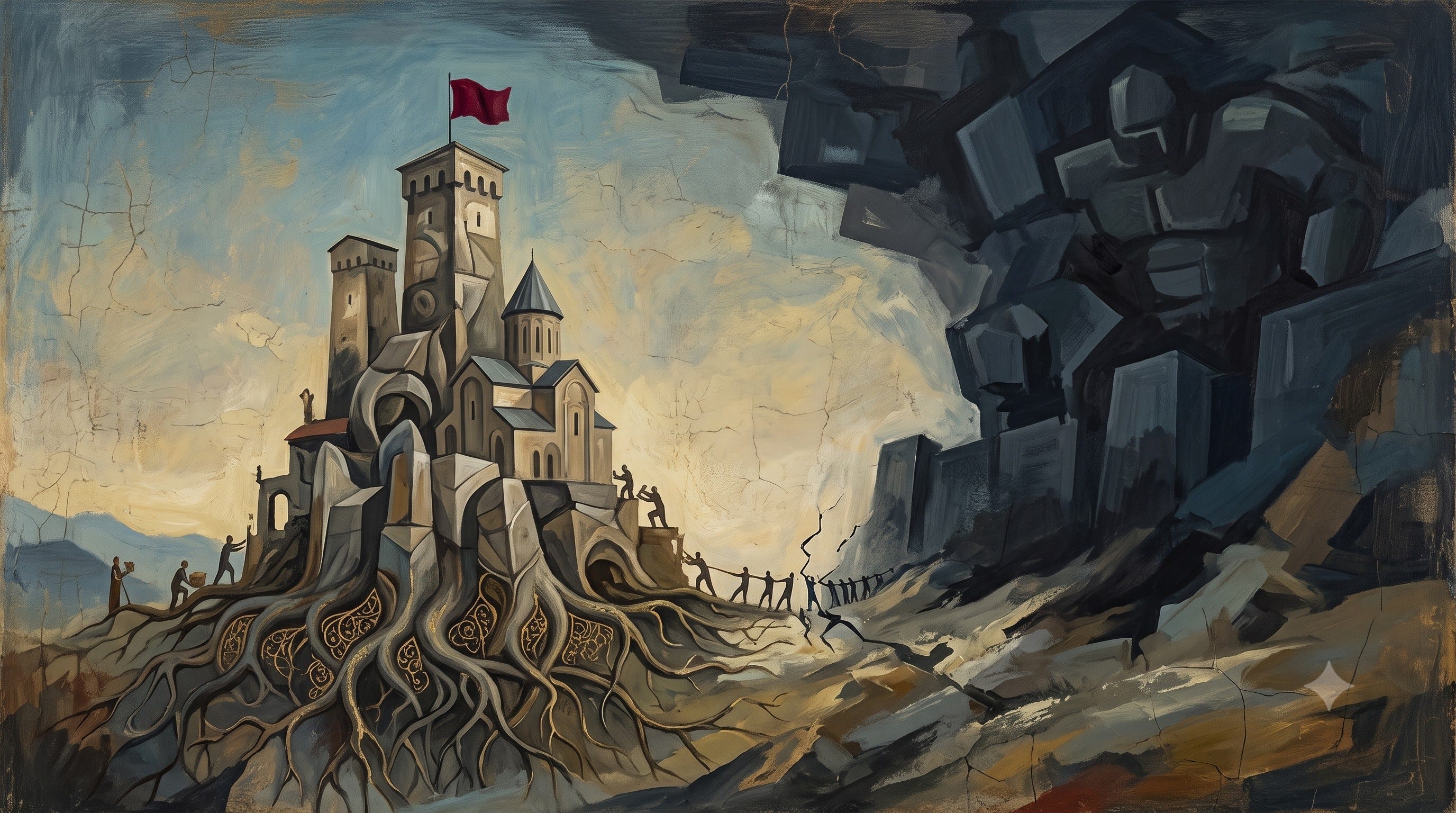
[Written, Researched, and Edited by Pablo Markin. Some parts of the text have been produced with the aid of Agent, Minimax, tools (July 18, 2026). The featured image has been generated in Gemini, Google (July 18, 2026).]
OpenEdition suggests that you cite this post as follows:
Pablo Markin (July 17, 2026). Book Review: Philipp Ammon’s Georgien zwischen Eigenstaatlichkeit und russischer Okkupation. Open Culture.
This is the synthesis dispatch — the place where the recent days are read as coherent arguments. These dispatches go out every week; subscribe to get them in your inbox.
If a dispatch earns its keep, you can support the work directly — one-off [https://buy.stripe.com/28E8wOfvo6jIalv6MM3Ru01] or, if you’d rather, monthly [https://buy.stripe.com/14AbJ02IC37w0KV0oo3Ru02].
Comments
Nothing yet. Say the first thing.
Sign in to join the conversation.