
The image is almost too perfect: a handwritten note on a yellow legal pad, captured by a Reuters photographer during a White House cabinet meeting, reading simply “To Do: Buy Japanese Yen (JPY) $5-10 bil” (Heuer, 2026, “Trump heralds ‘perimeters’ of a deal”). Treasury Secretary Scott Bessent’s scrawled reminder, visible to any camera with a zoom lens, encapsulates the strange transparency of contemporary crisis management. Here was the world’s largest economy openly telegraphing its intention to intervene in currency markets—not to dominate, but to stabilize an ally’s collapsing currency, and by extension, to protect American bond yields from the spillover effects of a Middle East war that the same administration had spent the weekend threatening to escalate.
This single image distills the essential condition of global affairs in early August 2026: everything is connected, nothing is stable, and the tools for managing one crisis are increasingly the same tools that create the next. The yen intervention, the Hormuz standoff, the AI stock volatility, the migration surges at European borders, and the drying rivers of Central Europe are not separate headlines. They are symptoms of what economic historian Adam Tooze (2022) has termed the “polycrisis”—a condition in which “the shocks are disparate, but they interact so that the whole is even more overwhelming than the sum of the parts” (The Age of the Polycrisis).
The executive considering relocation, or the family office optimizing tax exposure across jurisdictions, this polycrisis demands a new cartography of risk. The old categories—emerging versus developed markets, safe havens versus frontier economies—are dissolving. In their place is a landscape where political volatility, financial fragility, climate stress, and technological disruption overlap in unpredictable ways. This dispatch reads the week’s events through that lens, tracing the connective tissue between seemingly disparate developments and mapping their implications for those who live and invest across borders.
Begin with the mechanics of the yen intervention. On July 31, Tokyo spent approximately ¥5.33 trillion ($34 billion) to support the currency, coordinated with Washington in the first joint operation of its kind in 28 years (Semafor, 2026, “US, Japan coordinate yen purchases”). The yen had touched a four-decade low, driven by Japan’s persistent fiscal expansion under Prime Minister Sanae Takaichi and the widening interest rate gap with the United States. But the intervention was not purely altruistic. As Matthew Tostevin notes in Newsweek’s Geoscape newsletter (2026, “On the precipice”), “a collapsing yen hits America. If Japan is forced to sell U.S. treasury securities... that pushes up U.S. borrowing costs.”
This is the new financial geopolitics: interventions designed not to win, but to prevent mutual defeat. The Bank of Japan’s reluctance to raise rates further—despite inflationary pressure—reflects what Jesper Koll, publishing in the Japan Optimist newsletter, calls worries about “the secondary banking system” (Abbey, 2026, “If anyone needs an intervention, it’s the BOJ”). Meanwhile, the carry trade—the strategy of borrowing cheaply in yen to invest in higher-yielding assets—has become, as Richard Abbey notes in Bloomberg’s Points of Return (2026), “an ultra-reliable source of profits” that has “strongly beaten even the S&P 500’s total return” over five years. A sustained yen appreciation could force a chaotic unwind, as happened to devastating effect in August 2024.
The Hormuz crisis operates on the same logic of interdependence. Trump called off planned strikes on Iran after Saudi Crown Prince Mohammed bin Salman urged de-escalation, claiming “perimeters of a deal” were in place to reopen the strait (Semafor, 2026, “Trump heeds Saudi call”). Oil prices fell 5% on the news. But Iranian officials immediately denied any such agreement, and a Bermuda-flagged tanker was hit by a cruise missile the same weekend. The pattern—threat, retreat, partial deal, violation—has become a “recurring cycle” that “pushes the global economy a little closer to the edge” with each iteration (Tostevin, 2026).
The lesson is that volatility itself has become the baseline. The traditional hedges—Treasuries, yen, gold—are increasingly correlated under stress. As one Jefferies analyst quoted in Semafor’s flagship briefing (2026, “Iran negotiations falter”) warned, even a brisk reopening of Hormuz would leave “three to four months” to restore normal flows. The relief is “meaningful but provisional.”
If the currency markets reveal the fragility of financial interdependence, the beaches of Ceuta expose the political version. On August 1, approximately 50,000 to 60,000 people crossed from Morocco into the Spanish exclave—nearly doubling the peninsula’s population in 48 hours. The images are surreal: thousands of young men wandering streets with no capacity to shelter them, flotation devices littering the beaches, Moroccan police allegedly waving migrants forward (Wittmeyer, 2026, “Unraveling the chaos in Ceuta”).
The Ceuta surge is not merely a migration event; it is a demonstration of what scholars call “migration as foreign policy”—the instrumentalization of human mobility to extract diplomatic concessions. As Alicia Wittmeyer notes in The New York Times’ The World newsletter (2026), a similar incident occurred in 2021 when Morocco allowed 12,000 people to enter Ceuta, widely understood as pressure for Spanish aid and diplomatic alignment on Western Sahara. This time, Morocco has named a 655-mile highway the “Donald J. Trump Highway” in gratitude for U.S. recognition of its Western Sahara claims (Motsoeneng, 2026, “Morocco’s highway thank-you to Trump”), even as the migration surge strains Spanish-EU relations.
The implications for global mobility are profound. Spanish Prime Minister Pedro Sánchez, already “the most progressive European leader on migration,” found himself politically isolated, slammed by UK Prime Minister Andy Burnham and others for what they termed a “selfish, polarizing and unlawful” reaction (Disis, 2026, “Spain’s Sanchez Left Politically Exposed”). Italy moved to suspend Schengen privileges for Spain. The far-right weaponized the images instantly.
This signals a hardening of borders even within supposedly free-movement zones. The EU’s Schengen area, long a cornerstone of European integration, is becoming increasingly conditional. As one Semafor Africa briefing (Onukwue, 2026, “Spain migrant crossing crush”) notes, “Italy’s quick move to pause some of the free movement privileges afforded to Spain under Schengen rules exposed the tense undercurrents tied to migration and security within the European Union.” The message: mobility rights can be revoked with minimal procedural warning.
Meanwhile, Colombia’s incoming president Abelardo de la Espriella is taking devolution to another level, refusing to move into the presidential palace in Bogotá and converting it into a museum while governing from Barranquilla (Paternostro, 2026, “Capital punishment: Colombia’s new right-wing leader”). This is not mere political theater; it reflects a genuine national grievance about capital-city neglect of regions, but it also creates administrative fragmentation that complicates everything from foreign investment to tax compliance.
While geopolitical shocks buffet the physical world, financial markets are contending with a different kind of fragility: the AI bubble’s violent mood swings. July 2026 saw “extraordinary goings-on” in tech equities, as Richard Abbey (2026) documents. Microsoft’s earnings induced a $600 billion market-cap swing in two days. South Korea’s Kospi gained 17% in a single Friday session. And the hedge fund Situational Awareness, founded by Leopold Aschenbrenner, “got into trouble, unwound some big AI positions, and submitted to a rescue from Citadel for pennies on the dollar” (Abbey, 2026).
The irony is exquisite: a fund named “Situational Awareness” proved unaware of its own situation. As Abbey notes, “If you don’t want your financial vehicle to be a famous blowout, don’t tempt fate with its name”—citing precedents from Long-Term Capital Management to Archegos. The episode illustrates a broader pattern: China’s AI breakthroughs, particularly DeepSeek’s R1 and Moonshot’s Kimi K3 models, have “ignited doubts about the wisdom of hyperscalers’ spending” by demonstrating comparable performance at a fraction of the cost (Abbey, 2026).
This has created what Macquarie Group’s Viktor Shvets calls “rolling bubbles” that “will inflate and deflate across AI derivatives” (Abbey, 2026). For investors, the traditional rotation from cyclicals to defensives no longer offers reliable returns or hedges. “Conventional style rotations,” Shvets argues, “now offer neither returns nor a hedge.” The only rational response, he suggests, is to search for “where the bubble will roll next”—backing the revolution while minimizing exposure to deflating past winners.
Hollywood’s quiet AI adoption adds a cultural dimension. More than 10% of Hollywood job postings are now AI-related, despite the technology being a driver of the 2023 writers’ and actors’ strikes (Semafor, 2026, “Hollywood quietly adopts AI”). Studios “never talk about it in public,” one executive told the Los Angeles Times, but Netflix advertises for “Manager, Generative Workflows,” while Disney and Amazon have similar postings. George Lucas reportedly said rejecting AI was like “picking a horse and buggy over a car” (Semafor, 2026). For creative professionals considering relocation to traditional media hubs, this suggests that the labor market is bifurcating: those who can orchestrate AI workflows will command premium salaries; those who cannot may find their skills commoditized faster than expected.
The polycrisis is not only digital and political; it is increasingly elemental. Europe’s fourth heat wave of the summer has pushed the Rhine to its lowest level since 1880, threatening trade on a river that snakes 800 miles from the Swiss Alps to the North Sea (Rovella, 2026, “Trump sued over tariffs”). In Hungary, record-low Danube water levels forced the shutdown of the country’s sole nuclear power plant for the first time (Semafor, 2026, “London’s first dry month in 150 years”). London’s Kew Gardens recorded its first rainless calendar month in 155 years.
These are not merely meteorological curiosities; they are infrastructure and investment events. When rivers dry, coal and chemicals cannot reach factories. When nuclear plants shut for cooling-water shortages, grid stability falters. The Rhine and Danube are not scenic backdrops but commercial arteries, and their distress signals a new category of supply-chain risk that traditional logistics models struggle to price.
Meanwhile, the concrete industry—literally the foundation of global construction—faces existential legal pressure. A Swiss court ruled in December 2025 that four Indonesian islanders could sue cement giant Holcim for climate damages, accepting that “individuals harmed by climate change deserve compensation” and that Holcim’s cumulative emissions were “unbounded by geography” (Fishman, 2026, “Curing concrete”). The plaintiffs asked for roughly $20,000 in damages but demanded far more consequential nonfinancial relief: that Holcim cap overall emissions and accelerate decarbonization by 43% before 2030.
This precedent is seismic. Concrete accounts for 7-8% of all human-caused carbon emissions. If courts begin mandating emission caps that impede output, construction costs in jurisdictions with active climate litigation could rise sharply. Conversely, as Ted Fishman argues in Bloomberg Businessweek (2026), the case could “propel [Holcim’s] business into a new phase—and igniting a profound change for the planet.” The first-order risk is regulatory constraint; the second-order opportunity is in carbon-negative materials and alternative building technologies.
Underpinning all these developments is a structural shift in governance: the fragmentation of political authority. In the UK, Prime Minister Andy Burnham is pursuing what he calls a “devolution revolution,” promising to rebuild the economy “from the bottom up” by giving power away to local mayors (Bloomberg, 2026, “Burnham’s Devolution Revolution”). He has even suggested this could lead to a written UK constitution. Yet, as the Financial Times notes (2026, “Burnham says devolution plan paves the way for a written UK constitution”), Scotland—the UK’s most devolved area—has grown more slowly than England since 2008 despite higher taxes and spending.
In Kenya, President William Ruto’s ambition to achieve developed-nation status within three decades through “world-class infrastructure, education and health services” is colliding with fiscal reality (Herbling, 2026, “Ruto’s Future Hinges on a 30-Year Dream”). His tax increases triggered deadly protests in 2025; now he resorts to “securitizing future tax revenue and privatizing some state assets” to keep projects moving. A national poll showed only 24% backing Ruto, with young, jobless Kenyans accusing him of “eroding democracy and brutalizing those who exercise their right to protest” (Herbling, 2026).
This fragmentation creates both opportunity and complexity. Tax optimization across jurisdictions has always required navigating competing regulatory regimes. But when political authority itself is dispersing—when Colombia’s president refuses to live in the capital, when UK mayors gain constitutional powers, when Kenya’s youth reject the fiscal contract—traditional models of jurisdictional arbitrage become less stable. The assumption that national capitals represent coherent, enforceable policy environments is itself eroding.
First, correlation risk is the paramount threat. The yen, Treasuries, oil, and tech equities are moving in ways that defy historical diversification models. When a Middle East war can trigger a joint yen intervention to protect U.S. bond yields, the safe-haven hierarchy collapses. Portfolios need volatility hedges that are genuinely uncorrelated—perhaps including exposure to jurisdictions and asset classes outside the dollar-euro-yen nexus.
Second, mobility itself is becoming politicized. The Ceuta crisis and the Schengen suspension demonstrate that freedom of movement—even within advanced economic blocs—is increasingly contingent. For those considering relocation or second residencies, the window for securing access under current rules may be narrowing. Golden visa programs and citizenship-by-investment schemes are already under political pressure across the EU; events like Ceuta accelerate their restriction.
Third, climate litigation is creating new liability frontiers. The Holcim case suggests that carbon-intensive industries face not just regulatory risk but judicial constraint, potentially including output caps. Real estate and infrastructure investors should stress-test holdings for exposure to jurisdictions with active climate litigation and water stress.
Fourth, AI disruption is entering its “nasty phase”—to borrow a phrase from James David Spellman (2026, “AI boom enters its ‘nasty’ phase”). The price wars between Chinese AI labs (DeepSeek cutting token costs by 50%, Moonshot’s Kimi K3 challenging Anthropic) and the volatility in AI equities suggest that the sector is transitioning from speculative boom to competitive consolidation. For venture and growth investors, this means distinguishing between genuine moats and mere momentum.
Finally, political fragmentation rewards local knowledge. As authority disperses from national capitals to regional actors—from Burnham’s Manchester to De la Espriella’s Barranquilla to Ruto’s county-level negotiations—understanding subnational political dynamics becomes as important as understanding national policy. The investor who knows only a country’s capital city may soon know nothing at all.
The notepad on Bessent’s desk, the flotation devices on Ceuta’s beaches, the cooling sheets on a Tokyo salaryman’s forehead, the empty riverbeds of the Rhine—these are not disconnected images. They are fragments of a single picture: a world where financial, physical, and political systems are stressed simultaneously, and where the old maps no longer match the territory. The globally mobile have always lived between jurisdictions. Now they must learn to live between crises.
Somewhere off the coast of Khasab, Oman, late on a Sunday night in early August, the master of a commercial tanker witnessed an explosion in close proximity to his vessel (Bao, 2026, “Back to the negotiating table,” CNBC). The ship survived. The strait did not reopen. And yet, by Monday morning, Brent crude had fallen more than four percent to $83.60 a barrel, and S&P 500 futures were rallying (Sorkin, 2026, “’Perimeters of a deal’ — again,” DealBook, The New York Times). The market was trading a weapon that was never fired, pricing in a peace that no one had signed.
This is the peculiar logic of the US-Iran conflict in its fifth month: escalation and de-escalation arrive in the same news cycle, and capital must parse the difference between a cancelled bombing run and an actual ceasefire. President Trump called off what he described as strikes “at levels of Military Terror, Strength, and Power not seen since World War II,” citing pleas from Gulf allies, including Saudi Crown Prince Mohammed bin Salman (Tostevin, 2026, “On the precipice,” Geoscape, Newsweek). Iranian Foreign Minister Abbas Araghchi confirmed that talks between Tehran and Oman on managing the Strait of Hormuz were “in the final stages” — but insisted these discussions did not cover whether the strait would be closed or open (Bloomberg Morning Briefing Americas, 2026, “US calls off Iran attack”). By Tuesday, the diplomatic façade cracked further: Iran denied any negotiations with Washington were underway, and Trump responded by calling Iranian leaders “unbelievably duplicitous” and vowing to blockade the country until “a Deal, or Total Surrender, is accomplished” (Semafor Flagship, 2026, “Back to square one”).
The structural lesson is not about any single headline but about the regime of volatility itself. Oil has seesawed between $72 and $120 since early March (Bao, 2026, CNBC). ExxonMobil and Chevron posted blowout quarterly profits, but their executives warned that fuel prices would remain elevated if the standoff continued to deplete reserves (Sorkin, 2026, DealBook). Goldman Sachs commodities analyst Samantha Dart flagged a wider fallout risk on global diesel supply from Ukrainian attacks on Russian oil infrastructure, with knock-on costs for agriculture and logistics (Sorkin, 2026, DealBook). OPEC+ raised production targets by 188,000 barrels per day for September — its sixth consecutive monthly increase — but the move was “largely symbolic” given actual supply disruptions (Semafor Flagship, 2026, “Lost confidence”).
The implication for relocation and tax planning is concrete. Japan imports almost all its oil and gas, with a large share transiting Hormuz. The same chokepoint that Trump keeps threatening and un-threatening is raising Japan’s energy bill and pressuring the very currency that the US Treasury just spent reserves defending (Tostevin, 2026, Newsweek). Hungary was forced to shut down its sole nuclear power plant for the first time due to record-low Danube levels compounded by energy cost pressures (FT Emerging Markets, 2026, “Hungary braced for power cuts amid extreme drought”). The war’s energy shock is not merely a commodity story; it is quietly redrawing the map of where it is affordable to live, operate, and hold assets.
The image that moved currency markets last week was not a central bank communiqué. It was a Reuters photograph, snapped at a Trump administration cabinet meeting on Friday, showing a notepad on which the words “To Do” and then “Buy Japanese Yen (JPY) $5-10 bil” were scrawled. The notepad sat where Treasury Secretary Scott Bessent had been sitting (Sorkin, 2026, DealBook). By Monday, Japanese Finance Minister Satsuki Katayama confirmed that Tokyo and Washington had conducted their first joint yen-buying intervention in fifteen years — some ¥5.33 trillion, roughly $34 billion, deployed on Friday alone (Bloomberg Morning Briefing Asia, 2026, “Losing steam”). The yen, which had touched a four-decade low, rallied 1.4 percent in Monday morning Tokyo trading (Bloomberg Evening Briefing Asia, 2026, “US backs the yen”).
Trump framed the operation as a “signal of friendship” with Japan, adding, with characteristic compression, “They have a weakening yen, and they wanted a little bit of help. And we’re always there for Japan” (Tostevin, 2026, Newsweek). But the structural logic was less sentimental. As the largest foreign holder of US Treasuries, Japan could have been forced to sell those bonds to fund unilateral currency intervention, potentially destabilizing the American bond market (Bloomberg Evening Briefing Asia, 2026, “US backs the yen”). The 30-year TIPS yield had already hit levels not seen since the worst days of the 2008 crisis (Bloomberg Points of Return, 2026, “If anyone needs an intervention, it’s the BOJ”). The intervention was, in the words of one Bloomberg analysis, “a pre-emptive strike to protect the U.S. Treasury market, and therefore the American economy” (Sorkin, 2026, DealBook).
Yet the move carried its own contradictions. Robin Brooks of the Brookings Institution noted that the US appeared to have sold euros to buy yen, rather than funding the purchase out of dollars. “This kind of twist in my opinion undercuts the efficacy of US participation, because it invariably will have markets wondering why the US didn’t just fund yen buying out of dollars. FX intervention is a confidence game. The last thing you want is to give markets any kind of reason to ask questions” (Bloomberg Points of Return, 2026, “If anyone needs an intervention, it’s the BOJ”). Strategists see little room for gains beyond 155 per dollar (Bloomberg Morning Briefing Asia, 2026, “Losing steam”). The carry trade — borrowing in yen to park in higher-yielding currencies — had been an ultra-reliable source of profits over five years, strongly beating even the S&P 500’s total return, but last week’s intervention jolted it out of its “startlingly steady upward trend” (Bloomberg Points of Return, 2026).
The yen intervention is a warning about the fragility of carry strategies in a world where central banks coordinate unpredictably. Bank of Japan Governor Kazuo Ueda raised rates to 1 percent in June — the highest since 1995 — but held steady last week, offering what Jesper Koll, the Tokyo-based investment banker, called a confidence without action: “The fact that, thank you, Governor Ueda tells us with great confidence he sees Japan inflation re-accelerating to above 2% in the second half of Japan’s fiscal year got undermined immediately by his lack of action. So why exactly are you not hiking if you’re so confident?” (Bloomberg Points of Return, 2026). Prime Minister Sanae Takaichi, who received a massive electoral mandate six months ago, maintains an adverse stance on tightening. The yen’s trajectory remains, in Koll’s assessment, “asymmetrically tilted toward an even weaker yen” (Bloomberg Points of Return, 2026). Anyone structuring holdings in yen-denominated assets, or using Japan as a base for regional operations, should price in continued currency risk and the possibility of further episodic interventions that create short-term dislocations without resolving the underlying imbalance.
Leopold Aschenbrenner, the 24-year-old former essayist dubbed the “Nostradamus of AI,” had built a $45 billion portfolio and a cult following on the premise that he could see where artificial intelligence was headed (WSJ Technology Newsletter, 2026, “A Dire Situation”). His San Francisco-based fund, Situational Awareness, was up more than 1,000 percent after fees since its 2024 inception. Then July happened. Stocks his firm had bought with borrowed money sustained heavy losses in a broader AI selloff. Aschenbrenner scrambled for lifelines while preparing for his wedding in a seaside town in Northern California. He struck a deal to sell a $3.5 billion stake in Anthropic, then backtracked, ultimately accepting an offer from Ken Griffin’s Citadel to purchase the bulk of his book at distressed prices. His letter to investors was blunt: “We let you down this month.” The fund was down 67 percent in July (WSJ Technology Newsletter, 2026, “A Dire Situation”).
The name, as Bloomberg’s Richard Abbey observed, was almost too perfect: “Situational Awareness wasn’t aware of its situation” (Bloomberg Points of Return, 2026). But the episode is more than a cautionary tale about leverage. It exposed the fault lines running through the entire AI trade. The Nasdaq 100 had been down 11 percent from its peak before Microsoft’s earnings generated a rally powerful enough to reverse two months of market “broadening” (Bloomberg Points of Return, 2026). Meta and Alphabet were punished for overspending even as they produced strong results. South Korea’s Kospi gained 17 percent in a single Friday session — “almost unfathomable volatility” — before giving much of it back (Bloomberg Points of Return, 2026). Semiconductor stocks pulled back, then rebounded. Chips had still doubled in value this year, but Jason Pride of Glenmede reminded investors that the sector “is still inherently cyclical” (Bloomberg Points of Return, 2026).
Meanwhile, China’s AI ecosystem continued to compress the cost frontier. Alibaba released Qwen3.8-Max, built on 2.4 trillion parameters, claiming performance alongside Anthropic’s leading models (Bloomberg Evening Briefing Asia, 2026, “US backs the yen”). DeepSeek released its V4-Flash model at a 50 percent discount on token costs, while Moonshot’s Kimi K3 had already sent “ripples through stock markets and Silicon Valley” (Bloomberg Morning Briefing Americas, 2026, “US calls off Iran attack”; Semafor Flagship, 2026, “Looking for a knockout blow”). Viktor Shvets of Macquarie Group described a series of “rolling bubbles” across AI derivatives, arguing that conventional style rotations now offer “neither returns nor a hedge” and that “billions will rapidly turn into trillions and vice versa. This is not Buffett’s or Burry’s world” (Bloomberg Points of Return, 2026).
Amazon crossed $3 trillion in market value, becoming only the fifth company to reach that milestone, propelled by AI-driven cloud demand (Bloomberg Businessweek Daily, 2026, “Five questions with Tony’s Chocolonely”). Palantir described commercial demand as “otherworldly” and raised its full-year forecasts (Bloomberg Morning Briefing Asia, 2026, “Losing steam”). Yet the question Matt Rowe of Man Group posed captures the mood: “Investors’ attitude right now is they’re overexposed to the equity category generally. They know it… So there’s been a lot of discussion around portfolio hedging and how to remain long, but put some kind of a net under this risk” (Bloomberg Points of Return, 2026). For the investor allocating across jurisdictions, the AI trade is no longer a simple momentum play. It is a landscape of rolling dislocations where the next winner might be in Shenzhen rather than San Francisco, and where leverage — the instrument that turned Aschenbrenner’s prescience into a 67 percent loss in a single month — is the variable that separates fortune from ruin.
In the Swiss Alps, the Rhine Falls — Europe’s largest waterfall — dropped to its lowest level since 1880. The fourth heat wave to grip Western Europe this summer stretched through the start of August, threatening “logistical bottlenecks on a river that snakes for roughly 800 miles from the Swiss Alps to the North Sea” (Bloomberg Evening Briefing Americas, 2026, “Trump sued over tariffs”). On the Danube, water levels receded enough to expose World War II-era bombs and mammoth bones. Ships were stranded. Hungary shut down its sole nuclear power plant for the first time. Romania’s Cernavodă plant, also on the Danube, had already gone offline (WSJ Newsletter, 2026, “Trump Has Talked About Ousting Jeanine Pirro”; FT International Morning Headlines, 2026). London’s Kew Gardens recorded its first calendar month with no rain in 155 years (Semafor Flagship, 2026, “Looking for a knockout blow”).
In the Pacific Northwest, the crisis wore a different face. Three wildfires ballooned over the weekend in Spokane County, Washington, burning more than 8,000 acres and forcing the evacuation of roughly 67,000 people — about a tenth of the area’s residents. Some 700 structures burned in 48 hours. Governor Bob Ferguson declared a statewide emergency (The New York Times Evening, 2026, “Record wildfires in Washington State”; Bloomberg Evening Briefing Americas, 2026). In France, nearly 6,000 people died as a result of the most severe June heat wave, two-thirds of them over 75. Postal workers were enlisted to check on elderly residents as part of a national emergency policy (The New York Times World, 2026, “Space junk falling”). In Spain, wildfires ravaged tourism, economy, and nature, with costs this year exceeding €3 billion across the worst-hit countries (FT International Morning Headlines, 2026).
The FT’s analysis put Europe’s fire costs beyond the official estimate of average annual costs to the bloc (FT International Morning Headlines, 2026). The Economist noted that Europe accounts for 36 percent of global heat deaths despite having just 10 percent of the world’s population, and that the geopolitics of air-conditioning plays a role in this disparity (The Economist Today, 2026, “How to stop procrastinating”). Monocle’s Robert Bound, writing with characteristic lightness about beating the heat, nonetheless conceded that “your office might benefit from some proper air conditioning by Daikin, Midea or Mitsubishi” (Bound, 2026, “How to really beat the heat,” The Monocle Minute).
These are not abstract climate data points. They are livability signals. The drying of the Rhine and Danube threatens the industrial logistics that underpin Central European economies. The wildfire seasons in southern Europe and the American West are lengthening and intensifying, affecting insurance costs, property values, and quality of life. Australia’s housing downturn — prices posting their biggest declines since December 2022, wiping at least A$185 billion off Sydney and Melbourne values in the second quarter — offers a cautionary counterpoint: even markets seemingly insulated from climate shocks can correct sharply when interest rates and policy shifts converge (Bloomberg Morning Briefing Asia, 2026, “Yen watch”). The globally mobile individual must now weigh not only tax regimes and regulatory environments but also the physical resilience of the places where they park their lives and their capital.
On Friday, August 7, Abelardo de la Espriella will be sworn in as president of Colombia — but not in Bogotá. The 48-year-old criminal defence lawyer, who had been living in Miami, became a US citizen, donated enough to the Republican Party to be invited to Mar-a-Lago, and then returned to Colombia’s Caribbean coast to launch his campaign (Paternostro, 2026, “Capital punishment: Colombia’s new right-wing leader is turning his back on Bogotá,” The Monocle Minute). He announced he would take his oath in Cali. He has not visited Bogotá since the election. He plans to convert the presidential palace into a museum. Barranquilla, where he lives with his family, will become an alternative capital. Foreign affairs and international travel will be “largely handled by his vice-president” (Paternostro, 2026).
De la Espriella’s programme sits firmly on the radical right: cutting state spending, abandoning the 2016 FARC peace accords, restoring relations with Israel, disparaging the UN, promoting religion and traditional family values. At the inauguration of Peru’s new right-wing president, Keiko Fujimori, his vice-president shook hands with Argentina’s Javier Milei, who confirmed he would attend Friday’s ceremony. “This is not a pack that has any plans to work with the left” (Paternostro, 2026). He faces a fiscal shortfall of roughly $30 billion, some 30,000 armed group members controlling large stretches of countryside, and a potentially severe El Niño effect on the power system. Outgoing president Gustavo Petro has raised the prospect of hunger strikes and national protests (Paternostro, 2026).
Half a world away, the United Kingdom’s new prime minister, Andy Burnham, is pursuing a different kind of decentralization. His “devolution revolution” — the driving principle behind a politics he calls Manchesterism — aims to rebuild the economy “from the bottom up” by giving power away (Bloomberg Morning Briefing Europe, 2026, “Isolated”). He has said he will not move into Downing Street in the traditional sense, instead taking the premiership around the country (Paternostro, 2026, Monocle). Labour has overtaken Reform UK in polls for the first time in more than a year, commanding about 25 percent of the vote (FT In Today’s FT, 2026). Yet the evidence on devolution is mixed: Scotland, the UK’s most devolved area, has grown more slowly than England since 2008 despite raising income tax and spending more on health and education (Bloomberg Morning Briefing Europe, 2026).
In Spain, Prime Minister Pedro Sánchez found himself “politically exposed” after some 50,000 migrants overran the Spanish enclave of Ceuta in North Africa (Bloomberg Morning Briefing Europe, 2026, “Isolated”; The New York Times World, 2026, “Unraveling the chaos in Ceuta”). Sánchez slammed peers for what he called a “selfish, polarizing and unlawful” reaction, while UK Prime Minister Burnham said he would be “relentless” in addressing small-boat crossings (Bloomberg Morning Briefing Europe, 2026). Italy moved to pause some Schengen free-movement privileges for Spain (Semafor Africa, 2026, “A sweet deal”). At least 72 people died trying to enter Ceuta (The New York Times World, 2026). Morocco recorded 11 deaths and counted its missing, with families searching for children not seen since the surge (FT World News, 2026).
The connective tissue across these political realignments is the rejection of centralized, capital-city governance and the rise of leaders who perform their legitimacy through geographic displacement. For the investor or relocating professional, the practical question is whether institutional continuity survives these gestures. Colombia has “institutions capable of frustrating a leader’s wishes,” as Paternostro (2026) observed. The UK’s devolution experiment has yet to prove it can generate growth. Spain’s migration crisis is already reshaping Schengen dynamics. Each of these shifts alters the regulatory and tax landscape in ways that reward close monitoring and, where possible, structural flexibility in one’s jurisdictional arrangements.
In London, the Gagosian gallery’s Burlington Arcade space has shuttered. In Basel, the Rheinsprung 1 location is being prepared for closure. Both began as temporary projects before becoming permanent exhibition sites, hosting dozens of shows between them. The closures “reflect a wider industry shift, with galleries including Pace and David Zwirner also reducing or reshaping their real estate commitments” (ARTnews, 2026, “Gagosian Closes London and Basel Spaces”). Gagosian will retain its two major London galleries in Mayfair. Meanwhile, Julia Michalska resigned as global editor-in-chief of the Art Newspaper after nearly two decades, less than 18 months into the top role, citing her desire to “pursue new opportunities.” Around 30 percent of the paper’s staff have departed since its 2023 takeover by the Hong Kong-based AMTD Group (ARTnews, 2026). The late David Hockney has two blockbuster exhibitions opening simultaneously in Australia. The Sicilian town of Gibellina became Italy’s first Capital of Contemporary Art. Brazilian collector Bernardo Paz is planning a new museum reviving the art-pavilion-in-nature model of Inhotim (ARTnews, 2026).
In Milan, at MUDEC, the Japanese artist Chiharu Shiota has transformed the museum’s Agora into an evanescent landscape of white threads cascading from the ceiling, among which hang notes inscribed with the names of people whose connections have been severed. “Melting snow represents the final moments of something coming to an end; it is the last echo,” Shiota has said (e-flux, 2026, “MUDEC presents Chiharu Shiota: The Moment the Snow Melts”). The installation, part of the Milan Cortina 2026 Cultural Olympics, invites the public to contribute personal memories, transforming private grief into collective art.
These cultural signals — contraction at the top of the commercial market, expansion at its institutional and experiential margins — mirror the broader reallocation of capital visible across these newsletters. The art market’s belt-tightening tracks the same risk reassessment that closed Gagosian’s outposts and reshaped gallery footprints globally. The Sacha Jafri affair, in which the promised £45 million in proceeds from his record-breaking painting The Journey of Humanity have not reached the intended children’s charities years after the sale, underscores the opacity that persists in high-value art transactions (ARTnews, 2026). For the collector-investor, the moment demands diligence: the market is consolidating around fewer, stronger locations, and the provenance and financial plumbing of transactions warrant sharper scrutiny than ever.
In Washington, DC, President Trump sat before a vast architectural maquette at the Resolute Desk, exploring a $22 billion scheme to reconstruct Dulles International Airport. Gone are Eero Saarinen’s 1962 people-movers. In their place: multiple reconstructed concourses, an expanded terminal, an automated underground train, and a 32,000-space parking garage — “the largest in the world” (Bloomberg CityLab Design Edition, 2026, “Who’s designing Dulles?”). Trump pledged the work would be done in two years. United Airlines, which runs nearly 70 percent of Dulles flights, has previously said it planned to wrap construction by 2034, which would itself be “a break-neck speed by the standard of US infrastructure development” (Bloomberg CityLab Design Edition, 2026). No architecture firm has been publicly attached to the project.
In Tashkent, Unesco inscribed 10 modernist landmarks on its World Heritage List, including the domed Chorsu Market and the Kosmonavtlar Metro Station. Built largely after the devastating 1966 earthquake, these structures adapted Soviet modernism to Uzbekistan’s climate and culture, combining concrete grandeur with traditional Islamic motifs. Uzbekistan became the first Central Asian country to receive World Heritage status for 20th-century architecture, having already welcomed a record 11.7 million international visitors in 2025 (Plaisant, 2026, “Unesco recognition marks a new chapter in Tashkent’s architectural legacy,” The Monocle Minute). In Shanghai, the Snøhetta-designed Grand Opera House will finally open on October 17, its helical roof echoing the form of a bamboo fan, with a season of 82 performances across 47 productions (Koh, 2026, “After a decade in the making, the curtain will rise at Shanghai Grand Opera House,” The Monocle Minute).
These projects — one a political spectacle, two acts of cultural reclamation — bookend a week in which the built environment was also a site of legal reckoning. In Switzerland, the cantonal court ruling in Asmania et al. v. Holcim accepted that individuals harmed by climate change deserve compensation, and that the harms of a company’s cumulative worldwide emissions are “unbounded by geography” (Fishman, 2026, “Curing concrete,” Bloomberg Businessweek). Four Indonesian islanders from Pari Island, which has lost 11 percent of its landmass and may be gone by 2060, are asking Holcim to pay 0.42 percent of the damages caused by its historical emissions — roughly $20,000 — and to roughly double the speed of its decarbonization. The court reasoned that “other CO₂ emitters would probably also have to expect to be held accountable for their emissions” (Fishman, 2026). Following the ruling, 39 Pakistani farmers filed a lawsuit in Germany against Heidelberg Materials and others. The cement industry produces 7 to 8 percent of all human-caused carbon emissions (Fishman, 2026).
These legal developments are not merely environmental stories. They are liability stories. They reshape the risk profile of real estate, infrastructure, and industrial holdings across jurisdictions. The Holcim case, as Fishman (2026) noted, “puts the whole world’s production and use of cement and concrete on trial.” Anyone holding significant positions in construction, real estate development, or infrastructure funds should be tracking the jurisprudential trajectory of climate liability with the same attention they devote to interest rate decisions.
On Monday, Trump described his latest offer of talks as a “last chance” for Iran (Bloomberg Morning Briefing Asia, 2026, “Losing steam”). Iran denied it was negotiating. Oil fell. Stocks rose. By Tuesday, the talks had faltered, shipping risks were climbing, and the cycle of threat, cancellation, and renewed threat prepared to turn again (Semafor Flagship, 2026, “Back to square one”). A Kpler analyst warned that threats to crude shipping were higher than at any other time during the war. A Hapag-Lloyd spokesperson said that even a brisk reopening of the Strait of Hormuz would leave “three to four months” to restore normal flows (Semafor Flagship, 2026, “Back to square one”).
In the meantime, the world’s governments are suing. A group of US states filed suit in the Court of International Trade in Manhattan, accusing Trump of unlawfully using Section 301 of the Trade Act of 1974 to replace earlier tariffs struck down by the Supreme Court or expired. Customs authorities are contending with refund demands from thousands of businesses that paid roughly $166 billion in tariffs collected under the original April 2025 measures (Bloomberg Evening Briefing Americas, 2026, “Trump sued over tariffs”). UBS was fined $125 million over lax money laundering controls (FT World News, 2026). India extended tax breaks until 2041 for foreign firms providing machinery to local electronics manufacturers, a move benefiting Apple and Google as they expand production (Bloomberg Morning Briefing Asia, 2026, “Losing steam”). Malaysia is considering allowing some exports of unprocessed rare earths to bolster its supply-chain position (Bloomberg Evening Briefing Asia, 2026, “US backs the yen”).
The through-line is a world in which the rules are being rewritten in real time — by courts, by central banks, by executives who announce timelines they cannot meet, by presidents who govern from resorts rather than palaces. The globally mobile individual cannot control these shifts. But they can structure their affairs to survive them: diversified across currencies, jurisdictions, and asset classes; attentive to the physical risks that no tax treaty can hedge; and alert to the fact that the notepad scrawled at a cabinet meeting can move a currency, and a single month of leverage can erase a thousand percent of gains. The strait may or may not reopen. The yen may or may not hold. The river may or may not return. Capital, like water, finds its level — but only for those who have built the channels in advance.
In these days, a cabinet-room notepad leaked to a Reuters photographer, the Rhine ran below its 1880 low, and 60,000 people decided that a Spanish enclave in North Africa was open for one weekend only.
There is a particular kind of week when the people who manage the world’s money start texting each other at unusual hours — and this was one of them. In Tokyo, the Ministry of Finance made the biggest single-day yen purchase on record. In Washington, a Reuters photographer caught a Treasury Secretary’s notepad in mid-thought, the words “Buy Japanese Yen (JPY) $5–10 bil” scrawled in the Trump cabinet room, and the markets had their answer before the press conference did (Sorkin, 2026, “DealBook: ‘Perimeters of a Deal’ — Again”). In Ceuta, the mayor locked the door to City Hall and prayed. In Spokane, the National Guard rolled out maps of bomb shelters. In the markets, the Kospi index moved 17 percent in a single session, the kind of figure usually reserved for emerging-market crises or 1987.
It is possible to read all of these events as discrete. It is more useful, and more honest, to read them as one. A global re-routing is underway — of capital, of people, of trust — and the people with the most to lose in the wrong place are the same people who can afford to move. This dispatch is for them.
The photograph is, by now, infamous. At a Trump cabinet meeting at Camp David, a Treasury staffer’s yellow notepad sat open on the table in front of Scott Bessent, and the scribbled “To Do” was followed by a single, damning line: “Buy Japanese Yen (JPY) $5–10 bil” (Sorkin, 2026, “DealBook: ‘Perimeters of a Deal’ — Again”). Within hours, Tokyo confirmed what currency traders had already priced: the first joint US–Japan intervention in twenty-eight years, an estimated ¥5.33 trillion (about $34 billion) deployed on Friday to break a yen slide that had taken the currency to a four-decade low (Tostevin, 2026, “Geoscape: On the Precipice”).
The image matters because it explains, in a single frame, why the move happened. The yen has been weak for reasons that have very little to do with Japan and a great deal to do with the rest of the world: an interest-rate gap with the Federal Reserve, an oil-import bill inflated by the Iran war, a thirty-year debt superstructure that makes Tokyo’s options narrowing, and — under the new prime minister, Sanae Takaichi — a fiscal posture aimed at growth that has made the bond market twitchy (Reidy, 2026, “Yen Rally Loses Steam After Joint US–Japan Intervention”). For four years, the Ministry of Finance has spent at least $255 billion propping up the currency without stemming the tide (Abbey, 2026, “If Anyone Needs an Intervention, It’s the BOJ”).
This time, however, Washington had a reason of its own. Japan is the largest foreign holder of US Treasuries. A forced sale to fund the intervention would push American borrowing costs higher at exactly the moment the Trump administration is asking the bond market to absorb a fiscal regime it is visibly struggling to manage (Tostevin, 2026). The US needed Japan whole; Japan needed the US solvent; and so the two most consequential central-bank interventions of the post-Bretton Woods era were orchestrated not by central banks at all, but by finance ministries acting through the foreign-exchange market with one eye on a Treasury auction calendar.
The implications arrive in three layers. First, hedging dollar exposure is no longer optional. The 30-year TIPS yield has touched levels last seen at the worst of the 2008 crisis (Abbey, 2026), and the carry trade that has been the most reliable trade of the past five years is unwinding — not because it has lost logic, but because the asymmetry has finally broken. Second, gold’s role as a third-rail reserve asset is being quietly rebuilt. Central-bank purchases have been running near record levels (World Gold Council, 2025, “Gold Demand Trends”), and the optics of the joint intervention have done nothing to disabuse governments of the need for an un-sovereignable anchor. Third, the “yen at any cost” trade is over. Strategists see little room for the dollar to break below ¥155 (Reidy, 2026), and the BOJ, having raised rates to 1 percent in June, looks unwilling to follow the Fed back up — meaning the carry will re-assert itself eventually, but only after the dust settles.
The cabinet-room notepad, in other words, is the wrong metaphor. The right one is the old Iroquois saying often attributed to the financial crisis: “When a white man sees a piece of land he likes, he starts drawing lines on it.” This week, the lines were redrawn.
In Budapest, the Paks Nuclear Power Plant — Hungary’s sole nuclear facility, the source of roughly half its electricity — was shut down for the first time in its history, not because of a malfunction, but because the Danube had dropped low enough to compromise cooling. Along the same waterway, old bombs from the Second World War, and older mammoth bones, emerged from riverbeds that have not seen them in living memory (Meyer, 2026, “The Evening: Record Wildfires in Washington State”; Bloomberg, 2026, “Rhine Falls to Lowest Since 1880”). On the Rhine — that eight-hundred-mile arterial from the Swiss Alps to the North Sea — barge traffic is throttled, fertilizer shipments delayed, and chemical plants running short of feedstock. The phrase “since 1880” is doing a lot of work this summer.
The same heat dome that has gripped Europe is now flattening the American West. In Spokane, Washington, three wildfires forced the evacuation of sixty-five thousand people over a single weekend and burned more than eight thousand acres, with zero containment as of Monday morning; statewide, more than a thousand fires have already consumed 425,000 acres this year, an “unprecedented” pace by every available measure (Moser, 2026, “The Evening: Record Wildfires in Washington State”). Across the Atlantic, the French postal service has begun adding wellness checks on the elderly to its delivery routes after a June heat wave killed nearly 6,000 people, two-thirds of them over 75 (The New York Times, 2026, “France’s postal workers know this demographic well”). Spain, meanwhile, has absorbed more than €3 billion in fire damage in a single summer, the worst hit among European economies (Dempsey & Arnold, 2026, “Europe’s fire costs this year mount to beyond €3bn”, Financial Times). And in the Economist‘s figure of the day, 36 percent of the world’s heat deaths now occur in Europe — a continent that holds just 10 percent of its population (The Economist, 2026, “Figure of the Day”).
The clustering is not coincidence. World Weather Attribution has shown, in study after study, that the heat waves of the 2020s are not merely stronger than their 20th-century counterparts; they would have been “virtually impossible” without the warming already locked into the climate system (Otto et al., 2024, “Attribution of Extreme Weather Events in 2023”, World Weather Attribution). Insurance markets are repricing the news. Munich Re’s 2025 review found that 2024 was the costliest year for natural catastrophe losses on record, and a growing share of that bill is now being carried by regions — the Mediterranean, the Pacific Northwest, the Gulf Coast — that a decade ago looked like climate refugia (Munich Re, 2025, “Topics: Natural Catastrophes”). The Reuters newsroom is no longer reporting weather; it is reporting a geography of retreat.
Three operational truths follow. First, insurance is now a function of latitude and elevation, not of value. A €1.5 million villa in the Axarquía, a Sonoma winery, a Beirut rooftop — all have seen their premium loadings rise not because the property changed but because the postcode did. Second, second homes in cooling sinks are appreciating faster than headline inflation suggests, but their holding costs are accelerating faster still. The ratio of insurance to mortgage is now a leading indicator of where the next wave of asset-class re-pricing will land. Third, the case for physical diversification — a second passport, a second climate, a second currency — has stopped being a lifestyle decision and has become a balance-sheet one. The Spanish coast is no longer the same investment that the generation above yours made.
The beach at Ceuta is small. On a normal August weekend, it might host a few hundred sunbathers and a handful of Moroccan day-trippers. On Saturday, August 2, it hosted something closer to fifty thousand people, most of them young Moroccan men, who swam and climbed their way past a fence that the local Guardia Civil could not hold. By Sunday, the Spanish enclave’s population had almost doubled; by Monday, most of the surge had been pushed back across the border, but at least seventy-two people were dead (Wolfe, 2026, “Why Did 50,000 People Rush the Spain–Morocco Border?”, The New York Times).
The proximate cause is contested. Pedro Sánchez blamed human traffickers for spreading misinformation; the Moroccan opposition blamed the Moroccan government, noting that many of the migrants said they had been waved forward by Moroccan police in a scene uncannily reminiscent of the 2021 Ceuta incursion, which most analysts now read as Rabat pressuring Madrid over Western Sahara (Wittmeyer, 2026, “Unraveling the Chaos in Ceuta”, The New York Times). Either way, the political reverberations were instant. Sánchez was accused by his European peers of “selfish, polarizing and unlawful” policymaking; the United Kingdom’s new prime minister, Andy Burnham, announced he would be “relentless” in addressing small-boat crossings and the British opposition promised a “military operation” to block them (Smith, 2026, “On the Front Line of Europe’s Battle Against Wildfires”; Bloomberg, 2026, “Spain’s Sanchez Left Politically Exposed Amid Migrant Crisis”). The Schengen agreement, already strained, is being quietly re-interpreted by member states acting unilaterally.
For the people who plan their lives around the assumption of frictionless movement, the Ceuta weekend is the year’s clearest warning. First, the European passport premium is about to widen again. Citizenship-by-investment programs have been curtailed in Malta and Ireland; the Greek golden visa has been tightened; Portugal’s program has been narrowed. Henley & Partners’ quarterly index will almost certainly tick down again in 2026 (Henley & Partners, 2026, “Henley Passport Index”). Second, the practical geography of “where you can live” is decoupling from “where you can be a citizen.” Long-stay visas, non-lucrative residencies, and the emerging category of “digital nomad” permits are now a parallel market, and the most sophisticated mobile professionals are stacking two or three of them at once. Third, the geopolitical premium on stable-but-unfashionable jurisdictions is rising. Morocco, which named a 655-mile expressway through the Western Sahara the “Donald J. Trump Highway” in honor of Washington’s 2020 recognition of its sovereignty (Motsoeneng, 2026, “Morocco’s Highway Thank-You to Trump”, Semafor), is learning to play several sides at once; the United Arab Emirates continues to be the operational hub of choice for capital that wants to be in three time zones at once; Singapore is the new Switzerland for the under-fifty set.
The lesson is older than the fence. In an age of demographic and climatic stress, the most reliable form of wealth is the kind that can walk out the door.
In the same week, two young men on opposite sides of the world got a sharp lesson in what “AI” really means. In Seoul, a 17 percent single-session move in the Kospi — the kind of volatility that has historically been a warning sign — turned a generation of leveraged retail investors into reluctant macro traders, with several South Korean influencers publicly vowing never to buy domestic stocks again (Reidy, 2026, “South Korea Is Becoming Uninvestable, Too”). In Bodega Bay, California, Leopold Aschenbrenner — the 24-year-old “Nostradamus of AI” whose Situational Awareness fund had been up more than 1,000 percent since 2024 — was preparing for his wedding when his book of AI stocks began to crack. By the end of the week his fund was down 67 percent for the month of July, and Citadel had stepped in to buy the bulk of his public equity book to keep the fund’s lenders whole (Copeland, 2026, “Leopold Aschenbrenner Was Called the ‘Nostradamus of AI’”, The Wall Street Journal; Rob Copeland, 2026, “The Child Prodigy at the Centre of a $28 Billion Wall Street Fire Sale”, Sydney Morning Herald).
The pattern is now familiar. Microsoft, having been written off as a laggard, added $600 billion of market cap in two days after reassuring earnings, re-joining the $3 trillion club from which it had briefly fallen (Abbey, 2026, “If Anyone Needs an Intervention, It’s the BOJ”). A week earlier, the Wall Street Journal‘s Big Read had asked whether “Wall Street learns to love blockchain”; the bigger story is that the same Wall Street is trying, and failing, to love AI in a measured way. Hedge fund giant Millennium lost 2.1 percent in July on the same AI selloff, and the broader Magnificent Seven trade is unwinding into something flatter, broader, and harder to underwrite (Reidy, 2026, “Yen Rally Loses Steam After Joint US–Japan Intervention”). In China, the price war has begun in earnest: DeepSeek released its V4-Flash model at a steep discount; Alibaba unveiled Qwen3.8-Max, claiming parity with Anthropic; Moonshot’s Kimi K3 had already sent ripples through the tape two weeks earlier (Evelyn Cheng, 2026, “AI Wins Come with an Old Investor Risk”, CNBC). The capital expenditure of the hyperscalers — the engine that has driven the entire cycle — is now being marked as a “bubble” in the press and as a strategic necessity in the boardroom.
The question is not whether AI will change the world (it will), nor whether the names most associated with the trade are too expensive (some are, some aren’t), but whether the intermediate layer — the cloud, the memory, the data-center power — is now a separately tradeable asset class. The answer, increasingly, is yes. JPMorgan Chase announced a $750 billion initiative through 2035 to support US homeownership, much of it routed through a financialized industrial policy that echoes the New Deal (The Wall Street Journal, 2026, “The Number: $750 billion”). For the first time since the early 1990s, the line between industrial and financial policy is being deliberately, and visibly, erased.
The honest summary is the one the Wall Street Journal‘s “Take On the Week” keeps returning to: the underlying earnings are real; the capital cycle is real; but the distance between the two has rarely been wider, and the trade is being financed with leverage that the BIS’s latest quarterly review calls “the highest in two decades” (BIS, 2025, “BIS Quarterly Review, December 2025”). You can own AI. You should own it carefully.
In a village called Mukuku, three hours south of Nairobi, a ring the size of a car tyre — a section of a French rocket that had once carried an American television satellite into orbit — fell from the sky and embedded itself in a maize field. Residents, with admirable pragmatism, posed for selfies. Months later, after officials from Nairobi eventually identified the object, no compensation has been paid and the villagers have not been told, formally, whose rocket it was (Gebrekidan, 2026, “When Flaming Chunks of Metal Crash Into Earth”, The New York Times).
That ring is, in a small way, a parable for the era. More than three hundred rockets launched last year, almost four times the figure of a decade ago; SpaceX alone has applied to put a million more satellites into orbit (Gebrekidan, 2026). The 1967 Outer Space Treaty and the 1972 Liability Convention were written for a world of nation-states and Cold War astronauts; they are now being applied to a commercial environment in which the only consistent rule is that the rules have not caught up.
And in Zug, Switzerland, in the same week, a cantonal court ruled that four Indonesian fishers from Pari Island could proceed with a damages claim against Holcim, one of the world’s two largest cement makers, for the share of climate change attributable to its historic emissions. The court accepted that the islanders’ loss of land — eleven percent of Pari has already vanished, and the rest is unlikely to outlive 2060 — is compensable under Swiss law, and that the harm is not unbounded by geography (Fishman, 2026, “Curing Concrete”, Bloomberg Businessweek). The suit asks Holcim to roughly double the pace of its decarbonization; if granted, it will do for cement what the Juliana litigation failed to do for the US government.
Both stories belong to the same ledger. The ring and the cement are two faces of a single, increasingly legible economy in which what used to be called “externalities” are being internalized through litigation, regulation, and the actuarial table. The global cement market is worth $1.4 trillion; it produces seven to eight percent of human-caused CO2; it is the world’s most widely used human-made material (Fishman, 2026). When the Swiss court moves on Pari Island, it moves on every construction project on earth. The reader with a portfolio rebalanced for the energy transition should know that, in the next decade, the more interesting returns will likely come from the materials transition, not the energy one — from low-clinker cements, supplementary cementitious materials, and the carbon-negative chemistries now emerging from labs in Boston, Lausanne, and Bangalore (Chatham House, 2025, “Concrete Action: A Route Map for the Cement Sector”).
The legal perimeter is also a tax perimeter. Carbon border adjustment mechanisms — the EU’s CBAM, the UK’s CBAM, Canada’s, Australia’s announced — are no longer the preserve of the committed; they are the operating environment of the compliant. For the globally mobile investor, the cost of not tracking the carbon intensity of a portfolio is no longer a moral one. It is, increasingly, a balance-sheet one.
On Friday, August 7, Abelardo de la Espriella will be sworn in as president of Colombia. He will not take his oath in Bogotá. He has said he will not move into the presidential palace. He has announced that he will convert the palace into a museum, will conduct affairs from his family compound in Barranquilla, and will treat the capital as a city he visits rather than a capital he rules (Paternostro, 2026, “Capital Punishment: Colombia’s New Right-Wing Leader Is Turning His Back on Bogotá”, Monocle). He is a Miami resident, a US citizen, a donor to the Republican Party, and a criminal-defense lawyer by training. His vice-president shook hands with Javier Milei at the inauguration of Peru’s new right-wing president, Keiko Fujimori. The ideological frame is regional: a Latin American right that is friendly to Washington, hostile to Beijing, skeptical of multilateralism, and convinced that the capital city is the problem.
It is tempting to read the Western Hemisphere’s drift as a regional curiosity. It is not. The same week, The Atlantic published the most extensive polling to date on the unwinding of the so-called Trump realignment. Donald Trump’s approval is at 32 to 34 percent across three major surveys — his lowest since 2017, with white working-class voters, Hispanic men, and voters under thirty all softening measurably (Graham, 2026, “Americans Are Turning on Trump”, The Atlantic). The Heritage Foundation, the institutional right’s premier think tank, is in an open civil war between its old policy wonks and a younger, more conspiratorial cohort (Zerofsky, 2026, “The Crackup of the Heritage Foundation”, The New York Times). Michigan’s Senate primary, in which the progressive Abdul El-Sayed holds a double-digit lead over AIPAC-backed Haley Stevens, is testing whether the Democratic Party is moving leftward on Israel fast enough to alienate its Jewish centrists or not fast enough to retain its anti-establishment youth (Gorelick, 2026, “The Morning: Michigan Looks Left”, The New York Times). And in the United Kingdom, Andy Burnham, the new prime minister, is making devolution the founding principle of his government — a quiet, constitutional revolution that has more in common with Colombia’s regionalism than either politician would care to admit (Burnham’s devolution plan was profiled in The Economist, 2026, “Starting Strong: Andy Burnham Passes His First Test”).
The operative insight is that the political axis is no longer left–right in the way your parents understood it. It is centralized–decentralized. The capitals are losing to the regions. Bogotá loses to Barranquilla. Brasília loses to its statehouses. London loses to Manchester and the new combined authorities. Washington, however dysfunctional, is still the node through which bond yields and dollar liquidity flow — but the political energy of the moment is flowing the other way, and the most resilient asset classes of the next decade will be the ones that benefit from that diffusion: mid-cap industrial logistics, regional banking, secondary-city real estate, decentralized infrastructure, and the boring, durable businesses that don’t depend on a single political capital behaving well.
The corollary is more delicate. The Trump administration has now been judged, in effect, by its own coalition. The reflexive anti-Trump derangement of 2017 has not been replaced by a Trump-friendly re-alignment; it has been replaced by a quiet withdrawal of attention, capital, and trust (Graham, 2026). The 30-year TIPS yield tells the same story as the polling. The “TACO” cycle — Trump Always Chickens Out, in market parlance — is now embedded enough in trader behavior that every escalation is partially priced as a partial reversal. The political risk premium for US assets, never quite zero, is no longer being measured in basis points; it is being measured in custody decisions.
If you have read this far, you are, almost by definition, the kind of person who keeps a mental file of the next country they might live in, the next currency they might hold, the next jurisdiction in which they might file a tax return. You do not need to be told that the world has gotten more complicated; you have felt it in the cost of your insurance, the speed of your KYC, the friction in your bank transfers. You are looking, instead, for a framework.
Here is one, distilled from this week.
Map 1: The Currency Map. The dollar is no longer the only game in town in the way it was from 2010 to 2022, but neither is it the basket case its critics predicted. It is, instead, a high-carry, high-policy-volatility asset, and that combination is best held in tranches: some in dollar-denominated operating liquidity; some in euro and sterling for European optionality; some in yen and gold for tail-risk hedging; some in Singapore-dollar or Swiss-franc instruments as a stable third rail. The cabinet-room notepad reminded us that the great interventions are no longer announced in advance, and the next one — on either side of the Pacific — could come at any time.
Map 2: The Climate Map. The premium for being in a temperate, water-secure, well-governed jurisdiction is going to compound. Portugal, the Pacific Northwest, the U.S. Midwest, the Levant’s mountain cities, the Andes, the Japanese Alps, and a handful of carefully chosen African and Southeast Asian second-tier cities are all being repriced. So is the cost of being in a place that is no longer what it was — a Mediterranean coast, a Gulf-facing condo, a Caribbean island. The asset-allocation equivalent is to underweight exposure to physical assets in the most climate-stressed regions, even when the cap rate looks irresistible, and to overweight the infrastructure that the transition itself demands: data centers in cold places, transmission in under-stressed grids, water rights wherever they remain tradeable.
Map 3: The Citizen Map. The premium for a second passport is rising, and the supply of second passports is narrowing. The European programs are tightening; the Caribbean programs are under scrutiny; the Gulf’s residency-by-investment tracks are quietly becoming the most reliable in the world for high-net-worth individuals who can clear the due-diligence bar. The honest answer for the reader is to do the dull, expensive, undramatic work now: secure the second residency while it is still grantable, and treat the third passport as a ten-year project rather than a one-year transaction.
These are not predictions. They are the operating conditions of a world that has, in the space of seven days, been quietly, substantially re-priced. The map has moved. The question, as always, is whether you moved with it.
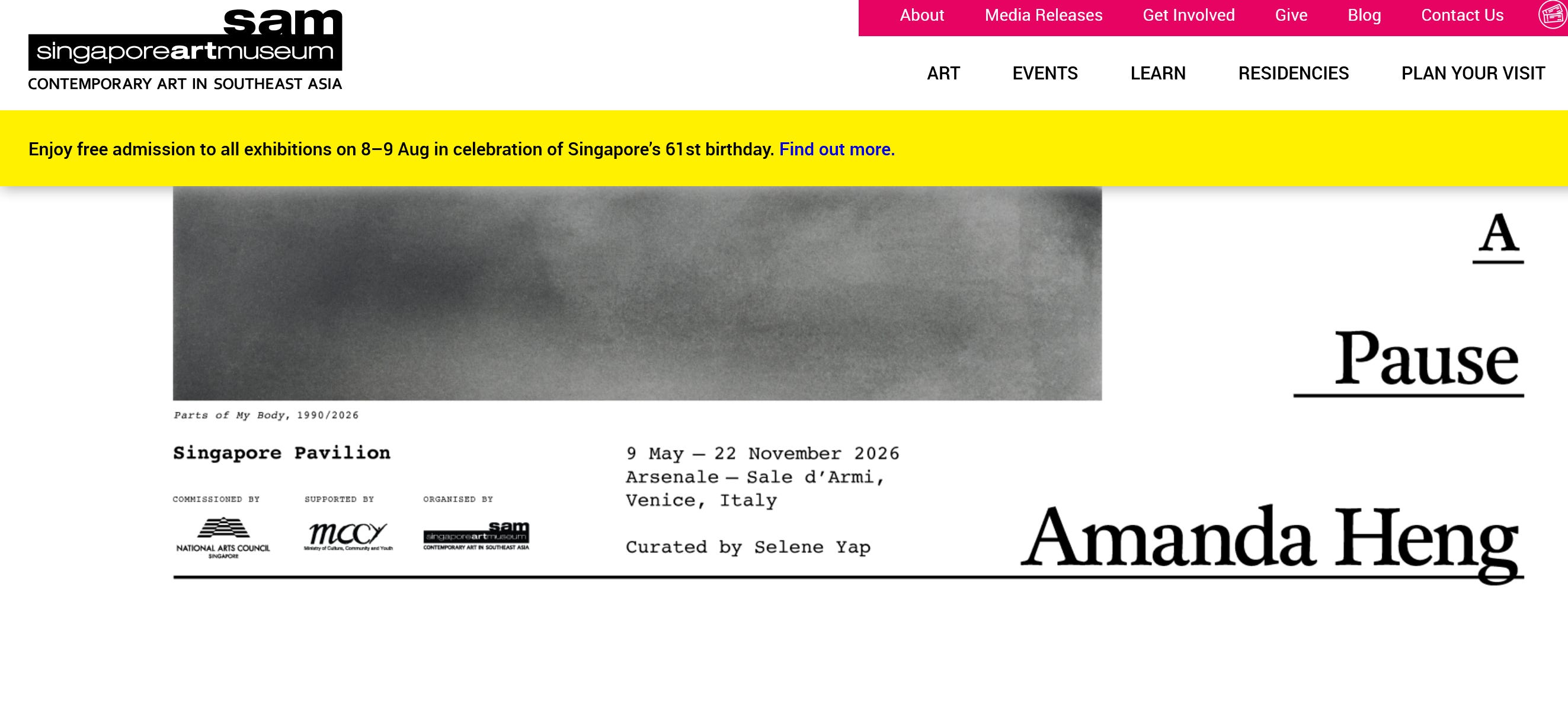
At the world’s largest art contest, where ninety-nine nations compete for attention across the sprawling Giardini and the cavernous Arsenale, the Singapore Pavilion offers something unexpectedly radical: permission to do nothing. Amanda Heng Liang Ngim’s A Pause transforms the historic Sale d’Armi into a gently terraced landscape of low larch-wood steps that rise and fall in shallow increments, each broad enough to sit, recline, or simply pause. There are no prescribed routes, no obvious focal points, nothing to complete, nothing to optimise, nothing to prove. After hours of endurance walking through one of the most saturated exhibitions in the Biennale’s history, visitors encounter a space that asks them to stop. Nothing more, nothing less. It is, by deliberate design, the quietest pavilion in Venice — and arguably one of the most resonant.
The 61st International Art Exhibition of La Biennale di Venezia, running from 9 May to 22 November 2026, is framed by a theme that already carries the weight of posthumous tribute. Titled In Minor Keys, it was conceived by the late Koyo Kouoh, the Cameroonian-Swiss curator who died of liver cancer in 2025 at the age of fifty-seven, before she could see her vision realised. Kouoh’s curatorial statement called for a decisive move away from spectacle: “In refusing the spectacle of horror, the time has come to listen to the minor keys ‖ to tune in to the whispers, the lower frequencies; to find the oases where the dignity of all living beings is safeguarded.” Her proposition was for a Biennale that favoured attentiveness over monumentality, intimacy over grand gestures, and listening over shouting.
That proposition feels especially pointed this year. The Biennale has opened amid considerable geopolitical turbulence: strong protests over Israeli and Russian participation, frictions surrounding national pavilions such as South Africa and Australia, where artists faced censorship over works addressing Israel’s actions in Gaza and Lebanon, and broader institutional strain across the exhibition. Against this backdrop of noise and conflict, Heng’s pavilion feels like an oasis of the kind Kouoh described — a space where the dignity of being, rather than the drama of doing, takes centre stage. Although Heng’s work was conceived before the Biennale’s theme was announced, it aligns so precisely with Kouoh’s vision that one suspects a deeper structural resonance was always at work.
This marks the twelfth presentation of the Singapore Pavilion, commissioned by the National Arts Council (NAC), supported by the Ministry of Culture, Community and Youth (MCCY), and organised by the Singapore Art Museum (SAM). Singapore’s presence at the Biennale has evolved considerably since its earliest iterations. Following a strategic review in 2013, NAC returned to the platform with a dedicated Singapore Pavilion situated at the newly restored Sale d’Armi space within the Arsenale, moving from collateral exhibitions in shared venues to a permanent architectural footprint. Over the years, the pavilion has showcased an increasingly confident range of artistic positions — from Song-Ming Ang’s conceptual sound works to Zulkifle Mahmod’s Banished Book, curated by Haeju Kim in the previous 2024 edition — and A Pause continues this trajectory of growing conceptual ambition, even as it marks a striking tonal departure.
At seventy-four, Heng is the most senior artist to present a solo presentation at the Singapore Pavilion, and only the second woman to do so. Her selection carries particular significance within Singapore’s art ecology. A founding member of The Artists Village (1988) and Women in the Arts (1999), recipient of the nation’s Cultural Medallion (2010) and the Benesse Prize (2020), and inductee into the Singapore Women’s Hall of Fame (2023), Heng is a figure whose career has been inextricable from the development of contemporary art in Singapore. Her Venice presentation is not merely a national showcase; it is the culmination of four decades of sustained, interdisciplinary practice, brought to bear on one of the most visible stages in global contemporary art.
The pavilion’s architectural intervention, designed by Irin Siriwattanagul and Nathaphon Phantounarakul of SP/N in Bangkok and fabricated in larch wood by eiletz ortigas | architects in Ljubljana, draws directly from the urban fabric of Venice itself. A city navigated on foot, Venice is punctuated by small bridges that rise in shallow steps, constantly breaking the rhythm of movement and forcing a subconscious deceleration. Heng and her curator, Selene Yap, have translated that experiential logic indoors. Visitors enter an environment shaped by broad wooden treads that modulate pace and rhythm; movement slows into moments of sitting, leaning, and quiet exchange. The colour palette is almost monastic in its restraint — warm blonde wood against the raw brick walls of the Sale d’Armi — while the lighting design by Phanumas Siriwattanagul creates pools of warm light that suggest intimacy without enclosure. You do not pass through the space so much as settle into it, slowing, sitting down, and lingering longer than you expect.
At the centre of this architectural framework are two bodies of work that ground Heng’s long engagement with the body as both subject and medium. The first, Parts of My Body (1990, reprinted 2026), is a series of nine gelatin silver prints first created thirty-six years ago. These black-and-white close-ups of Heng’s own body — her clavicles, the dip of a hip, a crease in an unspecified joint — are positioned along the stepped wooden structure like bodies at rest, leaning and reclining against the warm wood. The images are direct and unadorned, almost scientific in their treatment of the subject, conveying the sense of a woman’s neutral self-regard and curiosity about her physical form. Printed by Sandra Barnard in Sydney for this presentation, the series traces the beginnings of Heng’s career and its inseparability from the feminist discourse developing in Singaporean contemporary art during the early 1990s, after she left her position as a tax officer in her mid-thirties to study art. They locate a life in continuity through the discipline of looking.
The second body of work, a newly commissioned synchronised double-channel HD video also titled A Pause (2025–26), extends this attention from the personal to the communal. Running for twenty-nine minutes and forty seconds on loop, the video was filmed in collaboration with Venetian participants — Alberto Cancian, Samantha Chia, Francesco Cipollini, Francesca Fassioli, and Bogdan Koshevoy — as they go about the ordinary activities that punctuate daily life: watering plants, preparing breakfast, walking, looking up at the sky. Filmed in real time without intervention by cinematographer Russell Morton, the work follows bodies as they turn inward and move beyond physical form, settling into a quiet, steady pace in relation to their environment. The video resists monumentality and iconic Venetian vistas, attending instead to how stillness is negotiated within dense urban settings and how bodies quietly reclaim their own rhythms. A second channel extends this gaze to Heng’s own body at home in Singapore, creating a visual dialogue between two cities, two contexts of rest.
For art professionals familiar with Heng’s oeuvre, the Venice presentation represents a marked evolution. Since emerging in the late 1980s as part of a pioneering, male-dominated generation of Singaporean contemporary artists, Heng has been known for body-centric works that interrogate gender roles, societal expectations, and lived memory through everyday gestures. Her long-running performance series Let’s Walk (1999–ongoing) was directly inspired by the 1997 Asian financial crisis, when reports emerged that female workers were the first to be fired in Asia and that women were turning to cosmetic procedures to retain employment. Heng responded with a simple but unsettling act: walking backwards through city streets with a high-heeled shoe held in her mouth and only a handheld mirror for navigation. The performance made explicit the connection between patriarchal beauty standards, labour policy, and the constrained mobility of women.
The Singirl series (2000–), which appropriates the iconic Singapore Airlines “Singapore Girl” figure — a demure-sexy advertising icon dressed in a skintight Malay kebaya widely criticised for reinforcing stereotypes of subservient Asian women — further developed this feminist critique. In Singirl Revisits (2011), Heng subverted the image by donning the uniform without makeup, her grey hair woven into two braids, photographing herself against decidedly untouristy Singapore backdrops such as a coffee shop at Joo Chiat and the last surviving kampung at Lorong Buangkok. The Singirl Online Project (2009–) invited women over eighteen to submit photographs of their bare buttocks, creating a body-positive wall of anonymous backsides of all shapes and sizes.
A Pause turns that outward critique inward. Where the earlier work was charged, public, and confrontational — staged in malls, on streets, in full view of passers-by — the Venice presentation is quiet, interior, and contemplative. The shift is not a retreat from politics but a deepening of it. As curator Selene Yap has articulated, “For Amanda, the pause is a form of attention. Pausing is not passive. It’s thinking about how we sustain ourselves and how we continue on – because the pause is actually where the work happens.” The body, which was once a site of protest and provocation, has become a kind of archive — a place where time, memory, and experience quietly accumulate. This recalibration is grounded in Heng’s own life, particularly the years she spent caring for her mother, who died in 2023. As she has described: “I was racing against time – caregiving and making art at the same time. At some point, my body simply couldn’t keep up. That was when I realised I had to find a way to recalibrate.”
Selene Yap, a curator at SAM who was appointed as one of the four curators for Singapore Biennale 2025, brings to the project a practice defined by close, sustained dialogue with artists whose work responds to the contingencies of place, process, and memory. Yap’s recent solo and joint presentations — including shows with Pratchaya Phinthong, Simryn Gill and Charles Lim Yi Yong, Ho Tzu Nyen, and Joo Choon Lin — have been marked by critical engagement and conceptual depth. Her curatorial approach here is evident in the precise calibration of the architectural experience, where every material and spatial decision serves the pavilion’s central proposition: that slowness is not passivity but a mode of active, sustained attention.
The collaborative network behind the exhibition is also noteworthy. The architectural design emerged from a Bangkok-based practice (SP/N), the larch wood fabrication spanned Ljubljana and Venice, and the lighting design originated in Bangkok. Exhibition identity and graphic design was handled by Currency in Singapore, while the accompanying publication — co-published by SAM and Stolon Press with essays by Anca Rujoiu, Lee Weng Choy, Lilian Chee, and anthropologist Souchou Yao, alongside Heng’s own voice – embodies the kind of cross-border, interdisciplinary dialogue that characterises the best national pavilions at the Biennale. The decision to include both an early photographic series and a newly commissioned video work creates a temporal bridge within the pavilion, connecting Heng’s beginnings to her current concerns, and grounding the exhibition in a continuous artistic biography rather than a discrete, festival-driven project.
What makes A Pause compelling for a professional audience is the rigour with which it translates a simple premise “slow down” — into a fully realised spatial, temporal, and conceptual experience. The strength of the work lies not in its novelty but in its honesty. Heng has resisted the pressure to produce a spectacular national statement at the Biennale, choosing instead to extend the logic of her lifelong practice into a new register. The result is a pavilion that feels both inevitable and surprising: inevitable because it grows organically from decades of artistic investigation into the body, care, and everyday gesture; surprising because of the confidence with which it occupies one of the most competitive stages in global art with such deliberate understatement.
The decision to work with Venetian residents in the video component is particularly astute. It situates Heng’s practice not as an imported Singaporean product but as a responsive, site-sensitive engagement with the specific locality of the Biennale. The video does not exoticise Venice or document its landmarks; instead, it mirrors the quiet attentiveness of the pavilion’s spatial design, turning the camera towards the rhythms of domestic life that the architectural intervention invites visitors to share. This relational approach avoids the common pitfall of national pavilions that treat the Biennale as a mere showcase for pre-existing work, and instead generates work that is genuinely embedded in its context.
If there is a limitation, it may be that the pavilion’s restraint, while admirable, risks being too easily absorbed by the surrounding exhibition. In a Biennale where louder, more aggressive installations compete fiercely for attention, a work premised on slowness and subtlety may struggle to register with visitors who have already been fatigued by hours of spectacle. The architectural intervention mitigates this risk to some extent — the stepped structure is physically impossible to rush through — but one wonders whether more explicit visual signposting might have drawn more attention to the conceptual depth beneath the surface calm. That said, this very tension between the work’s modesty and its intellectual ambition is arguably part of its point: in a culture that valorises speed, efficiency, and productivity, pausing is itself a radical act.
A Pause stands as one of the most considered national presentations at this year’s Biennale. It succeeds not through grand spectacle but through the inverse: a rigorous, spatially orchestrated argument about what it means to stop. By translating four decades of embodied, feminist, and socially engaged practice into an architectural experience, Heng and Yap have created a pavilion that rewards the very quality the Biennale most urgently demands: attention. In a year marred by geopolitical noise and institutional conflict, that is no small achievement. The Singapore Pavilion does not shout. It waits. And in that waiting, it says everything.
Detail Information Exhibition A Pause Venue Singapore Pavilion, Level 2, Arsenale – Sale d’Armi, Venice, Italy Dates 9 May – 22 November 2026 Artist Amanda Heng Liang Ngim (b. 1951, Singapore) Curator Selene Yap (b. 1988, Singapore) Commissioner Elaine Ng, National Arts Council Singapore Organiser Singapore Art Museum (SAM) Supported by Ministry of Culture, Community and Youth (MCCY) Artworks Parts of My Body (1990, reprinted 2026), 9 gelatin silver prints; A Pause (2025–26), synchronised double-channel HD video, 29:40 min; A Pause (2026), architectural installation in larch wood Publication A Pause (SAM / Stolon Press, 2026), ed. Selene Yap, with essays by Anca Rujoiu, Lee Weng Choy, Lilian Chee, Souchou Yao
Sources: Singapore Art Museum (singaporeartmuseum.sg); Art Review, May 2026; The Business Times, 6 May 2026; La Biennale di Venezia (labiennale.org); Whitewall, 12 May 2026.
[Written, Researched, and Edited by Pablo Markin. Some parts of the text have been produced with the aid of Qwen, Alibaba, Agent, Minimax, Kimi, Moonshot, and GLM, Zhipu, tools (August 7, 2026). The newsletters were sourced from ARTNews, Artforum, The Atlantic, Bloomberg, CNBC, Deutsche Welle, The Economist, e-flux, The Financial Times, Le Monde, Monocle, The New York Times, Newsweek, Nikkei Asia, Noema Magazine, El País, Rest of World, Radio Free Europe/Radio Liberty, Semafor, The South China Morning Post, The Sydney Morning Herald, and The Wall Street Journal (August 2-4, 2026). The featured image has been created based on the following URL (August 7, 2026): https://www.singaporeartmuseum.sg/art-events/exhibitions/venice-biennale-2026.]
Comments
Nothing yet. Say the first thing.
Sign in to join the conversation.