
👋 Hey, it’s Shaina, and I’m back for another issue of On Work, the weekly letter on independent entrepreneurship, fractional work, portfolio careers, and more.
If you’re new, hi! Welcome. Help me spread the word by sharing with your friends, and please say hello in the comments.
I sit in a happy little seat over here, chatting daily with independent operators from Hello Generalist and Manual Override — portfolio careerists building businesses based on their expertise and passions like fractional work, advisory, coaching, simple product offerings, and so much more.
Most of them came to this work from a first chapter in tech, which makes them natural early AI adopters.
Set aside the 20-year-old vibe coder working all night, and these are some of the most committed AI tinkerers I know (an under-appreciated truth!). A lot of that is plain need. They’re mostly solopreneurs, building several income streams on their own, and the opportunity in front of them is huge — work that used to take a whole team, one person can now do alone. They’re racing toward their vision for success, handing the busywork to AI so they can spend their hours on what they’re uniquely great at.
I’m always inspired when I get to peak at what they’ve stood up, so I asked them to show and tell for you all. Everything was on the table: the internal skills and automations, the customer-facing work, the for-funsies stuff.
Four themes came out of what they shared, each with plenty of examples to be inspired by, all in detail below:
Their business runs on an AI operating system, comprised of context, skills, and automated recurring tasks
They’ve built simple product experiences that they offer to prospects for free, or that they’re selling to customers as part of their business
They keep their hands on the wheel of almost all automations
Beyond business, they’re joyfully dabbling in passion projects that may or may not make money some day, but enrich their lives in the meantime
Here’s our cast for today, in alphabetical order. Work like this wouldn’t be possible without their time and energy, so please thank them by giving them a follow, and checking out their links:
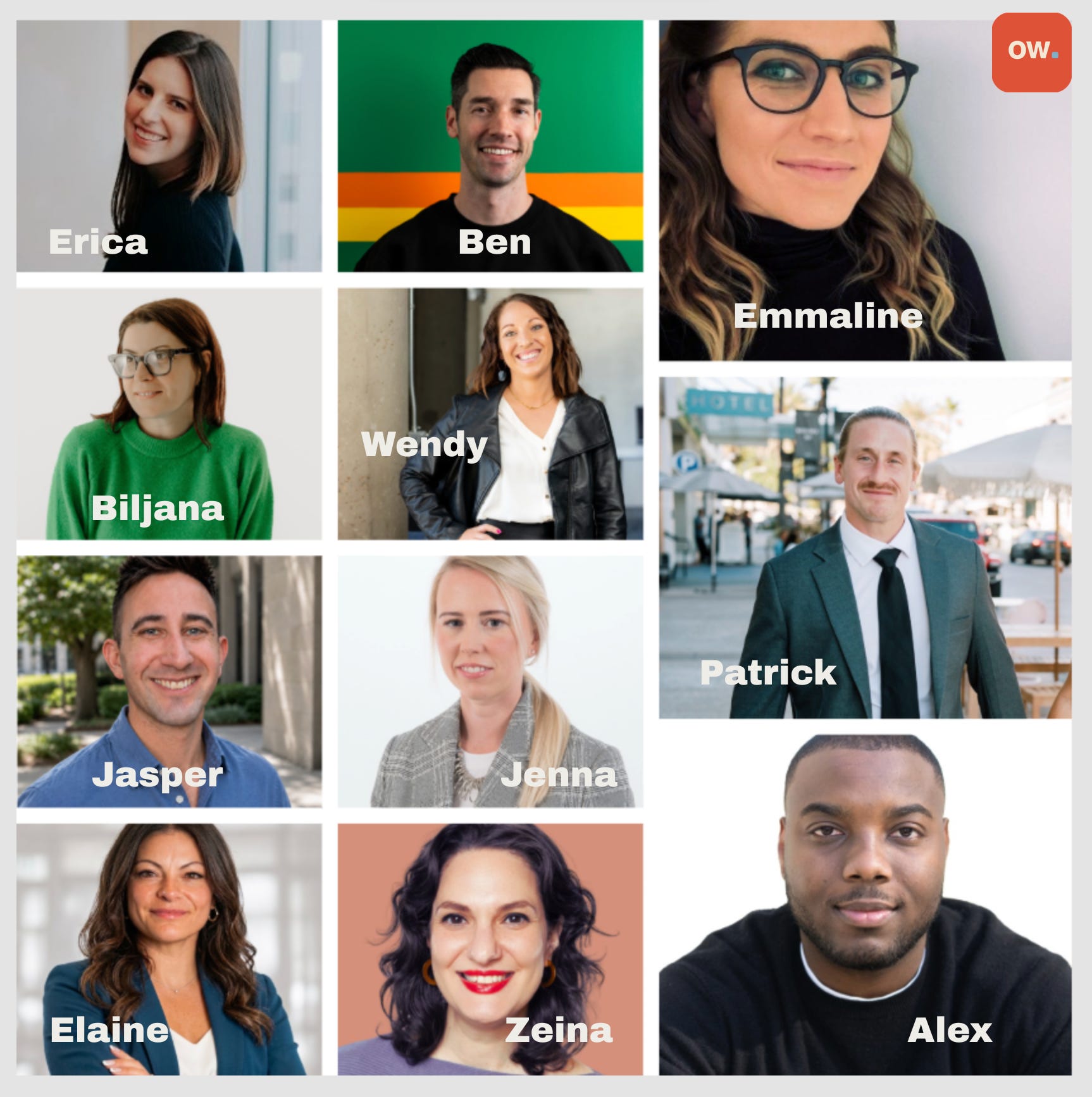
Alex Williamson (LinkedIn · Substack): BizOps and GTM operator. Runs everything from customer acquisition to workforce modeling, investor decks, and compliance for founders building toward a clear end state. Mostly works with early-stage health tech and med device companies.
Ben Levinson (LinkedIn · Startup Craftsman): Fractional operations and GTM, founder advisor, and micro-SaaS builder. Splits his time between operating roles, coaching founders (including accelerator and VC partnerships), and building products of his own.
Biljana Tasetovikj (LinkedIn · The Invisible Rules · The 11th Rule): Building Invisible Rules, a platform helping non-Western talent build successful careers by developing cross-cultural fluency inside global, Western-led organizations. Works with individuals (mostly Eastern Europe and the Balkans) whose careers are stalled by cultural barriers, and companies that want to be globally fluent.
Elaine Adamson (LinkedIn · Elaine Adamson): Fractional HR for when companies scale faster than their HR infrastructure. Heavy on international compliance and HR systems. Works with scaling startups, roughly Series A and up, 50–500 people.
Emmaline Swanson (LinkedIn · Substack): Fractional Chief of Staff and Fractional Compliance operator (regulatory + data privacy/security: SOC 2, ISO 27001, GDPR, CCPA, HIPAA, CMMC), plus advisory for early-stage founders.
Erica McAfee (LinkedIn · ELM Strategy): Founder of ELM Strategy, a fractional finance and ops practice for early-stage startups. Works to hand off the finance and ops founder’s have been doing themselves — with a major focus on delivering AI-native solutions to them.
Jasper Stephens (LinkedIn · JNSQ): 1:1 advising and coaching, network advisory, and curated exec GTM dinners that move pipeline. Works with startups, e.g. SafetyKit (YC, Ribbit, FirstRound), Runway (A16Z), BuildBetter.
Jenna Gaff (LinkedIn · Null Results): 0→1 product builder working across the physical and digital (manufacturing, digital twins), plus AI automation in business operations. Works with early-stage and scaling teams with a manufacturing requirement or automation blocker, primarily in the circular and creator economy.
Patrick Casey (LinkedIn · Tropicali Ventures): Runs Tropicali Ventures as a fractional operator with finance and strategy at the core. Part coach, part operator. Works with Seed to Series B, the funds that back them, and owner-operated businesses, much of it in AI, AgTech, climate-tech, and infrastructure.
Wendy Moore (LinkedIn · Elevé): Founder & CEO of Elevé Talent, an embedded fractional talent partner team (she runs a collective of 8, from Fractional Heads of Talent to Recruiters), hiring across leadership, GTM, ops, product, and eng. Also advises early-stage startups, coaches founders, and angel invests.
Zeina Muna (LinkedIn · Zeina Muna): Fractional customer revenue leader. Embeds part-time across pre-sales through post-sales, connecting acquisition to retention so growth doesn’t leak. Also launching a newsletter for “ambitious humans who don’t know what’s next.”
The 4 themes are opened up below. I’ve included links highlighted like this to live products that you can play with, and, otherwise, dropped in screen shots.
Happy inspiration hunting!
The most universally inspiring builds here are infrastructure for their businesses. Scheduled jobs, custom skills, agents wired into email, calendar, and notes, doing work for them in the background.
At Manual Override, we describe this custom cocktail as your business’ Operating System: A bunch of interconnected AI-ified tools built on top of some sort of context / knowledge base (like a Google Drive folder). It handles select admin work, does things that make your days easier, or helps you deliver work for your customers.
Elaine Adamson — an evening automation system of 3 sequential nightly runs (Evening Debrief, Night-Before-Prep, Nightly Sync) plus a 5pm CRM refresh, built in Claude Code and wired into Granola, Gmail, and Notion. “It’s the operational backbone of my pipeline. It keeps the CRM from going stale while I’m heads-down on client work.”
Patrick Casey — the “Tropicali Business Operating System”: a Google Drive backbone built with Claude that holds every workflow and report, with a 16-agent automation roadmap “allowing a solo shop to operate like a team.” It sits on a broader stack — Claude as his main driver, plus Perplexity, Grok, Granola, Gemini, and NotebookLM.
Alexander Williamson — “Command Center,” a skill that pulls from email, calendar, Slack, Granola, and Notion and runs automatically every Monday. Flags “where I need to show up, what’s at risk, and what slips if I don’t move.” Most useful after a dense stretch of meetings: “Without it I’d spend the next hour reconstructing context instead of doing anything.”
Jenna Gaff — “Mission Control,” a homemade ops backbone built on Next.js, Supabase, and the Anthropic SDK — A CRM running everything from accountability and pipeline to invoicing, investor memos, and placing big bets. “I used Claude design and handed off to an agent team to build it like a dev team would keeping close to debugging etc as the PM.”
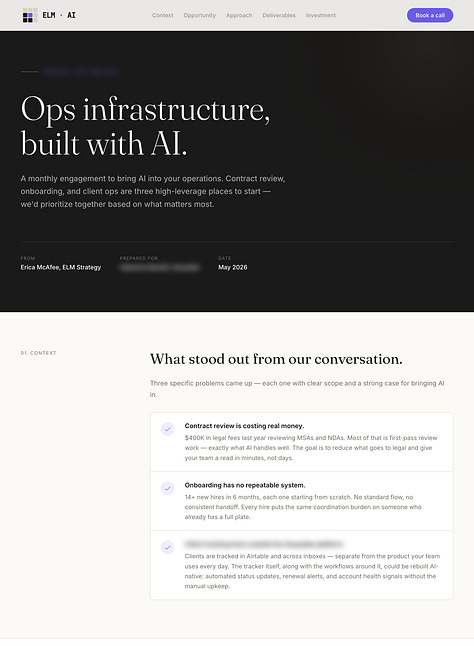
Erica McAfee — "I've built my whole operating system in Claude Code. My internal ops, my client deliverables and how I prospect and send proposals all run through it. I put in a lot of hours creating the pieces behind it, the custom skills and workflows that shape how it works. For a proposal, I take notes in Granola on the call, have Claude research what’s publicly available about the company for context, then describe what I want the founder to see. It builds the page in my design system. I host it and send a private link, password-gated so it’s just for them.”
Biljana Tasetovikj — a weekly accountability skill (Sunday planning with Claude, Friday review), a daily digest tool, and Boswell, a three-part personal intelligence system that synthesizes patterns across her calls and field. “There is a patterns log where I jot down what I notice in myself after calls and key moments, an intel layer that tracks evolving signal on each person I'm in conversation with, and a culture brief that scans the wider field weekly for shifts in the conversation around cross-cultural work and global talent. The three feed into a periodic synthesis that helps me see patterns I'd otherwise miss.”
Zeina Muna — Scale with Soul, an Outbound Pipeline Generator built to solve “the ‘I know I should be reaching out but I don’t know who to start with’ problem.” Built with Lovable, Claude, Apollo, and Supabase; someone called it “its like having your own Head of Sales powered by Apollo.”
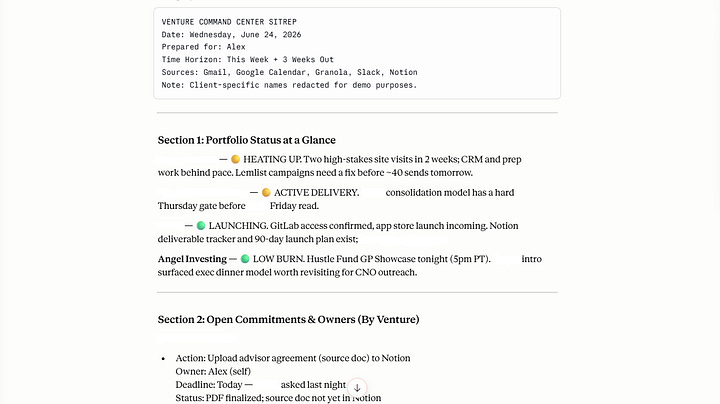
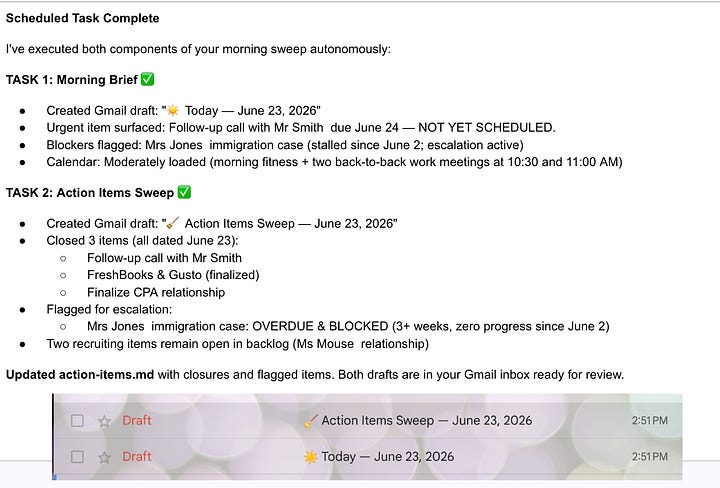
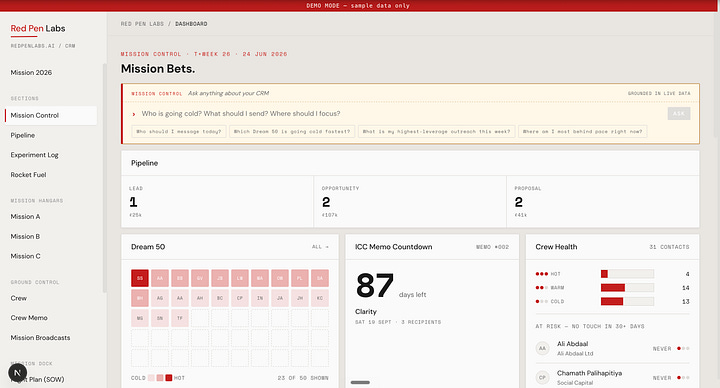
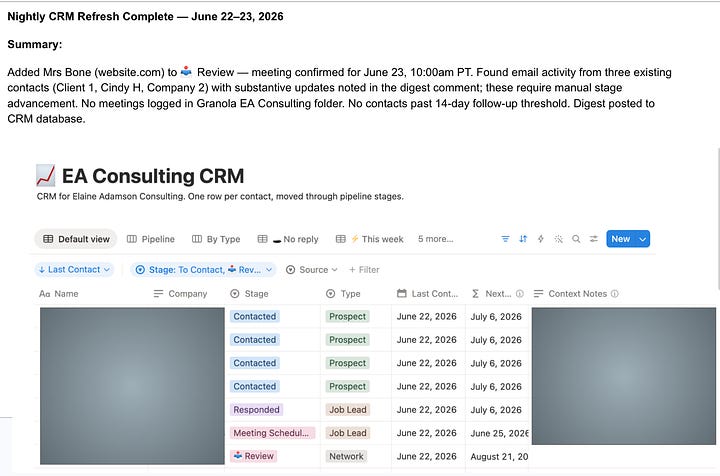
1. Alex's Command Center, 2. Demo from Elaine's daily prep, 3. Jenna's Mission Control, 4. Elaine's Claude-managed CRM in Notion
Maybe my favorite theme: Building products ain’t just for engineers anymore. Operators who have never written a single line of code are building and selling real-ass products. They’re lead gen tools for prospective customers, and are also the very thing they’re selling.
“Big whoop, they vibe coded a thing,” you might say. Uhhhh, do you realize that they’re replacing what tech companies spend millions per year building and supporting?
There’s even a visible ladder of how far people are taking it: from a scrappy build in a day, to productizing the expertise that used to live only in their head, to running a team of AI agents like an engineering manager.
Zeina Muna — Zeina in Your Pocket, a single-file diagnostic she built in a day as a give-value-first entry offer for outreach. "It's a value-first way to start a conversation with a founder before pitching anything. They take the diagnostic, I see the results, we have something real to talk about."
Wendy Moore — NextFive (launching soon), a guided talent-strategy tool that externalizes “a process that has historically lived in my head, in client calls, in working docs, and in years of pattern recognition.” The name comes from teams now “adding five very strategically placed people who can change the shape, velocity, and trajectory of the business.” Built at the Lovable SheBuilds hackathon.
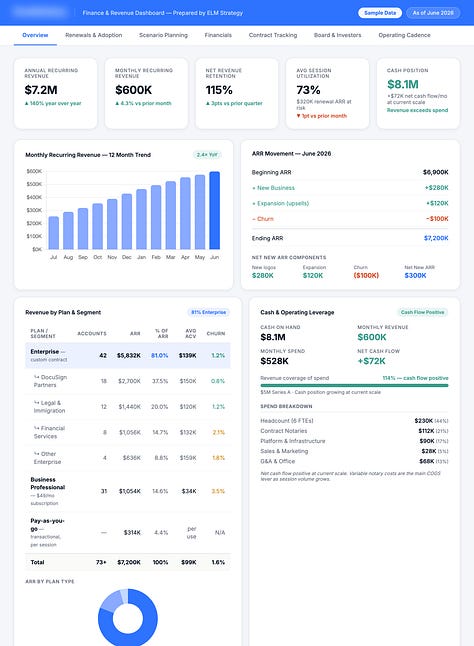
Erica McAfee — For Erica’s finance work, the AI is the deliverable: proposals built in her own design system, password-gated, out in under 24 hours, plus live client dashboards on real numbers “so they’re never waiting on a monthly deck to see where they stand.” More, her FinanceDash serves as a lead gen tool and legitimately helpful thing for founders.
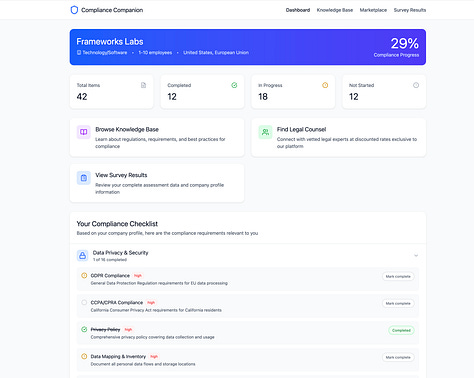
Emmaline Swanson — Compliance Companion, which maps compliance requirements to a specific business and context — e.g. researching “permitting for a parking garage in a particular city and state” and getting back a full requirements list with links to the relevant agency sites for validation. “Internal, for now, but will be an app in the near future.” Built on Claude and Roam Research, prototyped in Figma.
Biljana Tasetovikj — The Invisible Rules diagnostic quiz built into her site: people get a read on their cultural friction points and can book a call right from there. “People take it, get a read on their cultural friction points, and can book a call with me directly from there.”
Ben Levinson — Built a VC client their own operator-network matcher that matches portfolio companies with the most relevant operators based on the specific challenge they’re trying to solve. “The VC team was manually searching through their network every time a founder needed help. This made the process dramatically faster and produced stronger matches.”
For all the automation, no one has handed over full control.
First, the deciding stays human. The AI captures, drafts, and proposes; the person reviews and sends.
Second, on the big stuff, they don’t take the model’s word for it. Over and over, people built their tools with full awareness that AI can’t yet be trusted to be totally right. They’ve grounded the work in real documents and verifiable sources instead.
Elaine Adamson — "The part I'm proudest of is my own manual override: the email-to-myself step where I decide what actually needs to be sent. The AI captures and proposes. I stay the one who decides." She even adds: "Nothing auto-sends. Everything is drafted and waits for me."
Wendy Moore — uses AI “without removing the judgment, nuance, and human connection that great recruiting requires,” and protects “the parts of the work that still require real human judgment.”
Emmaline Swanson — “using AI can be extremely risky because it doesn’t always provide correct information. This app [her Compliance Companion] instead pulls from both my documentation, as well as trusted sources to ensure a high degree of accuracy in the output.”
Alexander Williamson — built research agents because the alternative was “asking a generative model and hoping the answer was real”; now they return “actual metrics I can pressure-test.”
Patrick Casey — keeps NotebookLM “isolated and fed only with the specific documents that inform my company’s positions… a highly trusted source rather than a noisy firehose.”
Jasper Stephens — a proposals-and-contracts Claude project “trained on past contracts.”
Zeina Muna — pulls live contact data from Apollo and Exa rather than letting the model invent it.
The beauty of building a portfolio career: the playground is yours. The same people automating their pipelines are building for their bodies, their families, their gardens — things that may never make a dollar, and don't need to.
Patrick Casey — a hybrid-athlete training agent (a React app wired to his Google Calendar that programs and tracks lifting, running, surfing, and golf), a cluster of smaller models for diet and daily planning, and a dedicated agent whose only job is keeping track of his garden. "I run my personal life the exact same way as my business.”
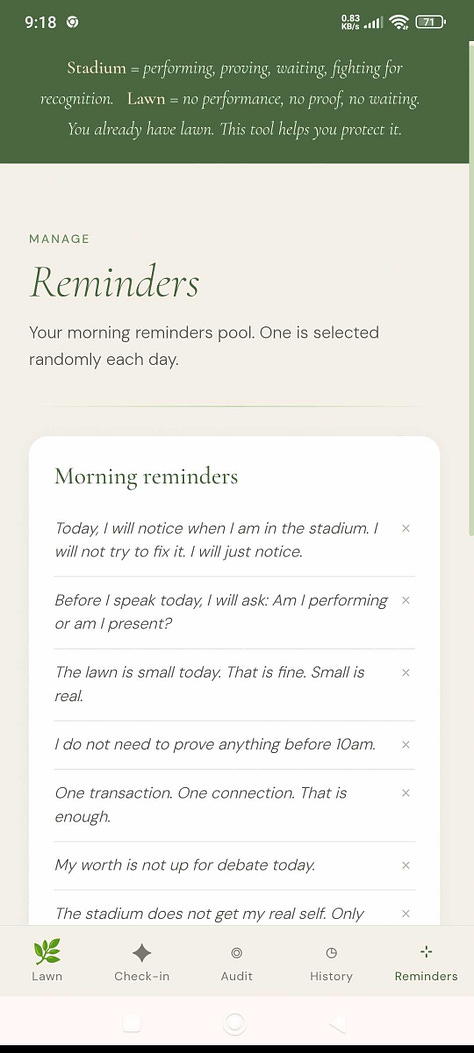
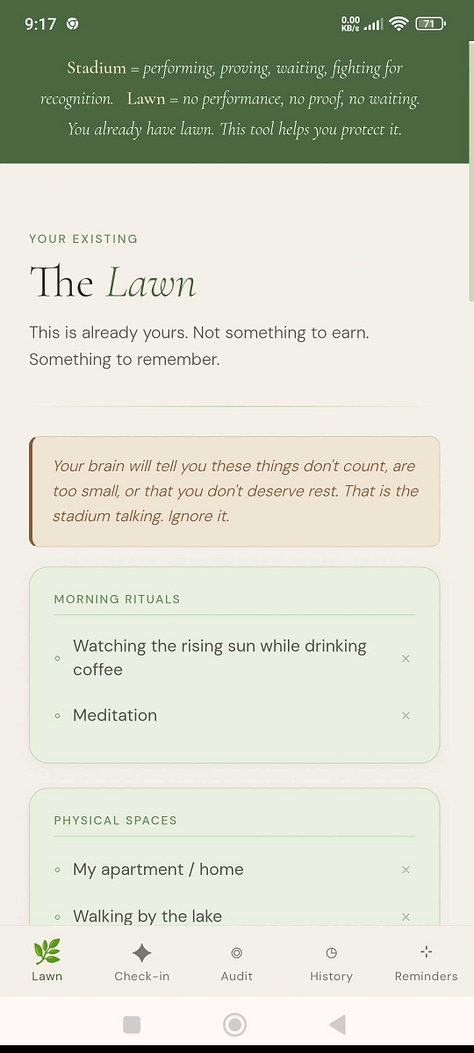
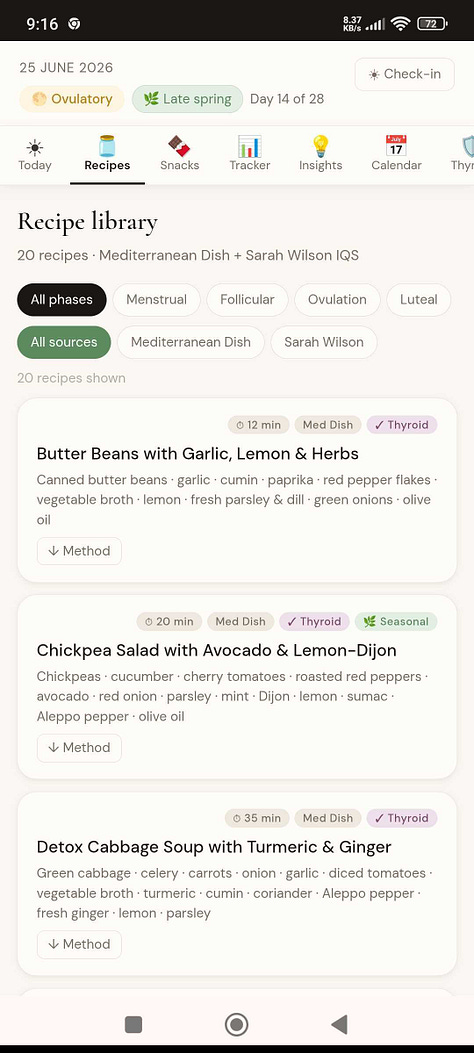
Biljana Tasetovikj — Body Compass, a cycle-synced wellness app tuned to her energy and needs; and Stadium & Lawn, a daily reflection app built on a personal philosophy — “the Stadium is performing, proving, waiting, fighting for recognition; the Lawn is the part of life that asks for none of that, nothing to earn, just something to remember” — that’s become “a living collection of the small true-joy moments that actually fill my tank.”
Zeina Muna — Dear Z, a handmade-mail advice column with a Cube Test personality tool tucked underneath. "I built it because I wanted to see if I could, and because the project deserved a home that felt like it."
Ben Levinson — a first iOS app, for dads: “mostly because it’s a problem space I care deeply about.”
Questions for this crew I can get answered for you? Additions of your own? Ideas this is sparking for you? I’d love to hear it.
Before we wrap, a few shameless plugs. If you’re into the ideas I write about, here’s a few ways for us to work together:
Want 1:1 time with me to talk about building your independent business? I’ll show up judgement free and candid, and make this hour a super valuable one for you. You can read more and book that here.
If you’re a startup who’s curious about fractional hiring, or a startup operations pro pursing fractional work, check out Hello Generalist.
If you’re a fractional, consultant, coach, or other flavor of independent operator wanting to build real sustainability in your business, check out Manual Override. Our Fall 2026 cohort applications haven’t opened yet, but please sign up for updates to hear once we do.
Until next time, Shaina
Comments
Nothing yet. Say the first thing.
Sign in to join the conversation.