
👋 Hey, it’s Shaina, and I’m back for another issue of On Work, the weekly-ish letter on independent entrepreneurship, fractional work, portfolio careers, and more.
If you’re new — hi! Welcome. Help me spread the word by sharing with your friends, and please say hello in the comments.
Before we get into today’s issue — After a truly wonderful inaugural cohort last summer, we’ve officially opened up the second cohort of Manual Override, our accelerator for independent businesses. Now accepting applications for our April 6 - May 15, 2026 group (get em in by March 27!).
If you’re new to working solo, or want to re-energize your practice, join us to supercharge the basics, and find readiness to launch additional revenue streams alongside 25 equally motivated peers. And excitedly, even if you’re an AI newb like me, you’ll walk away with an AI-forward operating system that will help you scale without doing more grunt work.
I’ll share more about Manual Override throughout this next month, but please do reply to this email if you’d like to chat. If you’re feeling ready, apps are due March 27, and free info session links are on the website.
Ok, now onto today’s issue.
Ah, the Generalist conundrum. You’re really quite good at several things, but how do you string a story together that tells that to others? How do you communicate what companies can hire you for without droning on for 23 minutes?
Particularly as more and more Generalists build portfolio careers (I wrote all about it here), the storytelling part — your positioning — is critical to help companies see why you’d be great to work with. While I think this also applies to Generalists seeking full-time jobs, I’ve written this for the fractional, the consultant, the aspiring portfolio builder who aims to work for themselves.
Generalists are meant for this type of work, and I’d say even more prepared than our specialist counterparts to thrive in the AI era. We’re problem hunters, able to dance across sectors and challenges, adept at playing when there’s uncertainty.
Make no mistake — a Generalist still has expertise. Still has depth. But the depth gauge hits big numbers in a few areas, not just one. Perhaps not as deep as our Specialist friends, but unlike Specialists, the Generalist has several expertise spikes, making it downright hard to name precisely what we’re known for.
With positioning work, I like to think of the ultimate goal as a customer looking at you, throwing their hands into the air and exclaiming, “My God! This person was put on earth to help ME! Surely, I must talk to them, and SURELY I must talk to them NOW!” Or at least a more mild mannered version of, “I need to know this person because they solve problems that I have.”
Said simply, the goal we’re after is to make it clear to a particular customer that you and your solution are right for their problems.
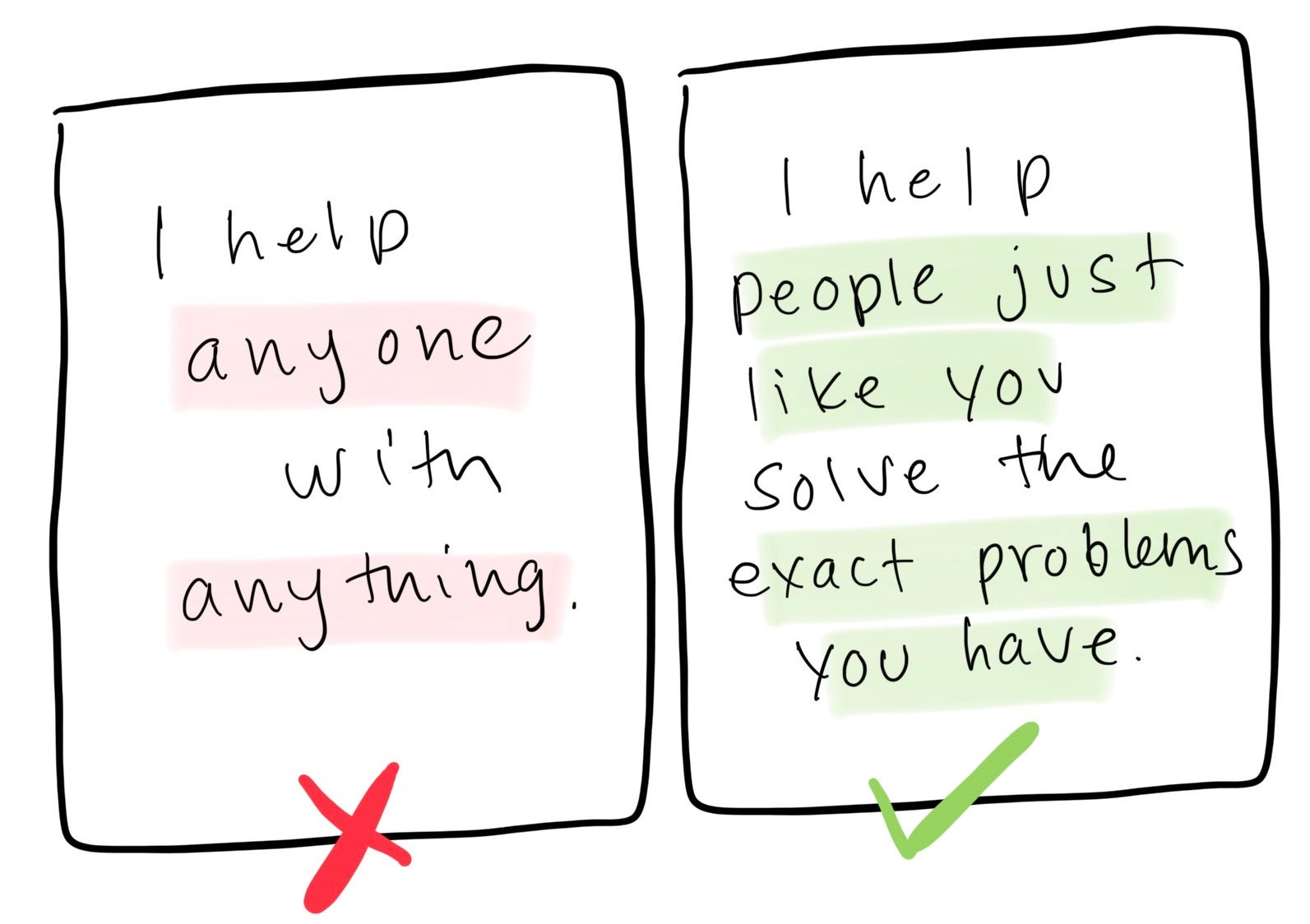
If you were to do the opposite? If you’re offering anything to anyone, you just create more questions — you create uncertainty for a customer. And customers want certainty.
So, yes, I am going to help you find your niche. It will look different than a specialists niche, but it will be a niche nonetheless. (Perhaps this is disappointing to some of you? I hope you’ll read on anyway as you may be surprised.)
We’ll break down the problems Generalists confront on their way to nailing this, and I’ll offer my method for wiggling into a good position without giving up all the goodness that makes you a Generalist in the first place.
This really is my Hair Club for Men moment — I’m a Generalist who’s building an independent portfolio career, and I had to figure this out for myself.
More so, after I did it for myself, I even built a whole-ass company that helps startups hire Generalists fractionally (extra spicy!). I’d go as far as to say that one of the secret sauce ingredients behind HG is our ability to help Generalists find where their skills are a natural, obvious fit in the market.
So, hi, it’s me, not just the President, but also a Client, of the Generalist Positioning Club.
To show you what I mean, before this company building chapter I’m in now, my wiggly career included:
Setting dinner tables on farms around the world for Outstanding in the Field — and leading their Partnerships team, driving work with Coachella, Visa, and RED
Leading B2B Marketplace Operations at Chewse for 5 years, stretching from their Seed stage through Series B acquisition, where I built and lead 3 teams: marketplace supply, food delivery operations, and national expansion.
Slinging food out a food truck window — and helping the small business get off the ground, build a memorable brand, and end up on The Food Network and in the New York Times
Serving as Chief of Staff at Yelp Restaurants during the Covid years
Starting my career in the classical music world: Studied opera in college, lead ops for a top youth orchestra, hosted arts and community events for a beloved community nonprofit foundation
You see what I mean? Kind of ops-y, kind of food-y, kind of entrepreneurial-y.
When I first got serious about fractional work, I was a little confused about how I might formalize my services — there were many paths I could go down, many problems I could solve, many arenas I could work in.
And that was, in part, what appealed to me about working for myself: I could do all this stuff! I didn’t want to niche down! I wanted to be true to myself! Not undersell my abilities! Not forgo my love of working across sectors and problems! Not miss out on something cool!
But I also needed to sell my services. I needed to communicate why I was the obvious, natural fit for a particular customer to hire. I needed to pitch why I’m the solution for their problem. I needed to become a known expert to get the word out.
I needed to pick a lane or sorts. I needed to name it and claim it. I needed to position myself without giving up the diversity of work I wanted.
In order to solve any problem, we need to first name and understand the problem. I think the Generalist Positioning Conundrum has two big ones:
The emotional challenge: Just like I went through, deep in your soul, perhaps just don’t wanna pick one thing. It hurts you to say “I do this” when you know you the truth is that you also, “Do all this other stuff too.”
Maybe you’re feeling fear that you’ll miss out on opportunities you’d be good for, or enjoy doing, if you don’t include that work in your offerings.
The tactical challenge: Put very simple, how do you pick your thing among the many things?! I bet your career highlights look like mine — how do you go about picking the thing you offer?
More, maybe you’re feeling a little insecure that you don’t have enough experience in the one thing to be taken seriously for it. Could you go up against someone who has 20 years experience solely in the thing?
You must confront both.
I’d like to suggest a look-yourself-in-the-mirror moment. An open journal. A chat with your spouse or friend. Any of this resonate? Are there stories you’re telling yourself that might not be true? Are there stories you’re telling yourself that are preventing you from moving forward? Why those feelings might be showing up?
For many Generalists, this is uncomfortable, but courageous and necessary work. Once you’ve recognized the feelings, you can decide to move through them.
Remember, our goal is to help you build a thriving, profitable, independent business where you meet your goals, whatever they might be. And to do that, we need to make it clear to a particular customer that you’re the right person for them.
Shed some light on your own challenges here, and then let us move forward to solving them.
Are you familiar with the Japanese concept of Ikigai? It’s a tidy 4 circle venn diagram that helps you examine 1. what you love, 2. what you’re good at, 3. what the world needs, and 4. what you can be paid for, and explore the intersections between them.
It’s a great exercise!
But for our purpose, I’ll suggest an amended version, the Independent Business Ikigai:
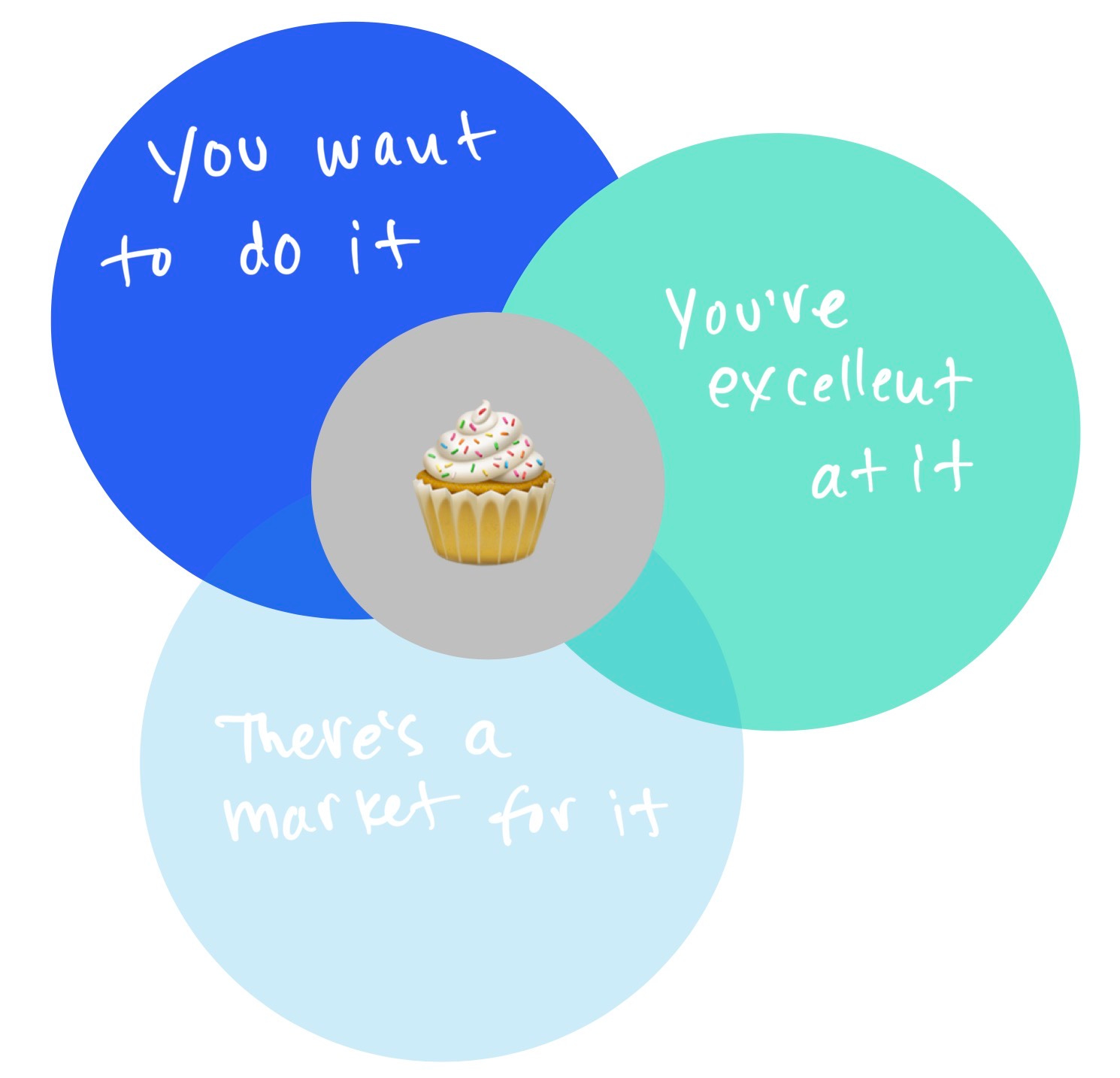
My version asks you to look at 3 things:
1️⃣ What do you love doing and want to do more of? What work lights you up? Fires up your brain, keeps you awake at night tinkering? Make a list of past projects, jobs, hobbies, lessons that fit the bill here.
2️⃣ What are you excellent at, even compared to peers you’ve worked with before? Unique from the above, to answer this one, make a list of the professional work you’ve done that you are exceptional at, even just when compared to immediate peers. A project you crushed. A skill you nail. A category of work
3️⃣ What does the market want? This one is different from the above in that it’s almost impossible to answer on your own. Don thy research hat, and get to work talking to potential customers, seeing what jobs are posted online, brainstorming with your favorite LLM. What burning problems do these customers have that are inside your wheelhouse? What are they willing to spend real dollars on to solve?
Like the original Ikigai, you then examine the intersection. At the center of our venn diagram is the sweet spot of your business — or at least, a few rough frames of what your business could be.
What overlaps do you see? Did it surprise you? Does it feel familiar? My guess is that there are a few pathways that open up.
Cool, so you’ve worked through the above, and you probably have a short list of things in the sweet spot. It’s likely a little jumbled, and it definitely isn’t a “position” yet.
To get there, we need both art and science. We need to take your jumbled list, and through artful examination and prose, end with the elements of our positioning math equation:
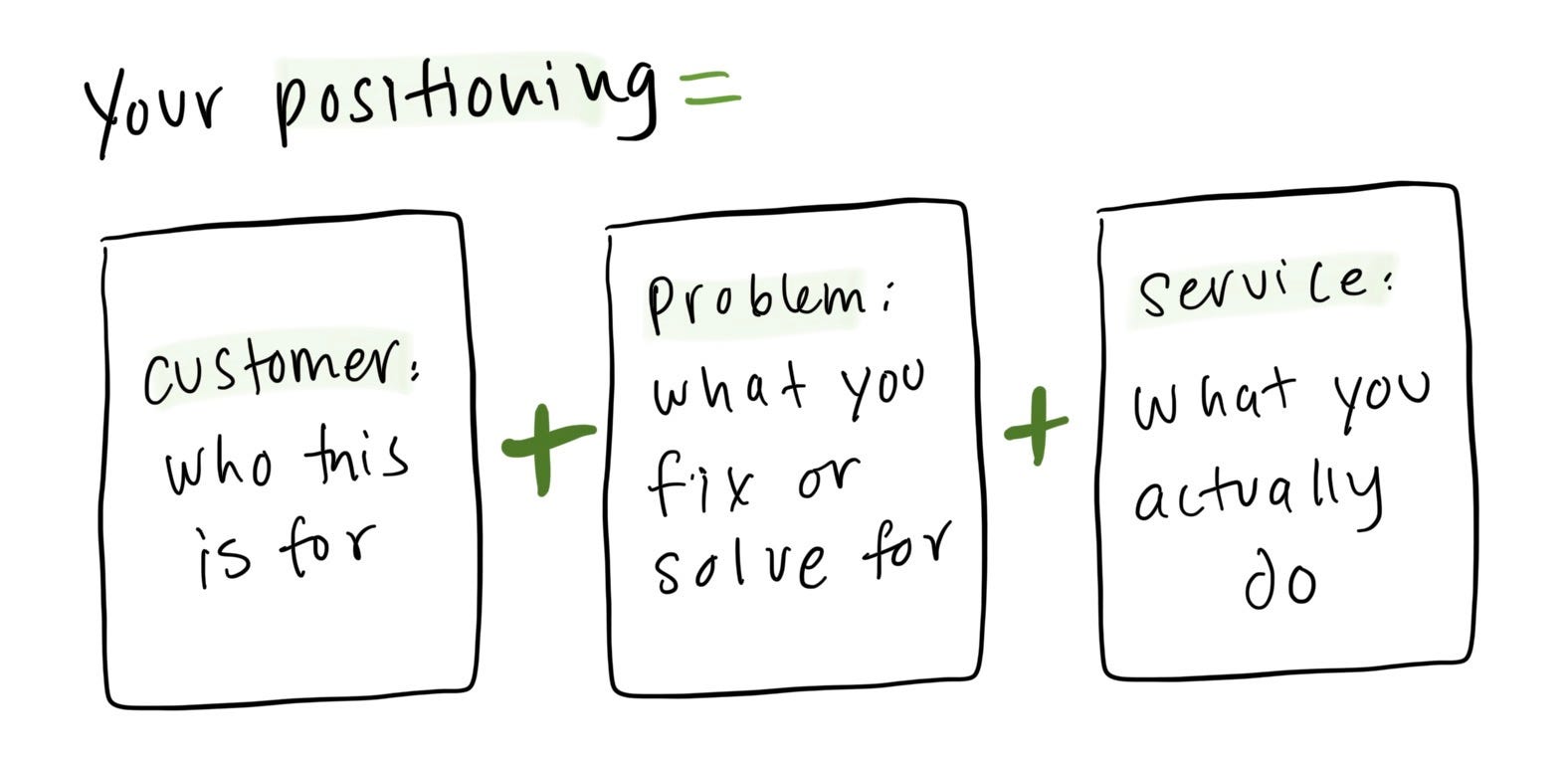
So there’s the science.
On the artful side of things, think of this way: You need a central storyline to weave those inputs above around.
And this is really where Generalists get to shine.
In the old world, you'd have to spend 20 years doing, like, SEO marketing, before anyone would hire you to do it. Your niche used to equal your resume.
But today, I think there are 3 artful ways to tell the story:
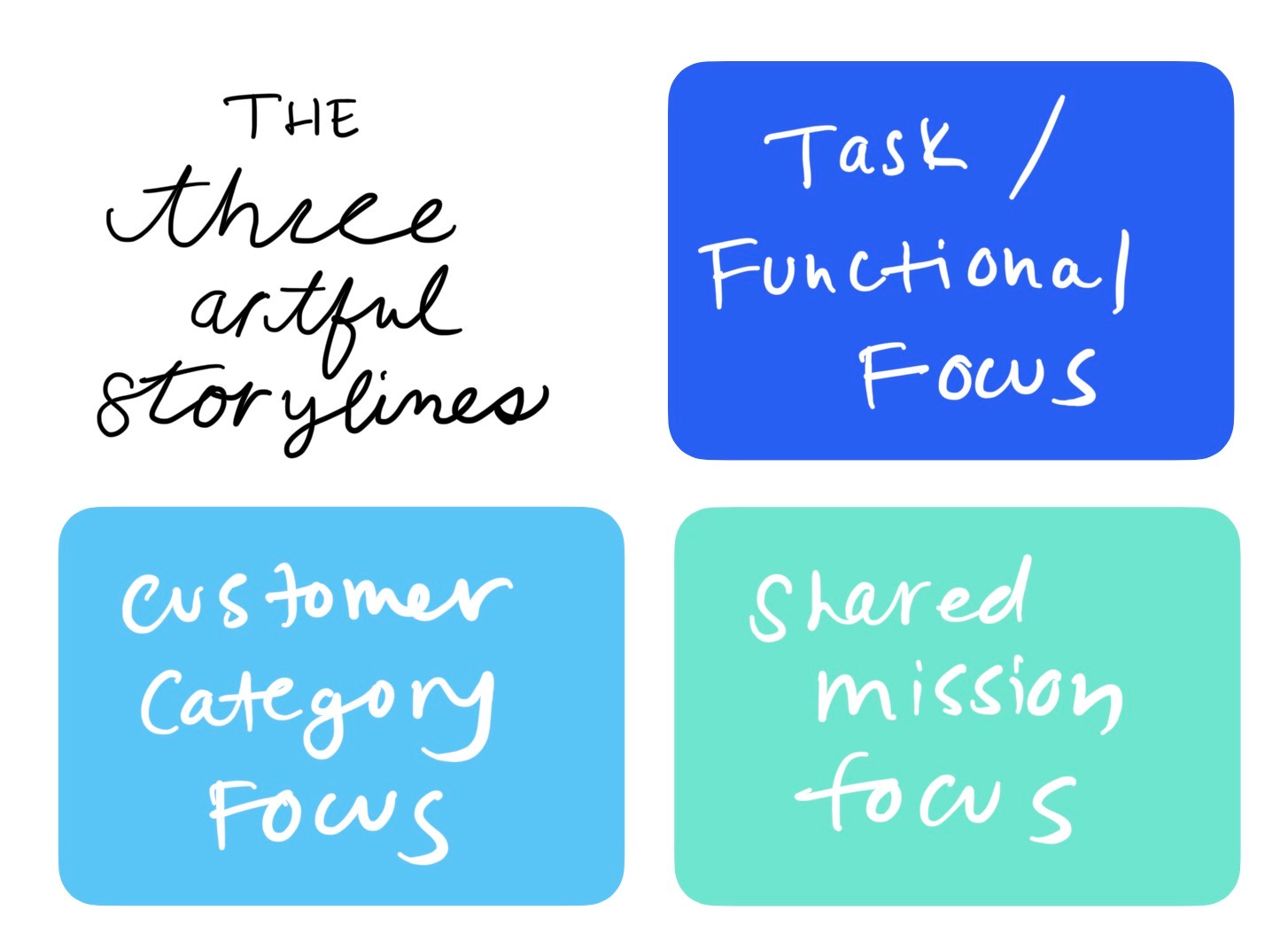
1️⃣ Task / functional focus
“I do SEO Marketing for political organizations.”
“I’m an accountant for SMBs.”
Pick a task you're top 10% great at, and claim it as yours, building the story around the task. Though the task needs to be specific for this to work, you can likely do it for a broad group of customers.
2️⃣ Customer category focus
“I help early stage CPG companies with back-office operations”
“I do finance work for female-founded small businesses.”
For when your resume has a cluster of experiences in a company category or segment, like B2B Marketplaces, early stage MarTech companies, or Pre-Seed and Seed FinTech Startups. Because you’ve had some depth in that segment, you can likely play with a broad set of functional tasks, like “finance” or “marketing,” rather than getting very specific on the task itself.
3️⃣ Shared mission
“Marketing for climate-tech startups.”
“Legal work for companies building at the profit and purpose intersection.”
Some independents are framing their work around a shared mission with their customer, pulling on deep insight from this problem space and storytelling accordingly. Like the above, if you have enough depth in working toward this mission, you could play pretty broad with what you offer.
Try one on for size. When you line these up with the work in your sweet spot, anything emerge for you? Is there a grouping of work that stands out as interesting and true to you? I hope so.
And when you put it in practice, these categories become an anchor for the rest of your positioning math.
To give an example, for my fractional work, I went with a customer category focus. Here’s the (long version) blurb I used to adapt for my pitches:
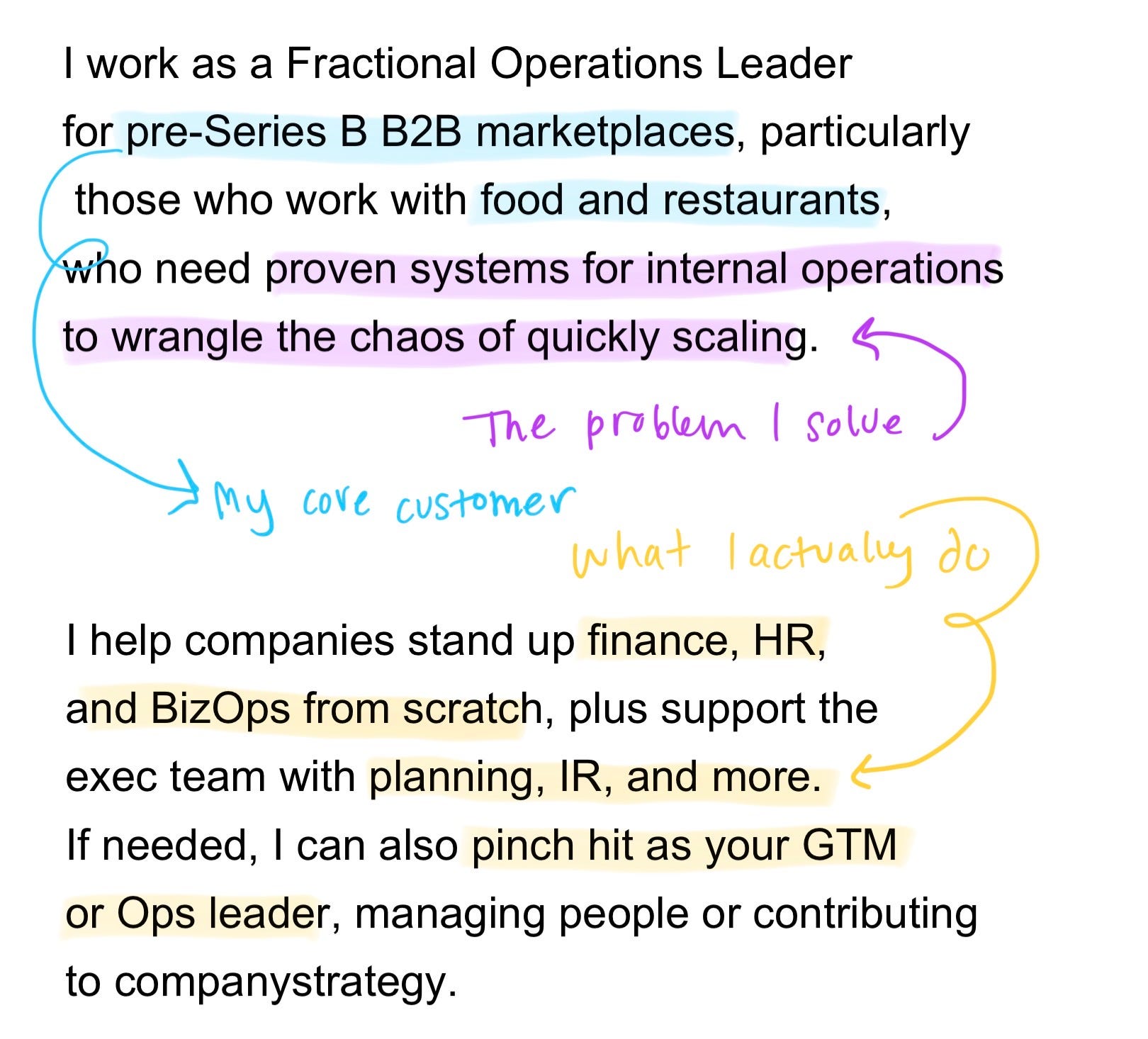
You then get to show why you went this route, using your artful storyline to talk about yourself. I say show, rather than tell, because you want to be specific here, naming instances, resume line items, projects, accomplishments, numbers — anything that feels like proof to why this storyline is right.
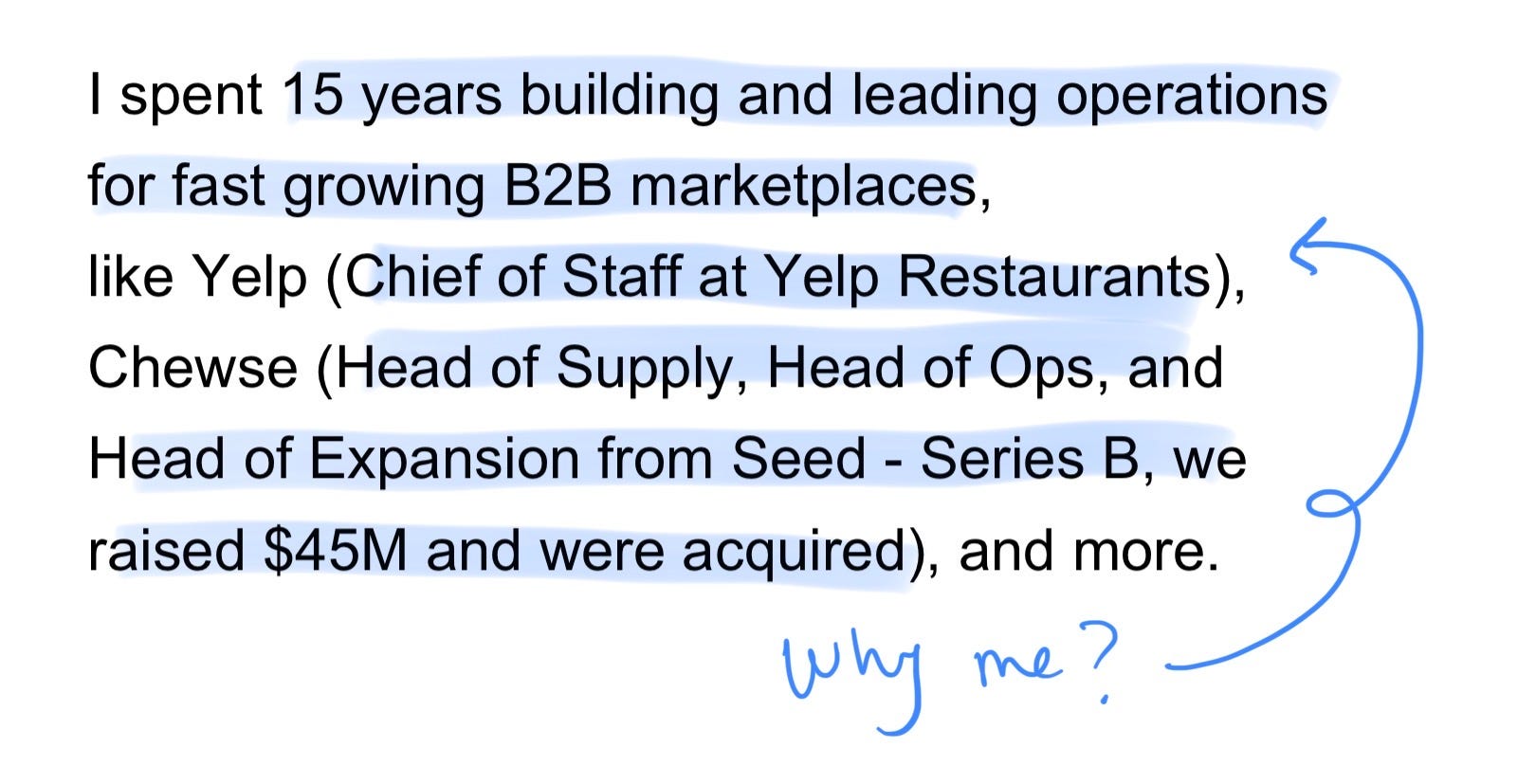
Altogether, the story feels almost obvious, right? Natural? Connected?
And if I continued with this position, you can imagine how all my marketing, all my social posts, and all my case studies would be for this B2B marketplace / food and restaurant customer segment. I would name it and claim it.
If you go back to my original career highlights, do you see how much I cut? Do you see where I’ve made big decisions in each part of the positioning math? Imagine what this would look like if I didn’t use the Customer Focus framing, instead just a smattering of ops work — it would read as unfocused.
With the Focus, I still get to offer a wide range of services, still get to stay true to my goals for independent work in the first place — and this is a vastly different world than our “20 year SEO marketer” lived in.
So, dear Generalist, what say you? A bit closer to a starting point? Feeling more hopeful that you can pull out the work you want to offer and story tell around it? I hope so.
Do let me know in the comments how this goes for you — or if you have another approach!
Before we head out, a few shameless plugs. If you’re into the ideas I write about, here’s a few ways for us to work together:
If you’re a fractional, consultant, coach, or other flavor of independent operator wanting to up-level with AI, community, and a strengthened biz foundation, check out Manual Override.
Want 1:1 time with me to talk about building your independent business? I’ll show up judgement free and candid, and make this hour a super valuable one for you. You can read more and book that here.
If you’re a startup who’s curious about fractional hiring, or a startup operations pro pursing fractional work, check out Hello Generalist.
Be well! Until next time, Shaina
Comments
Nothing yet. Say the first thing.
Sign in to join the conversation.