
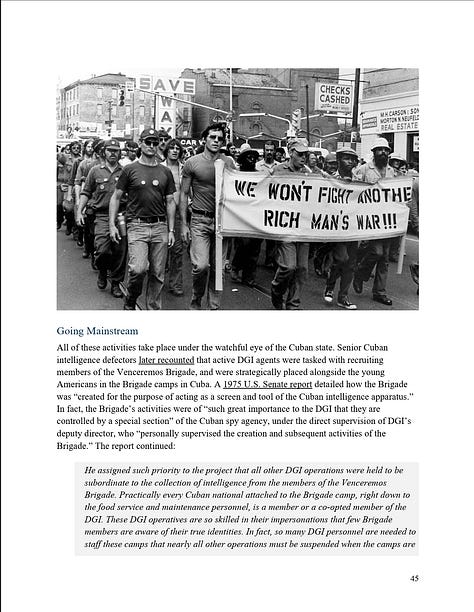
On page 45 of the State Department’s new report, Cuba: The Capital of 21st Century Communism, a black-and-white photograph nearly fills the page.
The veterans in the photograph, identifiable as such with their orderly formation and some wearing pieces of their Vietnam-era uniforms, are marching behind a banner that reads:
WE WON’T FIGHT ANOTHER RICH MAN’S WAR!!!
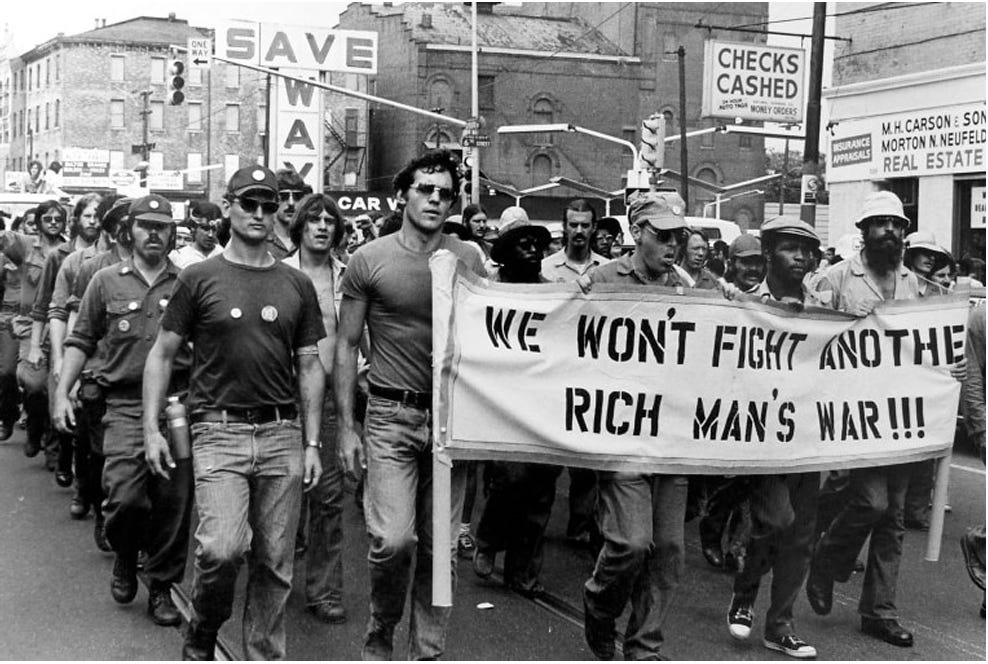
There is no caption.
There are no names, no date, and no explanation of what the photograph depicts. There is no allegation that the men pictured committed a crime, worked for a foreign government, or even traveled to Cuba.
The photograph shows Vietnam Veterans Against the War demonstrating in Philadelphia during the 1976 Bicentennial. They were veterans who had come home from Vietnam and organized against future wars, unemployment, and cuts to veterans’ benefits.
But the State Department dropped their photograph into a section about Cuban intelligence cultivating American political movements. It appears directly above a subsection titled “Going Mainstream.”
The omission of a caption is not an oversight. It is the point.
The report does not have to accuse these veterans of being Cuban agents. The placement does that work through insinuation. It invites the reader to associate antiwar veterans with communism, foreign subversion, and terrorism without ever supplying evidence that would justify that association.
That photograph is the connective tissue between several stories unfolding around us right now: a failing war in Iran, preparations for possible military action against Cuba, an expanding federal campaign to treat antifascism as a domestic terrorist conspiracy, and Republican efforts to intimidate veterans who challenge their policies.
These are not separate developments.
On Tuesday, Defense Secretary Pete Hegseth appeared before the Senate Appropriations Committee to ask Congress for another $67.1 billion for the Pentagon, largely to cover the war with Iran and replenish what the military has already expended.
Hegseth told senators that the war has cost the Pentagon $37.5 billion so far. The administration’s total supplemental request is $87.6 billion. Republicans are considering packages that would spend even more.
Those numbers will continue to climb.
The war began on February 28. At least eighteen American service members have been killed as of the time I’m writing this, including three more whose deaths were announced this past weekend. More than 100 have been injured since fighting resumed less than two weeks ago.
The Strait of Hormuz remains a crisis. Iran is still launching missiles. The Pentagon has been forced to divert money from training, maintenance, and weapons programs to sustain ongoing operations.
The strategic picture is no better.
American intelligence assessments reportedly conclude that additional U.S. strikes are unlikely to significantly change Iran’s behavior or soften its negotiating position. Intelligence analysts describe the United States and Iran as trapped in an indefinite space between war and peace, with continued escalation unlikely to produce a decisive political outcome.
The Pentagon is now running short of money while consuming weapons that cannot be quickly replaced and limiting the training and maintenance required to keep the rest of the force ready.
By the administration’s own stated objectives, this strategy is failing.
Iran can still strike American forces. The administration has not achieved a durable settlement. Not one, but two critical shipping routes remains under threat. American troops continue to die. The military is draining its readiness. And the intelligence community reportedly believes that more bombing will not produce the political change the administration wants.
Hegseth’s answer is more money, more munitions, and more of the same strategy.
As a veteran of the disastrous campaign in Iraq, I have seen this pattern before: political leaders refuse to admit that their strategy has failed, so they ask service members and their families to absorb the consequences of prolonging it.
Then they treat anyone who objects as disloyal.
Congress has never passed a binding authorization for this war.
In June, both chambers approved a War Powers concurrent resolution directing Trump to end unauthorized hostilities. It was a historic rebuke: Congress demonstrated that a measure opposing the war could pass even under Republican control.
But the White House dismissed the resolution as symbolic, and it did not carry the force of law. The war continued. The ceasefire collapsed. More American troops died. The administration resumed large-scale strikes and asked taxpayers for tens of billions more.
Congress cannot declare victory because it passed one resolution that Trump ignored.
Representative Seth Moulton’s H.Con.Res. 93 would direct the president to remove American forces from hostilities against Iran unless Congress passes a declaration of war or a specific authorization for the use of military force. It preserves the military’s ability to defend the United States or an ally from an imminent attack while requiring the president to comply with the War Powers Resolution.
Moulton introduced it with Representatives Jason Crow, Pat Ryan, Chrissy Houlahan, Jimmy Panetta, Jake Auchincloss, Maggie Goodlander, Eugene Vindman, and Bobby Scott. It has been sitting in the House Foreign Affairs Committee since April 28.
It needs to be brought to the floor.
If House leadership prefers another War Powers measure, bring that one to the floor. The point is not whose name appears at the top of the resolution. The point is forcing every representative to state publicly whether they support continuing an unauthorized war.
We are approaching the six-month mark. Americans are being killed. The administration is discussing further military expansion. The Pentagon is running through its money and weapons. Meanwhile, the cost of the war is worsening the affordability crisis facing people at home.
The House is about to leave Washington for a five-week August recess. Lawmakers should not be allowed to pack their bags without telling their constituents where they stand.
Call your representative. Call Democratic leadership. Tell them:
Force another vote on a War Powers Resolution before August recess. Congress has never authorized this war. Put every member on the record before they leave Washington.
You can find your representative here or call the United States Capitol switchboard at 202-224-3121 and ask to be connected.
Our service members cannot leave the battlefield for a five-week recess. Congress should not abandon its constitutional responsibility while they remain in danger.
While the Trump administration struggles to manage the war it already started, senior Pentagon officials have been examining military options against Cuba.
According to reporting from CBS News, planners have discussed a range of possible operations, including an Army-led air assault involving thousands of soldiers from the 101st Airborne Division.
No operation has been approved. Military planners routinely develop contingency options, and acknowledging that matters.
But context matters too.
This planning is taking place while the administration tightens economic and political pressure on Cuba, depicts the island as a forward operating base for Iran, Russia, and China, and publicly discusses regime change. It is also taking place while the State Department constructs an ideological argument that portrays Cuba as the organizing center of nearly every significant left-wing movement in the United States.
Cuba is an authoritarian state. Its government represses political dissent, holds political prisoners, and has conducted real intelligence operations against the United States. None of that should be minimized or excused.
But documented Cuban espionage does not make every American who opposes fascism, criticizes immigration enforcement, supports Palestinian rights, belongs to a socialist organization, or objects to American foreign policy an instrument of Havana.
The State Department report repeatedly blurs that distinction.
It moves from legitimate examples of Cuban intelligence activity to decades-old revolutionary organizations, and from there to modern nonprofits, unions, universities, racial-justice protests, anti-ICE activists, the National Lawyers Guild, Democratic Socialists of America, and “Antifa.”
The report even claims that Cuba’s influence can be found in contemporary events ranging from the protests following George Floyd’s murder to campus demonstrations and the rise of antifascism.
The method is guilt by ideological genealogy.
If a person or organization had contact with Cuba, attended a conference, opposed the embargo, defended someone accused of political violence, or expressed ideas resembling something once promoted by a Cuban-aligned group, the report treats that relationship as another strand in a sprawling network of subversion.
The result is not a conventional assessment of a foreign threat. It is a political dossier on the American left.
The treatment of Vietnam Veterans Against the War shows how this method works.
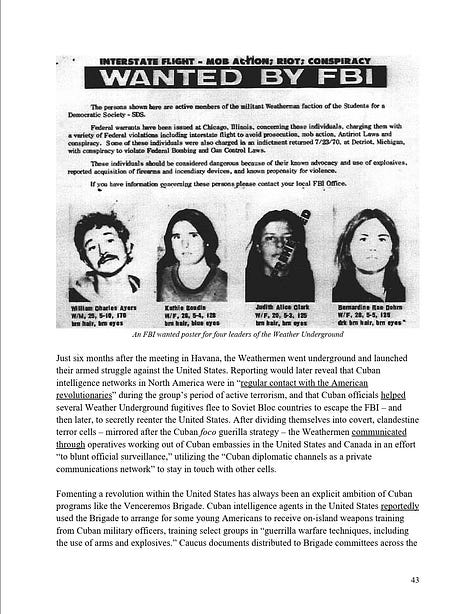
On the page before the photograph, the report discusses the Venceremos Brigade, an organization that brought Americans to Cuba for work projects and political education. It cites a 1975 Senate report claiming that the Brigade sought to recruit American military veterans and turn their training toward the creation of a “people’s militia.”
Then the reader turns the page and sees a wall-sized image of American veterans declaring that they will not fight another rich man’s war.
The report never establishes that the veterans pictured were members of the Venceremos Brigade. It never establishes that they received direction from Cuba. It never establishes that their demonstration was part of a Cuban intelligence operation.
It does not establish those things because it does not need to. The sequencing creates the association.
The actual demonstration occurred on July 4, 1976, when Vietnam Veterans Against the War called veterans to Philadelphia to demand jobs, adequate income, better treatment for veterans, and an end to wars fought for the interests of the wealthy.
Those veterans had firsthand knowledge of what happens when politicians sell a war with false promises and then abandon the people sent to fight it.
That experience gave their opposition credibility.
It still does.
A government waging an unpopular war has an obvious interest in making antiwar veterans appear suspect. If veterans opposing another open-ended conflict can be portrayed as communists, extremists, or agents of a foreign influence network, the administration does not have to answer their arguments.
It can simply treat their dissent as a threat.

The attack on veterans who speak out extends beyond the Trump administration—and beyond veterans protesting war.
The Veterans of Foreign Wars is one of the oldest and largest veterans’ organizations in the country. Its accredited service officers help veterans and their families file claims for VA benefits, free of charge.
Recently, the VFW opposed provisions in House Veterans’ Affairs Committee Chairman Mike Bost’s proposed Take Care of America’s Veterans Act.
The legislation includes several provisions the VFW supports. But it would help pay for those benefits by changing disability ratings for tinnitus and sleep apnea, reducing compensation for future generations of disabled veterans.
The VFW’s position is straightforward: Congress should not make one generation of disabled veterans pay for benefits provided to another.
As part of its “Honor the Contract” campaign, the VFW used a political cartoon showing suited figures labeled “bureaucrats” and “media” pointing rifles at two veterans. Words surrounding the image referred to punishing service, removing benefits, and accusing veterans of waste and fraud.
The VFW has used variations of this firing-squad cartoon since the 1930s to protest attacks on veterans’ benefits. It is provocative political satire. It is not an instruction to commit violence.
Bost nevertheless accused the VFW of promoting dangerous political rhetoric and demanded that it remove the image.
Then Bost and fellow Republican Representative Jack Bergman went further.
On July 1, they quietly sent a letter to VA Secretary Doug Collins asking the department to review the VFW’s accreditation, its representatives’ standing, and its commercial relationships. They claimed the cartoon could be interpreted as “glorifying or normalizing political violence.”
They did not identify a veteran whom the VFW had failed.
They did not identify misconduct by an accredited VFW service officer.
They did not identify an ethical violation in the handling of a benefits claim.
They attacked the VFW’s fitness to represent veterans after it publicly challenged Bost’s legislation.
Whatever label Bost chooses to place on his actions, the sequence is difficult to read as anything but retaliation.
The chairman of the committee responsible for veterans’ affairs used the threat of federal investigation against a veterans’ organization that opposed his policy.
This is the same underlying authoritarian impulse visible elsewhere: disagreement becomes extremism; criticism becomes incitement; and government power becomes a weapon for disciplining institutions that refuse to fall in line.
The VFW is not an antiwar organization. Its members span the political spectrum. Many probably disagree with me on any number of issues.
That is precisely why this episode matters.
Republicans are not only casting suspicion on veterans associated with left-wing movements. They are willing to threaten a mainstream, congressionally chartered veterans’ organization for forcefully defending veterans’ benefits.
First a Republican committee chairman asks the VA to investigate the VFW after it criticizes his bill.
Then the government puts Vietnam Veterans Against the War into a dossier about communist subversion.
The common denominator is not ideology.
It is veterans refusing to remain silent.
If you are eligible for membership, join the VFW.
Organizations respond to their members. Joining strengthens the VFW’s ability to defend veterans, and it ensures that today’s generation of post-9/11 veterans has a voice inside one of the country’s most influential veterans’ institutions.
Whether or not you are a veteran, follow the VFW on social media. Like and share its posts. Amplify its advocacy. Help it reach people outside the traditional veterans’ community.
You do not have to agree with every position the VFW has ever taken to defend its right to speak—and to make clear that threatening its ability to help veterans will carry a political cost.
An attempt to silence a veterans’ organization should result in that organization gaining members, followers, and influence.
The Cuba report is just the latest building block in the growing federal campaign against antifascism.
On September 22, 2025, Trump issued an executive order purporting to designate “Antifa” as a domestic terrorist organization—even though “Antifa” is not a single organization with a membership list, leadership structure, or bank account.
Three days later, Trump signed National Security Presidential Memorandum 7.
NSPM-7 directs federal agencies to investigate not only people suspected of violence but also the organizations, nonprofits, funders, financial networks, and supposed sources of radicalization behind them. It specifically calls for scrutiny of nongovernmental organizations and Americans with foreign contacts who might be investigated under laws governing foreign agents, money laundering, or support for terrorism.
Then, on December 4, Attorney General Pam Bondi issued a memo implementing NSPM-7.
Bondi ordered every federal law-enforcement agency to review its files for “Antifa and Antifa-related” information and deliver that material to the FBI.
The memo directed the FBI and Joint Terrorism Task Forces to compile lists of organizations, map relationships and funding networks, develop informants, solicit tips, and consider statutes ranging from RICO and material support to tax crimes.
It also identifies political ideas as potential characteristics of the threat. Those ideas include opposition to immigration enforcement, anti-capitalism, what the administration calls “anti-Americanism,” and an “anti-fascist” political platform.
Read those documents together and the sequence becomes clear:
First, identify a disfavored political ideology.
Then search government files for people associated with it.
Map their organizations, lawyers, donors, and relationships.
Look for a foreign connection.
Then find crimes to charge.
The Cuba report supplies the missing foreign narrative. It depicts American antifascists and other left-wing movements as the present-day descendants of a network cultivated by a hostile communist government.
It turns political disagreement into a national-security threat.
This machinery to bring the full force of the federal government against antifascists is already in motion.
On June 23, the Justice Department announced that eight defendants in the Prairieland ICE detention-center case had received a combined 450 years in federal prison.
It is important to describe what happened honestly—and completely.
During the July 4, 2025, confrontation, Benjamin Song fired a rifle and shot Alvarado Police Lieutenant Thomas Gross in the neck. Gross survived.
The government was entitled to prosecute that shooting and require a jury to determine criminal responsibility. But the jury was not permitted to consider every defense the defendants wanted to present.
The defense sought to argue that Song fired in self-defense or in defense of another person after Gross arrived with his weapon pointed toward someone who was fleeing.
Before the jury could evaluate that theory, U.S. District Judge Mark Pittman granted the government’s motion prohibiting the defendants from claiming self-defense or defense of a third party.
Prosecutors argued that the defendants had provoked the police response by shooting fireworks and damaging property. They relied on precedent arising from the federal confrontation with the Branch Davidians in Waco, in which an appeals court ruled that defendants who initiated a confrontation could not later claim self-defense against the resulting law-enforcement response.
Judge Pittman ruled that Gross pointing his gun at a fleeing person was not excessive force as a matter of law because Gross did not fire first. Gross, however, testified that he had not seen or heard the fireworks when he arrived.
This does not establish that Song acted lawfully. A self-defense argument might still have failed if the jury had been allowed to consider it.
But it is inaccurate to describe the verdict as if jurors heard that defense, weighed it against the government’s evidence, and rejected it. They were barred from treating self-defense or defense of another person as a legal justification.
That procedural history matters when evaluating the extraordinary sentences that followed.
Song was convicted of attempted murder and sentenced to 100 years. Five other defendants received 50 years each. Maricela Rueda received 70 years.
Attorneys for some of the non-shooting defendants said they were not involved in planning the shooting, did not carry firearms, or left before the violence occurred.
Daniel Sanchez-Estrada received 30 years even though he was not at the detention center and, according to his attorney, was not involved in planning the demonstration. He was convicted of document-concealment charges after moving a box containing artwork, journals, poetry, and political zines following a telephone call from his incarcerated wife.
During sentencing, federal prosecutor Frank Gatto said:
“People with that kind of extremist beliefs need extra time in prison.”
That sentence should alarm anyone who believes the government should punish criminal conduct rather than political belief.
The Justice Department called Prairieland the first sentencing of defendants “affiliated with Antifa” since Trump issued his executive order. FBI Director Kash Patel used the announcement to promise that the Bureau would dismantle “Antifa and its funding networks across the country.”
Then the State Department’s Cuba report folded Prairieland into its larger story.
The report cites the National Lawyers Guild’s public support for the defendants as evidence of coordination between the Guild and “Antifa.” It then uses the Guild’s historical relationship with Cuban causes to connect the entire supposed network back to Havana.
The Guild’s initial description of the Prairieland confrontation as a typical pro-immigrant protest was deeply inadequate. A police officer was shot, and acknowledging that is not optional.
But acknowledging the shooting does not require us to ignore a barred defense, extreme sentences for people who did not fire a weapon, the use of political literature as evidence, or a prosecutor’s demand for additional imprisonment based on “extremist beliefs.”
Nor do lawyers defending unpopular people, organizations criticizing severe sentences, and activists possessing political literature thereby become participants in a foreign-backed terrorist conspiracy.
The administration is using an identifiable act of violence—whose complete circumstances the defense was not allowed to argue—to justify investigating an entire political ecosystem: protesters, lawyers, nonprofits, researchers, donors, book clubs, and anyone else who can be placed somewhere on the resulting map.
That is how prosecuting conduct becomes criminalizing a movement.
In his latest New York Times column, Jamelle Bouie argues that Trump’s attempt to revive Cold War-era fear of communism is unlikely to succeed as an electoral strategy.
I think he is right.
For millions of younger Americans, the “communist threat” is an abstraction from a world that ended before they were born. Calling every Democrat a communist does nothing to address rent, health care, wages, or the cost of groceries. Many Americans are less hostile toward socialism—and less enamored with capitalism—than previous generations.
Trump’s rhetoric is stale, derivative, and disconnected from their lives.
But an unpopular political message can still be a powerful instrument of government repression.
The term “communist” does not have to persuade a 25-year-old voter to give federal agencies a pretext for surveillance. It does not have to win a debate about housing costs to help prosecutors characterize a book club, nonprofit, or protest network as part of a foreign influence operation.
Bouie briefly notes that the administration is wielding the specter of communism as it makes plans for Cuba. The State Department report shows the other half of that project: Cuba gives the administration a foreign government to place at the center of its theory about domestic dissent.
That foreign nexus matters.
It allows officials to recast American political movements as security threats with overseas direction, support, inspiration, or financing. It creates potential pathways to counterintelligence investigations, financial surveillance, Foreign Agents Registration Act cases, material-support prosecutions, asset freezes, tax investigations, and terrorism enhancements.
This is what separates ordinary campaign name-calling from a functioning Red Scare.
The rhetoric may be ridiculous to much of the public. The investigative files, retaliation, prosecutions, and prison sentences are not.
Reject the false choice between condemning violence and opposing authoritarian repression.
We can prosecute the person who shot a police officer without treating political literature as contraband.
We can condemn the Cuban government’s repression without supporting an American invasion.
We can care about Iranian civilians and the American troops being sent into an open-ended war.
We can oppose fascism lawfully, strategically, and in community without becoming the fictional terrorist organization that Donald Trump needs “Antifa” to be.
Here are four concrete actions:
Find your representative or call 202-224-3121.
Tell your representative and House Democratic leadership to force another vote before August recess on Seth Moulton’s War Powers Resolution or an equivalent measure.
Congress has never authorized this war. Every member should be required to tell voters whether they support continuing it before leaving Washington.
If you are eligible, join the VFW.
Veteran or not, follow the organization through the social-media links at VFW.org. Like and share its posts. Amplify its campaign to protect future veterans’ disability benefits.
Make Mike Bost’s attempt to intimidate the organization backfire.
At VeteransFightingFascism.org, we have published free guides on how to start an antifascist book club and how to be antifa.
Being antifascist is not about joining a centralized organization. It means learning how authoritarian movements operate, protecting targeted neighbors, defending democratic institutions, and organizing responsibly in your own community.
I wrote the introduction to a new collection of Major General Smedley Butler’s writings, War Is a Racket.
Butler was a two-time Medal of Honor recipient who became one of America’s most forceful critics of war profiteering. He fought for veterans who had been denied promised benefits and warned that wealthy interests would exploit veterans to advance fascism at home.
I wanted to introduce Butler’s antiwar, antifascist, and pro-veteran organizing to a new generation.
I wish his warnings were becoming less relevant.
Instead, the Trump administration is burning through lives and billions of dollars in Iran, considering military options for Cuba, and placing a photograph of antiwar veterans inside a government dossier about communist subversion.
Meanwhile, Republicans are threatening the ability of the VFW to help veterans because the organization criticized legislation that would reduce future veterans’ benefits.
The veterans in the State Department’s photograph had it right.
We will not fight another rich man’s war.
War is a racket.
Antifascism is patriotism.
Thanks for reading On Offense with Kris Goldsmith! This post is public so feel free to share it.
Comments
Nothing yet. Say the first thing.
Sign in to join the conversation.