
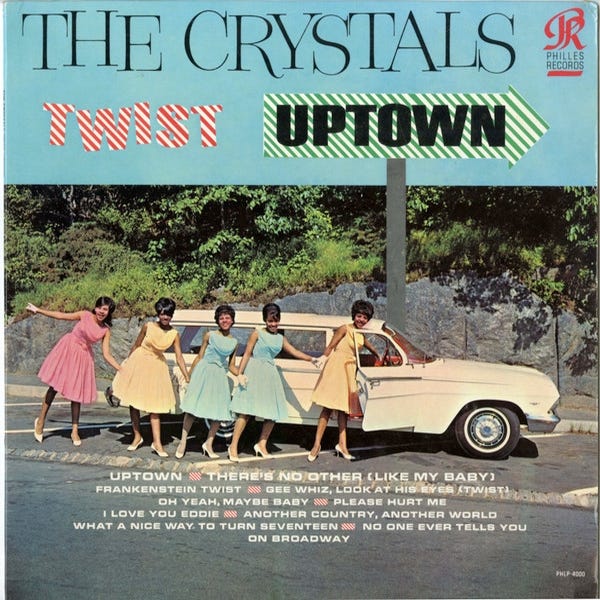
Tracks: 1) Uptown; 2) Another Country – Another World; 3) Frankenstein Twist; 4) Oh Yeah, Maybe Baby; 5) Please Hurt Me; 6) There’s No Other (Like My Baby); 7) On Broadway; 8) What A Nice Way To Turn Seventeen; 9) No One Ever Tells You; 10) Gee Whiz Look At His Eyes (Twist); 11) I Love You Eddie.
REVIEW
Like so many other girl groups of the early Sixties from the NYC area, The Crystals were largely a vehicle, with little to no agency of their own; I don’t think that even the average Sixties’ pop lover typically remembers any of their names — but here is the original 1961 line-up, just in case: Barbara Alston (lead singer on most of the early recordings), Mary Thomas, Dee Dee Kenniebrew (the only constant member from start to finish), Patsy Wright, Myrna Giraud (the first member to be replaced already in 1961, by La La Brooks (who would go on to sing lead vocals on the later hit singles). Brooklyn was their natural habitat, and quick oblivion would probably have been their destiny, if not for the oddest of accidents that somehow turned them into the torch-bearers for an entire new sound for their generation.
As the story goes, the group was put together by Benny Wells, a wannabe «talent manager», who recruited his own niece, Barbara Alston, and several of her friends to put together a presumably standard neo-doo-wop combo, with the aim of making a few recordings and singing at local weddings and parties. The brother-in-law of one of the girls (Patsy) was Leroy Bates, a small-time songwriter in Brooklyn, who offered them a fresh composition of his, ‘There’s No Other (Like My Baby)’, which they somehow ended up rehearsing inside the midtown Manhattan office of the Hill & Range publishing company — Wells got them there through his personal acquaintance with some of the local songwriters — and that, on some bright day in March 1961, was when they were overheard by Phil Spector, who had a part-time job as a talent scout for Hill & Range at the time.
As of early 1961, Spector’s highest moment of glory still remained his original recording of ‘To Know Him Is To Love Him’ from 1958, which he made as a 19-year old lad with his first vocal group, The Teddy Bears. He had already realized that his true future lied with studio production rather than performing or even songwriting (though he would never be above adding his name to the songwriting credits of any juicy material that came into his hands), but most of his activities in that sphere around 1959–1960 were baby steps and training moves: of everything he did in that period, I think we mostly remember his contributions to Ben E. King’s beautiful recording of ‘Spanish Harlem’ (co-written and co-produced with Leiber & Stoller, who briefly acted as Spector’s spiritual guides in the complicated musical business of New York City). Like many other aspiring producers with big ideas at the time, he desperately needed his own set of guinea pigs, but the first artists he got to work with were either already established acts in their own rights — Ray Peterson, Ruth Brown, etc. — or not sufficiently gifted to implement any of his ideas in the right way.
The Crystals, on the other hand, turned out to be perfect, at least for the time being: a bunch of young girls with no true experience or confidence to speak of, but with a good amount of vocal talent and the capacity to harmonize and belt that could rival everybody else at the time, be it «veterans» of the scene like The Chantels or feisty newcomers like The Shirelles (Motown was not yet a serious contender in early 1961, as its first major girl group hit, ‘Please Mr. Postman’, would not be issued until the fall of that year). Already with his very first recording with them, Phil demonstrated his power when he urged them to remake the original upbeat version of ‘There’s No Other’, slowing down the tempo to add a monumental, church-like quality to the recording, which neither the girls nor Leroy Bates probably could not have anticipated.
In all honesty, it’s not a particularly great composition. The chord progression is standard fare doo-wop, the lyrics are trite, the rhyming schemes are as generic as they come (”there’s no other like my baby, don’t mean maybe“) and all of the song’s secrets are spilt over the first thirty seconds. Amusingly, the only cover version of it that I am aware of is the Beach Boys’ half-drunk rendition on the pseudo-live Party! album from 1965 — which proves that they must have been under its spell back in 1961, but also that this kind of style would be much perfected by Spector’s later work with The Ronettes. Yet even so, the song managed to climb into the top 20, as it was clear there was something quite special about it. It might help to put it in the context of some of Spector’s most obvious influences — the string-laden Leiber-Stoller-produced hits by The Drifters, the gospel-influenced Chantels classics like ‘Maybe’, etc. — just to see more clearly that spirit of monumentality Spector was already going for: slowing down the tempo allows him to place as much emphasis as possible on the ecstatic choral vocals and the epic reverberating strings, amplifying the simple, but seductive message of the song ten-fold. In YouTube comment style, this would have boiled down to something like: “Hey Mr. Spector, do you want a deeply intimate prayer or an all-out loud stadium anthem?“ – “YES“.
Honorary mention goes to the single’s B-side: ‘Oh Yeah, Maybe Baby’, credited to little known songwriter Hank Hunter with Phil again adding his name to the credits — its most distinctive element is probably the bombastic drum pattern with its echo splash, again presaging the big drum component of the «wall of sound». On the whole, it’s even more reminiscent of the Ben E. King era Drifters hits, what with the faster tempo and the Latinized rhythms, but there is a much sharper contrast between the bombast of the instrumentation and the sweet vulnerability of the lead vocal — in fact, both on this and many subsequent songs by the group there is often an impression of the helpless girls drowning in a sea of passionate turbulence: the playing and singing may be a bit more homebrewn and rough around the edges than the slick, ultra-professional sound of Atlantic Records, but there’s much more drama that way, and in 1961, rough drama always got the upper hand on smooth professionalism.
The next single, however, raised the stakes on the drama angle even higher. ‘Uptown’ was one of the first songs co-written by the fabulous duo of Barry Mann and Cynthia Weil (yes, from those happy days when «corporate songwriting» could still be a respectable profession) and also one of their first attempts to inject a little social consciousness into the generally toothless world of pop — apparently, they wrote it about a Hispanic couple, with the husband suffering from oppression and discrimination at the workplace (”where everyone’s his boss and he’s lost in an angry land“) but rewarded with a bit of loving family bliss back at home (”then he’s tall, he don’t crawl, he’s a king“). The setting explains certain things about the arrangement, such as the bits of flamenco acoustic guitar in the verses — although it also sort of fits in the overall trend of merging Latin and African-American elements in black pop music at the time (see ‘Spanish Harlem’ and all of those other Latin-tinged hits by Ben E. King).
In any case, Spector allegedly modified the original lyrics in such a way that they would better fit a black perspective, and off they went. This was a completely different turn for the band: a juxtaposition of a grim, minor-key verse melody and an explosive, major-key upbeat chorus that eventually ends up absorbing and swallowing the depressing melancholy of the verses in a «love conquers all» framework. Suddenly The Crystals end up having more than one dimension, and becoming arguably the first young girl group to remind us that escapism into rosy clouds can work so much better if you are first explicitly reminded of where exactly it is that you are escaping from. Spector’s own contribution to the arrangement is fairly modest here, not really exceeding the Leiber-Stoller standards; he must have correctly deduced that the song’s main attraction would be in that sharp contrast between verse and chorus, and put more effort into making the flamenco guitar ring out loud and clear than into any sort of bombastic layering — good for him, good for us.
Interestingly enough, this classic version of the song almost came not to be: apparently, Mann and Weil were disappointed with the singers, claiming that Alston could not reach the required high notes (probably on the “he’s a little man“ part of the verses), and begged Spector to change the vocalist — so he tried the song out with Little Eva instead (who, at the time, was still in her pre-‘Locomotion’ fame era), but they did not get along in the studio, and so he had no choice but to return to the original version. Little Eva did eventually record her own version of the song, but while technically she is clearly a more powerful vocalist than any of the Crystals, her version almost completely effaces the musical contrast between verse and chorus, or at least evens it out to be much more subtle, and it is nowhere near as stunning; the original remains, by all means, as the definitive performance.
From a story-telling perspective, I must say that when I first heard the lyrics without any background information, my own sick mind came up with an even more «socially conscious» interpretation — triggered by the fact that the lyrics go “but then he comes uptown each evenin’ to MY tenement“ rather than “OUR tenement“. This would, I guess, imply that he and she are not living together, and then this could imply lots of other unsettling things... like, who really is the girl from whose perspective the song is delivered, and what is her exact relation to the him of the song? and is the song really about «love conquers all» or is it about the psychology of power-play? there just might be a darker tinge to this whole thing than we usually perceive, even if it’s just my imagination playing tricks on me — but then again, imagination never plays tricks on you unless there’s a genuine stimulus, and ‘Uptown’ is nothing if not arch-stimulating.
Honestly, one is not to blame for being suspicious because those Crystals songs constantly beg for creepy interpretations. The B-side, contributed by Brill Building’s Jack Keller and Larry Kolber, sports the glaring title ‘What A Nice Way To Turn Seventeen’ — and with lyrics like “the party’s through and I’m alone with you... I feel your sweet lips against my cheek / The lights are off, your shoulder feels so soft...“, I don’t think the message could be any more obvious, even if they try to distract you from it with the stupid verse about “a golden heart inscribed to me, ‘Happy Birthday with all my love’“. The song itself is rather undistinguished, just a standard old-fashioned doo-wop waltz, but the implied message is hard not to notice. There’s no second act to this play, though, unlike, say, the more sophisticated drama of something like ‘Will You Love Me Tomorrow’, so it’s nowhere near as interesting.
That said, both of these interpretations can be just as easily ascribed to dirty-leanin’ overthinking: if you want to stay firmly on the side of high ideals, ‘Uptown’ is a song about a devoted, loving girlfriend welcoming her tired man after a hard day’s night (heck, we could actually imagine ‘A Hard Day’s Night’ itself as the male’s counter-perspective on ‘Uptown’), and ‘What A Nice Way To Turn Seventeen’ is about a sweet boyfriend’s goodbye hug after a happy birthday party. Nothing too taboo or suspicious on the part of either the songwriters or the producer or the singers — that’s fine. But then, of course, what shall we do with the next Crystals single — so controversial even for the standards of 1962 that it had to be withdrawn from the market, and never got an actual chance to even be included on the group’s first LP?
The story goes that Gerry Goffin and Carole King wrote the shockingly titled ‘He Hit Me (And It Felt Like A Kiss)’ after discovering bruises on the arms of the aforementioned Little Eva — at the time when she still worked as their maid and babysitter, rather than tore up the charts with ‘The Loco-Motion’ — and learning that they were left by her boyfriend, who, as Eva explained herself with an air of sancta simplicitas, had a habit of expressing his jealousy in this manner because he really cared for her. This discovery stunned them so much that (instead of reporting the boyfriend to the police, as they would probably have done today) they went and wrote a song about this circumstance... then gave it away to Phil Spector and the Crystals to record.
In the modern day and age, any discussion of the song (e.g. such as witnessed among amateur reactions and assessments on YouTube) almost inevitably divides people into two groups. The main one are, of course, the accusers — a vile, disgusting, trashy song from a barbarous age that glorifies domestic abuse and sets a bad example (yes, and even John Lennon probably beat his first wife because Carole King and Phil Spector said it was okay for him to do so). A smaller group of defenders counterattacks the accusers by pointing at the song’s genesis and saying that it condemns domestic violence, albeit in a subtle way. However, unlike such classics as ‘Brown Sugar’ or ‘Woman Is The Nigger Of The World’, whose (relative) «cancellation» is almost totally the product of changing 21st century attitudes, it is interesting to note that ‘He Hit Me’ shocked audiences even back in 1962 — the single was very quickly pulled from the airwaves after a wave of listeners’ complaints, and never got the chance to chart before Spector’s label, Philles Records, was forced to stop distribution.
Of course, the truth is a little bit more sophisticated than that. Decades later (many decades later), Carole King even issued a personal apology for writing the song, saying (I’m quoting from a frequently reposted 2012 interview): “I think in some ways – I’m only speculating – that for some women that may be the only manifestation of what they perceive as love. And that’s certainly true for the woman in that song. And you know, that’s all wrong. So that’s one song I kind of wish I hadn’t had any part of writing“. This is all true from a basic point of view, but... it’s like, say, Alice Cooper talking about ‘I Love The Dead’ and saying: “I think in some ways — that for some men holding bluing flesh may be the only manifestation of what they perceive as love. And that’s certainly true for the necrophiliac in that song. And you know, that’s all wrong. So I kind of wish I hadn’t written that, especially because I’m really tired now of chasing all these freaks off my family cemetery every night.” Well, I guess it’s just a tad hyperbolic, but you probably get the analogy.
The strange genius of ‘He Hit Me’ — triple strange genius, because it is reflected in the songwriting, the singing, and the production — is in that the song simply tells the story. It neither glorifies nor condemns the hitter, or the victim, for that matter. It gives a perspective — a perspective, which we, from our cozy high perch, may easily find terrifying, but which for lots of people at the time (including Little Eva), and, while we’re at it, for a hell of a lot of people today, was merely a fact of life. Remember Bessie Smith, the quintessential symbol of female empowerment in the 1920s? “I swear I won’t call no copper / If I’m beat up by my papa / ’T ain’t nobody’s business if I do“. Or let’s go further back in time and remember Nancy and Bill Sikes from Oliver Twist — I mean, they might just as well have included ‘He Hit Me’ into Oliver!, where it would have fit like a glove (and even the time frames are compatible — Oliver! premiered in 1960).
This attitude is somehow reflected in the performance as well: ‘He Hit Me’ is an oddly glacial tune, setting a mood that I could only call «serious», but not leaning into either emotional desperation or emotional exaltation. The metronomic bassline that opens the song sets a rigid, strictly disciplined pattern, which is later amplified by equally well-regimented, almost military-grade strings, while the vocals telling this uncomfortable story of acceptance-through-violence feel almost intentionally de-emotionalized. The “..and I knew he loved me“ bit, in particular, does a fine job of conveying this strange (to many of us) idea of love as a possessive ritual with its own harsh set of rules — reminding us, among other things, of how it used to be in society before we began mollifying it with newly-evolved humanistic attitudes.
It’s interesting how the last verse of the song might actually be trying to escape from this trap while only getting further entangled in it. Just like Billie Holiday’s version of ‘Gloomy Sunday’ had to be supplied with a special «happy ending» to deflate the suicidal nature of the song, so did Gerry Goffin realize that the conflict in ‘He Hit Me’ needed a nice resolution, so he threw on “And then he took me in his arms / With all the tenderness there is / And when he kissed me / He made me his“ — which aptly completes the ritual of possession. This “he made me his“ (not “I made him mine“ or even “I knew it was all right“) is sheer accidental (or not so accidental) genius, and that entire last line is delivered by Alston in such an almost proto-Gothic manner that I’m really tempted to think of how terrifying this song might have sounded if covered by the likes of, say, Nico in her solo prime.
But, as I reiterate, we should not hyperbolize things. ‘He Hit Me’ by itself is not out there to terrify you; it is out there to lay out before you a controversial slice of reality, in an aggrandized, ritualized, solemnified manner to which you, the listener, may then attach your own interpretation, from whichever background you come from and/or perspective you desire. Maybe you think there’s a happy ending. Maybe you think there’s a nightmare ending. The song makes no judgement, which is what makes it so particularly unappealing to a lot of people these days, when all of us are pretty much expected to give out judgements with all the rapidity and predictability of mindless automatons. And which still makes it one of the most unique and unpredictable products of that entire era of teen pop.
Actually, not all that unique, though, because what almost always flies under the radar is that Goffin and King wrote a sequel to it — and that sequel, too, was recorded by the Crystals; however, since it was (prudently) not turned into a single, but rather buried within the depths of the group’s first LP, it somehow managed to avoid the same degree of critical scrutiny. Everybody rails about ‘He Hit Me’, but nobody ever remembers about ‘Please Hurt Me’, which actually takes the masochistic self-sacrifice theme up another notch: “I won’t cry if you deceive me / I’ll take it with a smile / I know someday you will leave me / But at least I’ll have you for a while“... — and then the devastating: “...and if I have to be a play thing / that’s what I’ll be“. Musically, the song connects more with the same old-fashioned doo-wop than the far more innovative ‘He Hit Me’, but the vocal performance is a little more «alive», which makes the whole thing even more disturbing — it’s as if the victim of ‘He Hit Me’ is breaking through the ice, but instead of «doing the right thing» — standing up for herself and everything — she is heading in the unexpectedly opposite direction.
Very little, if any, factual information has been preserved about the creation of ‘Please Hurt Me’ — we can surmise that it, too, was written on the heels of Goffin and King’s experience with Little Eva, especially since Eva herself would also record the song eventually (I think it’s the only cover version of ‘Please Hurt Me’ ever made) — but from a sheer psychological viewpoint, it goes deeper and, perhaps, in an even more «depraved» direction than its predecessor. ‘He Hit Me’ is simple, unburdened with any kind of introspection or strong emotional tug, well attuned to this primitive understanding of «love» as «possession». ‘Please Hurt Me’, in comparison, is Goffin and King’s attempt to put the situation into some sort of dark Freudian or post-Freudian context, write a song from the perspective of somebody with a «battered woman syndrome», able to identify the problem but unable to deal with it and, in fact, reveling in it for reasons that are too deeply hidden in the human psyche for us to properly understand them. In other words, ‘He Hit Me’ states the fact, while ‘Please Hurt Me’ self-reflects on the fact and celebrates the fact, which makes it quite a nightmarishly tragic song. Many a tune we know has the girl pleading “don’t hurt me” before her cheater and abuser; but how many songs are brave enough — or foolish enough, if you wish — to skip directly to the “please hurt me” acceptance stage? It’s not a piece to be forgotten — it’s a piece to be studied and understood, like Holocaust movies or something.
It’s interesting that 2014 — just two years after that Carole King interview — saw an actual revival of the ‘He Hit Me’ / ‘Please Hurt Me’-type controversy when Lana Del Rey’s ‘Ultraviolence’ came out, directly quoting lines from the Crystals’ unfortunate second single and once again polarizing audiences in the exact same way. (Here’s Lorde on ‘Ultraviolence’: “This sort of shirt-tugging, desperate, don’t leave me stuff. That’s not a good thing for young girls, even young people, to hear“ — déjà vu, anyone?). And when you strip away all the post-modern gloss of Del Rey’s oh-so-artsy pop-art, it just goes to show that some topics, as ugly or uncomfortable as they might seem to be, are, in fact, eternal, no matter how much we might delude ourselves into making «emotional progress» as a species. And, needless to say, these Crystals songs touch me far more directly than Lana Del Rey — in 1962, you didn’t really have to bury your ideas and feelings under a whole lot of verbal and musical layers to get where you wanted to get.
I do suppose that a whole lot of bad rep that ‘He Hit Me’ and its forgotten follow-up has accumulated over the years has to do with the Phil Spector association — after all, even before Phil Spector was known as a woman’s murderer he was well known to be a misogynistic asshole, and it is quite possible that if the Crystals had a different producer, they would never have ended up with these songs, which Phil did pick out for them out of a large pool of possibilities. Certainly Phil was the kind of guy who could hit, hurt, and abuse without a whole lot of moral scruples, and these particular songs were right up his alley. But on the other hand, he did not write them, and he did not impose any sort of undeniably-glorifying musical interpretation on either of them, even though with his musical vision, he could easily have — I mean, even if his actual mind was totally rotten and evil (which I doubt, because total rot usually sets in after a number of power trips, and he was just 22 years old at the time), he still wouldn’t dare directly expose this «evil» to the world. Instead, as I said, his production leaves a whole lot of space open to the work of the listener’s imagination, precisely as it should be.
Both songs also fit in a larger general pattern of «downer» tunes that Goffin and King had developed a strong taste for: the B-side to ‘He Hit Me’ (which did make it onto the LP) was ‘No One Ever Tells You’, a slow shuffle with «western» string overtones which, I would guess, is the strongest example of Lee Hazlewood’s influence on Spector at the time, taking a few pages out of the book of the Master of Mystical Melancholy. The melody has some shared chords with ‘Will You Love Me Tomorrow’, the lyrics state simple teenage truths without any unnecessary embellishments, and the Crystals themselves pull off another startlingly «de-emotionalized» performance — repeated listens to the song help stabilize the atmosphere, which comes out somewhere in between «lost on the endless prairie» and «sealed inside a living tomb». The final “no one ever tells you how it hurts to live, no one tells you, you just live and learn“ hits pretty hard for 1962. This would certainly have been a safer choice as the A-side, but the song’s just too icy and morose to have had hit potential.
In the meantime, Philles Records were busy coming up with the group’s first LP, which may have been in the works ever since the success of ‘Uptown’ and whose release was not to be derailed by the ‘He Hit Me’ incident. This being 1962 and everything, of course it needed the magic word twist to succeed, so a simple Uptown became Twist Uptown because it was for teenagers, and all teenagers are moronic Pavlov’s dogs reacting to the simplest of stimuli. To «justify» the title, they did include one song that fit the fad: ‘Frankenstein Twist’, a simplistic boogie-woogie probably knocked off in about three minutes by some completely unknown songwriters whose chief source of inspiration was Ray Charles’ ‘What’d I Say’ — it whirls around with the limp energy of an early Fifties’ rockabilly number and ends up neither funny nor energetic, so I’d say Phil probably took a little nap on that one.
But the album does dutifully collect all the above-mentioned A- and B-sides with the exception of ‘He Hit Me’ itself (but with the addition of the non-single ‘Please Hurt Me’), and it does have a few additional worthwhile recordings. For instance, ‘Another Country – Another World’, contributed by Doc Pomus (Spector adds his own co-credits again), one more moody ballad about unrequited / impossible love with somebody outside of your league, is notable for its odd contrast between quietly sad vocals (the «outside») and an utterly tempestuous, rising and falling string arrangement in the background (the «inside»), another sign of Spector’s creativity in his orchestration.
And then there’s Mann & Weil’s ‘On Broadway’ — the song that we primarily remember as a big hit for The Drifters, but it came later: actually, the first officially released version of the song was on Twist Uptown, and it has his own charm. Instead of the bluesy rock guitar solo on the Drifters’ version (incidentally, played by Spector as well!), this early rendition with simpler lyrics (which don’t even have the “I can play this here guitar“ line) features a «mad sax» part in the background — not quite John Coltrane, but blowing some fairly wild post-bop phrases anyway — and an oddly loose percussion arrangement, as if the intention was to recreate a bit of the chaos and fuss of big city entertainment with the simplest of available studio means. The Crystals themselves don’t exactly turn in a masterpiece of a performance, but then neither did The Drifters: ‘On Broadway’ always made it due to the production and atmosphere rather than individual vocal talent.
Speaking of songs we’ve probably already heard elsewhere, there is also an «upbeat» reinterpretation of Carla Thomas’ ‘Gee Whiz’, which does not work because in this case, Phil’s experimental handling of the rhythm section makes it feel like you’re caught up in a minor earthquake all the way — and it works poorly, because this way, the girls have to be fighting against the music all the way rather than going along with it. The vocals themselves are very nice — not quite up to Carla’s own standards, but somewhere in the vicinity — but the arrangement pulverizes that advantage.
Finally, there’s third-rate corporate songwriter Hank Hunter contributing ‘I Love You Eddie’, which, I guess, is somewhere in the lower reaches of teen pop — well, you can’t really expect much from a song starting out with “I love you Eddie / But so does Betty / ’Cause you’re such a handsome guy“, as gritty-realistic as the described situation purports to be. There’s still a bit of naïve bubbly charm to it, but where many of those early Crystals numbers, from ‘Uptown’ to ‘Please Hurt Me’, can be shown to rise above common teen-pop clichés, ‘I Love You Eddie’ has the girls eating humble pie on the subject. Then again, contrast is an essential pre-requisite to recognizing quality, isn’t it?
More importantly than standing on its own, ‘I Love You Eddie’ would end up as the B-side to the Crystals’ next single, which, in a baffling twist of events... would not actually be a Crystals recording at all. In fact, its very existence is documental proof that, for all their niceness and sincerity and Brooklyn authenticity, the Crystals in all their early incarnations would be little more than a functional vessel for the ideas of their songwriters (Goffin/King, Mann/Weil, Barry/Greenwich, etc.) and, naturally, their producer — a vessel that served its purpose well enough, but any of whose components could be easily replaced at a moment’s notice if need be.
In this case, the «need» was for The Crystals to move from the East to the West coast, as Phil was getting progressively disappointed with work conditions in NYC and realizing that Californian studios and musicians would suit his vision much better. But apparently the girls could not relocate fast enough, and he needed to have the Gene Pitney-penned ‘He’s A Rebel’ recorded as soon as possible before a competitive version by Vikki Carr hit the market. The solution was to have a local LA girl group — The Blossoms, with Darlene Love as lead singer — to cover for The Crystals, to get paid for the recording, but to have the recording itself credited to The Crystals, with the idea that it would be The Crystals and not The Blossoms who would subsequently promote the record. Ironically, it then turned out that Barbara Alston could not carry the lead melody, so La La Brooks had to substitute for her, which in turn made her the lead vocalist for most of the subsequent Crystals singles (which were indeed recorded by the Crystals).
Anyway, the vibe of ‘He’s A Rebel’ couldn’t have been more different from the submissive melancholy of the group’s previous releases — though, when you really put two and two together, the «he» of ‘He’s A Rebel’ could very easily have turned out to be the same as the «he» of ‘He Hit Me’ (we would only have to reverse the chronological order of the stories). “Why is he always the one / To try the things they’ve never done?“ does, after all, often go hand-in-hand with “he couldn’t stand to hear me say / That I’d been with someone new“ in real life. Yet it is no accident that after the success of ‘He’s A Rebel’ Spector would steer the Crystals (as well as the Ronettes after them) to an overall more positive vibe than the melancholy gloom of the early singles — not even so much for commercial reasons as simply because a more positive outlook connected better with the symphonic ideal that was starting to take concrete shape in the back of his mind.
It’s interesting to compare Spector’s version of ‘He’s Rebel’ with the aforementioned «competition» by Vikki Carr: both recordings, in the end, came out almost simultaneously (in August ’62), but Vikki’s only hit #115 on the charts, whereas Spector’s went all the way to #1. While this may have had something to do with the intricacies of the promotional business rather than musical quality, it is still tempting to put faith in humanity for once and suggest that the record-buying people truly sensed a path into the future with the Crystals / Blossoms / Wrecking Crew performance. Carr’s performance is not bad at all, and her vocal conveys the essence of the song pretty well — but it came out on Liberty Records, produced by the same Snuff Garrett who was in charge of Johnny Burnette’s career, a big lover of pompous swooping strings over «aggressive» rock instruments. These Hollywood strings, along with gallivanting martial drums, are all over Vikki’s version, ironically giving it a louder, more bombastic vibe than Phil’s early version of the wall-of-sound — but it’s not a vibe of power, it’s a western-meets-Vegas vibe, through which the «rebel» of the song becomes more of a happy prancing cowboy than a leather-clad motorcycle bandit whom the song more likely implies.
Phil’s version, on the other hand, features no strings whatsoever — either he didn’t have enough time to get them, or intentionally did not mean to bother for the time being — but the big sound he extracts from his band, starting with Hal Blaine’s monumental drums and ending with the roar of Steve Douglas’ sax, is like a huge Panzer tank, nonchalantly rolling over the red-pants strings and dragoon drums of Snuff Garrett, with a sneering «meet modern warfare, suckers!» attitude. Even that opening five-note piano riff, played by Al De Lory (later one of the chief pianists on the Beach Boys’ Pet Sounds), despite the childish simplicity, rings out with cocky satisfaction, carefully mixed on top of everything else so as not to get lost in the crowd of instruments — later on, with Douglas joining in, the sax and piano intertwine in a maniacal dance, just like the biker hero and his exuberant girlfriend, joining forces against the whole wide conformist world. And when that little bridge-inside-the-chorus part comes in (”just because he doesn’t do what everybody else does...“), with its stops and starts, it’s like a hot tango twist breaking in with the power of a Beethoven symphony — if the song somehow did not grab your attention before, it’s bound to succeed at least in this moment of total assault.
Admittedly, the approach is not quite as revolutionary in itself as is sometimes described: Spector was clearly influenced here by fellow producer Frank Guida and those bombastic, no-holds-barred Gary U.S. Bonds records like ‘New Orleans’ and ‘Quarter To Three’, but where Guida’s take on the wall-of-sound was more of a laissez-faire variety — from a technical point, they all sounded awful dirty and messy — Spector was an Apollonian perfectionist, taking great care about all the instruments fitting together, sounding clean, disciplined, and focused. As a result, his ‘He’s A Rebel’ pretty much sets in stone the template for the «big band teen pop sound» of the early Sixties, and counts as a crucial influence for more or less any «big band pop/rock» after 1963 (the E Street Band being one of the key examples, but far from the only one — doesn’t that mighty melismatic wobble at the end of Darlene Love’s “..when he goes walking by-aah-aii-aah-aii“ remind you of a similar move done by Russell Mael in the chorus to Sparks’ ‘Amateur Hour’?).
For a year like 1962, with its typically meek expectations for pop music in general and teen pop / girl groups in particular, ‘He’s A Rebel’ must have felt like a bit of a tsunami wave. The minority of listeners who still wanted «rough» emotional reactions from their music usually went to the blues / R&B circuits at the time (think James Brown or Ike & Tina Turner); pop, be it black or white, all ended up on the smooth and sentimental side of the emotional spectrum. And here was a song about an explicitly non-conformist behavior pattern, hitting on all cylinders — not angrily or aggressively, but with plenty of muscle and driving power, and you couldn’t even properly decode where that power came from, because Phil’s tactic of beefing up the sound with all those extra «felt-but-not-heard» instruments was as of yet a professional secret. (Nor, for fairness’ sake, should we forget about the brilliance of Pitney’s composition: ‘He’s A Rebel’ is arguably the most musically interesting song Gene ever wrote — certainly a huge step over ‘Hello Mary Lou’).
So overwhelming was the success of ‘He’s A Rebel’ that Spector would immediately try to pull the same dirty trick twice: the follow-up to ‘Rebel’ was ‘He’s Sure The Boy I Love’, a Mann-Weill composition which he recorded with the same band and also gave to Darlene Love and The Blossoms to sing while crediting it to The Crystals. It was a fine romp in its own right (not as groundbreaking or melodically interesting as ‘Rebel’, though), but it was also the straw that broke the camel’s back — even girl groups have feelings, you know — with both the West Coast and the East Coast ladies ganging up against their Pygmalion, who finally had to give in and resume a more normal recording practice with the real Crystals (though, as I said, from then on it would be La La Brooks who’d handled most of the new lead parts).
It did not prevent Phil, however, from repackaging Twist Uptown a year later as He’s A Rebel, leaving out a couple of songs (‘Gee Whiz’ and ‘Please Hurt Me’) and replacing them with ‘He’s A Rebel’ and ‘He’s Sure The Boy I Love’ — and also somehow managing to slip in ‘He Hit Me’ in the dead of night. Both versions have since then circulated around for decades, getting their own CD reissues and stuff, even if they were essentially the same album: well, naturally, any album that has ‘He’s A Rebel’ on it instead of anything else is better, but while ‘Gee Whiz’ is indeed quite expendable, ‘Please Hurt Me’ is an essential track to the early stage of the Crystals’ legacy, so in the end, what works best is an amalgamation of the two.
In fact, looking back at Twist Uptown on the whole, I am genuinely amazed at its consistency: in an era when a genuinely interesting girl group LP — as opposed to a single A-side — was literally unthinkable, Phil and the Crystals managed to put together a collection where sufficient care was allocated to almost every single track (even failed experiments like their take on ‘Gee Whiz’ were still curious experiments). For all the obvious strong feelings we can throw at Phil as a human being, nobody could deny that this feat was all his: he picked just the right songs, he was responsible for the arrangements and atmospheres, he led his guinea-pigs through a set of musical styles to find the perfect sonic ambience for each. As a result, the best stuff on Twist Uptown — and there’s a whole lot of it — is not only some of the most influential music from 1962 ever recorded, but still remains as a chunk of the most entertaining and intriguing pop legacy from that era. In some ways, this little journey from ‘There’s No Other (Like My Baby)’ to ‘He’s A Rebel’ is even more fascinating than any of the wall-of-sound triumphs (with the Ronettes and others) Spector would achieve at his proverbial «peak» in the next two years — because here you actually get to see the little boy growing up into The Man, making fabulous progress with each new step he takes, rather than settling into an equally-fabulous-but-predictable pattern.
As for the Crystals themselves... well, once again I feel a little guilty downplaying the girls’ own strengths, but the harsh truth is that they were «vessels». They did not write the songs, their harmonies were good but not great, and their first lead vocalist had a limited range, little power (as compared to Darlene Love, for instance) and did not have much of an individuality; on all these counts, they actually lose out to earlier competition like The Chantels and The Shirelles, or even to some of the Motown girl groups. Perhaps they’d had a better chance of thriving on their own without the strict dictatorial control of somebody like Phil from the start — but their future failures after having cut ties with Spector do not lend much credibility to the suggestion. As it is, the vocals on these recordings aren’t bad, but on their own, they are probably the least impressive part of the entire package, and it can be easily understood why Spector ended up abandoning them for the vocally superior Ronettes, as cruel as that decision might have been. But on the bright side, we do get to remember them all through these early, formative, but in some ways timeless classics, so, uh... «thank you Mr. Spector»? Sounds almost kinky.
Only Solitaire reviews: The Crystals
Comments
Nothing yet. Say the first thing.
Sign in to join the conversation.