
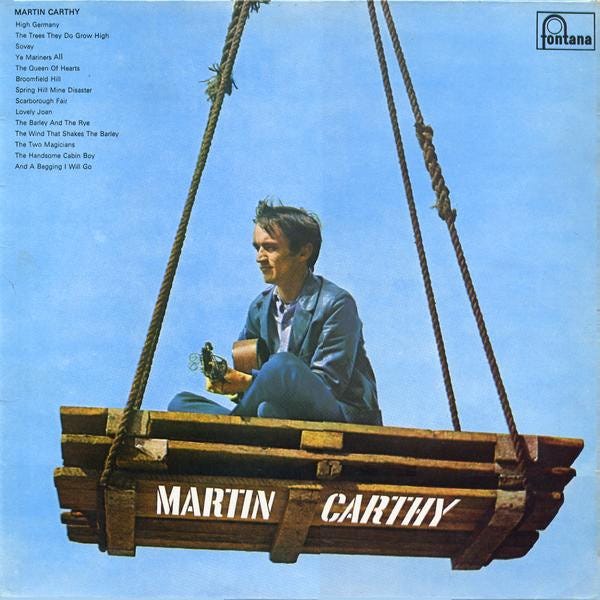
Tracks: 1) High Germany; 2) The Trees They Do Grow High; 3) Sovay; 4) Ye Mariners All; 5) The Queen Of Hearts; 6) Broomfield Hill; 7) Springhill Mine Disaster; 8) Scarborough Fair; 9) Lovely Joan; 10) The Barley And The Rye; 11) The Wind That Shakes The Barley; 12) The Two Magicians; 13) The Handsome Cabin Boy; 14) And A-Begging I Will Go.
REVIEW
This is how the introductory passage for Martin Carthy’s Wikipedia page currently reads: “Martin Dominic Forbes Carthy MBE is an English singer and guitarist who has remained one of the most influential figures in English folk music, inspiring contemporaries such as Bob Dylan and Paul Simon, as well as later artists such as Richard Thompson, since he emerged as a young musician in the early days of the folk revival in the UK during the 1960s and 1970s.”
The correct message to be taken away from this «glowing» introduction is easily decoded: “Martin Carthy is an old-timey English folk singer whom nobody on Earth would remember and who probably wouldn’t even have his own Wikipedia page if not for the fact that one of his songs caught the attention of Bob Dylan at a time when Bob Dylan already had a recording contract while Martin Carthy still did not. Oh, and he also got his MBE in 1998, at a time when they ran out of everybody else of note to give the little shinies.” ‘One of the most influential figures in English folk music’ indeed.
But don’t get me wrong: while there certainly are objective reasons to why Martin Carthy remains an obscure figure despite a sixty-year (!) recording career, my jabs here have more to do with the part hypocritical, part hyperbolic distortions of the «public consensus» than with the man himself or the quality of his art. In reality, Carthy was the English equivalent of such Greenwich Village figures as Dave Van Ronk, Tom Paxton, and other traditionalists who had limited recognizability even in their heyday for two interconnected reasons: one, they looked a bit too closely toward the past rather than the future of their musical curriculum, and two, they never paid serious attention to self-promotion, avoiding fame’s beckoning rather than embracing it. Maybe also three — they weren’t musical geniuses — but that, of course, is the most subjective call to make, and I can theoretically see why some people would even prefer listening to Martin Carthy than they would to Bob Dylan (for one thing, he certainly has a more «naturally pleasant» singing voice).
Anyway, Carthy’s musical origins were in skiffle (he is said to have picked up the guitar after hearing Lonnie Donegan, and from 1961 to 1964 he played in the skiffle outfit Thameside Four), and as we know, from skiffle one usually either goes forward — to rock’n’roll — or backward, to the «authentic» folk tradition, which is where Carthy quickly ended up, honing his skills at the Troubadour club in Earl’s Court. Allegedly, this is where he was seen by Dylan on the latter’s first visit to England in 1962, performing ‘Scarborough Fair’ — which then served as the melodic and thematic inspiration for ‘Girl From The North Country’, just as the commercial recording, issued on Carthy’s debut in 1965, was picked up by Paul Simon and served as the basis for his own recording with Garfunkel. Apparently, Carthy and Simon used to hang together quite a bit during Simon’s early stay in England, but would have a falling out after ‘Scarborough Fair / Canticle’ ended up officially credited to «P. Simon / A. Garfunkel» without any acknowledgement of Carthy.
In all honesty, though, Carthy had just as little claim to the song as did Simon and Garfunkel themselves. ‘Scarborough Fair’, originally and/or contemporarily also known as ‘The Cambric Shirt’, is a song that goes back to at least the 17th century, with its lyrics more or less stabilized no later than 1891 by Frank Kidson. The first recorded versions of the song, such as a 1954 live performance by musical actors Gordon Heath and Lee Payant, used a more upbeat and danceable melody, actually treating the subject matter as humorous — after all, it does originate as a taunting, amicable battle of the sexes in which the gentleman and the lady goad each other into performing impossible tasks to win each other’s hand. When and where exactly it managed to turn into this haunting, melancholic piece about the fragility and futility of loving relationships is not clear, but at the moment, the first identified version to use the commonly recognizable «mournful» melody is an a cappella performance by Audrey Coppard, released on Folkways in 1956 as part of her one and only LP, English Folk Songs. One year later, Ewan MacColl put it out with an acoustic guitar arrangement as the «British» equivalent to the merrier and more upbeat «Appalachian» performance of ‘The Cambric Shirt’ by Peggy Seeger (on their Matching Songs Of The British Isles And America LP). After that, barring another a cappella recording by Shirley Collins, the song disappeared off the record industry’s radar for several years, but it may be safely assumed that folk musicians performed it regularly on both sides of the Atlantic, with Carthy’s personal take on it being just one of many.
Admittedly, if you play Carthy’s and Simon’s recordings back to back, it is clear that Simon’s acoustic melody «grew out» of Carthy’s and nobody else’s. Paul made it a little more sophisticated, adding more contrast between the lower and upper strings to enhance the song’s «enchanted forest» vibe — and, of course, Carthy’s solo vocal performance cannot compete with the otherworldly harmonies of Paul and Art on the 1966 recording. But it can be argued that the song’s transformation from a simple piece of folk history into a modern anthem of moody melancholia begins with Carthy and that simple, but astonishingly deep-penetrating little guitar riff which he may have invented specifically for this tune. It also seems to be Carthy (though I am not sure) who removed the call-and-response dialog setting from the song: now it is sung exclusively from the male protagonist’s point of view, and while the basic reason for this may have been technical — the oddness and discomfort of one guy singing both parts, including the woman’s perspective — the end result is that the song completes its transformation from a playful, taunting courting ritual into an unhappy loner’s acknowledgment of his solitary destiny.
The weakest part — though some might call it the strongest — is Carthy’s singing. He has a fine, honest, slightly gritty, quite sympathetic tone, but nothing about it feels outstanding: there may literally have been hundreds of voices like these in London and Manhattan cafés at the time, and the best thing I can say about it is probably Carthy’s refusal to follow the old conventions, overemoting or faking a Celtic accent. He sings his material naturally, which is good if you compare him to the aforementioned Ewan MacColl, for instance, but not if you compare him to Dylan, with Bob’s unique phrasing and vocal attitude, or to Simon and Garfunkel with their one-in-a-million harmonic effects. Throw in the fact that he is a good, but not outstanding acoustic player — certainly nothing special when compared to contemporary British greats like Davey Graham or Bert Jansch — and Martin Carthy emerges as an honest-to-God, pleasantly mediocre folk record, and one that came out just a little too late to be admired by anyone other than stark traditionalists, or, at best, more talented artists looking for inspirational trampolines to launch their own trajectories (like Simon).
There are, of course, thirteen other songs here, not just ‘Scarborough Fair’, but singling out other individual highlights is difficult because none of them would be elevated to the same heights of recognizability as ‘Fair’. To avoid being way too monotonous, Carthy alternates between three types of arrangements: (a) ballads accompanied by solo acoustic guitar, the most common type, kicking off with the opening ‘High Germany’ and closing off with ‘A-Begging I Will Go’; (b) a cappella performances which he strives to make as melodically different from each other as possible, but usually fails (‘Ye Mariners All’, ‘The Barley And The Rye’, ‘The Handsome Cabin Boy’); (c) several tracks on which he is accompanied on fiddle by his friend Dave Swarbrick, future hero of the British folk-rock scene in his own right and a long-term member of Fairport Convention (‘Sovay’, ‘The Two Magicians’; I think that Swarbrick is also playing the banjo-style mandolin on ‘Broomfield Hill’, though this goes uncredited). ‘The Two Magicians’ actually leaves Swarbrick as the sole instrumentalist, and since he is quite a virtuoso of the violin, compared with Martin on guitar, it may be counted as a special attention-grabber (not to mention the naughty lyrics about the “lusty blacksmith“ magically deflowering his reluctant bride-to-be in a couple dozen supernatural ways — good old folk tradition, aye?).
To ensure some cultural connection with the present day, the only song here not included in the Roud Folk Song Index is ‘Springhill Mine Disaster’, a Ewan MacColl / Peggy Seeger account of an infamous Canadian incident that had since its 1958 origins entered the setlists of quite a few performers; this is Carthy’s only open hat-tipping to his buddies across the Atlantic, which he tries to grace with a particularly eerie acoustic arrangement. Overall, though, this and perhaps ‘High Germany’ are the only songs here with an easily discernible social justice message; Carthy is far more interested in anonymous tradition than contemporary neo-folk songwriting, and anonymous tradition, being the equivalent of modern day’s commercial pop songwriting, has always valued romance over social struggle.
As I find it hard to verbalize any extra impressions from the record, I sort of catch myself thinking that perhaps its very ordinariness is precisely the thing, paradoxically, that sets it apart. Indeed, when you think of early Sixties’ folk singers, you visualize either «angels of beauty», be it the celestial Joan Baez or the somewhat more earthy Shirley Collins, or «odd rough types» like Dave van Ronk, or artists with exaggerated Irish / Scottish accents, or guitar virtuosos, or, well, any other manner that makes you stand out of the crowd and initially amazes or stuns the listener, then runs a serious risk of turning irritating once you begin running your mannerisms into the ground. Carthy did none of these things — and so this is an album which you either turn off right after the first song, or listen through all the way to the end without accumulating any negative feelings (but possibly at a loss for seriously positive ones as well).
Indeed, most of the positive evaluations I have seen for the album (very few, as you can imagine) concentrate on words like grit and honesty, the man singing it like it is without any embellishments whatsoever. It is somewhat symbolic that the song chosen to end the record was ‘And A-Begging I Will Go’, a famous ode to the benefits and advantages of the freedoms that the begging profession provides for all those daring to embrace it; it goes without saying that in 1965, playing and releasing music like this for a musician was pretty much the equivalent of begging, and, true to this symbolic creed, Carthy would never ever strive for fame and fortune throughout his entire career. This does not mean he would for always stay fixed on the exact same kind of sound — but one thing would never change: he would never, ever make any attempts at becoming an original songwriter, staying fully content with what the preceding musical centuries had to offer as the basis for his arrangements and performances. And that, I guess, is really the best safeguard possible against succumbing to temptations of fame and fortune. Isn’t it?
Only Solitaire reviews: Martin Carthy
Comments
Nothing yet. Say the first thing.
Sign in to join the conversation.