
To a soft, but stern opening bass pattern, a couple of well-synchronized trombones deliver an equally soft, but threatening yawn, like a giant cat stretching open its maw for unknown purposes. This yawn, alternating between a slightly higher and a slightly lower variant, is repeated several times as the trombones start subtly weaving their way toward it — feels like the imaginary cat is actually stretching its limbs. Then, out of nowhere, an odd, somewhat old-fashionedly comical alto sax pattern strolls in — like a Jerry to the Tom of the menacing trombones, blending in and out of the main melody, protecting its own comically cocky individuality while at the same time unafraid to pull at the cat’s whiskers. Soon the two are taking a stroll together, with the rhythm section becoming a lively shuffle... but the stroll does not last long, as the couple suddenly shifts trajectory and starts shooting for the sky, higher and higher. Off they finally go, barely fifty seconds into the composition — and we’re back where we started.
Although this is hardly relevant, I can’t hold back from telling a funny story: my original digital copy of Mingus Ah Um happened to have a silly flaw where, instead of the actual track, the recording consisted of just the opening minute, looped over eight times in a row. Since the overall running time matched all available discographic information, I thought it was simply one of Charlie’s crazyass experiments — but the odd thing is, I never got tired of that loop; the effect was somewhere in the same ballpark as, say, the coda to the Beatles’ ‘I Want You (She’s So Heavy)’, with the bizarre feel of the theme only becoming goofier and goofier with each new repetition. It wasn’t until I started reading about the track and learning that it was supposed to have a Mingus bass solo on it that I realized something was not quite right here — and you know what? when I finally heard the correct version, I was initially a little disappointed. I mean, who really needs all these solos when the main theme is really where it’s at, right?
To me, the main theme of ‘Fables Of Faubus’ is simply one of the greatest moments in all of post-WWII jazz, and pretty much the embodiment of what truly great jazz music should be all about. As you know, I’m not that much of a jazz fan — my anti-credentials involve getting bored with Kind Of Blue and A Love Supreme on a regular basis — and whenever I start asking myself why that is, the simple answers just don’t fit. Lack of vocals? of course not. Too much improvisation? but I do dig all those lengthy Cream and Can jams quite a bit. Not enough memorable themes? well, what is it that’s supposed to make a theme memorable anyway?
The complicated answer is that music is meant to be an organic amplifier of our own feelings — it should latch on to one of your nerve endings and bring it to its own orgasm — and that is precisely what jazz fails to do to me, much more often than it succeeds. If you reduce these feelings to light and dark, classical music works much better with light, while rock music fares more efficiently with dark, though it can be occasionally inverted (think Beach Boys for light and Shostakovich for dark, for instance). Jazz always seems to have a much harder time reaching either of these extremes — there’s just something ingrained in the essence of it that makes it a bit of a middle ground by definition, music to be professionally respected and played in the background rather than be subservient to your own cathartic purposes. I think most of those who are «simply not that much into jazz» would back me up here, though, of course, other people will have different paradigms of thought on the issue.
Anyway, for those who understand what I’m talking about here and who find jazz, particularly the «intellectual» strains of jazz that the bebop movement brought into being, difficult to get into for exactly those reasons — for all such people, Mingus might be the easiest gateway into the genre, or, at least, just an exceptional representative of it. To put it in very simple terms, he, more often than anybody else in jazz at the time, tried to have his music kick ass — and not in a gentle, polished way, but in mean, dark ways that really hurt and stimulated. From ‘Haitian Fight Song’, whose broohaha crescendo was about as aggressive as jazz ever got to in the first forty years of its existence, to 1959’s ‘Boogie Stop Shuffle’, which was as close as jazz ever got to the essence of rock’n’roll, he was one nasty son of a bitch, and he constantly imbued his music with this wicked spirit of mischief and hooliganry that attracts me to his art probably more than any other jazz artist since the pre-war greats.
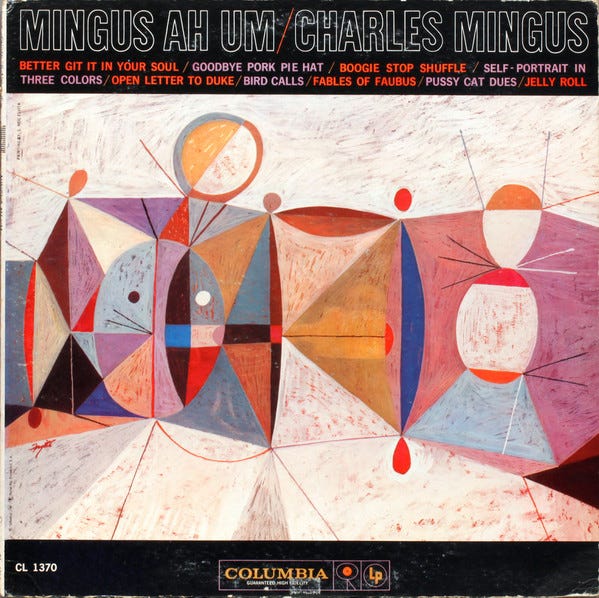
But other than that, or maybe even as an integral part of that, he could also be the master of the melodic hook — nowhere better expressed than on Mingus Ah Um, his 1959 masterpiece and one of the greatest jazz albums ever made, if not the single most wholesome one, in my opinion, if only because of its incredible depth and diversity. This is where we find the original ‘Fables Of Faubus’, which may not be as emotionally stunning as something like ‘Goodbye Pork Pie Hat’, as festive as ‘Better Get It In Your Soul’, as quirky as ‘Bird Calls’ or as joyful as ‘Jelly Roll’ (all masterpieces!) — but, in its own way, is more intriguing and unusual than all of those.
What’s most intriguing about it, though, is that the best impression made by the song ultimately has very little to do with the ways in which it is most often discussed. The original version on Mingus Ah Um is an eight-minute instrumental which creates, extends, and extinguishes a mood, but never really tells you explicitly what that mood is supposed to be. The only «hint», and a really subtle one for all those not living in the United States in the late Fifties, is its alliterative title, referring to a figure which, today, probably has to be googled even if you are an American: Orval Faubus, the governor of Arkansas whose most (in)famous act remaining in the public conscience was sending the National Guard to forcibly protect school segregation in the 1957 Little Rock Crisis. As a socially conscious and politically active artist, Mingus had a few things to say about that...
...except that ‘Fables Of Faubus’ does not actually say a single thing! Allegedly, the song is reported as having been meant to have lyrics — not «verses» per se, but rather a sarcastic, mocking vocalize commemorating American racism; yet Columbia Records, to whom Mingus was signed at the time, vehemently suppressed the idea, out of fear of sparkling too much controversy. Thus, at least, goes the commonly retranslated and generally believed story — though my own limited-resource digging through Internet resources shows that the only source to somehow confirm this is Gene Santoro’s Myself When I Am Real, a 2000 biography of the man in which (on p. 154) it is briefly stated that “Columbia, Mingus said, wouldn’t let them record the lyrics“.
It’s perfectly possible, of course, as Columbia wasn’t exactly known as a hotbed for social and racial protest at the time — and, in fact, Mingus was only signed to it for one year and just two LPs anyway, by the legendary producer Teo Macero, after which the contract was not renewed. On the other hand, say what you will, but ‘Fables Of Faubus’ feels perfectly organic without its lyrics in the context of the rest of the tracks on Mingus Ah Um: it is an album whose purpose is to express the essence of the many forms of jazz in music and music only, and having a bunch of politically charged lyrics on just one of its tracks as an exception would seriously disrupt the flow. Additionally, Mingus Ah Um is a highly polished album: it has a very «composed» sound, with most of the recordings carefully assembled from several takes, and the vocals to ‘Faubus’, which mainly consist of call-and-response semi-improvisation, would not really fit into that particular style.
So I wouldn’t be at all surprised if the myth were to be debunked and it emerged that the original ‘Fables Of Faubus’ were never meant to have any vocals, while Mingus himself came up with the story of Columbia’s censorship later in his life, be it deliberately or subconsciously. Not that it really matters all that much. What does matter is that the 1959 recording of ‘Fables Of Faubus’ is a masterclass in «jazzy story-telling» all by itself, outside of any possible political context. Even beyond its main theme, the extended solo sections are not mere rounds of improvisation, but actually take on the roles of separate chapters of an intriguing mini-novel, with sometimes unpredictable rhythmic twists (bordering on the avantgarde) and plenty of suspense along the way. Honestly, I don’t know what it all has to do with Faubus or segregation; I look at it more like a strange, wobbly journey through some unfamiliar swampy terrain, or perhaps the corridors winding around The Red Room in Twin Peaks, something like that.
There are actually two solo passages: a short interlude, from 1:30 to about 2:00, where three different brass instruments essentially turn into three little very sloppy drunk pigs — fifteen seconds of free roaming, then a speedy double-time tempo change for fifteen seconds of being chased back into the stall. Then, after the main theme repeats itself, come the actual solos, to subtly shifting rhythms which throw you off constantly — as if you’re trying to walk straight but somehow keep poking your nose into the wall anyway (and where did that wall come out of anyway?). Word of advice: when listening, don’t try to follow the sax or piano solos, they’re nowhere near as fun as what the rhythm section is doing, mainly Mingus himself, of course, but also Dannie Richmond, who’d worked with him longer and more tightly than anybody else and was probably the only guy on record capable of anticipating Charlie’s every move (or most of them, anyway).
In short, there’s an aura of deep strangeness, mystery, and danger to this track that is not too often matched even by Mingus himself, let alone any other jazz master from the same era. The main theme, with its «Henry-Mancini-meets-Scott-Joplin» superimposition of the corny spy thrill onto old-timey ragtime nonchalance, can be dismissed as comedic fluff if you so desire — but I don’t think that would be the natural reaction if you just heard the track for the first time, not armed by the extra knowledge that it is supposed to be mocking a stupid racist governer. I know for sure that my natural reaction was, «hmm, if I ever were to film my version of Alice In Wonderland, I might use this for the Caterpillar or the Mad Hatter episode». Then again, if you so desire, you can whittle out a purely political interpretation — with some of the instruments playing out the part of Faubus and his fellow segregationists, while others represent a rallying (if somewhat lazy) call for freedom and open-mindedness. It’s all for grabs out there.
Where the political interpretation obviously comes knocking at our door is the moment Mingus actually managed to record a vocal version of the song — specifically, on October 20, 1960, at a single-day session at the Nola Penthouse Sound Studios (West 57th Street, next to Carnegie Hall) that yielded the Charles Mingus Presents Charles Mingus album for the recently established Candid label, run by Nat Hentoff, who, as a left-leaning political activist, would certainly have no problem with Mingus recording politically charged vocals. The album itself was recorded by Mingus as part of a small quartet, with the same Dannie Richmond on drums and just two brass players: Ted Curson on trumpet and the not-yet-very-famous Eric Dolphy on sax — and unlike Mingus Ah Um, things are far more spontaneous here, in fact, the entire record is made to look like a live performance, which it more or less was (live in the studio, that is, without any serious audience).
It’s a fun version all right, and one might certainly say it comes closer to the original vision, with Mingus and Richmond exchanging jabs at Governor Faubus, “the first... or second, or third all-American heel“. But there are drawbacks. First, the recording quality is really inferior to the Columbia standards, almost lo-fi in comparison, and it preserves almost none of the classy mystique of the original. Second, the laments, taunts and jeers of the lyrics (”oh Lord, don’t let ’em shoot us!“) are somewhat clumsily attuned to the instrumental theme — they’re crude, and they do not let the melody truly shine through, taking away the listener’s attention and forcing it into the political pipehole (I fully endorse the attitude, but I’d rather have the music speak for itself). And third, for most of its duration the composition really becomes an Eric Dolphy showcase, whereas in the original not only was the soloing more evenly spread, but it also invited you to pay more attention to the weird behavior of the rhythm section rather than the soloists themselves.
This situation would become even more exacerbated in later live performances, such as, for instance, the massive 25 minute-long performance captured on The Great Concert Of Charles Mingus (a Paris show from April 19, 1964). The main theme is seriously sped up, again losing a large part of its taunting charm, and the main body of the performance consists of improvs of various quality (again, depending on how much you enjoy the avantgarde spirit of Eric Dolphy), so that by the tenth minute or so you have probably already forgotten what you were listening to in the first place. I don’t mind using ‘Faubus’ as a trampoline to jump off into the infinite unknown, of course, but it’s definitely not what drew me into the song in the first place.
Admittedly, if you compare all these versions in the overall context of Mingus’ output, then the 1960–1964 performances could be argued to represent the casual everyday work of the man much better. Mingus Ah Um, on the whole, is a much more polished, pre-meditated, and «doctored» work (only rivalled in this, perhaps, by Charles’ later conceptual masterpiece The Black Saint And The Sinner Lady) than the typically raw, loose, chamber-style concoctions of his small bands. But to me, the moral of this story is that, when all is said and done, jazz is really no different from other popular music genres of the 20th century: it can turn really special when the recording studio is used as a creative asset, rather than just a local simulation of the concert hall with next to no audience in attendance.
Out of curiosity, I compared half a dozen different covers of ‘Fables Of Faubus’ by later artists — big bands, small bands, modern jazz soloists, etc. — and most of them treat the piece as a carnivalesque act of buffoonery, not even bothering to explore its thrilling mystery aspect. The only curious exception I’ve met was this quite delightful version by the almost unknown Canadian guitarist Duane Andrews — who not only prefers to follow the Mingus Ah Um guidelines over the other performances, but also comes up with fresh ideas on how to revitalize it, for instance, adding a slightly Twin Peaks-like vibraphone accompaniment, or throwing in some flamenco lines in the solo. Here, the mystery is not only preserved, but even enhanced, though Andrews’ interpretation is certainly not going to make you forget the original (and thank God for that).
Of course, this cover — just like most of the other, inferior ones — is also a clear example of how a true musical masterpiece easily outlives any pragmatic context in which it was created. The name Faubus no longer means anything to younger listeners, and, in fact, the track itself might as well be renamed to Fables Of The Fawn these days — its mischievous little groove could easily be associated with the prancing and twirling of some feisty horned spirit of nature. There have been amateur musicological interpretations that tie in certain aspects of the melody to the struggle between tradition and progressivism, but they are neither obligatory nor, I believe, in any way helpful to just feel the spirit of the tune deep in your bones.
And what a spirit — the spirit of danger, humor, and melancholic yearning all at the same time. In sociopolitical terms, that would be the threat of racist violence, countered with the absurd demeanor of the wrongdoers, processed with the sadness from contemplating human imperfection. In any other terms, it’s just a complex emotional melange, with all of its facets perfectly expressed by various means of instrumentation. I know very, very, very few — if, in fact, any — equivalents in the jazz idiom that could go for this kind of combination, and even Mingus himself rarely achieved similar results (violence and melancholy often intertwine in his oeuvre, but violence, melancholy and humor... not even The Black Saint, in all of its seriousness, goes for something like that). In any case, if you’re still new to the treasures of Mingus Ah Um, or if you’re looking for an excuse to revisit them from yet another perspective, hopefully this little assessment — from the point of view of somebody who typically struggles to emotionally align himself with jazz music — might be an extra stimulus.
Comments
Nothing yet. Say the first thing.
Sign in to join the conversation.