
Last month I mentioned I was positioning with one foot out the door. This month I’ve become a little more defensive. Not because the market has rolled over, but because many of the indicators I follow have started flashing caution at the same time. The headline indices remain near their highs, but when risk and reward become less favourable, I prefer to be patient rather than aggressive.
June carried the melt-up to fresh highs for most of the quarter, yet the closing stretch delivered the first genuine test of its leadership. A sharp technology and AI valuation scare knocked the Nasdaq lower early in the month and drove a rotation out of the mega-cap winners, with value comfortably outpacing growth and the equal-weighted index outperforming its market-cap peer. A quarter-end bounce then carried the headline indices back towards their peaks. Rather than a broad risk-off environment, the market appears to be unwinding crowded positions while rotating capital into more idiosyncratic opportunities.
The Federal Reserve gave no ground. It held rates in a hawkish hold mid-month and its officials kept talking about hikes rather than cuts, such that the market now prices a real chance of an increase by September. Inflation backed them up, with the core measure the Fed watches most closely climbing to its highest level since late 2023 even as spending and incomes both rose solidly. This was a hot and resilient read, not the slowdown the bulls needed to force easing.
Oil went the other way and fell back to its pre-war levels as the Strait of Hormuz reopened and Iranian barrels began flowing again. That is a relief for inflation further out, but it is also a reminder that the war premium a lot of people were paying for has quietly drained away.
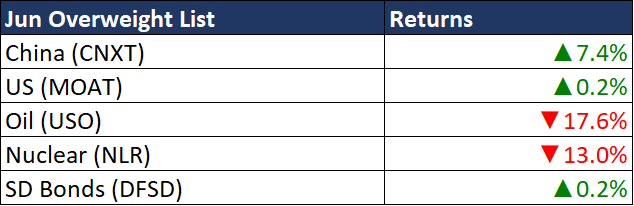
This month’s portfolio performance was widely disperse, and it was a down month overall, my first real drawdown of the year. China (CNXT) was the clear standout and gained 7.4%. My US (MOAT) position was flat at 0.2%, and short-duration bonds (DFSD) added 0.2% and did their quiet job of holding the book steady. The pain came from the two hedges I was carrying for a Gulf escalation that de-escalated instead, with oil (USO) down 17.6% and nuclear (NLR) off 13.0%. Right worry, wrong month. I would rather own that plainly than dress it up, because the same discipline that made me hold those hedges is the discipline now telling me to step back.
Source: Bloomberg
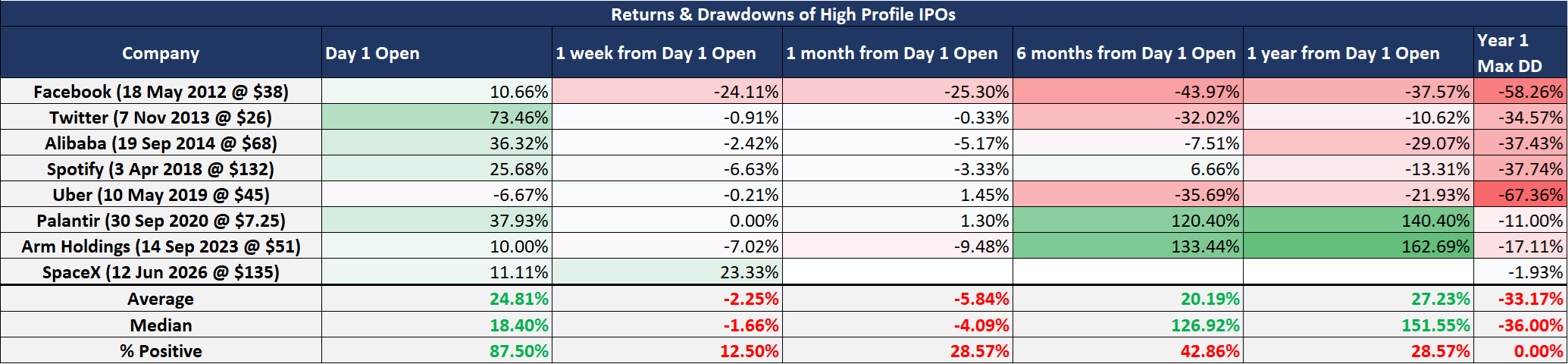
On 12 June, SpaceX, the year's flagship IPO, came public at an eye-watering valuation and then fell close to a third from its peak within weeks as the hype unwound and the company went to the bond market for cash. The chart above sets that episode against some of the great debuts of the past two decades, and the pattern is hard to unsee, because the big names tend to pop on day one, hand those gains back over the following weeks, and then suffer first-year drawdowns that average around a third. The supply is arriving precisely when a fully invested market can least absorb it, and that, more than any single headline, is the mechanism by which a genuine boom still turns into a genuine correction.
Ray Dalio’s Changing World Order
The single most important thing that changed in June is that global liquidity, the tide that lifts everything, has rolled from an uptrend into a downtrend. Liquidity is the fuel this rally has run on regardless of valuation, so when it turns, the melt-up loses the thing that was carrying it. Layer that onto Dalio’s late-cycle backdrop, a superpower stretched by war, debt and internal division, and the case for owning less US and more real assets and cheap emerging markets only gets stronger.
Howard Marks’ Pendulum
The pendulum has swung all the way to greed. The BofA Bull and Bear indicator, which was 8.5 when I wrote to you last month, has now sat above 9 for weeks, which is squarely a contrarian sell signal. When the crowd is this positioned on one side, the asymmetric bet is almost always on the other, so I am taking chips off the table rather than adding to the names everyone is chasing.
Peter Lynch’s PEG Bands
US trailing P/E is 26.6x, about 2.2 standard deviations above its ten-year mean, still close to the extreme. China sits at 9.0x, more than a standard deviation below its own history and the cheapest major market in the world. The valuation read could not be clearer about where the value is and where the risk is, and it is the backbone of my rotation away from the US and towards Asia.
Elliott Wave
This is where my caution is sharpest. The S&P, the Nasdaq and the FTSE All-World all look to me like they may be starting a third wave down, and a third wave is the powerful, trending part of a decline rather than a dip to buy. I am watching the 10-year Treasury yield and the dollar closely alongside it, since a firmer dollar and a steady bid for bonds would confirm the move to safety that the wave count implies. I could be wrong, and a clean break to new highs would tell me so, but the structure has my full attention.
Put the four lenses together and they point the same way for the first time in a while. Liquidity is receding, sentiment is stretched, valuations are extreme in the US and cheap in Asia, and the wave structure is turning. That is why I have pulled the other foot out the door.
Comments
Nothing yet. Say the first thing.
Sign in to join the conversation.