
Doesn’t it feel like a busy week on the internet?? Maybe it’s just that people are betting on every news event now… 🟧 This week, Emily Chang launches an international candy ecommerce store 🟧 an incredibly fancy Brooklyn townhouse 🟧 British pubs come for NYC 🟧 Kyle’s essay on why media is turning toward livestreaming instead of magazines…
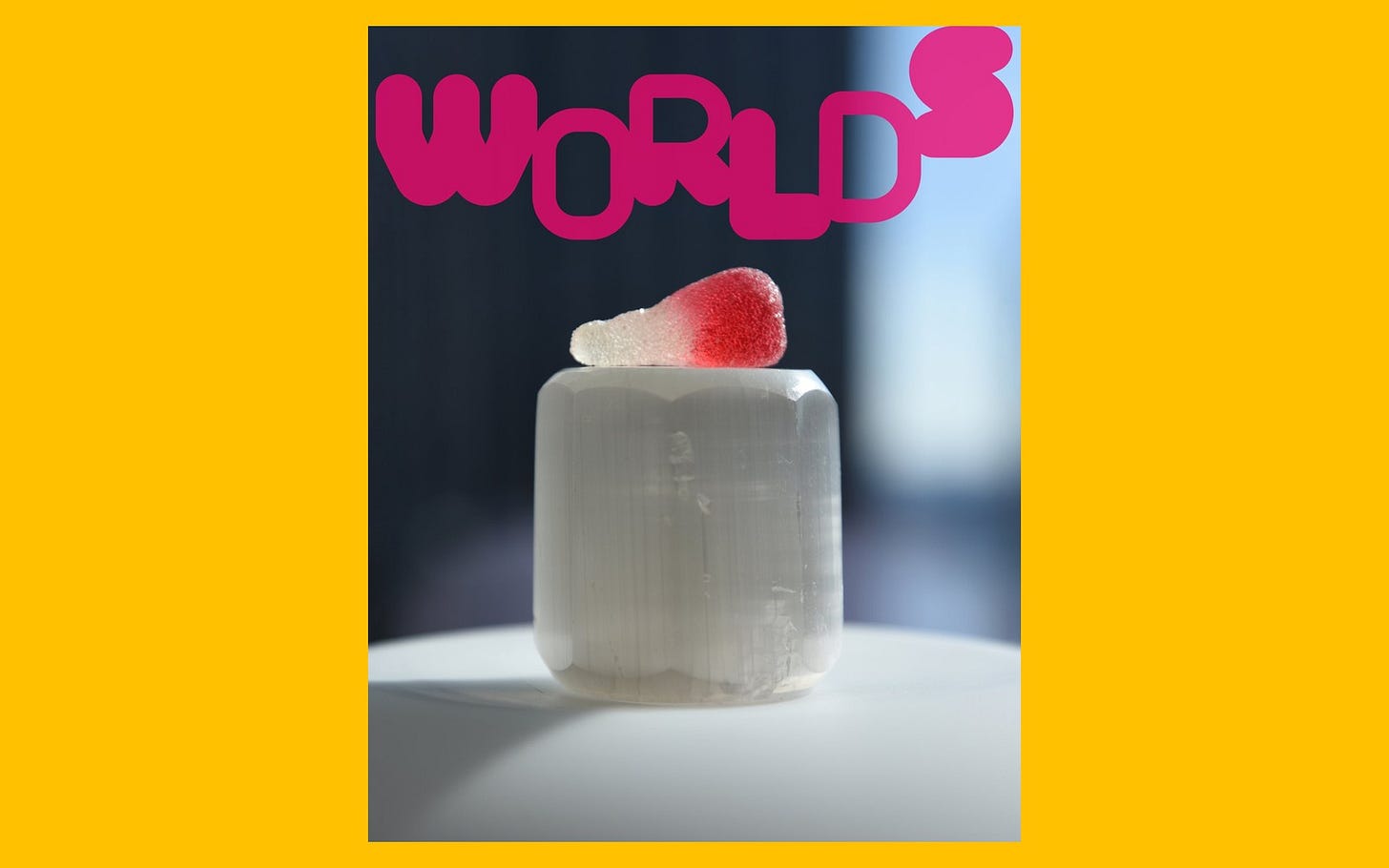
Sparkling Haribo for sale: One Thing contributor Emily Chang has launched Worlds, which is both a beautiful web design & branding project and an ecommerce operation for niche international candy, including blueberry cheesecake-flavored KitKats. “In most stores, foreign candy is displayed like a cheap grocery commodity rather than a special object of taste,” Emily said. The site’s elegant, animated photo shoots show off the products like an art gallery. Part of the inspiration came from Emily’s work trips for Uniqlo: “At the end of the day, we would go down to the 7-11 inside Uniqlo’s headquarters and spend the rest of our per diem. Needless to say, I spent it all on candy.” Check out the site, and maybe buy some grape-flavored Vineyard Jellybeans.
NYC is poised for a pub boom: Jess Shadbolt, of hip NYC restaurant King, opens Dean’s, a nostalgic riff on a British pub, serving Cornwall’s most photogenic dish: a seafood pie with fish heads poking through the crust. Recession indicator??
New dream chore coat: In a Paris suburb, New Zealand designer Oliver Church aka Singular Garments makes shirts and jackets one at a time from vintage French textiles sourced at flea markets — say, kelsch linen from Alsace trousseaus. One shirt takes up to 35 hours. “The best way to make money is not the best way to make clothes,” he says. Be warned: they cost €700, but you’ll want one. Follow on Insta.

Don’t overexpose your swag: Buenos Aires musician Estratosfera on how the stock-like imagery she made for her debut single went so viral it lost its origin, which made her turn against it. Good interview on the latest internet aesthetics.
Pierre Hardy has designed shoes for Hermès for 35 years straight.
Artists are creating handmade, animated No AI Used disclaimers.
If you collect enough Vivienne Westwood they might ask you to curate an exhibition of it.
Are we still trying to look “old money”?: Guy Trebay takes on the rich fashion aesthetic — no logos, monochrome, nice textures — and the coaches who try to teach it online. Trebay is too much of a legend to be accused of being late, but I feel like there’s a new, more maximalist style looming.
In a piece for Monocle, the estimable Colin Nagy argues that media should focus on building understanding instead of providing iterative news updates.
The swankiest property in Brooklyn is a Crown Heights carriage house renovated by an architect couple who carefully assembled vintage materials. The cedar soaking tub is the star of the show. Only $5.895 million.

by Kyle Chayka

As media consumption pivots toward singular personalities and multimedia platforms, the stars take power while institutional voices fade.
Two big things are happening right now in the relatively dry world of media business mergers and acquisitions. The first is that Vox Media, the parent company of Vox, The Verge, SBNation, and other publications you might know, is working to sell off its Vox Media podcast network, which produces shows for its own brands as well as with many celebrity-y partners, ranging from Kara Swisher and Scott Galloway to Megan Rapinoe and Esther Perel. Semafor covered the potential sale first, then NYT reported that Versant, a huge media conglomerate that owns CNBC and MS Now, is the likely buyer. Then, OpenAI bought TBPN (Technology Business Programming Network), a livestreaming, internet-TV tech talk show starring two bro-y entrepreneurs that gained traction on X. The price is reported to be in the low hundreds of millions of dollars — nearly the price Jeff Bezos paid for the entire Washington Post.
On the surface these are very different deals. OpenAI is buying the livestreamed-video-podcast because it wants to improve its corporate communication strategies, developing what sounds like AI-friendly media messaging, though they have pledged not to interfere with TBPN’s editorial process. TBPN’s advertising, which netted some $30 million in annual sales, immediately disappeared on the announcement of the acquisition, meaning that its primary business model (and the theoretical basis of its price) is totally undermined by its new owner. Vox Media sees its podcast division as a valuable asset that it would make money from by divesting it at a moment in which its price is at a peak (though it’s probably cheaper than TBPN’s hyped value), and it will likely sell to another corporate media production house. Both entities are selling on the way up, taking the money while it’s there, and both are valued based on their charismatic personalities who broadcast themselves on microphone and camera. “Vox Media is a creator collective,” the media reporter Mark Stenberg wrote after SXSW. That’s certainly not how we would have described it six years ago.
Faces and voices are how digital content is consumed now, and it’s where the highest ad rates are. I think consumers are gravitating toward markers of authenticity in the age of AI (livestreaming can’t be generated, for now), and multimedia is also simply an easier, more passive format to consume than text. It’s more believable and it’s less work — which doesn’t mean it’s better journalism; usually, it’s the opposite. This all makes me wonder about the fate of the “publication” or “magazine,” the media institutions that actually generate the journalism that podcasters reference and commodify. Publications are collective brands that provide an umbrella identity for many different people: journalists, editors, designers, fact checkers, social media producers. They are not just one or two celebrity voices. We love publications in theory, but we actually don’t have that many surviving with coherent identities and editorial outlooks. The Verge has that, as does my employer The New Yorker, The Atlantic, and New York Magazine, among others. Then there are much smaller indie publications like Defector or Aftermath, which have strong voices and devoted fanbases. Many other titles are defunct or lost in some vague middle ground, unable to compete in a Joe Rogan universe.
Institutional brands are less appealing and seemingly less valuable at the moment. Vox Media apparently tried to sell its publications as well as its podcasts, but did not get a good enough offer. Many of the most successful journalists are now building out independent companies under their own names (Joanna Stern, the former WSJ tech columnist, is one of the latest). Emerging freelance writers are focusing as much on their Substacks than their magazine commissions (Jasmine Sun, who recently became a contributor at The Atlantic, is a great example of the new model). Kylie Robison went from Wired to working for Ashlee Vance’s YouTube channel / newsletter. Institutions are hustling to find multimedia stars in their own newsrooms. The NYT hired a “video training” editor to develop talent. Is every magazine destined to become a daily livestreamed video show starring its editor-in-chief ensconced in some cozy library-esque study, like a fireside chat? I could see it. The “show” is the new magazine.
It makes me nostalgic for the early days of n+1 or The Awl, when you read an article (text!) as much for where it came from as who wrote it. The new, hot media brands lack the infrastructure as well as the identity of an umbrella publication — which also means they’re much more vulnerable when the individual voices burn out or leave. An institution can scale; an individual cannot. If you don’t have charisma in-house, you can try to buy it, a la OpenAI and TBPN, or maybe try to grow it, as this job listing for The Strategist seems to do (a criminally low salary for “hosting” shortform video). But there’s always the risk the talent will just run away from your publication and start their own.
Should you write a Substack instead of a book?: On the new ways knowledge is monetized online.
Gathering attention: How to re-organize audiences and focus their attention on the fragmented internet.
Conversations are the new unit of culture: Why people talking to each other and the performance of expertise have become so important.
The new rules of media: 20 guidelines for digital media during the video-podcast age, aka, why you need a personality cult.
What makes a good newsletter?: An expert roundtable about newsletter strategy. Are there too many!? Does good writing matter!?
No posts
Comments
Nothing yet. Say the first thing.
Sign in to join the conversation.