
Highly recommend listening to the Bill Evans album You Must Believe in Spring for this season, part quietly meditative, part mounting momentum for summer! If you’re planning a vacation now, maybe you need to check out our contrarian summer travel recs from last year? This week, quick cultural links & farther down, tech money tries to fund artistic innovation. — Kyle Chayka
Todd Snyder x Sperry x Mister Rogers’ Neighborhood: Collabs must be stopped.
Arches are coming back into fashion as architectural decoration.
Over in the UK, Pret is suffering a cornichon shortage, causing a catastrophic lack of jambon beurre sandwiches.
Australia’s prettiest street (it is an amazing view) is getting mobbed with Instagram tourists wanting to get the shot.
Hotel room homogeneity: Bloomberg investigated the financial and industrial factors behind hotels all looking the same, around the world and up and down the cost spectrum. In short, the real differentiators are amenities, not room decor. Fun game of trying to guess which plush beige room rendering costs more than the others.
“Blue-chip slop”: Is the art world leaning in to the most obviously appealing kinds of work in order to sell to collectors? Prob! But then many galleries always have, think of all those Julian Opies.
“A lot of galleries are just like, Oh, let’s attach ourselves to this life raft of things that present as painterly and not just decorative but are still quite safe and sellable,” says Jed Moch of Amity, an itinerant gallery that itself opened a show on Canal Street consisting mostly of works in pleasing washes of color. Even if he’s wary of an aesthetic consensus set by interior decorators, Moch has to be cognizant of the current market, which is dominated by paintings that are “a blending of figuration and abstraction that is delicate and very palatable.” The smaller scale of his gallery offers some freedom from the market mandate.
The Martha’s Vineyard Gazette is looking to hire a reporter! Get the job and you can probably get a memoir deal out of it, too. “This position is based full-time on Martha’s Vineyard and comes with fully funded housing in a furnished, well-appointed 2-bedroom guest house.”
Hyperlocal newsletters: My New Yorker column covered the rise of neighborhood-specific newsletters on Substack and elsewhere. Solo writers are having fun and getting paid subscriptions to write about pot holes and dive bars! It’s editorial that really matters to people. My favorite new newsletter is the Hamptons Chronicle, which is obviously juicy.
Vacation-rental ennui: Dyspeptic Italian novelist Francesco Pacifico bemoans the need to put his Roman apartment on a house-swap platform in order to maintain the middle-class travel lifestyle.
In praise of patina: An essay on the aesthetics of heavily worn and used objects, rebelling against the smoothness of quiet luxury, seeking a style that can’t be automated: “AI can generate a perfect image. It cannot generate a history.”

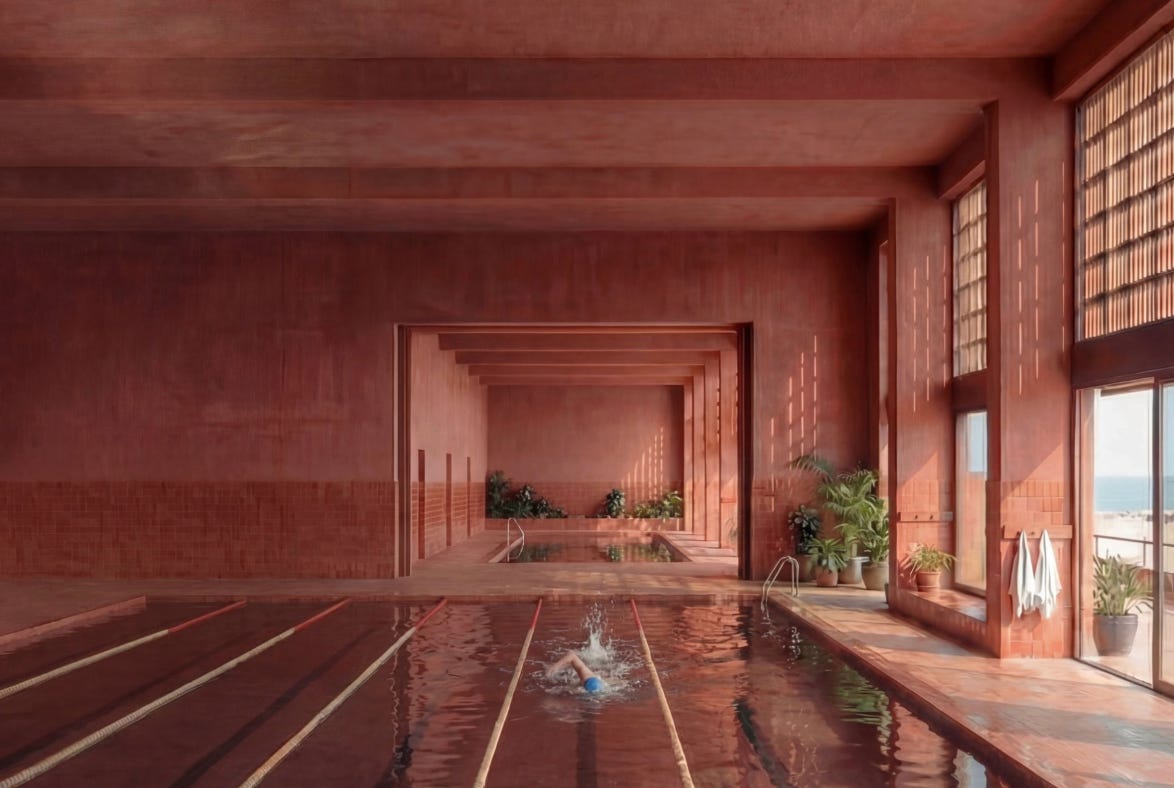
Patrick Collison, billionaire founder of Stripe, and Tyler Cowen, famed economist and podcaster, believe that art is dead, or at least dead-ended. Why, they wonder, don’t we have our own version of the Bauhaus, that legendary German art school that essentially created the modernist aesthetic? In December, they launched a grant program called “New Aesthetics” to fund artists, designers, and makers working on new paradigms for culture in the 21st century, giving creators anywhere from $5,000 to $250,000. “Today, futuristic aesthetics often mean retrofuturistic aesthetics. So, what should the future actually look like?” they wrote.
Last week, they announced the grant recipients, a list that also amounts to a fascinating look at where Collison and Cowen see art going. The winning visual artists, architects, and designers often use tech, particularly AI, to facilitate artistic production. They make AI-generated Delft tiles, 3D-printed ceilings, and digital participatory experiences. The group displays a tendency to revive or reboot old aesthetics into a new mode — Megan Gafford will use hand-drawing to develop a new style of architectural ornament, for example, moving toward a kind of neo-Art Deco. (Her attitude seems kind of anti-Bauhaus!) Another recipient will build a silent meditation timer. Friend of the newsletter Robin Sloan got a grant to continue his printing projects “at the physical-digital boundary” (real heads know that Robin has been investigating post-digital tech-aesthetics for many many years).
I love the enthusiasm and the immediacy of the grant projects, and I’m happy to see non-art world organizations attempting to make waves in visual art, which is often woefully ignored by the rest of culture. (To be clear, this is still a very non-art world list of grantees.) But I wonder if Collison and Cowen have considered the full model of the Bauhaus, which was an entire school that taught formalist aesthetic training from the ground up. To get to Bauhaus modernism, you have to start at learning color theory and making additive sculpture from trash. Generative AI, as deployed by grantee Estudio AD (above) among others, seems more often to shortcut this aesthetic training. The grant program follows Silicon Valley’s venture-investing thesis, which is if you sprinkle enough money around you’re bound to hit a few individual winners. Probably true, but it doesn’t amount to a mass movement.
No posts
Comments
Nothing yet. Say the first thing.
Sign in to join the conversation.