
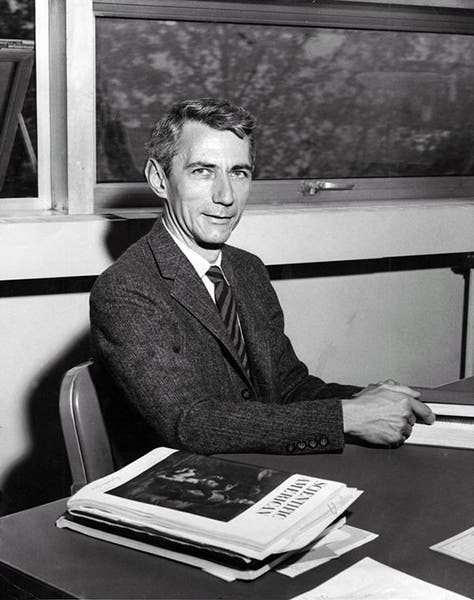
After Claude died in 2001, his family buried him at Mount Auburn Cemetery in Cambridge. His children wanted the entropy formula engraved on the front of his gravestone. Betty thought that would be too showy, so they put it on the back instead. A bush partly obscures it. Most people walking past see only SHANNON carved into the stone. Someone curious enough to walk around the grave finds the equation.
Millions of people use Claude every day, few are curious enough to wonder why Claude is called Claude…
I just finished reading a wonderful biography. In 1985 Claude Shannon attended the International Symposium on Information Theory in Brighton, a city I lived in. He was sixty-nine years old and had published A Mathematical Theory of Communication (the Magna Carta of the digital age) thirty-seven years earlier. At the evening banquet the chairman introduced him as one of the greatest scientific minds of the century, and the applause went on long enough to embarrass him. When he was finally able to speak, Shannon said, “This is ridiculous!” Then he took three balls from his pocket and began to juggle, something I do often. Afterwards somebody asked the chairman what it had been like to have Shannon there. He said it was as though Newton had appeared at a physics conference.
I knew the standard Claude Shannon before reading Jimmy Soni and Rob Goodman’s biography, A Mind at Play: Bell Labs, information theory, the it from the bit, the famous paper of 1948, the foundations of digital communication. Without question I knew that he belonged among that remarkable group who worked around the middle of the twentieth century and whose ideas have built our digital world. What I had never properly grasped, nor took the time to learn, was the personality behind the work, and it is the personality that makes this biography compelling.
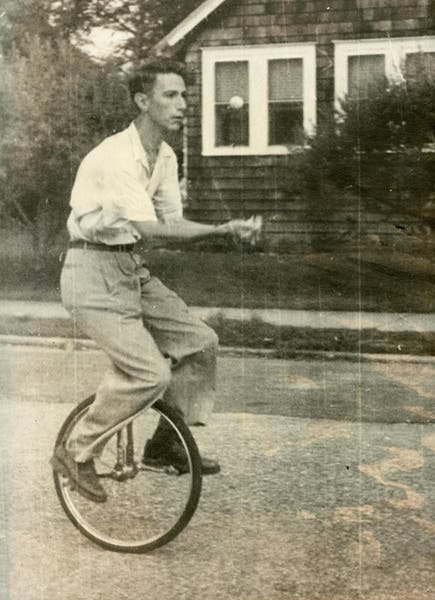
Just like the bongo playing Richard Feynman, Shannon was wonderfully peculiar, though never in the exhausting manner sometimes associated with Feynman. There were no grand vendettas, no theatrical pronouncements about rivals, no obvious appetite for intellectual court politics. His eccentricities were quieter and considerably more entertaining. He rode a unicycle through Bell Labs. He studied juggling seriously. He built an electronic mouse that learned to negotiate a maze, devised a calculator that worked in Roman numerals, played obsessively with chess machines and constructed what became known as the Ultimate Machine: a box with a switch which, once turned on, produced a mechanical hand whose entire function was to turn the switch off again.
That last invention tells us more about Shannon than a solemn catalogue of honours ever could. There is no practical defence of it. It does not improve productivity, shorten a process or solve a pressing industrial problem. The joke is the machine, and Shannon apparently found the joke sufficient. Soni and Goodman let us spend time with a man who was interested in things before he knew whether they were useful, and who seems to have kept throughout his life an almost boyish immunity to the idea that serious people ought to look serious while doing serious work.
Shannon grew up in Gaylord, Michigan, a small town in the north of the state where his father sold furniture, served as probate judge and occupied the sort of civic positions that small towns accumulate around dependable men. His mother, Mabel, was a teacher and school principal. There is nothing especially prophetic in the arrangement, and Shannon was not presented in childhood as a prodigy destined for greatness. His older sister Catherine was the more conspicuous student, and Shannon later admitted that her skill in mathematics may have provoked a little competitive interest in the subject. He also offered a far less dramatic account of his eventual career: “I think one tends to get into work that you find easy for yourself.” There was no childhood thunderbolt, no declaration that mathematics had seized him at the age of seven. He was good at it, liked it and made a career of it.
He also liked making things. He repaired radios, built a radio-controlled boat and worked with a friend on a homemade elevator in a barn. More memorably, he used half a mile of barbed-wire fencing to create a telegraph line between his house and a friend’s. Dry-cell batteries supplied the current, gaps were patched with spare wire, and insulation was improvised from leather straps, pieces of bike inner tube, glass bottlenecks and corncobs. Snow and ice periodically stopped the system, after which Shannon repaired it and resumed transmitting.
It is tempting to look at a boy sending coded messages along a fence and announce the future founder of information theory already present in northern Michigan. Biography becomes unbearable when everything in childhood is forced to predict adulthood, and plenty of children build contraptions and grow up to become dentists, accountants or people who later pay somebody else to fix the radio. Still, something in Shannon’s habits lasted. He wanted to know how systems worked, and once he had understood the system he tended to lose interest in the surrounding clutter. He later said that chemistry had always seemed dull because it held “too many isolated facts and too few general principles for my taste.”
He went to the University of Michigan and studied both mathematics and electrical engineering, mainly because, as he said, he could not decide which he preferred. “I wasn’t really quite sure which I liked best.” The choice was not part of some carefully plotted programme. The curricula overlapped, a few additional courses made the double degree possible, and he took both. One can spend a great deal of money today helping eighteen-year-olds devise career strategies, and there is something pleasing about the fact that one of the decisive educational choices in the history of computing arose from indecision.
At Michigan he acquired enough mathematics to think abstractly and enough engineering to know what switches and relays actually did. In 1936 he noticed a typed postcard on a bulletin board advertising a position at MIT. Vannevar Bush needed a graduate student to work on the differential analyzer, an enormous analog calculating machine assembled from shafts, gears, wheels and electrical relays. Shannon wanted the job badly, applied and got it. Years later he called it “one of the luckiest things of my life.”
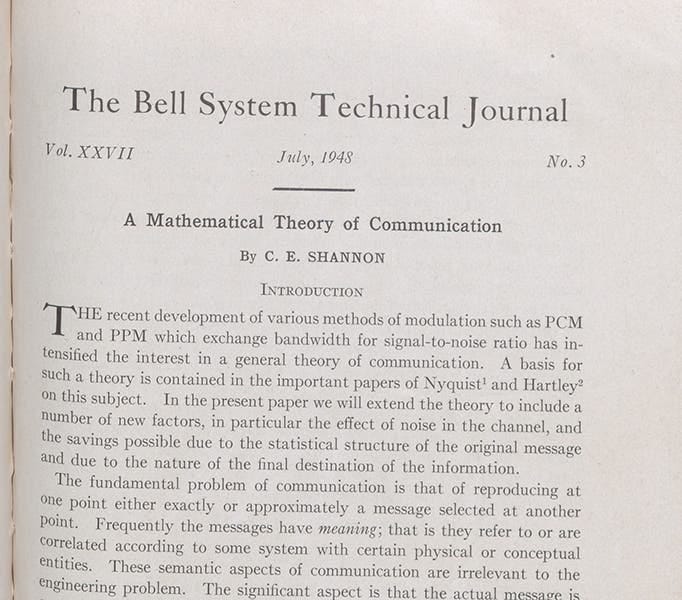
For the next several years he lived with the machine. The differential analyzer filled a room, and its electrical relays opened and closed to control its operations. Shannon knew these circuits from engineering. He also knew the logical algebra developed from the work of George Boole, in which propositions could be represented through binary relations. What seems extraordinary in retrospect is that the connection between the two had gone largely unseen. Shannon realised that the behaviour of switching circuits could be expressed through Boolean algebra, giving engineers a systematic mathematical method for designing them. His 1937 master’s thesis, written when he was twenty-one, established an idea that would become fundamental to digital computing.
The achievement is now so deeply embedded in the history of the subject that it is easy to read it backwards and make it sound inevitable. It was anything but. Shannon happened to know two intellectual languages that were rarely spoken by the same person, and he recognised that each could say something about the other. We spend a great deal of effort encouraging specialisation and comparatively little asking what becomes visible when somebody knows two fields well enough to see that the wall between them is unnecessary.
Bell Labs gave Shannon an unusually congenial place to work, and it occupies a large part of A Mind at Play. It is difficult to read about the place without some envy. Here was a commercial research organisation attached to the telephone system which employed physicists, mathematicians and engineers, gave exceptional people considerable freedom, and sometimes tolerated investigation without demanding immediate commercial justification. Shannon had worried that an industrial laboratory might restrict him. Instead he found engineers using the relay algebra from his thesis in practical circuit design, and wrote to Bush that he “got quite a kick” from discovering that Bell Labs attributed new circuit designs to his work.
That phrase, in one form or another, recurs whenever Shannon talks about his work. It stands out because so little of his intellectual life seems to have been driven by the language we now use to describe accomplishment. There is very little careerism in him. He wanted difficult problems, elegant solutions and the private satisfaction of getting somewhere. His great problem eventually became communication.
Telephone engineers, radio engineers and telegraph engineers were all concerned with sending signals, but each technology came with its own equipment, conventions and practical difficulties. Shannon began asking what remained if one stripped away the differences. What, in the most general sense, was being transmitted? His answer became the 1948 paper “A Mathematical Theory of Communication,” whose modest title gives no indication of the disturbance it caused. Shannon treated information as something that could be quantified independently of meaning. A photograph, a telephone conversation, a passage of prose or a sequence of symbols could be handled within the same treatment. Who had sent the message, why, and what it meant to the recipient were all irrelevant to the engineering question he had chosen to solve.
His great ability was not simply calculation. He was exceptionally good at deciding what could be ignored, which sounds easy until one tries it. Most difficult problems show years of accumulated assumptions, terminology, exceptions, local customs and expert knowledge, and people who have spent years inside a subject often become attached to these details, because expertise consists partly in knowing them. Shannon’s instinct was to ask which details belonged to the problem and which merely accompanied it. In his 1952 Bell Labs lecture on creative thinking he made the point plainly. Almost every problem, he said, was “befuddled with all kinds of extraneous data,” and one of the first tasks was to reduce it until the central difficulty could be seen clearly. There is a discipline in that which intellectual culture, forever rewarding visible complication, tends to undervalue. Shannon wanted the simplest version of the difficulty that kept everything essential.
That habit produced one of the most surprising conclusions in communication (and data) theory. Engineers had long accepted noise as an unavoidable source of corruption: a signal travelling through a real channel would suffer interference, and errors could be reduced, perhaps, but never entirely escaped. Shannon showed that, below a channel’s capacity, coding could make the probability of error arbitrarily small. The physical channel could remain imperfect while reliable communication became possible.
The practical consequences came slowly and then almost everywhere. Digital telephony, data transmission, storage, satellites, computer networks and the modern communications systems that now vanish into ordinary life all owe something to the framework he established. The peculiar thing is that the man responsible seems to have had very little desire to spend the rest of his life explaining his importance.
Information theory became fashionable during the 1950s, and researchers began applying its vocabulary to psychology, linguistics, biology, economics and a growing assortment of subjects. Shannon watched the expansion with discomfort and eventually published a short warning about the information-theory “bandwagon.” The founder of the field was asking some of its newest enthusiasts to stop treating it as a universal solvent. There is a recognisable academic life in which a scholar has one successful idea and spends the next thirty years discovering that the same idea explains leadership, education, society, creativity, morality, the future. Shannon had the rarer instinct of distrusting his own success once other people began extending it too freely. He preferred going back to his machines.
This is where A Mind at Play becomes more than the biography of a gifted mathematician. Soni and Goodman have written about a particular temperament: intensely curious, impatient with unnecessary complication, attracted to difficult problems, suspicious of fashion and unusually dependent on enjoyment. Shannon came close to describing it himself in the 1952 lecture. Intelligence and training were necessary, he told his audience, but neither was enough. A person also needed “some kind of desire to find out the answer, the desire to find out what makes things tick.” Without that impulse, he said, “you don’t have the questions and you won’t just find the answers.” He eventually settled on the ordinary word curiosity, and then added another quality, “constructive dissatisfaction,” which he described as “a slight irritation when things don’t look quite right.”
A great deal of serious thinking begins in exactly that unheroic condition. I know this feeling all to well, something is slightly wrong, an explanation feels too convenient, a procedure contains one step too many, everybody in the room accepts a premise that one person cannot quite accept. The irritation may be small enough to seem trivial, but instead of dismissing it the curious person keeps worrying at it. Shannon also insisted on pleasure. “I get a big bang out of proving a theorem,” he told his audience, before describing the satisfaction of finding an economical engineering solution that produced an unexpectedly large result.
We have made ambition sound much harder than this, with its endless counsel about discipline, routines and the management of time. Shannon certainly worked hard, but the biography keeps suggesting that something else ran alongside the effort. He liked what he was doing to an almost unreasonable degree, which may explain the juggling better than any theory of creativity. He did not regard it as time stolen from mathematics; he became interested in the mathematics of juggling. Chess led him toward computer chess. A toy mouse became an experiment in machine learning. His workshop filled with devices because the line between investigation and amusement never became very firm.
Eventually this brought him to questions we now file under artificial intelligence. He designed chess-playing machines and thought seriously about whether machines could be said to think. Asked about the claim that a machine could never surpass its creator, he dismissed it as “just foolish logic,” pointing out that a machine could operate more quickly than the neurons of the person who had made it. We tend to approach machine intelligence with the philosophical trumpets already sounding. Shannon was far less awed by the border people wished to draw around human intelligence. “I’m a machine and you’re a machine,” he once remarked, “and we both think, don’t we?” It is a willingness to ask the question without first arranging the answer to preserve human pride.
We are surrounded by confident declarations about what machines can never do, followed at shortening intervals by demonstrations of machines doing an inconvenient portion of it, after which the argument relocates and the disputed human capacity becomes more refined, more elusive, more carefully defined. Shannon would have recognised the manoeuvre. He was interested in capabilities, not reassurance.
The book offers a strange kind of reassurance anyway. Shannon’s life suggests that as machines become better at producing answers, the distinctive value of human intellectual life may come to depend more and more on the appetite that produces worthwhile questions in the first place. That appetite cannot be reduced to intelligence; he said so explicitly. It includes curiosity, irritation, play, taste, stubbornness and the willingness to spend an afternoon on something whose usefulness is not yet apparent.
Late in his life this becomes painful. Alzheimer’s disease gradually took his memory. His daughter Peggy remembered occasions when, even after the illness had advanced, he could still cut through a question with startling clarity, though later those moments grew rarer. Robert Fano once asked him something about the past and received the simple answer, “I don’t remember.” His wife Betty (also a maths genius) believed that Shannon never fully understood what the digital world had grown into during the years of his decline.
There is one final detail. After Claude died in 2001, his family buried him at Mount Auburn Cemetery in Cambridge. His children wanted the entropy formula engraved on the front of his gravestone. Betty thought that would be too ‘showy’, so they put it on the back instead. A bush partly obscures it. Most people walking past see only SHANNON carved into the stone. Someone curious enough to walk around the grave finds the equation.
Stay curious
Colin
Comments
Nothing yet. Say the first thing.
Sign in to join the conversation.