
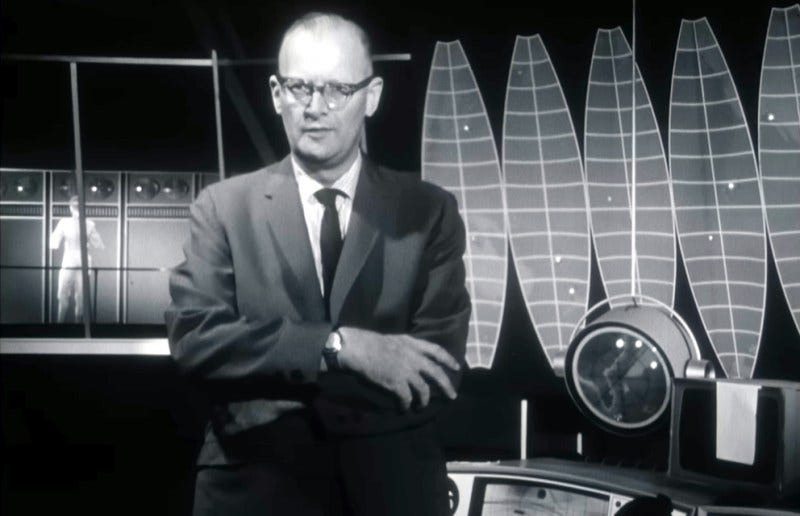
“The only way of discovering the limits of the possible is to venture a little way past them into the impossible.”
~ Arthur C. Clarke
Arthur C. Clarke published Profiles of the Future in book form in 1962. Portions had appeared earlier in magazines including Holiday, Horizon, Science Digest, and Playboy. The Bantam edition described the work as “An inquiry into the limits of the possible.” Its contents include chapters on transport, gravity, speed, communication, rockets, time, abundance, invisibility, biology, machine intelligence, and the long future of human life.
Clarke was already known for a specific technical forecast. In 1945 he had proposed communication satellites for global broadcasting. In 1947, in fiction, he had dated the first Moon rocket to 1959. In the introduction to Profiles of the Future, he admitted that he had misjudged several schedules. He had placed manned satellites in 1970 and a Moon landing in 1978. By the standards of the 1940s, those dates looked optimistic. By the standards of the 1960s, they looked cautious.
He was not writing a timetable. His concern, as he noted, was “what, not when.”
I think that is the sentence on which the whole book turns. Not because it excuses his mistakes about timing, though it does explain them. The argument turns because Clarke is attempting something more difficult than prediction. He is not asking when particular developments will occur. He is asking which developments belong within the realm of possibility at all. Dates are vulnerable to politics, economics, accidents, and chance. Possibilities are a deeper question. Clarke wants to know whether the barriers people take for granted are real limits or simply assumptions inherited from the present.
This is why Profiles of the Future still feels unnerving. It is not a book about gadgets. It is a book about intellectual courage. Its real subject is not satellites, rockets, robots, or immortality. Its real subject is how easily intelligent people convince themselves that something cannot be done simply because it has never been done before.
Clarke begins by refusing the dignity usually granted to sober error. “It is impossible to predict the future,” he writes, and then, with that dry British appetite for trouble, proceeds to do something more compelling. He tries to define the boundaries of the possible. I like the ambition because it is both modest and arrogant, which is often the correct mixture for serious thought. He knows that detail will make a fool of him. He knows that dates age faster than milk. He also knows that refusing to think beyond present arrangements is not prudence. It is abdication.
His first great charge is what he calls “the failure of nerve.” This is not ignorance. Ignorance is often forgivable. The failure of nerve is worse because the evidence is already available. The facts are no longer hiding. They are in plain view, accumulating on desks, appearing in experiments, turning up in workshops and laboratories. Yet the expert, confronted with them, retreats into certainty. No, he says. It cannot be done. It will come to nothing. Sensible people need not concern themselves with it!
Clarke’s gallery of wrongness is one of the most entertaining rooms in twentieth-century scientific prose. We meet the confident men who doubted electric light, flight, rockets, satellites, and space travel, and we do not merely laugh at them. We recognize them in ourselves. That is the uncomfortable part. They are not fools in the ordinary sense. Many were learned, accomplished, and mathematically competent. Their error was not the absence of information. It was the refusal to let information disturb temperament.
There is Sir William Preece, dismissing Edison’s electric light as an “absolute ignis fatuus.” Clarke cannot resist adding that “the fatuousness was not in the ignis.” Clarke delivers the correction in a single sentence and moves on, leaving Preece to argue with history. Preece was not condemning a fantasy of perpetual motion. He was condemning the electric bulb, a household item so plain that later generations would curse it only when it failed.
Then comes Simon Newcomb, the eminent astronomer, whose proof against heavier-than-air flight reached the public just as the Wright brothers were preparing to ignore him in the most practical way available. Clarke’s account is valuable because he does not treat Newcomb as an idiot. Newcomb could imagine some new principle, even the neutralization of gravity. What he could not accept was more humiliating: that the answer might already be in a bicycle shop.
That is one of Clarke’s central lessons. The future is usually determined from unexpected directions. More often than not, it begins with people working quietly on ideas that seem unimportant or impractical to everyone else. It comes not because a committee has granted it permission, but because two mechanics or one obsessive inventor or a neglected theorist has seen that the pieces already fit. The official mind, embarrassed by the informality of discovery, calls the result premature.
The rocket examples are even sharper. Clarke shows how distinguished scientists dismissed lunar flight and long-range rockets by beginning with assumptions that guaranteed defeat. Mathematics, he warns, is powerful, but “no equations” can reach truth if the starting point is false. The point is not anti-mathematical. It is anti-smugness. A calculation can be immaculate and still useless if its premises exclude the reality it is meant to describe.
The same error returns whenever a system is judged by the assumptions of the world it is about to disturb. I read Clarke now in the age of artificial intelligence and hear not merely a familiar tone, but a familiar structure of error. The contemporary version is not simply “AI cannot reason.” It is sharper than that, and more seductive. It says: a system trained to predict the next token is only doing statistical continuation; statistical continuation is not understanding; therefore no amount of scale can produce reasoning, creativity, or judgment. Within its assumptions, the claim has force. If one defines thought as grounded intention, lived experience, or human consciousness, then a language model does not think. The output follows directly from the initial specification of the terms.
That is the Newcomb move. The aircraft cannot fly because it is being judged by an account of flight that has excluded the thing about to happen. The rocket cannot reach the Moon because the calculation has been set up so that the payload must drag the wrong burden through the wrong trajectory. The language model cannot reason because reasoning has been defined as the possession of human inwardness rather than the public performance of inference, correction, abstraction, planning, and explanation. The bicycle shop has become a server farm, which is less picturesque and more expensive, but the intellectual embarrassment is much the same.
This does not mean that the enthusiasts are right. Many are selling champagne by describing tap water under theatrical lighting. Present systems hallucinate, flatter, imitate, fail silently, and can make mistakes with an assurance that would have served them well in politics. They lack stable world models in many settings. They do not possess human judgment. They do not wake in the night with remorse. But Clarke’s warning is that the wrong denial may be as dangerous as the wrong prophecy. To say “it is not human thought” may be true. To say “therefore it cannot perform large parts of what human beings have called thinking” is the error.
Clarke would not ask us to believe every claim. He would have had little patience for technical evangelists who treat doubt as a personal insult. His standard is harder. He asks us to distinguish disbelief from disciplined refusal. The first protects our status. The second protects reality. The difference is moral before it is technical.
That word, moral, is not too large. Clarke says the failure to appreciate the facts was “not so much intellectual as moral.” I find this sentence bracing. It rescues the future from the futurists and returns it to character. To think well about what may come next, one must have more than expertise. One must possess the nerve to follow a line of evidence past the limits of one’s comfort.
The second error, the “failure of imagination,” is gentler and more interesting. This occurs when the known facts are handled correctly, but the decisive facts have not yet been discovered. Auguste Comte could say that we would never know the chemical composition of the stars. At the time, this was not a foolish view. It was reasonable. Then spectroscopy arrived, and the underlying assumptions had to be revised. The lesson is not that Comte was stupid. The lesson is that intelligence can become provincial when it treats the present inventory of methods as final.
We live among people who say that technology is moving too fast and among other people who say it is not moving fast enough. Both groups have a point, and both can be unbearable before breakfast. Clarke asks a prior question: how should a serious person think when the pace of discovery keeps humiliating every fixed posture?
His answer is not optimism. It is disciplined audacity.
“The only way of discovering the limits of the possible,” he writes, is “to venture a little way past them.”
That sentence is often quoted as a slogan, but in the book it is closer to a method. It is not permission to babble. It is permission to test the fence. Clarke is not praising fantasy as escape. He is praising fantasy as stress-testing.
Here one must say something about science fiction, because Clarke does, and because he is right in a way that still irritates solemn people. He argues that a critical reading of science fiction is essential training for looking more than ten years ahead. The adjective does important work. A credulous reading will make one insufferable at dinner. A critical reading gives the mind practice in encountering arrangements not yet normalized by furniture, salary, law, or habit.
This is why Verne and Wells occupy such honored places in Clarke’s account. Verne lived at the hinge between locomotive and airplane; Wells had the larger artistic gift and the cheek to let facts step aside when they interfered with insight. Clarke is not saying that science fiction writers possess a private telephone line to the future. He is saying that certain kinds of disciplined fantasy rehearse the mind for surprise.
There is an important democratic implication here. Official expertise is necessary, but it is not sufficient. The future is not owned by the credentialed. It is shaped by tinkerers, amateurs, readers, eccentrics, engineers, merchants, soldiers, patients, children, hobbyists, and those maddening people who ask one extra question after the meeting has already gone on too long. One must be careful. Ninety-nine cranks are still cranks. But the hundredth may be Edison, Goddard, Turing, or the person whose notebook looks ridiculous until the world catches up.
Clarke’s own record gives the book a comic doubleness. He was right often enough to be dangerous and wrong often enough to be human. He predicted communication satellites with astonishing clarity, yet made no effort to claim the idea for himself. This is one of the better jokes in the history of technological foresight: the man saw the satellite age and forgot to send himself an invoice. He also overestimated some schedules and underestimated costs. In other words, he was not a prophet. He was something better: a disciplined guesser with a high tolerance for embarrassment.
That tolerance is central. Most people do not avoid thinking about the future because they lack intelligence. They avoid it because the future makes fools of nearly everyone, and nobody enjoys being caught in public with a confident sentence that has gone stale. Clarke accepts this humiliation as a necessary operating cost. He would rather be wrong at scale than correct within a room so small that nothing living can enter.
The book’s technological chapters now have the strange charm of old forecasts. Some are thrillingly prescient. Some are extravagant. Some are simply odd. But the value of the book does not depend on a scorecard. If one reads it as a betting slip, one misses the deeper argument. Clarke is not asking us to admire his accuracy. He is teaching us how not to let present limitations disguise themselves as eternal law.
“Any sufficiently advanced technology is indistinguishable from magic.” The line has been repeated so often that it now risks becoming a decorative tile in the bathroom of public thought. But taken seriously, it is less a line about magic than a rebuke to vanity. We are prone to think that what we understand is natural and what we do not understand is fanciful. Clarke reverses the social status of the words. Today’s impossibility may be tomorrow’s undergraduate exercise. Yesterday’s miracle may become a customer-service failure after ten minutes on hold.
The line contains a warning. Once advanced technology becomes ordinary, gratitude evaporates. A person who would have been burned for sorcery in one century complains about Wi-Fi in the next. This is not hypocrisy. It is habituation. Human beings are astonishingly quick at turning miracles into utilities and utilities into grievances. Clarke’s technological optimism is therefore not sentimental. He knows that abundance can breed boredom and power can produce childishness. He knows that the arrival of wonders does not automatically enlarge the soul.
In that sense, Profiles of the Future becomes more than a mid-century technological forecast. It becomes a book about maturity. Clarke says politics and economics are concerned with power and wealth, and that neither should be “the primary, still less the exclusive, concern of full-grown men.” One may quarrel with the confidence of that statement, especially from a century that has given us repeated lessons in the durability of power and wealth. But one should not miss the aspiration. Clarke wants a civilization whose central excitement is discovery rather than possession.
I find that both moving and chastening. Much of our contemporary technological culture has inverted Clarke’s hope. The machine is advanced, but the ambition is often miserably small. We have systems capable of translating languages, generating images, recognizing patterns, and assisting scientific work, yet a large share of the commercial imagination is devoted to advertising, surveillance, frictionless shopping, synthetic intimacy, and the efficient production of distraction. We built instruments that would have astonished Newton and set them to optimize thumb movement.
Clarke would have laughed, but not kindly. His humor has a way of leaving a bruise. He believed that the future would test the scale of human desire. Give people rockets and some will go to the Moon. Give them global communication and some will send invoices more quickly. Give them machine intelligence and some will ask it to write a better quarterly update. It is not the technology that looks small in such cases. It is us.
The most unsettling chapters are those on brain, body, and machine intelligence. Clarke grasped early that computers were not merely faster calculating devices. He calls them “dwarf brains,” not giant ones, because they were still primitive. Even then, he saw the breach. Machines had begun to perform tasks once treated as signs of human exclusivity: translation, music, chess. He understood that the question would not remain whether machines could calculate. The question would become whether our favored definitions of thought could survive contact with machines that behaved intelligently.
Clarke invokes Turing’s test with admirable impatience. If a machine can conduct a long exchange and the human questioner cannot tell whether it is mechanical, the refusal to grant intelligence begins to look less like rigor and more like vanity. His joke about Homer is perfect: the skeptic who denies the result becomes “a splitter of nonexistent hairs.” Every field has such people. They can save a definition by draining it of use. They win the argument and lose the century.
Clarke’s treatment of machine intelligence is startling because it is both cheerful and pitiless. He imagines electronic companions that grow with us, learn our habits, handle routine correspondence, manage appointments, and even substitute for us in conversation. This was written in the early 1960s. Read now, the passage has the odd effect of making the present seem late. The personal assistant, the chatbot, the agentic system, the automated proxy: Clarke saw the family resemblance before the family had assembled for lunch.
Yet he does not stop at convenience. He asks the forbidden question: “Where does that leave man?” He then answers with a severity that still has the power to offend. The human species may not be final. Machines may exceed us, merge with us, or carry intelligence into environments where flesh cannot thrive. He does not present this as a horror story. He refuses the comic-strip fear that intelligent machines must be hostile. If conflict comes, he suggests, it may well be humans who start it.
That idea is difficult, and it should be. Clarke is not merely predicting AI. He is attacking human self-importance. We prefer warnings in which we remain the hero, victim, or tragic center. Clarke offers something colder. We may be a transitional form. Not worthless. Not contemptible. Not replaced in the crude sense of a worker dismissed from a factory. Transitional. A species through which intelligence passes into wider forms of agency.
I do not accept this without resistance. I do not want a philosophy in which the human person becomes an obsolete container for computation. I believe in obligations, memory, tenderness, conscience, and the irreducible significance of a face recognized by another face. A person is a learner, a judge, a witness, a companion, a maker of promises, and a keeper of obligations. Clarke sometimes writes as if intelligence were the principal drama, when human life also depends upon love, duty, forgiveness, and the stubborn holiness of ordinary care. These are not decorative additions to intelligence. They are claims made by one life upon another, and no increase in processing power can cancel the claim of the person who needs to be answered, accompanied, forgiven, or protected.
And yet I cannot dismiss him. His severity performs a useful service. It strips away lazy consolation. If we wish to defend human beings in an age of intelligent machines, we cannot do it by pretending that machines will remain toys. We cannot rest the case for humanity on chess, translation, calculation, pattern recognition, or polite conversation. Those territories have already shifted. The defense must be deeper. It must ask not merely what humans can do, but what humans are responsible for.
The danger in AI is not only that machines may become powerful. It is that we may become administratively, morally, and imaginatively smaller in their presence. We may outsource judgment and call it efficiency. We may surrender attention and call it personalization. We may accept synthetic confidence because it arrives faster than human doubt. We may confuse fluency with wisdom, and then wonder why our institutions sound eloquent while behaving foolishly.
Clarke’s lesson is therefore double. Do not underestimate technology. Do not overestimate the human beings who deploy it. The first error produces complacency. The second produces disaster with a press release.
His closing claim that the future will be “utterly fantastic” is not childish enthusiasm. It is a demand for seriousness. A fantastic future is not necessarily a happy one. It is a future in which inherited categories fail, and people must decide whether they will think freshly or merely defend old sentences with louder voices. That is why Profiles of the Future remains so alive. Its predictions may age, but its discipline does not. Clarke is training the reader to distrust the authoritative no, the comfortable yes, the tidy schedule, the official impossibility, and the expert who mistakes his own habits for the structure of the universe.
I think of the book finally as a manual against premature finality. Do not close the case too early. Do not confuse current cost with permanent impossibility. Do not let the elegance of a calculation hide the poverty of its assumptions. Do not mistake the absence of a method for the absence of a future method. Do not laugh too quickly at the person in the workshop. Do not grant too much authority to the person at the podium. And do not imagine that the main question is whether the future will please us. The main question is whether our intellectual machinery will be robust enough to accommodate it without producing obvious errors.
Clarke’s finest quality is that he makes courage intellectually respectable. Not the loud courage of slogans. Not the theatrical courage of people who enjoy being difficult in public. The quieter kind: the willingness to entertain a possibility before it has become respectable, to test one’s own disbelief, to remain amused by one’s own errors, and to keep the mind flexible without letting it dissolve into credulity.
There is a scene I keep inventing after closing the book. Clarke is at a desk in Colombo, surrounded by magazines, letters, technical papers, and the patient heat of the afternoon. Somewhere in the pile is an idea that will become ordinary after he is gone. Somewhere else is an idea that will remain absurd forever. He cannot know which is which. Nobody can. He sharpens the pencil anyway, writes the next sentence, and leaves enough space on the page for the future to answer back.
Stay curious
Colin
Comments
Nothing yet. Say the first thing.
Sign in to join the conversation.