
The spread between 10 year Hong Kong and US government bonds recently reached its highest level in two decades. Given that the HKD is a pegged currency, many people have started floating ideas about "shorting HK and buying U.S. bonds".
Part of the problem is that many quants/traders focus on mathematics, but fail to understand relevant institutional hurdles.
Rather than seeing this as an “arbitrage opportunity”, I try to see it as a chance to look beneath the surface and understand the institutional reasons behind this phenomenon.
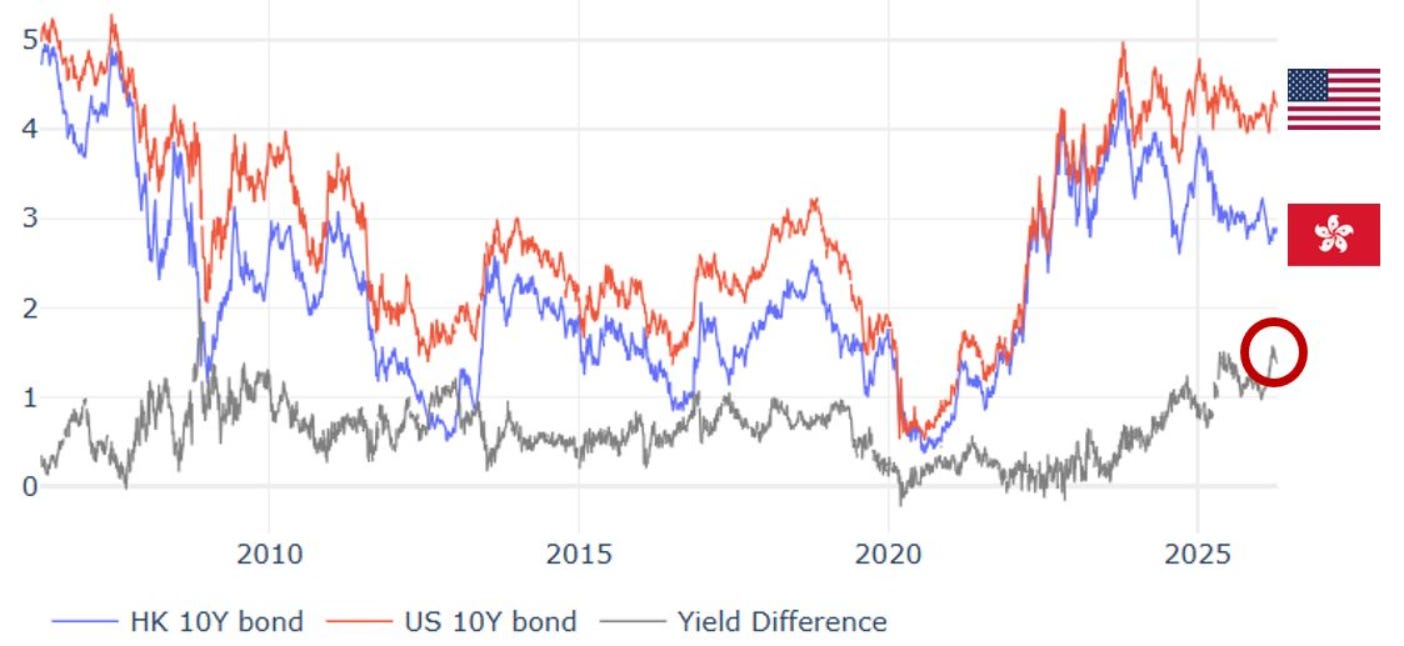
💡At first glance, the reward of such a trade would greatly outweigh the risks:
✅ FX risk - No material market FX risk, as the HKD is a pegged currency. FX depegging risk is worth considering, but only relevant if the HKD depegs upwards.
✅ Interest rate risk - Not relevant if the position is held for 10 years until maturity.
✅ Credit risk - Although both the U.S. and Hong Kong maintain similar ratings (AA+), Hong Kong enjoys a more favorable budget balance and debt-to-GDP ratio.
✅ Inflation risk - not applicable. U.S. inflation is higher and more volatile, while Hong Kong imports disinflation from China. However, inflation risk is not relevant if the trade is unwound back into the investor's domestic currency.
❓The next logical question is: why is everyone not raking in profits by shorting Hong Kong and buying U.S. bonds?
People who ask this question have only a vague understanding of what "shorting" is and of the underlying institutional mechanisms. Once these mechanisms are understood, it becomes clear why this supposed "infinite money glitch" doesn't work in real life.
🗝️Reasons:
Only the HK SAR government can sell bonds through direct issuance. The low yield on these bonds is here to benefit the public purse, not the speculators seeking cheap funding.
Everyone else who wants to short these bonds must borrow them via reverse repo transactions. This is complicated for several reasons:
1️⃣ Balance sheet limits - Hong Kong's public debt is minuscule compared to that of the U.S. (41B vs 35T) and is unlikely to grow significantly, especially since the HKMA has started promoting yuan-linked products.
2️⃣ Underdeveloped repo market - The HKD repo market is far less fluid than the U.S. market, as evidenced by the celebratory tone of press releases each time incremental progress is made.
3️⃣ Funding mismatch - No one will offer repo financing for the entire duration of a 10-year trade. Typical repos are offered only up to 6 months, with HK rates comparable to those in the U.S. This introduces a new, previously not mentioned risk: funding costs are subject to market forces and may not be fully recovered in adverse scenario.
... and that's why what looks like an arbitrage opportunity is rarely exploitable ❌️. But it never fails as valuable learning opportunity ✅️.
⚠️ DISCLAIMER: Not investment advice or trade idea. Opinions are my own and not those of my employer.
No posts
Comments
Nothing yet. Say the first thing.
Sign in to join the conversation.