

I was given a test project for a new agency today. The brief: the first 200 words of an article on the subject of AI in digital marketing.
My research threw up some interesting statistics:
Marketers' use of AI soared from 29% to 84% between 2018 and 2020 and is predicted to grow further.
73% of AI adopters believe AI is “very” or “critically” important to their business today
112.5% of writers are terrified of their job being stolen by robot overlords, according to AI-generated statistics
Artificial intelligence is already all around us: from our YouTube recommendations to those ads that follow you from site to site.
And the consensus seems to be that we’re okay with that, as long as those scary machine learning algorithm tin cans stay in their own lane.
You see, we’re cave painters at heart. Humans are more than happy to give the data-driven jobs of analytics and optimisation to artificial intelligence if it means we still get to tell ourselves no one will ever be as good at arranging Photoshop layers and dreaming up slogans.
Problems start to occur closer towards that no-man’s-land of writing: at the intersection of art and science, in that barren and desolate grey waste known as the creative side of marketing - copywriting.
Back in 2019, JP Morgan Chase signed a five-year deal with Persado after the startup’s AI produced higher click rates - more than double in some cases - on digital ads for Chase mortgages.
In one of their tests, an ad written by a human read:
“Access cash from the equity in your home.”
The more successful version, from Persado, read:
“It’s true—You can unlock cash from the equity in your home.”
It’s not hard to see how the machine won here.
“Cash” and “home” are familiar, benefit-driven words. “Access” and “equity”, however, are bank-speak. The AI simply kept “cash” and “home”, then it got rid of “access” and replaced it with the more powerful (read: hypey) “unlock”. Finally, as a bow on top, it added a garish qualifier: “it’s true”.
I’d like to add that “unlock” pairs quite nicely with “home” here, but that’d be giving the machine a little too much credit.
Impressive? The stats show that this was a particularly successful A/B. However, any decent copywriter worth their salt could have improved that headline.
I’m looking at you, Kristin Lemkau, chief marketing officer at JPMorgan Chase. I’m looking you dead in the eye.
“Persado’s technology is incredibly promising. It rewrote copy and headlines that a marketer, using subjective judgment and their experience, likely wouldn’t have.” Kristin Lemkau, CMO at JPMorgan Chase
The AI did nothing but apply generally accepted copywriting rules: emotion, simplicity, power words.
And what’s with “it’s true”? I hate it, but it worked. It would be really interesting to find out what rule led the AI to include it. To draw attention? To set a more conversational tone? Damned if I know.
All of this sounds cynical, and it is. Truthfully, it’s because I do believe AI has the potential to write great ad slogans and marketing content. It just isn’t there yet.
The fact is, Persado’s “message machine” builds copy from a database of more than one million words tagged and scored for emotional appeal.
Tagged and scored, that is, by humans. On a scale of emotion - which isn’t a scale that makes sense to machines.
In my opinion, they didn’t create a copywriting artificial intelligence so much as Frankenstein together words from copywriters around the globe.
And so the real potential of AI in its current form is not creativity, but personalisation.
Wrapped up in our own selves and products, humans tend to be blind to the needs of others. It happens all the time: I see creators obsessed with their products, unaware they’re trying to solve a problem their audience doesn’t even have.
Thing is, human needs are often expressed in the form of data which makes sense to AI: browsing habits, purchases, time spent on pages. Bounce rates. Heatmaps.
In other words, maybe your spouse didn’t notice you wistfully lingering over that $300 gaming keyboard on Amazon, but your browser cookies sure did.
Imagine a world where AI anticipates your needs. For example, after a late night browsing Amazon, you spot an AI-written ad for a mortgage:
It’s true - there’s enough equity in your home to buy that Razr Keymaster 2000.
Or how about artificial intelligence which knows which purchases you’re more likely to buy more often - say, toothbrushes - than a-few-a-lifetime products, such as mattresses:
You’ve already bought a good night’s sleep. Now, gift your loved one minty morning breath.
(The above example is sponsored by the time I shopped around for and purchased exactly one mattress, and got bombarded with mattress ads for the next six months.)
Evidence suggests that AI is here to stay. And although we mistrust it, it has its place.
In fact, it’s already writing more content than we know of. For example, did you realise that it’s not some poor 18 year-old with a Msc in Sport Management and a timeshare on a sofa in Islington writing sports updates for news outlets? More often than not, those live updates come from a robot.
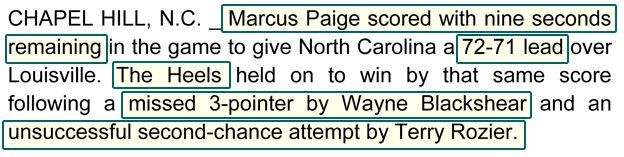
In the world of sports, like in finance, things happen at a fast pace which need to be interpreted by drawing from vast expertise. Things like tables, graphs and lists that might be hard to digest unless you're an expert are excellently parsed by AI in real time. Yes - it actually watches the match, tracking each player and their movements.
This has been going on since 2015, by the way.
Still here, human input is necessary to make the output more informal - referring to a “comeback” and a “streaky first half”. But this is mere semantics.
Could a human writer have described this match better, adding the bacon bits of a lifetime in sports punditry to bring the game to life? Absolutely.
Would BBC Sports readers have given them a Pulitzer for it? Nah.
Of course, even if we neatly categorise sports and finance as data-driven and we don’t necessarily miss the human input, that grey area still remains.
Between facts and creativity lie copywriting - and the news.
Persuasion can be attempted by AI - “it’s true!”, sorry, sorry - but in the end, it needs a raw, urgent understanding of human emotion at the cutting edge of modern context to be effective. And I just don’t think AI is anywhere near being able to simultaneously take the temperature of the homebuyer’s market, apply the appropriate emotional language, and still be persuasive.
Oh God, and then you have the bloody news.
Facts are meant to be all there is - and yet, the “news” is an increasingly persuasive, divisive force on Facebook and everywhere else.
On one hand, we need to know what happened. An impartial sports-esque ticker of “the world today” would be invaluable.
Then again - journalism is what it is because of interpretation from great minds. “Protest in Tiannamen Square” really doesn’t do the event justice. As a society, we’d need infinitely more nuance, more context, than machine learning could ever offer.
As writers, readers and consumers, we need to rethink our value of written projects: and that raises uncomfortable questions.
Which type of writing do we value more?
If we assign AI to basic data reporting, are we devaluing that kind of news? And if we invest more heavily in AI writing that eschews emotion and language, are we devaluing the efforts of the reporters, pundits and insurance actuaries who made these technological leaps possible?
Does this mean fewer jobs for human writers? What of the 18-year old intern on his London sofa? Will human-driven creative work be classed as “higher value” than that done by machines? And if so, will we actually have to start paying writers more?
On one hand, yay money. On the other, being hungry is the only reason I’m losing weight.
Ultimately, old men will yell at clouds all they want, but technology will not abandon its relentless march. But for us meat-bag marketers, we still have to lead it ourselves - for now.
No posts
Comments
Nothing yet. Say the first thing.
Sign in to join the conversation.