
If you've been diving into MPC-TSS (Multi-Party Computation Threshold Signature Schemes) protocols like I have, you know they're a game-changer for decentralizing asset custody on blockchains. In my recent Substack, I broke down MPC-TSS, explained why they matter, and shared a comprehensive database of available protocols. Unlike traditional single private key or multi-sig setups, MPC-TSS spreads control across multiple parties, making it ideal for secure, shared custody.
Institutions have embraced this tech for their custody solutions, but retail users often miss the point, confusing it with basic multi-sig or Shamir's Secret Sharing (SSS). That oversight ignores the real advancements and why it's exploding in institutional use.
With Bitcoin's Taproot upgrade introducing Schnorr signatures (via BIP 340), the MPC-TSS landscape for Bitcoin has narrowed to just a handful of Schnorr-compatible options. Among them, FROST (Flexible Round-Optimized Schnorr Threshold Signatures) stands out as the clear leader, powering many BTCfi (Bitcoin DeFi) builders. Take my last Substack on Botanix, a fresh innovator in BTCfi, they're using FROST to decentralize BTC custody. New players like Arch Network are leaning on it heavily too.
This got me thinking: Why is FROST everywhere in BTCfi? What makes it the go-to choice? Let's break it down.
FROST isn't untested, it's got real-world credentials that build trust. Zcash rolled it out for their Orchard shielded transactions as part of the NU5 upgrade in 2022, and it was audited by the NCC Group in 2023. This success story signals rock-solid reliability, so BTCfi projects can piggyback on Zcash's thorough vetting without starting from scratch.
It's not just Zcash. OG BTCfi projects like Stacks use FROST for managing sBTC withdrawals. Here, a decentralized group of stackers (validators) coordinates via FROST to process user withdrawals securely and without a single point of failure. When big names succeed with it, others follow suit.
One big boost? Excellent open-source libraries that make FROST a breeze to implement. Tools like Givre (from Dfns) and secp256kfun are well-documented, Bitcoin-compatible, and ready to go. This lowers the barrier for developers, sparking a cycle of wider adoption.
Remember, Schnorr signatures are superior to ECDSA in many ways—simpler, more efficient, and better for aggregation, but patents held back their use until 2008.
Now that Schnorr is free and clear, FROST's libraries are multiplying, reducing startup friction and encouraging more teams to jump in.
In 2024, the IETF published RFC 9591, officially standardizing FROST and giving it that "legit" stamp. For BTCfi developers, this means a safer, interoperable choice compared to alternatives that might have strong security on paper but lack this community-backed endorsement. Standardization builds confidence, especially in a space where security is everything.
FROST isn't just popular by accident—it packs practical perks that fit BTCfi's needs perfectly.
Flexible Key Setup (DKG vs. Trusted Dealer): FROST lets you choose how keys are generated during setup. Go with a trusted dealer for quick, simple distribution (great for semi-centralized use cases), or opt for Distributed Key Generation (DKG) where participants collaboratively create shares without trusting anyone. DKG adds rounds for extra security but enables fully decentralized setups. This versatility supports everything from basic wallets to complex DeFi protocols.
Two-Round Efficiency: With just two rounds (preprocessing and signing), FROST is fast and lightweight. Builders love this for quick transactions in BTCfi, where speed matters. Alternatives often require more rounds, slowing things down—especially when factoring in DKG.
Abort Capabilities for Security: If a signer acts maliciously in a t-of-n threshold setup, FROST can abort the process mid-way, preventing bad signatures. This adds a layer of protection, though it doesn't identify the culprit (a trade-off for simplicity). It's a big win for trust in adversarial environments like DeFi.
As more projects adopt FROST, it snowballs: better tools emerge, audits deepen (like fixes for known vulnerabilities), and community support grows. This makes FROST the default pick, from OG BTCfi pioneers to rising stars.
Its flexibility shines here too—whether you're building less decentralized tools or fully trustless systems, FROST fits. This broad appeal amps up the network effect, creating a virtuous cycle of adoption and improvement.
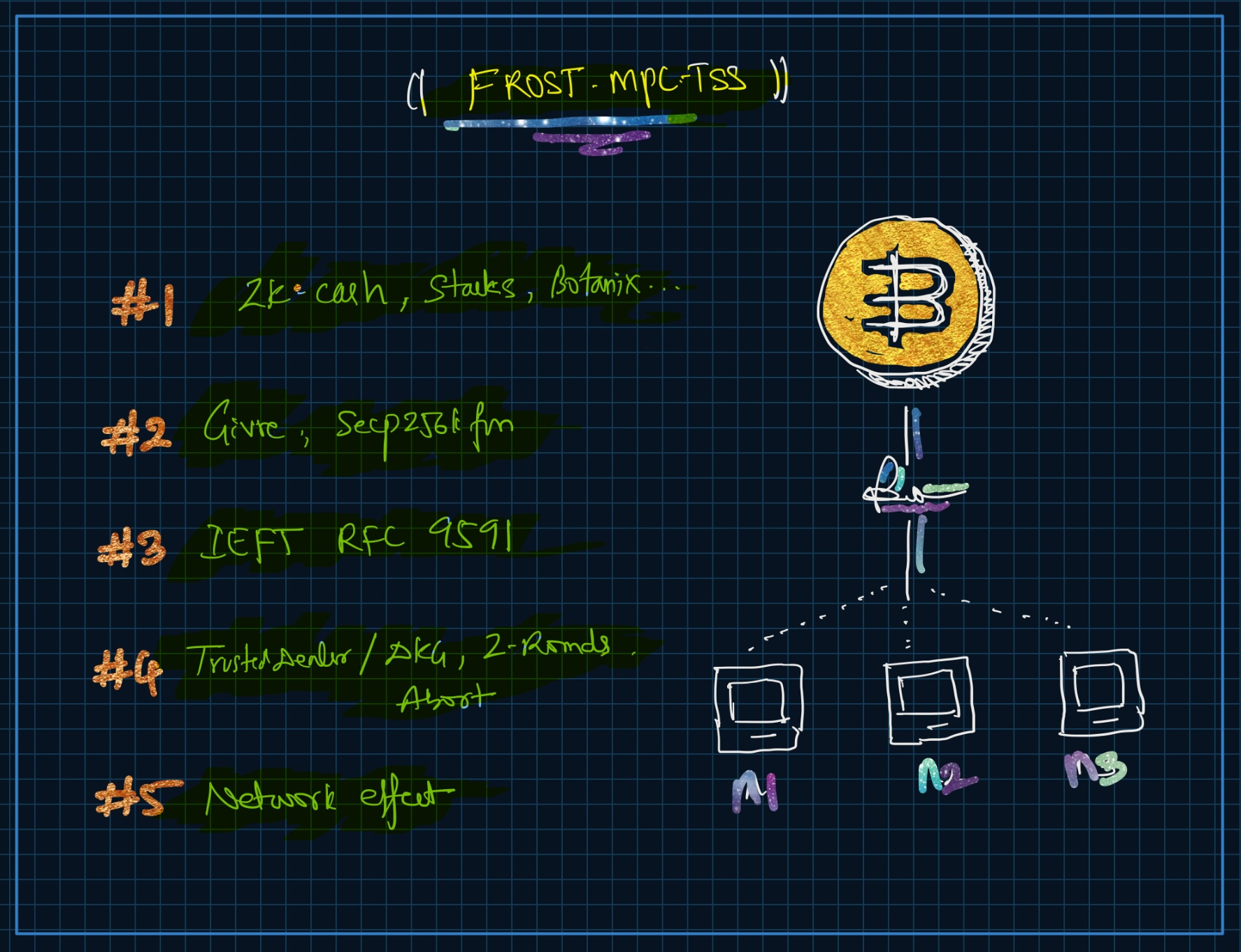
Based on my research, these factors are fueling FROST's rise in BTCfi. One caveat: FROST shines in the "happy path" where everyone cooperates, optimizing for speed and efficiency. But DeFi thrives on handling the tough scenarios—the "unhappy paths" like disputes or attacks. That's why at Surge, we're not just adopting protocols at face value; we're digging into the fundamentals to ensure they align with our use cases. What do you think—any other reasons FROST is winning? Drop a comment!
Thanks for reading Meta Bitcoiner! This post is public so feel free to share it.
No posts
Comments
Nothing yet. Say the first thing.
Sign in to join the conversation.