
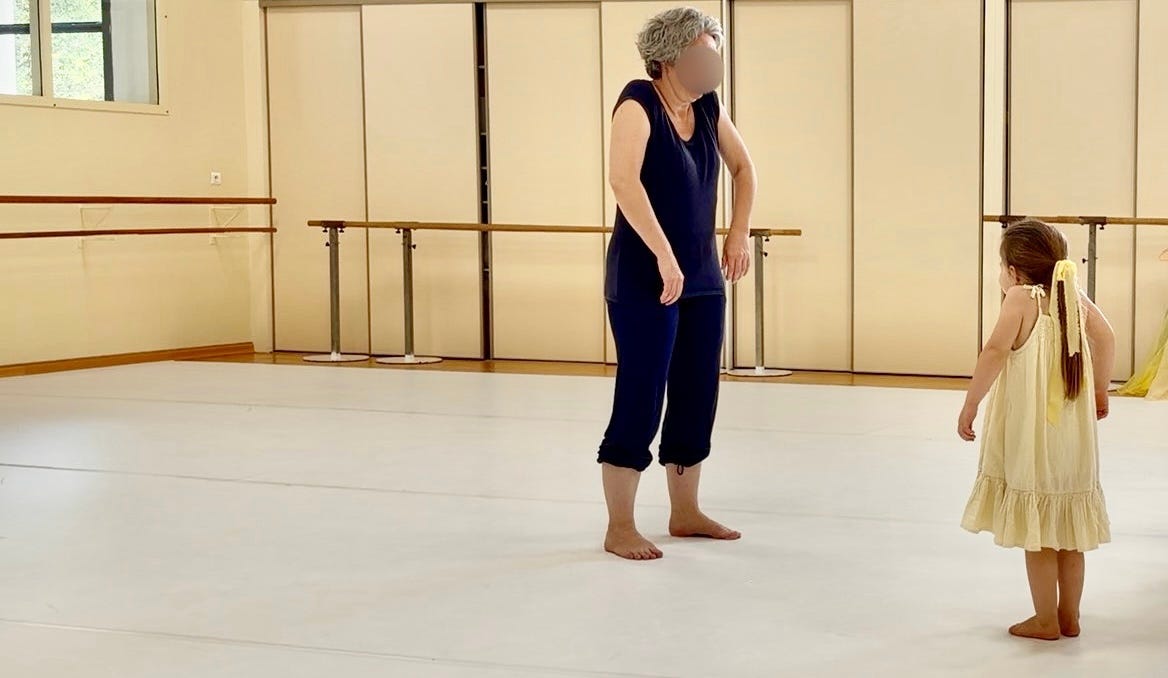
At my daughter’s dance performance last month, I spent most of it watching her watch the teacher.
Not the choreography. Not whether she hit the counts or kept the beat. Her face. She kept her eyes locked on the teacher at the front almost the entire time, the way you’d watch a magician you were determined to catch in the act.
The other little girls did what small children do at a recital, which is roughly forty percent dancing and sixty percent scanning the audience for their parents, waving, adjusting their tutus, occasionally forgetting there was a routine happening at all. My daughter was somewhere else. She was studying.
I’ve seen the same thing in my kids’ jiu jitsu class. Both of them. There’s a moment in every class where the instructor kneels down to demonstrate a move, and I can find my two children in the group without trying, because they’re the only ones with their eyes glued to his hands. The other kids fidget, whisper, pick at the mat. Mine watch like there’s going to be a test.
I want to be clear that I’m not trying to convince you that my kids are gifted and the rest are hopeless. The other children get the moves. They're bright, they're quick, they pick it all up fine. They're just doing it with their ears, catching the instructor's words while their eyes drift off, which is a perfectly sensible thing to do when the words happen to be your own language. That's the shortcut my two didn't have for a long time. Nobody ever handed them the option to look away.
We moved to France when they were two and four years old. Ten days after we landed, both of them started at an all-French school, where not one person, teacher or child, spoke English. I would love to tell you this was a gentle, carefully phased, expert-approved decision. It was not. It was the deep end. We threw them in, and then I drove home and spent the afternoon fairly certain I had broken them.
If you’re new here, welcome. We’re an American family living in a small château in rural France, raising two young kids and figuring it out one slightly reckless decision at a time. This post is free. If you’d like the rest of the story, come along.
When you're very small and dropped into a room where you understand nothing, you can't coast. You can't half-listen and catch up later, because there is no later, there's only the next thing you also don't understand. So they did the one thing still available to them. They watched. If they couldn't follow the words, they read everything else instead: the hands, the faces, where the other children were heading, how loud a voice got and why. They turned their eyes up to full volume, because sight was the only sense that still worked.
Their French is excellent now. Better than mine, a sentence I say with a completely straight face (and a small internal scream).
But the watching never switched off. It's in them now, the way a first language gets into your bones. So my children read people frighteningly well. Well beyond what their ages should allow.
During the heat wave last week, Sean was low. The garden was taking a beating, it was too hot to do the outdoor work he actually loves, and he was discouraged in the way that’s specific to him, which is to say invisibly. My husband does not announce his moods. He doesn’t complain. Whether it’s a virus or something heavier that’s settled on him for a while, you have to know him for years to catch it, and even then you mostly miss it. I have missed it plenty of times myself.
At dinner, I caught our son watching him. Not saying anything. Just watching, the same way he watches the jiu jitsu instructor. Later, brushing his teeth, he turned to me and said, “Daddy’s sad about something. I can see it in his face.”
He was right. Of course he was right. He had read it off a man who gives almost nothing away, across a dinner table, at five years old.
It isn’t only with Sean. They clock it in strangers, in teachers, in their family members over a grainy video call. They catch a shift in someone’s face before a word has been said about what’s wrong. They’re working off hand gestures and posture and the exact volume of a sentence, the whole channel of information the rest of us mostly stopped reading the moment we could rely on words to do it for us.
I didn’t give them this. I couldn’t have if I’d sat down and tried. It’s the accidental souvenir of a French village school and parents who made a big decision in a bit of a panic and then panicked some more in the car afterward.
Sometimes now I catch myself at the edge of a class, watching them watch, and I think about the version of me from three years ago, white-knuckling the steering wheel, convinced she’d ruined everything. She’d be relieved. She’d also, I think, be a little annoyed that the thing she agonized over for months went and turned out fine without her.
We're an American family raising two kids in a small château in rural France, and I write it all down here twice a month, free. The renovation, the forest, the chickens, and the slightly reckless decisions like this one. If you'd like the next one to find you, come along.
Comments
Nothing yet. Say the first thing.
Sign in to join the conversation.