
We are delighted to share the second quarterly Treasury report of 2026.
As always, this report is intended to provide a transparent overview of the Treasury’s financial status. In the report, we share a breakdown of the Treasury as of 30 June 2026, including current investments and other financial activities.
During the past quarter, the Treasury value decreased from $158,283,119 as of 31 March 2026 to $148,570,485 as of 30 June 2026. This represents a decrease of 6.14% compared to the previous quarter. During the same period, Bitcoin was down by 14.01%, while ETH was down by 25.31%. The total crypto market cap, represented by the CCI30 index, saw a decrease of 15.38%. Despite this market-wide downturn, the Treasury’s decline was materially lower, reflecting relative outperformance versus the broader crypto market.
In addition, the current BEAM holdings in the Treasury distributed across Ethereum, Beam Network, BNB Smart Chain, and Avalanche is 8,403,297,145 tokens valued at $11.82m.

As of 30 June 2026, the Treasury balance is valued at $148,570,485. In addition, the Treasury contains 8,403,297,145 BEAM tokens valued at $11.82m.
The Treasury also holds some very small positions, airdrop dust, residual tokens or gas fee money, with values lower than 0.001% of the total Treasury, these balances are not recorded unless they become more significant in value.
We will break down the Treasury in three categories; liquid crypto assets, NFTs and venture investments.
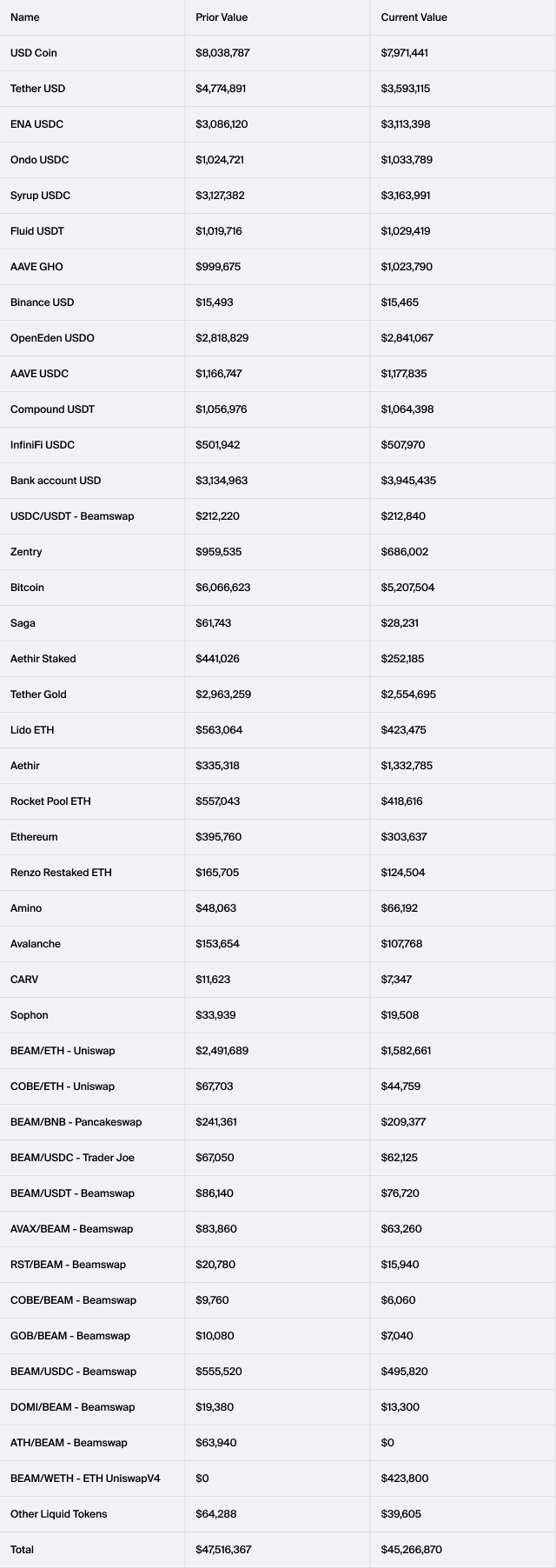
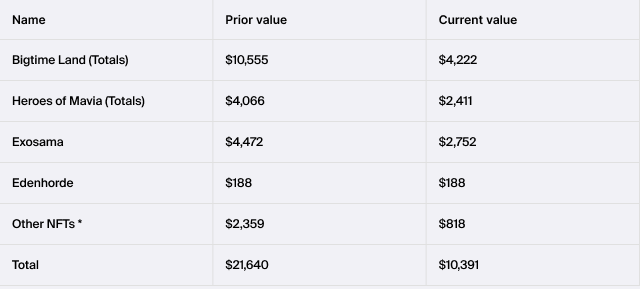
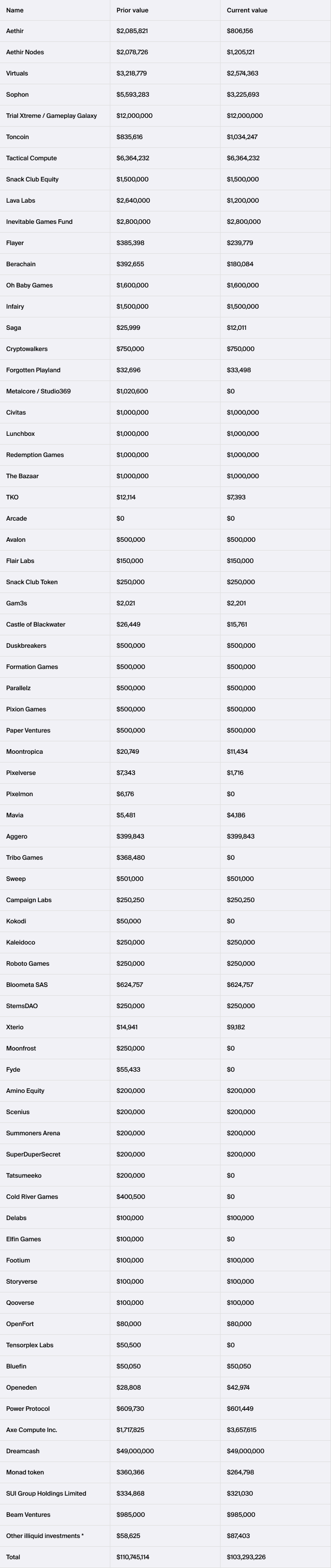
The Treasury dashboard includes a section for “Other Investments”, split across the three categories of liquid crypto assets, NFTs and venture investments. Since the start of the year and during the last quarter, some of the portfolio projects have been underperforming and have seen a significant loss of value. The Other Investments line item aggregates the costs and current realizable value of those projects that have underperformed and thus will usually reflect a significant loss relative to the cost amount.
We feel it is important to be transparent with the community while maintaining the quality of the Treasury reports, thus positions which have negligible value or are written off can be tracked as “Others”, removing the need to provide each one with its own line.

Beam’s positioning over the past quarter reflects where the market itself has been moving: from infrastructure toward the application layer, with teams increasingly judged on real usage rather than the rails they operate. This played out clearly across the portfolio. Aethir extended beyond raw GPU supply into hosting AI agents on its own cloud, Sophon announced it would sunset its chain to rebuild as a consumer product studio, and SUI Group Holdings shifted from passive holder to active financier while backing purpose-built AI for financial markets.
Rather than anchoring to a single category, Beam’s approach has been to stay flexible and opportunistic, allocating toward emerging technologies where long-term value is being built. The portfolio now carries growing exposure to AI, compute and data infrastructure, while retaining its roots in interactive and consumer-facing applications.
The direction remains consistent with the core strategy: staying in sync with market evolution, and positioning early around the sectors likely to define the next phase of the cycle.

This quarter Aethir extended its business beyond raw GPU compute, launching Aethir Claw, an AI agent hosting platform built on its existing GPU cloud.
The move marks Aethir stepping into the application layer rather than only supplying infrastructure to other companies. Aethir Claw lets users deploy AI agents directly on Aethir’s compute, which ties end-user activity back to network usage. Each instance consumes Aethir’s cloud resources, meaning application-level demand now feeds directly into ATH consumption.

Sophon made its biggest pivot yet in Q2 2026, announcing that it will sunset the Sophon Chain and reintroduce itself as Soph(+), a consumer product studio building on Base.
The reasoning is straightforward. After evaluating the business, the team concluded that running its own chain no longer justified the cost, with value increasingly shifting to the application layer, where utility, taste, and distribution matter most. Rather than maintaining infrastructure, Soph(+) is redirecting its team and focus toward building consumer applications. A migration guide has been published for Sophon Node holders and anyone holding assets on the chain.
The studio’s first product is Pyre, a daily payments app introducing what Soph(+) calls “entertainment finance.” Pyre turns ordinary transactions into interactive moments, where every payment opens a “bill” that users can either play or let settle. More consumer apps are planned for release throughout the year.
Sunsetting a chain that the team spent years building is no small decision. But the pivot plays to what Soph(+) has always positioned as its strength: creating high-quality consumer experiences with a direct path to users. We will continue to watch how Soph(+) positions itself ahead of its upcoming launch.
This quarter, Openfort expanded its embedded infrastructure layer for stablecoin applications, with the goal of enabling developers to ship products in days rather than months. The company reports that more than 50 projects are building on the platform, and it has approximately 37.5K followers.
The quarter’s releases centered on abstracting away chain, token, and gas friction. Universal Wallet Funding allows users to top up with any token on any chain and receive the specific asset an application requires. Gas fees can be paid in stablecoins that users already hold, supported by a Global Deposit Address with background auto-bridging and auto-swapping. On the tooling side, Openfort shipped webhook signing for event verification and searchable Project Logs.
Distribution efforts included a WalletConnect Pay integration, Farao (a Hyperliquid trading app) as the flagship implementation of headless deposits, and a CLI alongside agent-native workflows aimed at autonomous agents as users.

Sui Group Holdings reports that Q2 2026 marked a deeper role as an institutional capital partner within the Sui ecosystem while leaning into the agentic finance narrative.
Through recent moves, including expanding its lending agreement with Bluefin, SUIG increased its total SUI loan to 6 million and doubled its revenue share to 11%, with the additional capital supporting Bluewater’s acquisition of Suilend. This positions SUIG as an active financier rather than a passive holder. Its treasury also grew to approximately 108.8 million SUI as of May 19, 2026.
On the AI side, SUIG co-led a $15 million funding round for Nof1, an AI research lab training models for financial markets, and invested in Recursive Superintelligence’s $650 million funding round. Both investments reflect the thesis that purpose-built intelligence, rather than general-purpose models, will define the next phase of agentic trading.
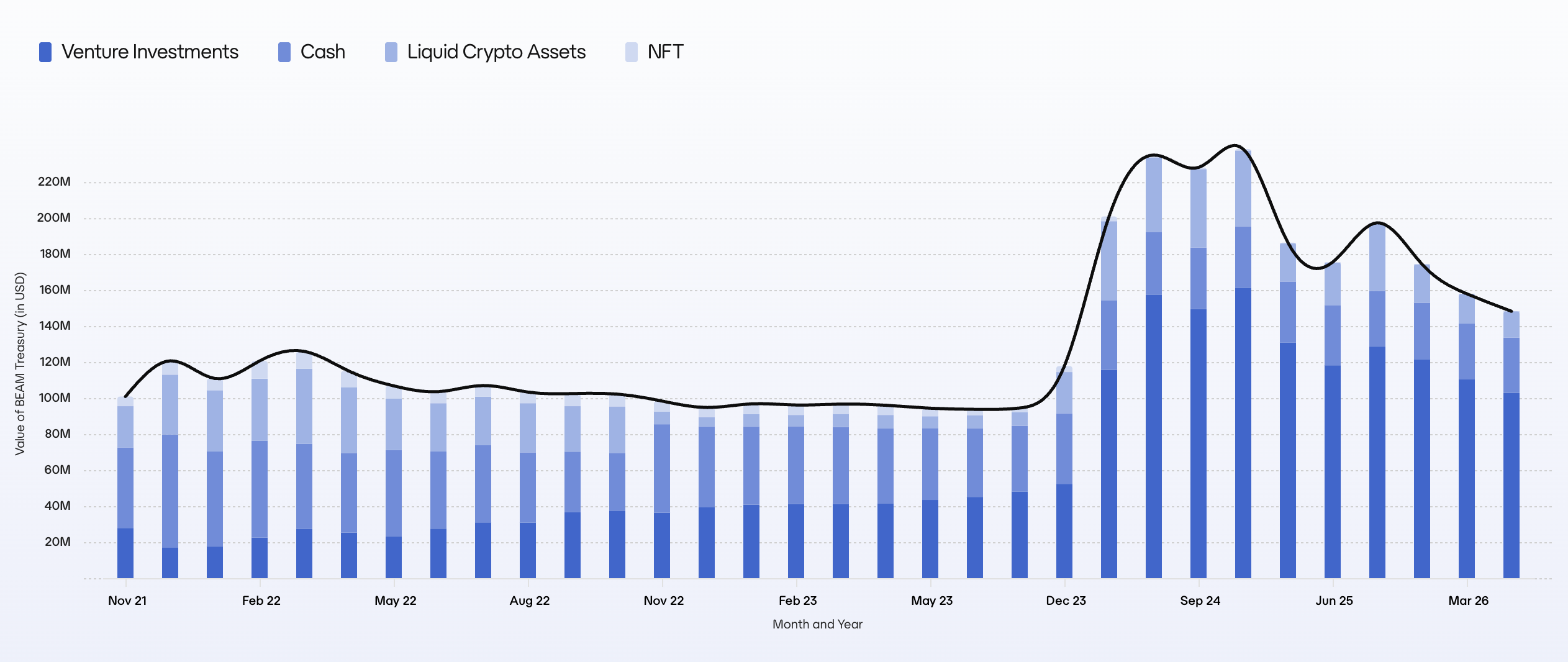
We have updated our treasury dashboard with the most recent data as of 30th June 2026.
Following numerous community requests, we’ve added exciting new features to the treasury dashboard, with the most important being the ability to display our complete treasury balance, including our BEAM holdings. While we’re proud of our substantial non-native treasury, we also want to present the full picture.
As development continues to evolve, we welcome feedback through any of our social channels. Without further ado, we invite you to explore the current treasury status on our updated dashboard.
Visit the dashboard here - treasury.onbeam.com
To operate completely transparently, we would like to provide a full list of wallet addresses the Treasury currently utilizes.
As the broader market navigated a challenging quarter, the Treasury demonstrated relative resilience while the portfolio continued to mature across key verticals. Beam remains focused on disciplined capital allocation and supporting ecosystem growth through shifting market conditions.
All balances and prices are based on calculations made as of June 30th, 2026.
All investments made after June 30th, 2026. are not included in the Treasury report, unless specifically mentioned.
Comments
Nothing yet. Say the first thing.
Sign in to join the conversation.