
This Substack is by David Perrine. I write about architecture, aesthetics, design theory, and philosophy. If you enjoy my work, please consider subscribing.
I was engaged in a discussion with the Dean of IIT’s architecture program (Reed Kroloff) where he noted that ‘Architectural Theory’ as an institution has recently been destabilized, or I guess restabilized depending on which side of the aisle you occupy. He suggested that there used to be a time when architecture could be discussed disembodied from architectural production or formal technique. Today, such discussions are unpopular (at least at his institution).
In an attempt to ensure I understood his point, I proposed that Greg Lynn’s “Folding in Architecture” seemed to be a manifestation of this more contemporary ethos. In Folding, Greg pulled from the purely theoretical metaphysics of Deleuze, and other Baroque notions, but connected these disembodied ideas with a real technique for architectural production, showing an actual path for an architectural product. This varies from older, more abstract, theories that made no real attempt to relate to architectural technique. The example given by Reed was the linguistic and structural analysis of Eisenman. Reed confirmed I had understood him correctly and noted that Greg represented a potential inflection point in the discourse of theory.
I regret not asking for his opinion on this shift. In the past, I have argued that an architecture theory which remains isolated from construction has utility when appropriately used.1
That being said, the idea that an architectural concept can remain disembodied from architectural production sounds strange or impractical, but I would argue it isn’t too rough to stomach if one keeps an open mind. As a provocation, one may be familiar with a parallel idea brought up by legendary theoretical physicist, Paul Dirac in his essay “The Evolution of the Physicist’s Picture of Nature” published in Scientific America 1963. There, he applying a similar argument in the realm of theoretical physics—outlining the utility in beautiful in not-yet-practical mathematics.
“It is more important to have beauty in one’s equations than to have them fit experiment.” - Paul Dirac
Additionally, Stan Allen has been perfectly willing to explore ideas which to him have questionable merit. For example, the last sentence in his introductory paragraph to Field Conditions:
“Field conditions cannot claim to produce a systematic theory of architectural form or composition. The theoretical model proposed here anticipates its own irrelevance when faced with the realities of practice. These are working concepts derived from experimentation in contact with the real” (Allen 2).
Thus, I argue that an architectural idea can be both beautiful and useful while paradoxically being unfeasible or under-developed for construction.
My most clear recollection of such theory in the realm of the arts came from Kant’s “The Critique of the Power of Judgment”. There, he delineates between the various types of aesthetics one can perceive. Specifically, concepts like agreeable, pleasing, tasteful, beautiful, and others were of interest. To Kant, these are all distinct concepts with their own complex definitions and connotations.
It is unclear if understanding the precise definition of these terms helps architects produce better architecture. The field has long ago strayed from the precision and clarity of a dogmatic, transcend goal such as beauty, or even function. Architects do what they themselves find interesting with the clients that afford them the right to do so. This classical notion of beauty doesn’t exist.
Additionally, the sensations of ‘pleasing’ and ‘agreeable’ to Kant are similar when experienced but come from different places (both are experienced as positive inclination towards something but ‘pleasing’ comes from an assumed intersubjective harmony or beauty while ‘agreeability’ comes from subjective preferences). Thus, understanding the difference when the experience is the same for the client isn’t too useful
That being said, Reading Kant, Allen, and Dirac have been personally very useful. These concepts have personally affected how I interact with media, and this has utility.
In an attempt to replicate such use(less/ful) theory production, I wanted to discuss other aesthetic terms and their structural relationship to beauty.
Enjoy and I hope you are doing well.
- David 🦆
Kant defined beauty as “the judgement of taste without interest.”2 Interest refers to the subjects individual feelings, biases, and contexts. A person judging something to be beautiful should also assume that others find that object beautiful as a result, and thus, beauty is a property of that object as opposed to a subjective characterization. Kant describes this as an assumed subjective universality.
In this text, Kant does not initially define beauty beyond an inter-subjective state of pleasure without judgment. This account describes an affective condition rather than a determinate aesthetic category. Beauty only becomes structurally intelligible once Kant introduces the sublime, at which point beauty is clarified relationally. While this does not constitute structuralism in the historical sense, it nevertheless mimics a structural logic, insofar as meaning emerges through opposition.
He associates beauty with an expression and articulation of limitation, while the sublime is the expression of vastness. Sort of like the differentiation of quality and quantity, of order and chaos.
Placing sublime as the binary opposition to beauty as opposed to ‘ugly’ is very provoking, but Kant isn’t the only figure who defined the terms as such. Burke also placed sublime and beauty as opposites.
“The most obvious point that presents itself to us in examining any object, is its extent or quantity. [...] A great beautiful thing, is a manner of expression scarcely ever used; but that of a great ugly thing, is very common. There is a wide difference between admiration and love. The sublime, which is the cause of the former, always dwells on great objects, and terrible; the latter on small ones, and pleasing; we submit to what we admire, but we love what submits to us; in one case we are forced, in the other we are flattered into compliance. In short, the ideas of the sublime and the beautiful stand on foundations so different, that it is hard, I had almost said impossible, to think of reconciling them in the same subject, without considerably lessening the effect of the one or the other upon the passions. So that attending to their quantity, beautiful objects are comparatively small.” (Burke)
“But notable differences between the two (the beautiful and the sublime) also strike the eye. The beautiful in nature concerns the form of the object, which consists in limitation; the sublime, by contrast, is to be found in a formless object insofar as limitlessness is represented in it, or at its instance, and yet it is also thought as a totality: so that the beautiful seems to be taken as the presentation of an indeterminate concept of the understanding, but the sublime as that of a similar concept of reason. Thus the satisfaction is connected in the first case with the representation of quality, but in this case with that of quantity. Also the latter pleasure is very different in kind from the former, in that the former (the beautiful) directly brings with it a feeling of the promotion of life, and hence is compatible with charms and an imagination at play, while the latter (the feeling of the sublime) is a pleasure that arises only indirectly, being generated, namely, by the feeling of a momentary inhibition of the vital powers and the immediately following and all the more powerful outpouring of them; hence as an emotion it seems to be not play but something serious in the activity of the imagination.” (Kant)
Using texts by Burke and Kant, we can develop an understanding of beauty through its relationship to the sublime. They are opposites in some ways, but both possess a high status in the art world and therefore share certain attributes and privileges. Each is associated with pleasure, and each has historically been understood as a legitimate ambition of the arts. The beautiful is however predicated on limitation, refinement, and quality, while the sublime, on vastness, exhaustion, and excess.
Due to this privileging of terms, it is hard to argue that they represent pure opposites, but instead, operate in a more network of terms. An addition of two more aesthetic concepts succinctly completes our analysis.
The first term I would like to introduce is the banal. Banal aesthetics is based on limitation, like the beautiful, but lacks transcendence. It is minimally harmonious and lacks elegance and intricacy. The formal language of banal products are most similar to minimalism but must not be confused with sublime minimalism. Minimalist art often speaks to a scaleless whole or something larger than itself. Rothko’s work for example, feels close to the banal, but presents a heaviness of which is clearly sublime.
This banality in architecture is somewhat repetitive and un-aspirational. Its compositional attributes supposedly come from it’s adherence to programmatic efficiency. It lacks the purity and abstraction of Modernism, while keeping its simplicity. It is sometimes clumsy and often inexpensive.
A purely repetitive architectural language sometimes appears banal but risks becoming sublime because repetition resists limitation. Such concept is echoed in Stan Allen’s “Field Conditions, where Stan notes that large repetitive systems speak to an indefinite (infinite) whole.
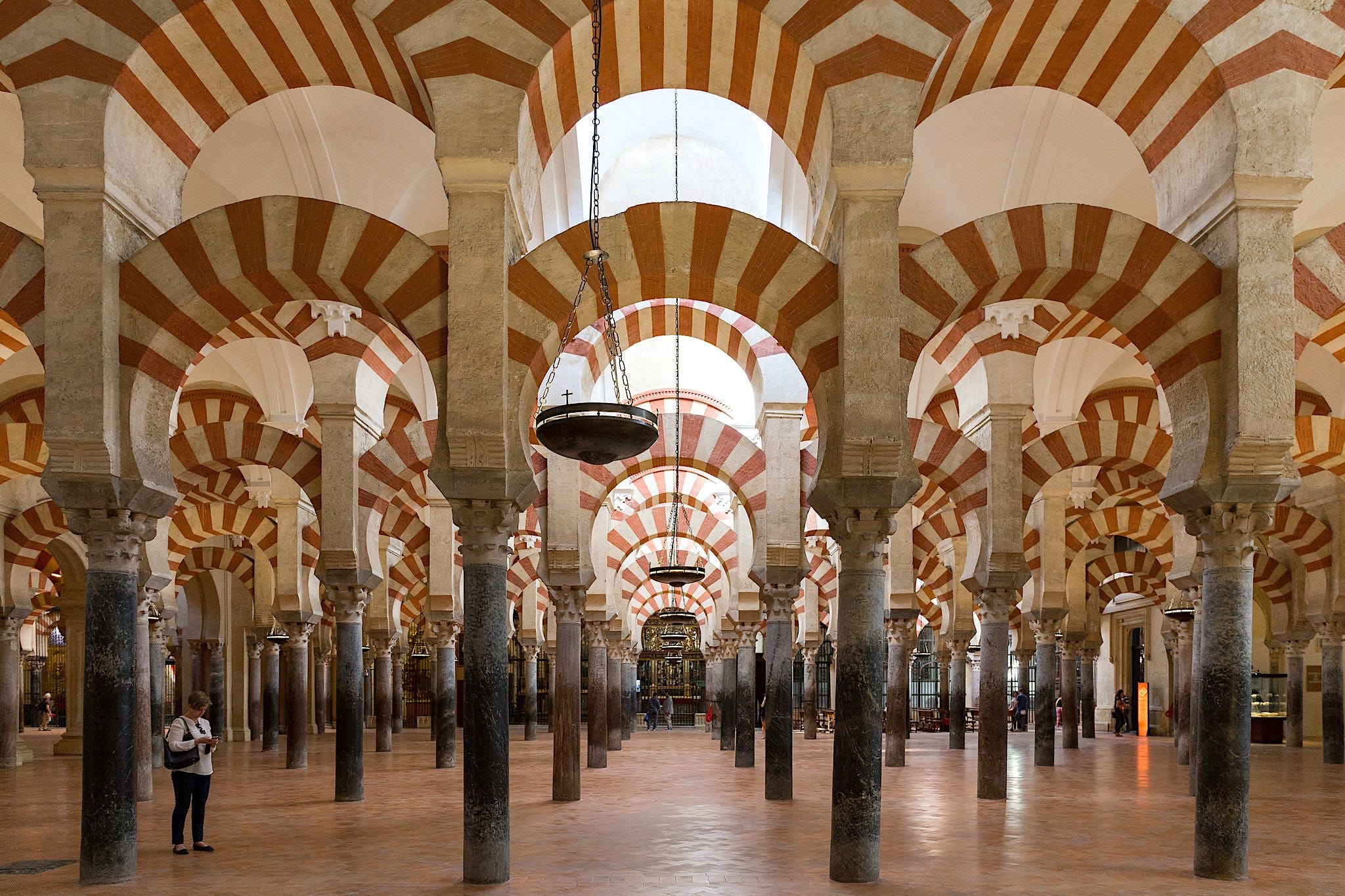
In Cordoba, for example, independent elements are combined additively to form an indeterminate whole. The relations of part to part are identical in the first and last versions constructed. The local syntax is fixed, but there is no overarching geometric scaffolding. Parts are not fragments of wholes, but simply parts. Unlike the idea of closed unity enforced in western classical architecture, the structure can be added onto without substantial morphological transformation. Field configurations are inherently expandable; the possibility of incremental growth is anticipated in the mathematical relations of the parts (Allen 2).
Achieving banality requires a healthy repetition (to avoid complexity) with only a small twist. A twist that is too large risks becoming too complex, but not a big enough twist won’t break the repetition and the project becomes too repetitive or abstract.
Practitioners of banal architecture include Studio Ames and Manthripragada, along with many GSD professors. It approaches the still life aesthetic discussed in my last piece here.
The introduction of banality to beauty and sublime can be represented with such diagram:
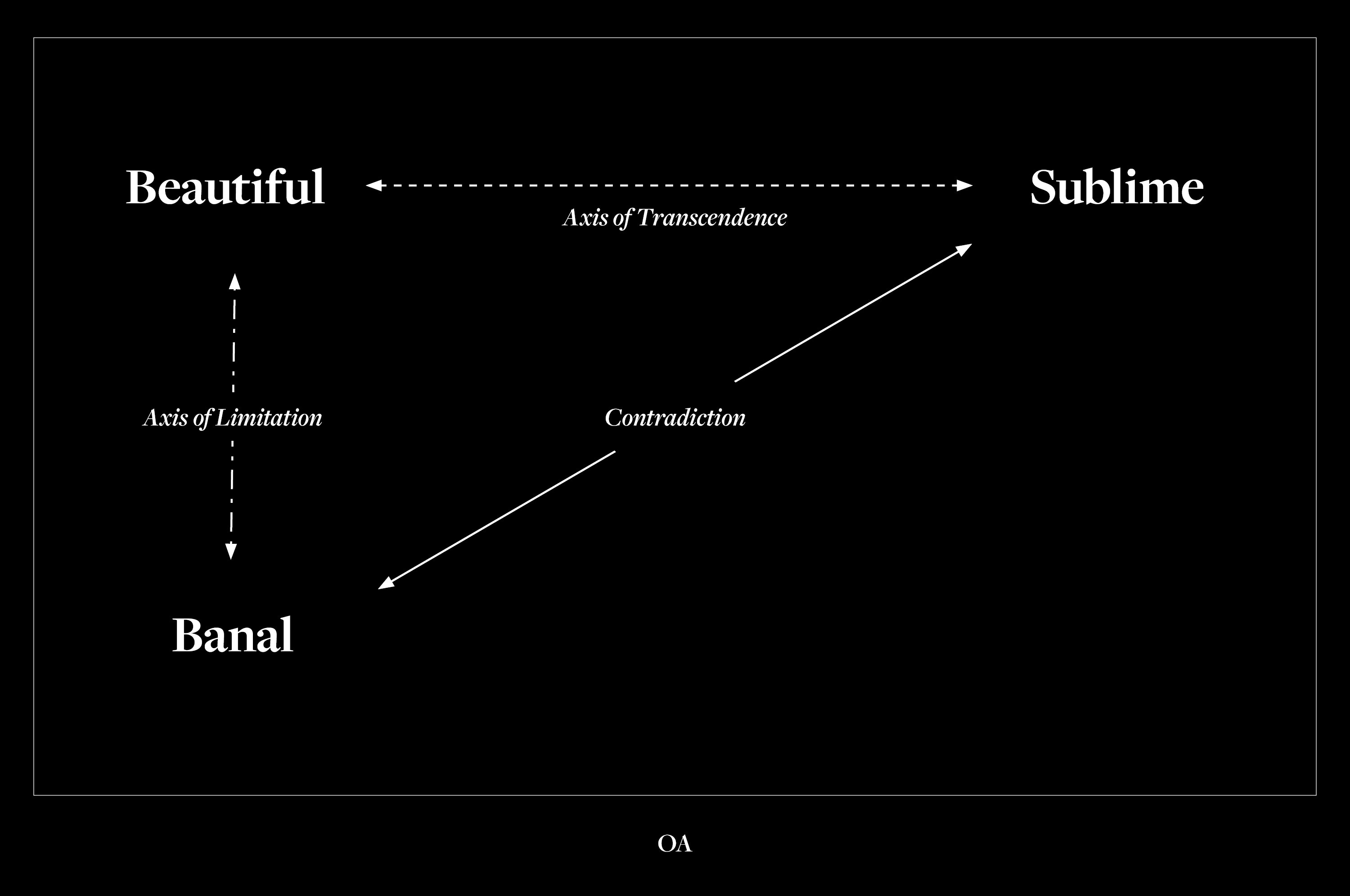
Beauty and sublimity represent two poles in this aesthetic matrix. The banal shares an interest in limitation but lacks status. Such diagram begs the question of an additional fourth term—One that shares an interest in the limitless like the sublime, and possesses the low status of the banal. In this position, we will use the term grotesque.
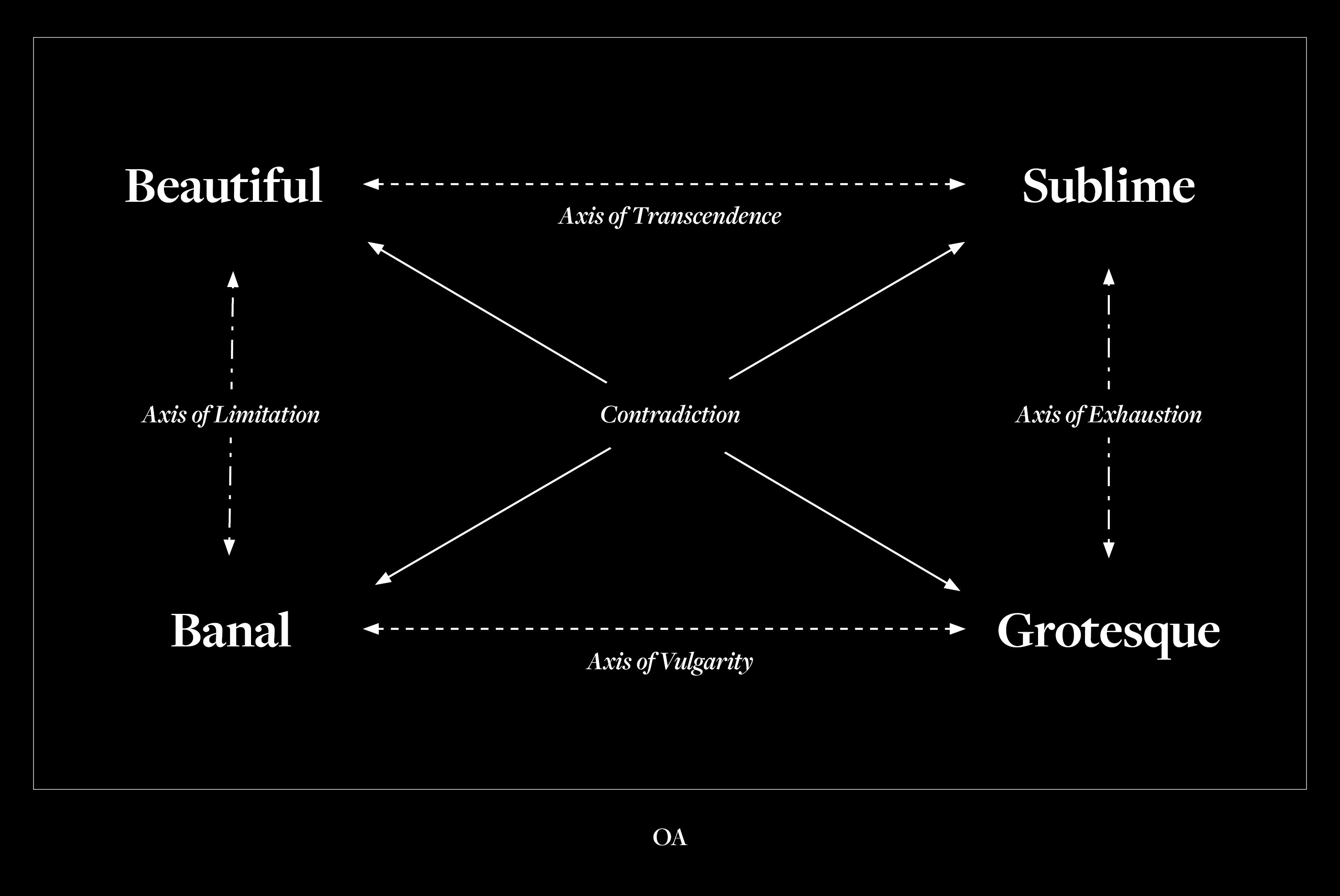
Grotesque aesthetics are based on exhaustion, like the sublime, but without its privileged status. It is dense, offensive, overwhelming, and sometimes comedic. The grotesque occasionally produces intimations of elegance before distorting it.
The grotesque shares many attributes with camp, though the two are not identical. Both operate through excess and both undermine transcendence through exaggeration and vulgarity. Camp is occasionally self-aware but the grotesque rarely is.
In architecture, the grotesque emerges when complexity or semiotics is pursued past legibility. It was first seen in Neoclassicism, when various Greek and Roman patterns were mashed together, forming strange results. Today, Grotesque-ness in architecture is best recognized the deconstructive work of Gehry or Daniel Libeskind.
I should note that the banal or grotesque are not dirty words and my characterizing of architectural work as such should not be confused as a cast of dispersion. Architecture that is banal or grotesque has certain freedoms not afford to other aesthetic projects. If anything, the existence of the beautiful and the sublime are dependent on their counterpart terms.
One of my favorite examples of a usage of the grotesque in media comes from the 2024 Body-Horror film, The Substance, where distortion, pressure, and exhaustion are necessary to its message on feminine beauty standards and the entertainment industry. Similarly, banal design was necessary for the capitalist critique seen in the hit show, Severance.
What matters here is not whether architecture should pursue beauty, sublimity, banality, or the grotesque, but that these categories still structure how architectural work is received. Even when rejected, they continue to operate and naming them only clarifies the discipline.
Thank you for reading. Please consider subscribing.
I would guess Reed would be indifferent, suggesting that the role of educators is to respond to the interest of markets and cultures.
this is somewhere in The Critique of the Power of Judgment. find it if you want. this isn’t an academic paper, fight me.
Comments
Nothing yet. Say the first thing.
Sign in to join the conversation.