
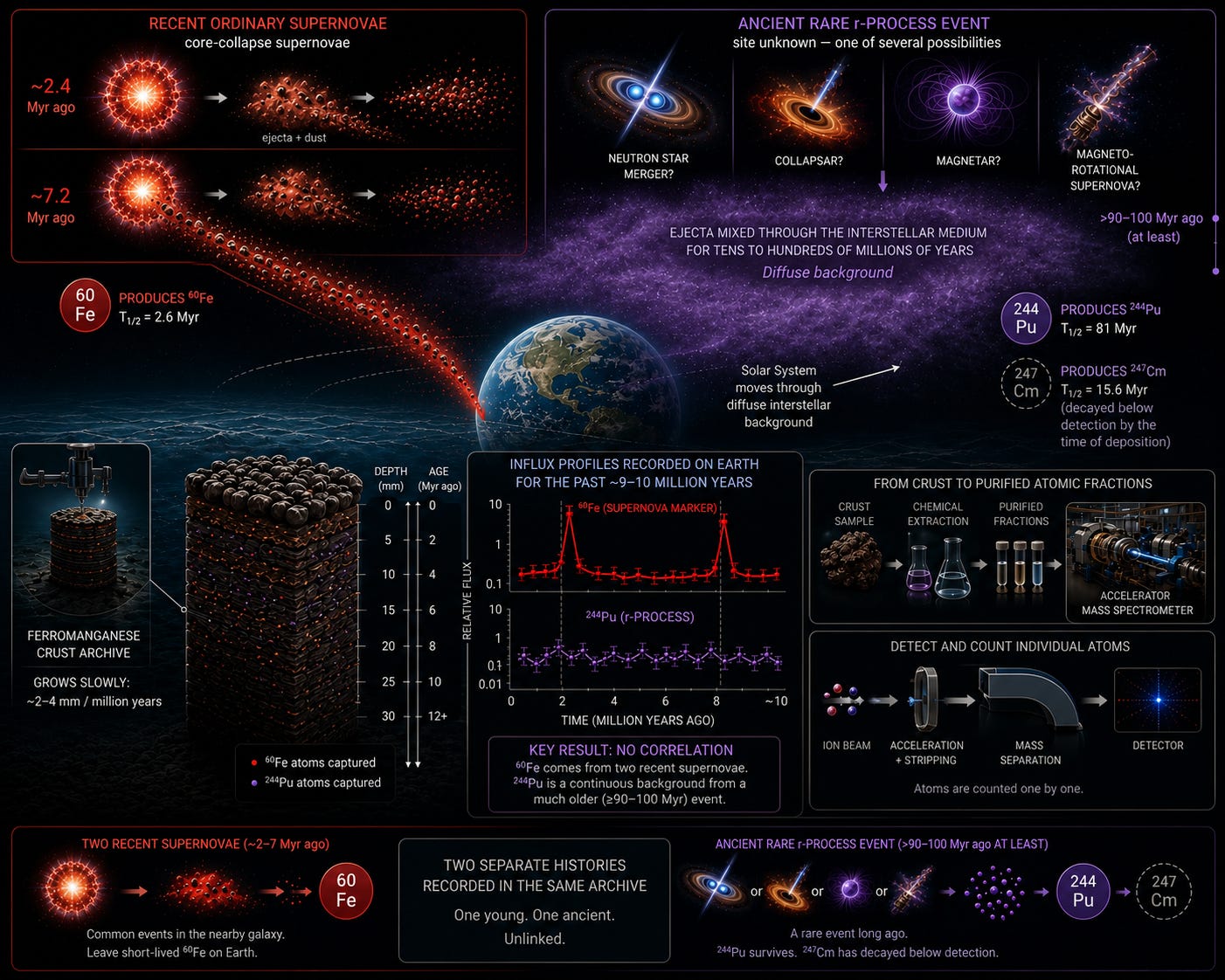
Two radioactive histories preserved in one deep-ocean crust: recent supernova-produced iron-60 and a diffuse plutonium-244 background from a much older, rare r-process event.
Every atom in your body has a history.
Hydrogen was born in the Big Bang. Carbon, oxygen, and iron were forged inside stars.
But many of the heaviest elements in nature including uranium, plutonium, gold, and platinum have a more violent origin story. They require environments so neutron-rich and extreme that astrophysicists are still debating exactly which cosmic events produce them.
A new paper in “Nature Astronomy” moves that argument forward. Not with a telescope pointed at the sky, but with a drill pointed toward the seafloor, 4,830 metres beneath the central Pacific.
Earth keeps a geological diary
Certain deep-ocean rocks, called ferromanganese crusts, grow at a rate that's almost difficult to comprehend: roughly 2 to 4 millimetres per million years.
As they grow, they incorporate material deposited from the ocean, including traces of interstellar radioactive dust that reached Earth after astrophysical explosions. Radioactive isotopes decay at known rates, so each one carries a built-in clock.
The result is a geological archive that has been recording our passage through the local interstellar environment for millions of years, without anybody needing to build or maintain it.
Three radioactive messengers
The researchers searched the crust for three isotopes, using accelerator mass spectrometry sensitive enough to count individual atoms.
“Iron-60” is produced in core-collapse supernovae. Its half-life is about 2.6 million years. Because it decays relatively quickly, live iron-60 found on Earth is evidence of comparatively recent nearby stellar explosions.
“Plutonium-244” is an actinide produced by rapid neutron capture. The r-process responsible for many of the universe's heaviest nuclei. Its half-life is about 81 million years.
“Curium-247” is also produced by the r-process, expected to form alongside plutonium-244. Its half-life is much shorter. About 15.6 million years. That difference is what turns the curium-to-plutonium ratio into a clock.
Two nearby supernova-debris influxes
The iron-60 record showed two clear deposition peaks: “2.4 ± 0.2 million years ago” and “7.2 ± 0.7 million years ago”. Earlier work had found evidence for both episodes; the new measurements improve their timing and statistical resolution considerably.
These peaks record two distinct periods when supernova-produced material reached Earth. They don't necessarily prove that exactly two individual stars were responsible. Each broad influx could reflect transport through the interstellar medium, multiple explosions, or Earth moving through previously distributed ejecta.
But the basic conclusion is secure: Earth received two comparatively recent deliveries of supernova-produced iron.
Then the plutonium refused to cooperate
If the same recent supernovae had also produced the detected plutonium-244, its abundance should track the iron peaks. It doesn't.
The plutonium signal stays low and roughly continuous across the entire measured interval, from about 1.2 to 9.1 million years ago. There's plutonium during periods when iron-60 is elevated. There's also plutonium when no corresponding iron influx appears at all. The two profiles aren't meaningfully correlated.
That argues against ordinary iron-producing core-collapse supernovae being the primary source of the plutonium in the crust. Using the especially low plutonium-to-iron ratio around the older iron peak, the authors constrain the plutonium-244 yield of a typical iron-60-producing supernova to less than roughly 10⁻¹⁰ solar masses, vanishingly little. That estimate assumes comparable dust formation, interstellar transport, and geological incorporation efficiencies for iron and plutonium, so it's best read as a conditional limit rather than a fully model-free number.
Still, the broader result is hard to escape: the recent supernova material and the plutonium background appear to have different origins.
The missing isotope becomes the clock
This is where curium-247 matters.
R-process models predict that curium-247 and plutonium-244 are initially produced together at a ratio around “²⁴⁷Cm/²⁴⁴Pu ≈ 0.5” once the short-lived parent nuclei that feed both isotopes have finished decaying. But curium decays much faster than plutonium. If the actinide-producing event had happened recently, measurable curium should still accompany the plutonium.
Instead, the researchers found no statistically significant interstellar curium signal, once contamination from nuclear-weapons fallout was subtracted out. Their measured upper limit was “²⁴⁷Cm/²⁴⁴Pu < 0.04”.
That absence sets a lower limit on the age of the event. Without correcting for chemical fractionation in the crust, it must have happened more than roughly “70 million years ago”. After applying the authors' estimated correction for preferential plutonium loss specific to this crust, that limit becomes more than roughly “95 million years ago” the basis for the paper's headline conclusion that the last nearby actinide-producing r-process event occurred at least 90 to 100 million years ago.
For perspective, that's older than the asteroid impact associated with the end-Cretaceous mass extinction, 66 million years ago.
Two different histories in one archive
The same crust recorded two astrophysical histories.
One is comparatively recent: supernova-produced iron reaching Earth around 2.4 million and 7.2 million years ago.
The other is much older: a rare r-process event that produced actinides at least tens of millions of years earlier. Probably more than 95 million years ago, under the authors' preferred chemical correction. The exact source remains unknown. Possible environments include neutron-star mergers, collapsars, magnetars, and unusual magnetorotational supernovae. The paper doesn't choose a winner.
Its conclusion is narrower, and stronger for it: the plutonium background wasn't produced by the same recent, ordinary supernova activity that deposited the iron-60. The ancient r-process ejecta apparently mixed through the interstellar medium over immense stretches of time, leaving a diffuse background through which the solar system later travelled.
The crust didn't need to understand any of this. It simply kept recording.
What the study actually establishes
The paper doesn't prove that neutron-star mergers are the sole source of the universe's heavy elements. It doesn't identify the ancient event. And it doesn't imply that ordinary supernovae produce zero r-process material at all.
What it does show is that frequent, ordinary iron-60-producing supernovae are unlikely to explain the local plutonium-244 abundance recorded in this crust. The data also disfavor a previously proposed nearby plutonium-producing kilonova within the last 10 million years.
The surviving picture: local actinides were supplied by an older, rarer event, rather than steadily replenished by the recent supernovae that produced the iron signal.
Sometimes science advances because a new observation identifies the answer. Other times it advances because the wrong explanation can finally be ruled out.
Reading the galaxy without looking up
The most striking part of this work may be the method itself.
Astronomy is usually imagined as the act of pointing instruments into space. This study reconstructed part of our galactic neighborhood's history from individual radioactive atoms trapped in a rock growing in darkness at the bottom of the Pacific.
Earth wasn't merely struck by cosmic debris. It archived it. Iron-60 preserved the arrival of recent supernova material. Plutonium-244 preserved the fading remains of a much older r-process event. The absence of curium-247 revealed how long ago that event must have occurred.
Every isotope carried a different piece of the story. Together, they tell us that the solar system has spent millions of years moving through the diffuse wreckage of ancient stellar catastrophes. Including events that occurred long before there was anyone here to recognize what their atoms meant.
Paper 📄
Koll, D., Fichter, S., Hotchkis, M.A.C. et al. “The timing of the last r-process event near Earth from interstellar ⁶⁰Fe, ²⁴⁴Pu and ²⁴⁷Cm deposition on Earth.” Nature Astronomy (2026). (https://doi.org/10.1038/s41550-026-02841-6)
No posts
Comments
Nothing yet. Say the first thing.
Sign in to join the conversation.