
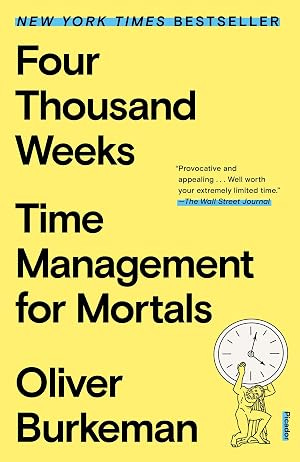
I don’t often read books by (white) (men). This was a choice I made years ago realizing that if I left my reading choices to the zeitgeist and recommendations by friends and reviewers, I wasn’t reading as many POC authors, writers from the Global South, translated works, and so on. (You can read a little more background in an essay I wrote for Wildness a few years ago.)
However, I relax this rule for nonfiction and am a huge fan of the books Why We Sleep, Poverty by America, When, The Extended Mind, 8 Steps to a Pain-Free Back (the last two by white women), and now this 4000 Weeks book. My sister recommended both Oliver Burkeman’s books to me specifically, in case it helped me get over my debilitating Type A stress about not getting enough done, ever. I’ve read the first book, and it really has helped! So if you have this particular psychology, read on. Also move over to Storygraph from Goodreads: it’s cute and not Amazon — created by a Black woman — and you can easily port over your Goodreads reviews.
Reading 4000 Weeks: Time Management for Mortals, by Oliver Burkeman felt both like an indictment, and surprisingly, a balm. Like Burkeman, I have found myself increasingly trapped by the capitalist (and Calvinist!) ethos of productivity: “haunted by the guilty feeling that we ought to be getting more done, or different things done, or both.” Not only is every minute valued according to how it’ll help us achieve some future goal, but even our leisure time has become “an opportunity for recovery and replenishment, for the purposes of further work.”
This isn’t surprising given that we live in a capitalist economy that has yoked us all to a system of time-based productivity. Burkeman calls this instrumentalizing:
“When your relationship with time is almost entirely instrumental, the present moment starts to lose its meaning... One way of understanding capitalism, in fact, is as a giant machine for instrumentalizing everything it encounters—the earth’s resources, your time and abilities (or “human resources”)—in the service of future profit.”
I myself have been in “productivity” mode for so long that it’s hard for me to think about leisure for leisure’s sake. When was the last time I did a non-worky thing that wasn’t for self-improvement or resting up to do more? Burkeman suggests taking up the “slightly embarrassing” hobby: ye olde scrapbook or D&D figurine painting or fill in your crafty blank. You’re likely not doing a hobby to get better at it or to show it off. You’re doing it because the doing brings you joy or peace. What a gift!
“Spending at least some of your leisure time “wastefully,” focused solely on the pleasure of the experience, is the only way not to waste it—to be truly at leisure, rather than covertly engaged in future-focused self-improvement.”
Burkeman’s oft-repeated mantra is about how so much of our anxiety comes from the (insane) idea that we could do it all, AND that we might do it perfectly. However, not only will we fail to do it all, we will fail to do most everything, and what we do accomplish will fall far short of our exquisite imaginations.
“Loss is a given. That ship has sailed—and what a relief.”
But lest you think this book is about settling for less, or giving up on big dreams, it’s not. It’s not even about acknowledging that we don’t have enough time or talent. Rather, Burkeman, armed with the maxims of philosophers past and present, flips all of it: “maybe it’s not that you’ve been cheated out of an unlimited supply of time; maybe it’s almost incomprehensibly miraculous to have been granted any time at all.”
It’s a way to reframe everything, even and especially, everyday annoyances. Burkeman thinks of his friend who died too early: “What would David have given to be caught in this traffic jam?” This may sound like schadenfreude. Also it’s true that the pithism “at least we’re alive” might not fix road rage. But here’s the rub: wishing things were otherwise, or that we had made better decisions, or that others had acted differently, is basically another form of anxiety.
“Worrying about the future robs the present of its power: its intensity, its vividness, its meaning.”
The fact that we’re here (in the traffic jam or at the most joyful occasion) was the result of far more random confluences than you could imagine. There’s so little certainty that things will go our way, it’s kind of astonishing we got here at all. Burkeman assures us that once we stop expecting, the anxiety dissipates. I am a bit suss it will actually dissipate, but that’s probably because I’m still hoarding a bit of expectation…
“Whatever you value most about your life can always be traced back to some jumble of chance occurrences you couldn’t possibly have planned for.”
The puzzle piece I personally struggle with is creative insecurity. I’m not benchmarking myself against Toni Morrison, but I’m also far too quickly persuaded of my artistic incompetence. At one end of the scale, not everyone (including me) is going to like my work all the time. At the other, I may genuinely delight people with something I make. I know I’m human, and I need acceptance and appreciation and a sense of creative competence. But I’m still annoyed that I spend so much of my precious time worrying about ending up on the bad end of the scale. And even if I do, is it really such a big deal?
“Originality lies on the far side of unoriginality: the trial-and-error phase of copying others, learning new skills, and accumulating experience.”
Burkeman recommends ditching the good-bad scale altogether. Since any outcome is wholly unpredictable, the point (just like with our hobbies) is to enjoy the making, the creative discovery (yes, both the boring and the brilliant bits). After all, haven’t I already decided that making art is a worthy enterprise, no matter what comes of it? It reminds me of the song “Matt and Ben” by the indie band Woodpecker! Singer-songwriter Josh Steinbauer is talking about the (musical) pursuit of fame, but in the end, he says, “we make music for our friends.”
“Your novel’s worth writing if it moves or entertains a handful of your contemporaries.”
I found these questions Burkeman poses especially powerful:
What if you took away the ability to see the results of your labour?
What if you were ok with not knowing what people would say or think?
What would you do with your life?
What would be meaningful in the now?
I’m thinking about Indigenous American ideology which asks you to do the thing that will benefit your descendants, seven generations after you (listen to the Long Time Academy 6-part podcast, esp. Part 2). I’m thinking about AA which asks you simply to “do the next right thing.” I’m thinking about Black civil rights leaders from Harriet Tubman to Rosa Parks to Ruth Wilson Gilmore - none of whom were certain they would see the fruits of their labour, and in fact often saw things go backwards in their lifetime (read Between the World and Me by Ta-Nehisi Coates). Look after your beloveds, speak up for what’s right, keep making things — even if you can’t see where it’s going.
“The cathedral’s still worth building, all the same.”
Burkeman takes aim at our efficiency obsessed culture, our need for ease and speed. Sure we can get same day groceries from Costco, fast fashion from Amazon Prime, takeout meals from DoorDash. But there is something vital and community-minded about talking to your corner bodega worker who makes the bean tlocoyos fresh every day, or the laundromat employee whose son draws Pikachu characters on everything. These “frictions” as he calls them, are essential to connection, to feeling like you live in a real place with real people.
In the last few years, I’ve been trying to buy more from bricks and mortar stores, as local as possible, frequenting the family owned pharmacy over CVS or boycott Target. For harder to source items, I’ve been using Etsy and eBay. I end up paying more, and not getting it as quickly, but it feels better on many levels.
Burkeman’s call to “remove flexibility in exchange for the rewards of community” also applies in the domain of collective action. He means grassroots politics, a vital part of a functioning democracy, but he also means any action you do with others: singing and dancing, watching or playing sports, family get-togethers.
“Time just feels realer—more intense, more vivid, more filled with meaning—when you’re synchronized well with others.”
In some cases, synchrony disappears time altogether. It could even dissolve your sense of self into a larger harmonious whole. As Burkeman says over and over again, what you focus on will define your reality. And if you pay attention to something you don’t especially value, “it’s not an exaggeration to say that you’re paying with your life.”
There are so many unknowable futures, so many uncontrollable permutations in the past. All we really have is the now (or as the poet Mary Oliver puts it, “your one wild and precious life”). If we can internalize that we are not superheroes (except maybe my sister who might be), then we release ourselves from impossible expectation, and focus on the few things (like literally 3 or less) that we can actually accomplish today (imperfectly, humanly).
So the next time you find yourself worrying about not getting enough done, or missing out on something, remember that FOMO is what makes our choices meaningful in the first place. If you could do everything, and had all the time in the world to do it, then no tasks or the order in which you did them, would really matter.
It’s because you have to choose it, that something becomes important. Either way, your time isn’t running out, babies. If you can be where you are, right now, you are time itself.
No posts
Comments
Nothing yet. Say the first thing.
Sign in to join the conversation.