
I’m 83 years old and have been reading The New York Times since a high school history teacher offered our class this advice: “If you want to keep up with what’s going on in the world, read the first paragraph of every article on the front page of the Times and the last paragraph of every editorial.”
I followed that advice—with the addition of daily solving the crossword puzzle, beginning during the Margaret Farrar-edited years through to the current Will Shortz-edited era, although I often disagree with his style and clue choices.
Now through midnight on Oldster’s 5th birthday on August 31st, save 25% off annual subscriptions for life! Oldster runs on paid subscriptions…
Several years ago, I learned that comedian and talk show host Jon Stewart, also a Times crossword addict, timed himself solving it. I began doing the same.
The routine: after returning home from a 7:00 a.m. workout with my swim team at the McBurney YMCA in Manhattan, I drink my first cup of coffee while barreling through that Times front page, the Opinion pages, a stopover at the Business section to see how poorly my New York sports teams are doing, then on to the crossword puzzle.
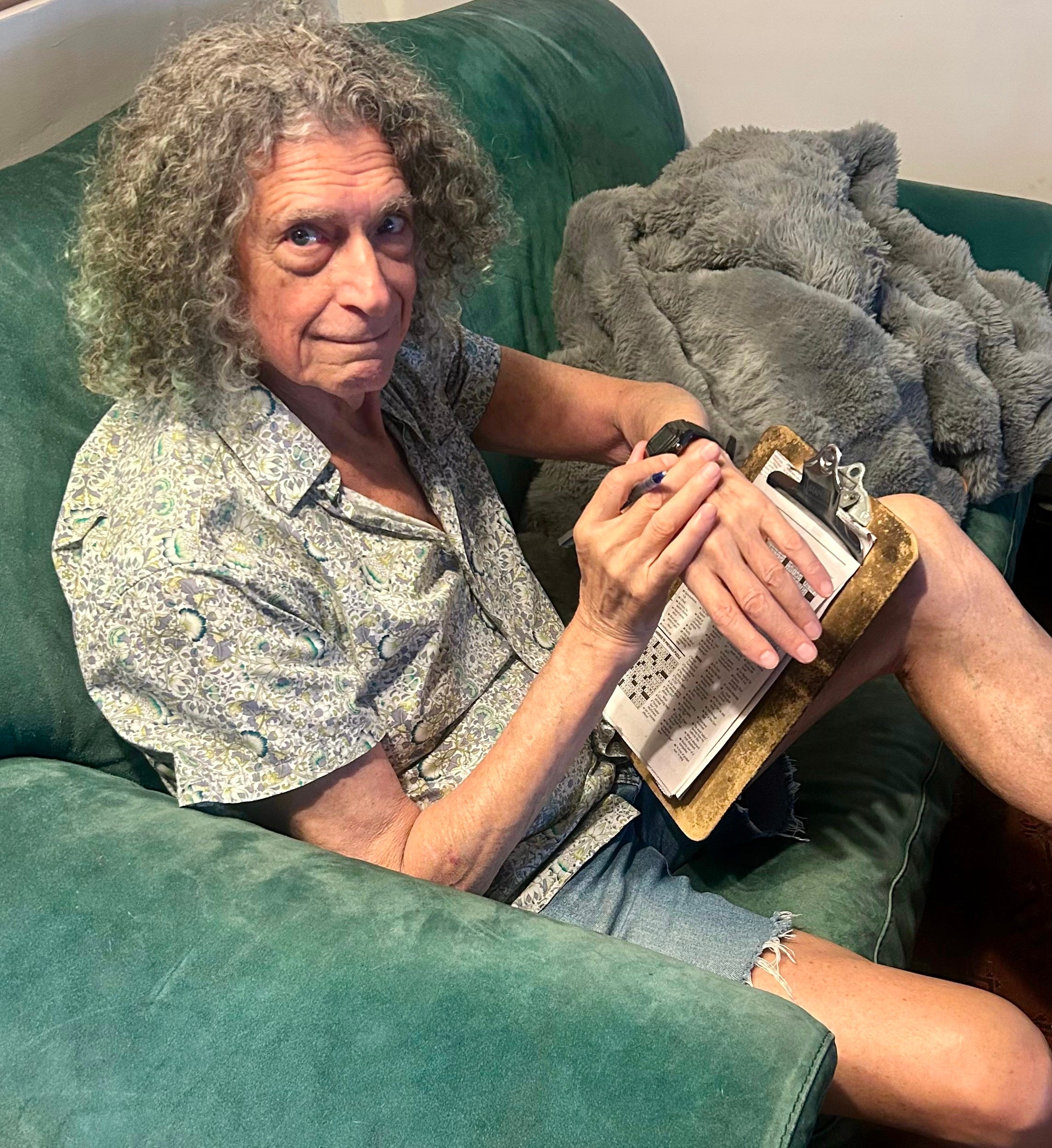
Over a second cup of coffee, with the Arts section folded back and held on a clipboard, a Pilot Precise V5 blue-ink pen in hand, I start the timer on my Casio wristwatch and solve.
Monday’s puzzles are the easiest; they get harder each day through Saturday, the toughest. (Sunday’s puzzle is not the hardest, just the longest—a 21-letter square as opposed to the 15-letter daily—about equal in difficulty to a Wednesday.)
I drink my first cup of coffee while barreling through that Times front page, the Opinion pages, a stopover at the Business section to see how poorly my New York sports teams are doing, then on to the crossword puzzle. Over a second cup of coffee, with the Arts section folded back and held on a clipboard, a Pilot Precise V5 blue-ink pen in hand, I start the timer on my Casio wristwatch and solve.
Prior to Monday, March 24, 2025, Monday puzzles took me 10 minutes or so to complete: half a minute less if I was particularly sharp that day, or if the puzzle was particularly easy; half a minute more if I was exhausted from a swim session.
The first hint of trouble: The Saturday and Sunday before that March 24th Monday produced an oddity: I could not drive “Pack Up Your Sorrows,” a Richard and Mimi Fariña song, from endless mental replay on the turntable in my mind. Normally, “Massachusetts,” by the Bee Gees, is my default song for expelling other ear-candy. But that weekend, “Massachusetts” wouldn’t do the trick; “Pack Up Your Sorrows,” a song I normally loved, would not stop, even in sleep. It drove me nuts.
The second sign occurred upon awakening Monday morning when, out of the blue, I couldn’t remember what the Starbucks medium-sized coffee was called. (A Grande.)
The final clue was the Times puzzle. As I said, Monday’s typical time was about 10 minutes. On the 24th, after an agonizing 19 minutes, I only had four barely legible answers scrawled in, answers I wasn’t even certain of.
Uh-oh, I thought. I called Jeff Engle, my doctor for over 30 years. He knew me inside and out. (Literally; he’s an internist.)
As soon as I told him about the crossword puzzle problem, he ordered me into his office. He performed a brief examination, and asked me to walk across the room and back. Then, he instructed me: “Touch your nose with your index finger, then touch my index finger.” When I was done, he delivered the bad news: “You’re leaving here in an ambulance.”
At Lennox Hill Hospital, a CAT scan revealed a subdural hematoma (SDH): A ruptured blood vessel on the right side of my brain was leaking fluid into the left side of my brain.
That evening, I underwent a procedure called a “mini-craniectomy for evacuation of SDH, with Logeviti Implant”: basically, a hole was drilled into my skull and a narrow tube inserted to drain that bloody brain-fluid into a clear plastic baggie taped to my gown.
Monday’s typical time was about 10 minutes. On the 24th, after an agonizing 19 minutes, I only had four barely legible answers scrawled in, answers I wasn’t even certain of. Uh-oh, I thought.
In the morning, one of the nurses came into the ICU room to replace the fluid-filled baggie with a fresh one. In the afternoon, Dr. Ben Shalom, the neurosurgeon who performed the operation, came in to check on me. I asked him what would have happened if I’d just chalked up the puzzle incident to typical Senioritis. He said, “You probably would have had a stroke, and maybe died.”
When Jeff called to see how I was doing, I said, “Thank you! You saved my life!”
He said, “No. You saved your life.”
What he meant was, timing myself daily on the crossword puzzle had established a base-line for measuring normal cognitive activity. As a result, the radical divergence on that March 24th Monday set off alarm bells.
No, Jeff, I didn’t save my life, the Times crossword puzzle did. As a consequence, I was forced to utter words I never thought I would: “Thank you, Will Shortz!”
P.S. Editor’s note: Remember a few months ago when “Oldster” was a word in the New York Times crossword puzzle?
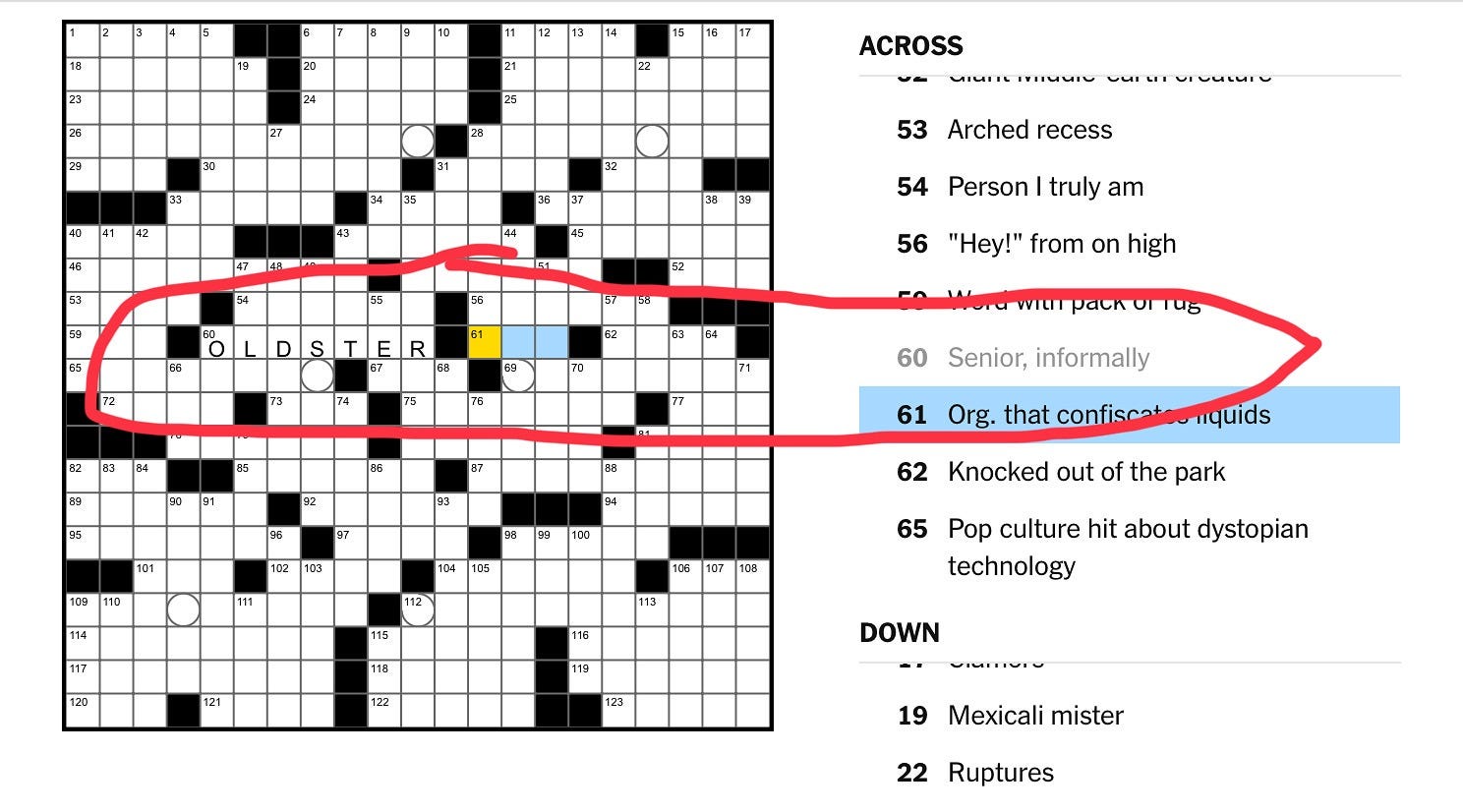
“I love the spirit of Oldster and the fresh perspective it brings to aging with its wide-ranging essays and interviews.” - Deborah Batterman, paid subscriber.
Comments
Nothing yet. Say the first thing.
Sign in to join the conversation.