
… on my way to work at the labor union office where I earn my daily bread. This is the neighborhood where so many of Boston’s undergrads and recent grads rent rooms. The lampposts in Allston are dense with flyers, and the stoops are crowded with secondhand furniture. Everything hums with a kind of semi-public student life.
On the way, I saw that someone had spray-painted a USPS box: “FREE RUMEYSA.” I liked the message. I shared a photo of it online. Not long after, I got a reply on socials from someone I hear from time to time, a man who had been a teacher and mentor to me in high school. He’s a military veteran, and someone whose role in the community I still admire deeply. He wrote, with evident exasperation:
I guess it’s okay when someone defaces public property if they have a statement to make, is that right?
My honest answer: Yes, that’s right.
And I believe this is a statement my mentor would approve of, if he considers how this act of vandalism lines up with the long pattern of history. If we say that everything painted on a wall is the same, we’re losing the forest for the trees. The question isn’t whether graffiti is legal. The question is whether we’re willing to listen when the message is a cry for justice.
The fact is that someone painted a mailbox. The concern is that this is vandalism. I understand that instinct. I share a version of it; when I see a name carved into the bark of a tree—“Gavin ❤’s Stacey ” or the like—I wince. That’s vandalism too, and a kind that causes harm. It scars a living thing.
But a postbox isn’t a tree. The difference matters. Not all vandalism is the same. If we can agree that carving a tree is different than tagging a mailbox, maybe we will agree on the general principle that context matters. If we find that common ground, then maybe we can go further: we can ask why someone painted those words, and what they were trying to tell us.
I can already hear the scoffs. “Oh, so you’re fine with people writing whatever they want on every available surface? What about responsibility? What about pride in the neighborhood?”
Listen. I’m a guy who, like Mike Dukakis, picks up trash on my walk to work. I take part in community clean-ups on the regular. I’ve rented dumpsters, on my own dime, to clean-up illegal fly-tipping. I pull weeds from between sidewalk cracks, and I tear out bittersweet and knotweed when I see them sprouting in the park. I don’t do these things because I want a sterile, gated neighborhood where the only color comes from government-sanctioned murals, but because I think our public spaces deserve both freedom and care.
The cool thing is that we don’t have to choose between free expression and clean sidewalks. We don’t have to live in a garbage heap to protect civil liberties. Neither do we have to cane residents if they get caught throwing chewing gum on the sidewalk. We just have to resist the easy reflexes—the “ugh, graffiti” reflex, or the “throw them in jail” reflex, or the “everything that’s not perfectly orderly must be a threat” reflex. Public space is a negotiation. We can love freedom and we can love clean sidewalks. These aren’t mutually exclusive values, unless we’ve forgotten how to live together.
For risk of losing sight of the moral forest for the anti-litter trees, let me bring this point about civic life back to the urgency of our moment. I don’t know the Allston artist who tagged the mailbox. But I know that Rumeysa Ozturk was taken in one of those quiet arrests that are becoming less rare and less quiet. I know what it means to see ICE agents hauling people off in unmarked vehicles in the neighborhoods we live in. I know that when rights are denied to any one of us, they’re weakened for all of us.
I should hope that my mentor would approve of any “Free Zak” graffiti that might appear, if they snatch me into a van and I’m lucky enough to have people coming to my defense.
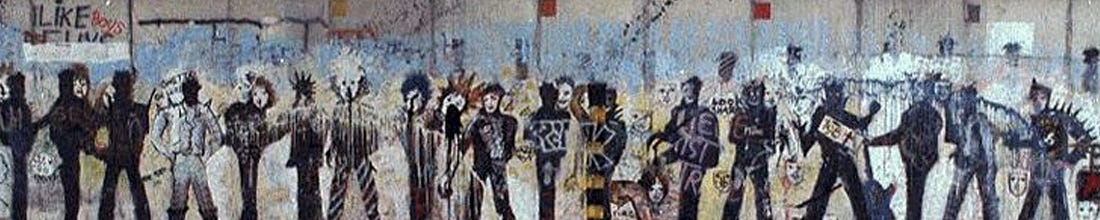
Growing up, I lived for a while in the Hudson Valley not far from West Point. I remember going there just twice as a kid. The first time was for a John Philip Sousa concert by the Army Band. (It’s probably that experience that spawned my lifelong appreciation of, if not quite enthusiasm for, oompa-oompa music.) The second time was to see a traveling exhibit of vandalism. Which is to say, to see a broken slab of the Berlin Wall. That chunk of concrete was covered in graffiti. It was sloppy, chaotic, amateurish, dirty. It was vandalism. But it was also memory. It was speech. It was hope, painted on the machinery of oppression. The message of that exhibit wasn’t, look at what these discontented Germans defaced! The message was: Look at what they dared to say.
I’ve scraped Patriot Front stickers off telephone poles in my neighborhood. I’ve reported swastika tags. I tear “FJB” decals off gas pumps. When I do so, I honestly don’t get upset about the vandalism aspect of it. These acts of stochastic street communication aren’t bad because they’re vandalism. These messages are bad because they spread hate. The context is key. The message is the test. It’s not about the paint. It’s about the values. History abounds with examples:
When Nazis painted “Jude” on Jewish businesses in 1933, it was vandalism—but the vandalism wasn’t the problem. The problem was the message: targeted dehumanization.
When French resistance fighters painted “COLLABO” on storefronts, that was vandalism, too—but it was also speech in defense of their neighbors. It was a demand for justice, and a refusal to let collaborators slink into the background where their treachery might stay hidden, waiting to re-emerge the next time oppressors were looking for allies.
Tony Shafrazi hit Picasso’s Guernica with red spray paint in 1974. He wrote: “Kill Lies All.” It was an act of vandalism, yes. But also a political gesture in response to the My Lai massacre during the Vietnam War. He saw it as an anti-war statement made atop an anti-war painting. A moment of justice-minded recklessness.
When someone tags a box with “Free Palestine” or “Truck Fump” or “Fire Musk” or “Free Rumeysa,” it might technically be vandalism—but it’s also a kind of civic flare, a cry for help, for dignity, for something better.
Artworks in galleries have been splashed with paint by climate activists. That too is vandalism. But Extinction Rebellion and Just Stop Oil aren’t doing it for fun. They’re sounding an alarm on behalf of the living Earth. If we can listen with curiosity instead of recoil with scorn, we might remember that civilization has often been awakened by protest, not process.
During the Maidan Revolution in 2013, protesters in Kyiv used every material at hand to transform the streets: spray paint on police shields, trash-sculptures, stenciled icons of Soviet saints with new meanings. It was vandalism. It was also art. Some of it is now in museums.
You know what was vandalism? The star-spangled, red-white-and-blue Boston Tea Party. Those boys, bless them, were breaking the rules, in defense of freedom, in another moment of justice-minded recklessness.
We look past the defacement and destruction of private property when the message matters to us or when we believe it’ll lead to a desirable good: a restored freedom, a torn-down wall, a new nation where liberty might be the shared inheritance of all.
The point is that not all vandalism is the same.
In my last year of high school, around the time of Homecoming, the graduating seniors painted “Go Greyhounds!” on the hallway lockers. Congrats to the Class of 1999. My freshman year, someone spray-painted the word “FAGGOT” on the locker of a boy I knew. Go team.
The janitorial staff had, I’m sure, the same trouble cleaning up the vandalism in each case. But what a difference in message. What a difference in impact.
To my mentor, I say this with respect: One of the lessons we picked up under your tutelage was to tell the difference between rules and principles. Another lesson was that loyalty to your country means asking what’s being done in its name—and standing up when the answer is unacceptable. Sometimes graffiti is just a nuisance. Other times, it’s the clearest voice our neighbors have left.
In this Old Growth essay series, I usually write about cities and communities the way we write about forests: systems of interdependence, growth, shade, struggle, regeneration, etc. Yes, it’s all very Boy Scout. The connection of today’s theme to that dominant metaphor might not be evident, so let me bring it home:
We’re writing about how to tend to the health of the whole forest, not just the appearance of a single branch. In ecology, there’s a concept called disturbance—a sudden change that cracks open the canopy and forces us to regrow differently. Protest is like that. Disruptive. Ugly sometimes. But essential.
When someone says, “But isn’t this just vandalism?”—I say, yes, sometimes. But look at what’s growing through the cracks.
Comments
Nothing yet. Say the first thing.
Sign in to join the conversation.