
When the North County Land Trust put out a call for volunteers to help survey a potential vernal pool for certification, I didn’t hesitate. I’m an easy mark for citizen science projects. I took it upon myself to volunteer my sister’s child as well, for they were staying with me that week and what better way to pass the time could I have found? Children yearn for the mines; surely wetlands grunt work offers comparable joy, or at least the kind of discomfort that makes for a good story later.
Let me reflect a moment my choice of words just now, namely, “My sister’s child.”
Why do I refer to this kid in such a round-about way? Well, they (singular) are non-binary, so neither “niece” nor “nephew” would apply. American English doesn’t yet have a graceful, widely accepted word for the child of a sibling when that child is gender neutral. The somewhat idiosyncratic term I like to use is nepos, borrowed from Latin and cognate to “nepotism.” To me it feels dignified. As a bonus, the long eee rolling into the crisp plosive P reminds me of the gorgeous meep of the American woodcock. But I digress. (More on the term nepos in the post-script “field note” below.)
The day for the pond project arrived. We woke early, hopped in the car, hit the Dunkin drive-thru for the essentials, and navigated to Route 2. Our destination was the Ebenezer Keyes Conservation Area outside Gardner, Massachusetts, where 157 acres of protected land encompass a globally rare sandplain grassland and several wetlands. The property includes an already certified vernal pool and at least one other candidate for recognition which would be the subject of our volunteer work.
The North County Land Trust has been restoring these habitats, monitoring wildlife, and inviting the public into their work through guided walks, iNaturalist bioblitzes, and seasonal calls for “citizen scientist” assistance. If you’re in the area, I encourage you to connect with them and get on their newsletter email list or follow them on social. If you’re not in the area, there is likely a similar organization in your neck of the woods.
A vernal pool (as one can learn from the Trust’s own literature and in helpful handbooks and guides published by various New England state agencies) is a small, seasonal wetland. It fills with snowmelt and rainwater in spring and supports a burst of amphibian and invertebrate life before drying in summer. Because they lack a permanent fish population, these ephemeral pools are safe nurseries for species like wood frogs, spotted salamanders, and fairy shrimp. Vernal pool certification—a legal process in Massachusetts—helps protect these habitats from development, as does the related and ongoing work of vernal pool monitoring.
As soon as we stepped out of the car, mosquitoes swarmed us in a whining cloud. Fieldwork is rarely comfortable. However, we didn’t use bug spray. It isn’t just that mosquito larvae can be an important food source in pools like this. More to the point, insect repellents and even sunscreen risk contaminating the water and harming the amphibian eggs, larvae, and adults dwelling therein. Instead, we were instructed by the Trust volunteer coordinator and the registered naturalist overseeing the data collection to shuffle our waders in a shallow tub. We repeated this biosecurity step after our volunteer shift was over, a precaution to prevent transporting unwanted organisms or harmful pathogens like Ranavirus between sites.
I’d been reading up on frog egg identification in the days before our trip. My classes at Scout camp were a lifetime ago and I wanted to know what we would be looking at. The type and abundance of species found in these pools matters in the certification process. The distinctions between eggs are subtle but once you learn to spot them in the wild, you feel like you’ve been brought into closer conversation with the ecosystem. I imagine trainspotters and birders feel the same way about their respective observational hobbies.
Here’s how I came to differentiate the frog species we were most likely to encounter:
Wood frog (Lithobates sylvaticus) eggs are the signature of an “explosive breeder”: the entire population converges on a pool within days after ice-out. They lay large, globular communal masses, often rafted together. The clear gelatinous matrix surrounding the black embryos turns cloudy as it ages. Wood frogs favor ephemeral vernal pools. This is perfect for avoiding fish predation, but risky if the pool dries too soon. Fun fact: the adult’s call sounds quite like a duck.
Green frog (Lithobates clamitans) eggs appear later in the season in permanent ponds and lakes as well as vernal pools. Instead of spheres, they form flattened sheets or loose surface films, sometimes draped over submerged vegetation. The eggs are more spread out, each one distinct in the jelly. They rarely appear in communal rafts.
Leopard frog (Lithobates pipiens) eggs fall in between these others in both timing and form: smaller, compact clumps, often attached below the surface to stems, each egg neatly distinct in a clear jelly. They prefer permanent or semi-permanent waters but can tolerate some seasonal change.
Spending a little time looking into the biology around these descriptions, I could appreciate how these differences are rooted in phenology (seasonal timing), oviposition (egg-laying strategy), and the particular structure of the gelatinous matrix (the jelly-like protective casing). Technical language isn’t just for scientists! These long and exquisitely specific terms are public access, open sources tools for seeing the world more clearly and referring to its components more precisely.
The pool itself did not disappoint. We pushed through the brush and stepped carefully into cold clear water tinted to the color of tea, courtesy of the tannins leaching from submerged leaves. As expected, we found frog eggs, with black embryos suspended like musical notes in translucent scores. We found gelatinous salamander egg masses as well, each with their protective outer layer and milky inner capsules. Alas, we spotted no fairy shrimp feeding and mating in their brief window of existence. We were left having to imagine them, spinning slowly through the water column of our minds. Maybe that’s half the work of naturalism? Filling the gaps with what you know should be there, even when the season has hidden it from you. The same is true in human communities. What we don’t see, we often have to imagine, and what we imagine shapes how we treat the unseen. I digress again; back to the pool.
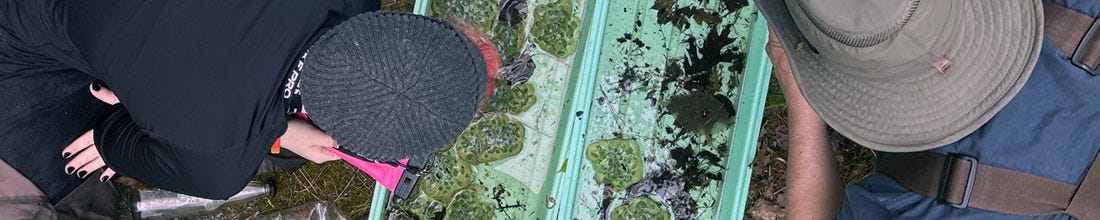
We moved slowly as we scrutinized the pond floor and lifted plant stems and sunken branches looking for egg attachments. The nepos crouched low and bent at the waist to shade the water with their body and break the glare. They even managed to take some excellent underwater footage by sealing their iPhone in a Ziploc bag. We used dip nets to scoop and carry eggs to shore, nestling them in temporary holding trays filled with water so that we could count our catch. This was ideal for peering closer to examine jelly clarity, stages of metamorphosis, and other clues to deeper understanding.
For a few hours we were apprentice naturalists together, learning the names and nature of our small neighbors. And that is no small thing.
Afterward, as we drove home, the kid and I talked about the common and Latin names of the species that we’d seen. Frankly, we had a blast looking them up online and reading the etymologies and seeing how the roots and affixes relate to each creature’s shape or habits. Learning these names is preliminary to learning the descriptions, and how tell a wood frog raft from a leopard frog clutch. Such naturalist skills-development is part of the same discipline as learning the names of the trees along your street, the birds in your yard, or the people who share your neighborhood. It’s a way of situating yourself within a web of relationships, of saying: I know you, you belong here, and so do I.
Knowing the names shows that you’re paying attention and allows you to speak more effectively and constructively with others who are paying similar attention. Back and forth it goes, our vocabulary informing our knowledge and our knowledge improving our technical vocabulary. It’s a small and powerful joy, to find the right name for something.
Ursula K. Le Guin wrote, “Names have power.” In A Wizard of Earthsea she reminds us that “My name, and yours, and the true name of the sun… all are syllables of the great word that is very slowly spoken by the shining of the stars.”
Old-growth forests—the namesake of this Substack, and of the Old Growth Initiative from which I took inspiration to start writing here—are characterized by diversity, reciprocity, and resilience. Every organism plays a role; every connection matters. Human communities can mirror that vitality when we practice the same attention and respect toward our own networks, human and more-than-human. To borrow and repurpose a sentiment from President John F. Kennedy:
… in the final analysis, our most basic common link is that we all inhabit this small planet. We all breathe the same air.
In a thriving, old-growth-style community, that principle applies as much to the web of life in a vernal pool as it does to the human world. Diversity is not an obstacle to overcome, but the very condition that allows a system of robust interdependence to flourish.
Our language makes space for some relationships but leaves others unnamed. “Nibling” is a relatively common gender-neutral option for this kin-term, blending sibling with niece/nephew. However, I don’t like it. The rank-relationship between siblings is lateral, and the one between an uncle and the nepoi is vertical. A parent doesn’t call their child-descendant a sibling; an uncle shouldn’t call his nepos a nibling. Other candidate terms include chibling, sibkid, nephiece and niephew. They each have their own charms but for my part I continue to prefer nepos. Language that names the relationship exactly carries power. Le Guin was right about that.
It makes a big difference, learning and using the right words. Using someone’s correct pronouns or preferred proper nouns (which is to say, their chosen name) is an act of recognition. This ethic extends outward, to streets, to neighbors, to the plants, animals, and habitats that make up our shared environment. The careful attention that takes pains to tell a wood frog’s egg mass from a green frog’s is akin to the skills of attentive mutuality and productive interactivity that keep communities—ecological and human—healthy and resilient. Knowing the names is a first step toward belonging and toward acting in ways that sustain the whole.
Comments
Nothing yet. Say the first thing.
Sign in to join the conversation.