
Previous: “Armageddon in the Dark Forest, Part I: Fire on the Mountain”
Winfield Scott Hancock rises early and in good spirits. The smell of brewing coffee and pine glides over the sleepy camps of the Army of the Potomac. As the sun begins to climb in the eastern sky, his men prepare to resume their march south. To the north, Warren’s 5th Corps likewise prepares itself for another day of hard marching. In stark contrast to Hancock, Warren is unnerved when he is notified of Meade’s last-minute changes to the cavalry deployments for the day. Due to the complete lack of a Federal cavalry screen on Warren’s front, he compensates by ordering that a picket be deployed to the west to screen the 5th Corps. Having tangled with Robert E. Lee at the edges of the Wilderness during the previous fall campaign, Warren is keenly aware of the danger his corps is in, strung out along the road and completely blind to the movements of the enemy.
The division of General Charles Griffin is ordered to march west down the Orange Turnpike to screen the 5th Corps. He is to hold that position until the rest of the 5th has marched south, then he is to reform his men in march column and bring up the rear. By the time that happens, John Sedgwick’s 6th Corps will be fully across the Rapidan and will be close behind Griffin on the line of march.
At Army headquarters, Grant is hopeful that Burnside will make good time today and rejoin the army before noon. The rest of the Army of the Potomac’s command staff know to expect far less of Ambrose Burnside.
Not long after sunrise, Hancock’s 2nd Corps assembles in march column and continues south toward Todd’s Tavern. The men of the 2nd Corps are glad to leave the eerie ruin of the Chancellorsville battlefield behind. As they move south, they run into a column of Union horsemen, causing a momentary traffic jam. The situation is solved through Hancock’s personal intervention, as he directs the 2nd Corps to make a slight detour to the east and south. The road they travel is the same road used by Stonewall Jackson to crush the Union Army’s flank at Chancellorsville a year ago.
At 5:00 A.M., James Wilson leads all but one of his cavalry regiments south from Parker’s Store toward Shady Grove Church and the Carpathian Road. Left behind at Parker’s Store, to keep a watch on the Orange Plank Road, is the 5th New York Cavalry under the command of Colonel John Hammond. At first light, Hammond sends Companies I and K farther west to scout the Orange Plank Road. Command of the assignment is given to Captain William Carey.
In column of fours, meaning four horsemen abreast, the two companies of cavalrymen trot down the Orange Plank Road. On either side of them are near-impassable woods. Carey cannot conceive of a worse place to maneuver large bodies of infantry, let alone the army’s cavalry and artillery, than a forest with sparse roads and visibility of barely a few yards.
The Union horsemen barely make it half a mile.
As he crests a low rise in the road, Carey halts his horse in stunned disbelief. Barely a hundred yards in front of him, in the half-darkness of the dawn, four dark shapes bolt into the woods and disappear into the morning fog. Horsemen.
In the silence that follows, Carey and his men strain to listen for sounds of the enemy. From the darkness comes the sound of clanking canteens, the shouted commands of officers, and snapping twigs and tree branches.
Infantry are marching down the Plank Road toward him.
It is the 47th North Carolina, of William Kirkland’s brigade, vanguard of A.P. Hill’s Third Corps. Having risen early, the Confederates are already marching east along the Turnpike and Plank Roads, ready to intercept the massive Union Army on its march south.
Carey quickly wheels his horsemen around and retires them up the road a few hundred paces. The Confederate horsemen emerge from the woods to shadow them. Each time Carey tries to wheel around again to confront them, the enemy withdraw back into the woods. The sound of the approaching infantry grows louder.
Carey does not know what unit is out there; nor does he know their strength or intentions aside from the fact they are marching toward Parker’s Store. He decides to test the enemy. Carey orders two soldiers, Privates Nick Darsy and Job Coddington, to empty their seven-shot Spencer carbines into the North Carolinians. The two men comply, and send a rapid volley toward the Confederates. The answer is a volley by files from the 47th.
The skirmish begins in earnest, with the scattered Union horsemen frantically firing their seven-shot repeaters, slowing the Confederate battle line. Return volleys smack into the dense trees on either side of the Plank Road. As the weight of fire begins to shift in favor of the more numerous Rebels, Yankee horsemen begin to fall. Company K, 5th New York Cavalry, suffers the first casualties of the Overland Campaign.
Carey remains mounted, a ghost in the eerie dawn fog, shouting orders and commands to his men. Slowly, they are being forced back. Kirkland brings up the second regiment in his column, the 44th North Carolina, and sends it into the woods to flank the New Yorkers.
Carey, while riding along his thin line and shouting orders to his troopers, comes across a recruit, new to the regiment and the Army, standing tall in the middle of the Plank Road, blazing away at the men in gray. He barks at the young man to get out of the open and pick his targets more carefully. The young boy, rattled by his first taste of combat, does not heed Carey’s command. He aims his repeater and fires again, pauses, and looks up at the mounted Captain.
“Oh, Captain!” he cries, voice brimming with youthful excitement. “I killed one!”
No sooner have the words left his mouth than a Confederate Minié ball slams into the side of his skull. The young lad dies without a sound. Carey must go on, to tend to the still living under his command. The body is left in the middle of the Plank Road.
Charles Griffin is the perfect man for the job of screening the 5th Corps during the morning of May 5. A West Point grad and seasoned Indian-fighter, the mustached son of Ohio is a martinet and a brawler. Brazenly outspoken and profane to a fault, he has a peculiar habit of dismounting during battle to give instructions to Union artillerymen and even taking over the process of loading and firing the cannons.
Griffin marches his division west down the Turnpike for a mile before deploying it — with great difficulty — in line either side of the road. The 140th and 146th New York and the 1st Michigan, all under the command of Colonel David Jenkins, are pushed farther west to screen the division. The rest of Griffin’s men resume their morning routine of boiling coffee and waiting until it is time to march. None of the boys in blue expect a fight today.
Griffin’s division holds its position through the dawn and for an hour past sunrise. Word from Warren reaches him that it is time for Griffin to retire east, fall in line, and take up the rear of the 5th Corps’s column. The Indian-fighter from Ohio is all too glad to do so; picket duty is cavalrymen’s work.
From the position of Jenkins’s outpost, the Orange Turnpike cuts a slightly uphill swath through the dense Wilderness. The Union soldiers quickly grow tired of staring at the barren path, waiting for phantom Rebels to materialize out of the morning fog. When the orders come down to prepare to retire east, all are eager to leave the boredom of morning picket duty behind.
As an afterthought, a Union private glances west one last time toward the Turnpike. Doing a double-take, the private squints his eyes. Just above the trees, glistening in the morning sunlight, a faint brush of dust trickles into the sky. Calling out to his commanding officer, the private now sees dark blots on the road, blots that slowly materialize into horsemen.
The horsemen peel off to the right, revealing a column of men in gray uniforms, slouch hats, and shouldered rifles. The Union pickets stare in mute disbelief as a column of Confederate infantrymen emerges out of the fog like phantoms.
Major George Hopper, 1st Michigan, is finishing breakfast with his commanding officer, Colonel William Throop, when a captain scrambles over toward him. “Colonel, the enemy are coming, horse, infantry, and artillery!”
Colonel Throop springs into action at once, ordering a message sent to Griffin and telling the assembling 1st Michigan to deploy back into skirmish order in the woods south of the Turnpike. Jenkins, once notified, cancels his orders to march his three regiments back to join Griffin’s division and spreads the two New York regiments in skirmish order on the north side.
Colonel Throop, still standing in the middle of the Turnpike, can now see the approaching column of Confederates in the growing morning light. He expects a charge, but instead sees the gray-clad infantry halt and begin filing off to the left, out of sight. The column of infantry seems to be without end. Colonel Jenkins also witnesses this eerie sight: an endless stream of men filing off the road to the left and right, out of sight, disappearing into the thick, dark woods. He has never felt more alone in his life.
To deceive the enemy, Major Hopper orders six men to form a column of two abreast and march across the road, into the woods, then turn around and to the same in the opposite direction. Mimicking the motion of the Confederate column, Hopper’s ruse gives the appearance of a similar Union column of infantry filing off to the left and right of the Turnpike. It is a clever ruse, but one that cannot last forever.
A mile to the east, at Wilderness Tavern intersection, Warren is mounting his horse, ready to begin the day’s activities and guide his men south to the Chewning Farm and the Orange Plank Road. From his perspective, all is well.
His tranquility is shattered by the sound of a panting horse. At full gallop, Colonel Throop’s messenger comes into the General’s bivouac. Having informed General Griffin of the approaching enemy column, the man had been immediately ordered on to find the 5th Corps commander.
Shock ripples through Warren and his entourage. How could this be? Lee is supposed to be miles away, filing into the old earthworks at Mine Run. Warren assumes that Griffin’s jumpy pickets have been spooked by a small detachment, meant to slow the 5th Corps advance.
“Tell Griffin to get ready to attack at once!” barks the commander of the 5th Corps.
A note is then drafted for the eyes of George Meade and Ulysess Grant.
Unconfirmed reports of enemy movement along the Turnpike. Likely a diversion. No modifications to the movement of the V Corps necessary. Such demonstrations are to be expected and show the necessity for keeping well closed and face toward Mine Run and prepared to meet an attack at once.
Warren has not even had a chance to dispatch his note to Meade when another messenger sent by Griffin arrives, his horse also out of breath from riding at full gallop. It is a note from Griffin himself, a man whose judgment is beyond question.
Rebel infantry are on the Turnpike, forming into a line of battle. Behind them, the pickets can see large clouds of dust.
Warren includes this information as a postscript to his message to Meade and Grant, then orders Griffin to send out skirmishers to ascertain the strength of the enemy on the Turnpike.
Griffin assigns the duty to the brigade of General Joseph Bartlett. Companies I and K of 18th Massachusetts and two companies of the 83rd Pennsylvania are chosen for the task. The four companies begin picking their way forward through the Wilderness, struggling to maintain contact and cohesion. After a few minutes, they come to the edge of a quarter-mile clearing called Saunders Field.
They see a clearer picture of what faces them: on either side of the Turnpike, which bisects Saunders Field, lines of Rebel infantry file to the left and right, occupying a wooded ridge on the western edge of the field that offers a commanding view of the entire clearing. Eager to get closer and ascertain as much information on the enemy as possible, the four companies are ordered forward into Saunders Field.
The Yankee skirmishers run headfirst into the skirmish line of the 25th Virginia. Part of the brigade of John Jones, Edward Johnson’s division, Richard Ewell’s Second Corps, these veteran Confederate infantrymen spring their ambush flawlessly.
Shots ring out before both skirmish parties melt away toward their respective lines. Private Josiah Siple, Company E, 25th Virginia, aims his musket at the retreating form of Private Charles Wilson, Company I, 18th Massachusetts. He exhales, steadies himself, and squeezes the trigger. Charles Wilson does not feel the bullet punch through his chest; he is dead before he hits the hardscrabble earth. The Massachusetts farm boy, just weeks past his 18th birthday, becomes the first Union infantry fatality of the Battle of the Wilderness.
The Confederates begin to entrench along the ridge, the shouted commands of their officers to fell trees and prepare breastworks clearly audible to the Union soldiers in the eastern tree line. After the retiring Union skirmishers report to their commanders, Brigadier General Bartlett retires the 18th Mass and 83rd Pennsylvania into the tree line to await further orders.
On the Confederate side, George “Maryland” Steuart supervises the deployment of his brigade of Virginians and North Carolinians to the north of the Turnpike. The Confederates begin digging in farther into the tree line. Behind Steuart’s brigade, the elite shock troops of the Stonewall Brigade under General James Walker emerge from the dust cloud and turn north, behind Steuart’s brigade, along a small dirt track called the Culpeper Mine Road. The Confederate line of battle begins to extend into the forest like a finger uncurling.
Behind the Stonewall Brigade, Leroy Stafford’s Louisiana brigade grope their way through the dense woods and try to establish contact with Steuart and the Stonewall Brigade. Stafford’s Louisianans are the rear of Edward Johnson’s column. A few minutes behind the Louisianans comes the vanguard of Robert Rodes’s division, caked in the dust kicked up by their comrades to the front. Filing to the right of the Turnpike are the brigades of Cullen Battle and George Doles. The men file behind the line of Jones’s brigade as it continues to entrench. The Georgians of Doles’s brigade march farther into the woods before aligning in a roughly oblique line to Battle’s brigade, leaving a gap between themselves and Jones’s Virginians.
In the rear, the North Carolinians of Junius Daniel and Georgians of John B. Gordon halt in column formation as the Confederates pause to see how the situation develops.
Gouverneur Warren, having made his way to the front, is aghast at the strength of the enemy before him at Saunders Field. All along the ridgeline before him stretches a battle line, three ranks deep, with the angry mouths of cannon protruding from the trees on the far side. Dirt flies into the air as the Confederates begin entrenching. They have no intention of leaving. This is no diversionary force.
“They have discovered our movements!” he exclaims. He orders Charles Griffin to bring forward his entire division and put it back into a line of battle. A flurry of orders is issued to suspend the V Corps’s southward march toward the Chewning Farm and the Orange Plank Road. Warren dashes off another message to Meade, this time informing him of the gravity of the situation. The V Corps is alone out here, in front of an enemy of undetermined but considerable strength.
He must hold the 5th Corps together until Sedgwick can arrive to reinforce him. So far, there has been no sign of the 6th Corps.
On either side of the Turnpike, two of Griffin’s brigades under Roman Ayres and William Francis Bartlett form into a line of battle and pick their way through the tangled mass of the Wilderness until they reach the tree line bordering their side of Saunders Field. Their dander up from the earlier skirmish, the 18th Mass and 83rd Pennsylvania march into Saunders Field. In a line of battle two ranks deep, the two regiments march across the field and into a low swale at the field’s center, staring up at the ridge occupied by the Confederates. The slope on the Confederate side is so steep that it offers a degree of protection from gunfire from the crest of the ridge. Two volleys ring out from the Union line, the bullets sailing harmlessly into the trees above the Confederate position. Return fire kills a few Yankees, and the two regiments withdraw to friendly lines. The morning has so far been marked by little more than bluster and light skirmishing with few casualties for either side.
At 7:15 A.M., George Gordon Meade realizes that he is in for a fraught day. As has become the norm for every Union commander, the tranquil morning is interrupted by the sound of thundering hooves and the shouts of an excited courier.
“General Warren begs to report that Lee has infantry on the Turnpike, less than two miles from Wilderness Tavern!” exclaims the breathless courier.
Meade hastens his pace and arrives at Wilderness Tavern in a few minutes. A few minutes later, Warren arrives with an entourage of staff officers, barking orders and clearly trying to arrest the southward march of the 5th Corps and get it into a line of battle facing the enemy.
“Well, Guv, if there is to be any fighting this side of Mine Run, let us do it right off!” Meade proclaims. The entire day’s plan of march is canceled on the spot, on his own authority. He sends off one of his own couriers to find Hancock, still far to the south at Chancellorsville and dangerously isolated from the rest of the army. Sedgwick is ordered to hasten his march from Germanna Ford and link up with Warren. Burnside, still too far away to be of any use, is ordered to redouble his effort to join the army. Meade has little confidence that the 9th Corps and its whiskered commander will materialize before tomorrow.
Having arrested his army’s southward march, Meade dispatches another messenger to notify Grant of the situation. The Pennsylvanian believes that Lee is only trying to delay the Army of the Potomac’s march through the Wilderness, and will not give battle within its dark and twisted depths.
In halting the Army of the Potomac in the middle of its march through the Wilderness, Meade unknowingly does exactly what Lee hoped. Before the Virginian’s marching columns lies a confused, strung-out force that is not expecting the hammer blow he has in mind.
Grant approves of Meade’s plan at once, feeling a sense of hope that the rumors of cowardice and intransigence that had plagued the Army of the Potomac were just that.
“If any opportunity presents itself of pitching into a part of Lee’s army, do so without giving time for disposition,” he writes back.
To Grant’s annoyance, and then fury, Meade only pays attention to the first half of his orders. Meade, Warren, and Sedgwick both begin taking precious time to get their troops in disposition, even as Ewell’s men shake themselves into battle formation and begin to carve a fortress out of the hill overlooking Saunders Field.
It has been two hours since the Rebel bullet tore through the young Union cavalryman’s brain in front of Captain Carey. Two hours of skirmishing, of falling back, of being flanked, of taking casualties. With Robert E. Lee and A.P. Hill breathing down his neck, Kirkland has deployed his entire North Carolina brigade in line, slowly and methodically pushing through the dense forest either side of the Turnpike. Swarms of Confederate skirmishers constantly threaten to envelop the spaced-out line of Companies I and K, 5th New York Cavalry. Only the steady leadership of Captain Carey and the profligate use of their repeaters have succeeded in slowing the enemy advance.
They have been pushed back to the Parker’s Store clearing. The entire 5th New York Cavalry has been thrown into the line in an attempt to stem the oncoming gray tide. A few miles up the Plank Road sits a gap between Hancock’s 2nd Corps, much of Sheridan’s cavalry, and the 5th, 6th, and 9th Corps strung out on the march. A.P. Hill’s Third Corps is posed to ram itself right between that gap after it has swatted the 5th New York Cavalry aside.
All that stands between the Confederates’ vital intersection with the Brock Road is the 5th New York. If the Confederates can capture this intersection, about three miles up the Orange Plank Road from Parker’s Store, then the Union army will be split in two.
This reality is plaguing Carey’s mind when the Rebel Yell erupts from the forest. Swarms of Minié balls strike out toward the 5th New York’s skirmish line. A line of battle in gray and butternut emerges from the wisps of smoke and fog, barreling toward the dismounted Yankees.
Seeing plainly that there is no more to be done, Colonel Hammond orders the 5th to mount and evacuate the Parker’s Store area. The emerging Rebels cut down several cavalrymen as they mount and flee across the clearing and into the woods. A scattered trail of dead men and horses marks the mile-long route of the battle since Captain Carey ran into Kirkland’s North Carolinians at dawn. Since the first shots were fired on the Orange Plank Road, the 5th has lost 50 men: 16 killed, 21 wounded, and 13 missing. A few score dead and wounded North Carolinians and an hour-long delay of Powell Hill’s march to the vital Brock Road crossroads are the tally exacted by Colonel Hammond’s troopers.
As the 5th New York disappears into the opposite forest, Kirkland’s brigade fully emerges from the woods into the Parker’s Store clearing. Having fought nonstop for nearly two hours, Kirkland halts his men and clears them off the Plank Road either side of Parker’s Store. Marching up the road in column of fours is the North Carolina brigade of John Cooke, making for the Widow Tapp farm, two miles up the Plank Road and one mile from the Brock Road intersection.
From the last wisps of the morning fog, leisurely striding their horses along the column of North Carolinians, three riders in gray emerge. Robert E. Lee, Ambrose Powell Hill, and Willian N. Pendleton are greeted with hearty cheers from the North Carolinians. Lee doffs his hat and urges the men to make haste. Having risen at 4 that morning, he is eager to drive Powell Hill’s corps forward into whatever awaits. Behind the three horsemen in gray, the divisions of Henry Heath and Cadmus Wilcox march four abreast. Ahead lies a small clearing and the home of Catherine Tapp, a widowed dirt farmer in her seventies. Beyond her small shack, a mile up the Plank Road, the Brock Road crosses the Orange Plank Road on its way south. Whoever controls that crossroads will control the unfolding engagement.
Having focused his attention on the situation developing on the Turnpike and at Saunders Field, Meade does not give much thought to the Plank Road front. After all, Wilson’s cavalry division was supposed to be screening that section of the Wilderness; if anything were amiss, surely he would have heard about it.
Such is not to be. Wilson and his entire cavalry division, save for the 5th New York, have disappeared south and have been cut off from the rest of the Army by Hill’s eastward lunge. It is not until a message from General Samuel Crawford, commanding the vanguard division of the 5th Corps as it marches south, reaches Meade that the true gravity of the situation is revealed. Crawford, from his position that morning on the hill behind the Chewning Farm, witnesses and hears the skirmish of the 5th New York, and as the sun rises, can see long columns of gray-clad infantry marching east down the Plank Road to his front, obviously headed for the Brock Road intersection.
After Crawford’s message reaches him at 10:15 A.M., Meade finally realizes once again that he has underestimated the audacity of Robert E. Lee. Crawford’s report dismays one of the Army of the Potomac’s commanders and delights another. Ulysses Grant, realizing that his enemy is marching out from behind the Mine Run entrenchments to meet him, swells with elation. With a few adjustments and some luck, he will have his chance to meet Robert E. Lee on the field of battle and bring the Army of Northern Virginia to its destruction.
“Order Hancock back to this position,” he tells Meade. “And have Burnside and Sedgwick make haste.”
The General of the Armies, wearing a brand-new pair of gloves purchased for him by his wife, then sits down on a stump, grabs a piece of wood, and begins to whittle it with a knife. Around him, the headquarters is a flurry of frenzied activity as the staff attempts the arduous task of arresting the Army of the Potomac’s southward march and getting it into battle formation is underway.
Lee chooses the small clearing that bears Widow Catherine Tapp’s name as his headquarters. As he dismounts, the sound of galloping hooves alerts him. Sandie Pendleton, staff officer in Ewell’s Second Corps, emerges out of the forest. He brings an update from Ewell: the Second Corps is digging in at Saunders Field and can see columns of Yankees marching south toward the Chewning Farm, which sits square in the middle of the mile-long gap between Ewell’s and Hill’s troops.
Lee reiterates his orders to the Second Corps’s commander: Do not bring on a general engagement until Longstreet has joined the army. As Pendleton gallops into the dark, twisted maw of the Wilderness to deliver the message, the sound of firing erupts to the north, in the direction of the Brock Road.
The 5th New York, their backs to the Brock Road, rallies and meets the advancing North Carolinians head on. These North Carolinians belong to John R. Cooke, who has replaced Kirkland’s tired infantry in their duel with the elusive New Yorkers.
“Heth must press them,” General Lee says, and a few minutes later: “We must have that crossroad.”
It is a picturesque scene: Traveller quietly nibbles on the grass some 20 feet away, while Lee himself rests under the shade of a large chestnut, conversing with A.P. Hill, who is bedecked in his famous red shirt, only worn when he expects to do battle. Walter H. Taylor and Edward Palmer, Lee and Hill’s respective aides de camp, chat about the morning’s deployments and unfolding events.
A few minutes past 11, Jeb Stuart emerges from the Wilderness, reporting that his cavalry has checked the advance of a mounted Union column on the Carpathian Road. Tom Rosser’s Laurel Brigade has encountered the wayward cavalry division of James Wilson and checked its move south.
Stuart’s aide de camp, Alexander Boteler, lies down under the shade of the chestnut tree and dozes off.
Something catches Lee’s eye. Abruptly, he turns away from Stuart, staring in disbelief at the northern edge of Widow Tapp’s field. There, emerging from the impenetrable green canopy, emerges a line of battle bedecked in Union blue and flying the Star-Spangled Banner. The battle line halts as it emerges from the clearing, both groups of men staring at each other in disbelief.
Lee calmly turns his back toward the Union troops, instructing Taylor to do the same, and to follow him slowly. He methodically strides toward Traveller, mounts his horse, and once the party is mounted, spurs Traveller into a gallop toward the Orange Plank Road.
Alexander Boteler is awakened from his doze to see Robert E. Lee, Jeb Stuart, Walter H. Taylor, and other mounted men galloping past him, nearly running him down. Boteler turns his head to the northwest, and sees the Union battle line, bayonets fixed and advancing toward him. Searching for his horse, he realizes that it has wandered away from where he had been napping.
Hunched over, he runs toward it, ignoring the shouted commands to stop and surrender from the approaching Yankees. In a marvelous feat of athleticism, he jumps astride his horse and spurs it after the fleeing generals.
The equally startled Union infantry, Companies C and K of the 1st Pennsylvania Reserves, are unaware of the prize they have let slip through their fingers. Feeling exposed in the middle of Widow Tapp’s field, hearing gunfire behind them on the Orange Plank Road, and unable to see into the foreboding forest that rings Tapp’s farm on all sides, the Yankees pull back into the safety of the trees and return toward their position at the Chewning Farm.
The 5th New York reels backward under the thunder blows of John Cooke’s North Carolinians. Their morning has been one continuous odyssey of retreat and repulse; a grinding retrograde up the Plank Road, past Parker’s Store and Widow Tapp’s field, scrambling through the thickets, swamps, and creeks of the green morass either side of the road. With blood and iron, the 5th New York has slowed the advance of Harry Heth’s division. Along the banks of the shallow Wilderness Run, the New Yorkers face the skirmish lines and regiments of the North Carolinians, making up for their lack of numbers with a heavy volume of fire from their repeating rifles. Every minute, the amount of lead pouring into the Federals seems to increase as Heth’s skirmishers creep forward and around the 5th’s skirmish line. The sound of thousands of lead projectiles snapping through leaves and trees reminds Colonel Hammond of a swarm of angry bees circling over his head.
At his headquarters, Ulysses Grant’s patience begins to fray. It has now been some three hours since contact with the enemy on the Orange Turnpike and Orange Plank Road. Meade had promised a vigorous assault on the Turnpike immediately; yet Warren has not moved forward. Hancock is still some three miles to the south of the Brock Road intersection, while reports from Colonel Hammond place Powell Hill’s men only a mile from that junction.
Believing that he is at the precipice of the great decisive battle of the war, Grant begins to eschew the divided command structure he had set up with Meade in the preceding months. Bypassing the Army of the Potomac’s commander, Grant orders Warren and Sedgwick to attack along the Turnpike, and orders the division of George Getty, under Sedgwick’s command, to detach itself from the 6th Corps and to march south to the Brock Road intersection.
Getty’s lead units are about two miles from the intersection of the Plank Road and the Turnpike; the only organized Federal force that may be able to beat Powell Hill to the punch. Grant orders Getty to double-time it to the intersection. Once there, he is to hold it against any Confederate attack, and then — in conjunction with Hancock’s 2nd Corps moving up from Chancellorsville — attack Powell Hill and smash him.
George Getty is a competent soldier, cool under fire, and dutifully quick-marches his division south toward the sound of Colonel Hammond’s gunfight with Harry Heth. He immediately sees the danger to the Army if the Confederates gain the Brock Road. With haste, Getty and his staff officers spur their horses to a gallop and leave his division in a cloud of dust. They make their way to the intersection in just 30 minutes. The intersection feels quite insignificant: just one dirt road heading south, and another slightly wider dirt path crossing it from west to east.
Already, there is the acrid smell of smoke and fire, and the eyes tinge in discomfort as wayward wisps glide through the air.
Union cavalry, the last of the 5th New York, emerge from the forest like ghosts. Getty is appalled. “My God, you look strung out!” he exclaims to Colonel Hammond.
Hammond, thoroughly wrecked by the morning’s fight and the devastation of his command, simply replies, “Rebel infantry are advancing along the Plank Road. Good luck to you,” before leading what is left of the 5th New York north and away from the fight.
Getty sends an aide back up Brock Road. “The men must come at the double-quick,” he says. “Even if it kills them, they must come at the double-quick!”
“Gather ’round!” he orders the rest of his staff. “On me!”
Wafts of smoke drift out of the woods, obscuring the Brock Road and the Turnpike in eerie shades of red and orange. The headquarters flag flutters in a soft breeze, snapping to and fro.
Concealed by the solid wall of briars and pines, the North Carolinians come. The sound of men moving through the underbrush, the shouted commands of officers, the sharp snap of twigs under human feet, and the rattling of bayonets and canteens can be heard plain as day. A column of infantry in gray turns the corner of the Orange Plank Road and begins to cover the final hundred or so yards to the Brock Road.
Sharpshooters pick their way forward and take shots at the mounted party. A bullet snaps by Getty’s head. Then another clips the sleeve of an orderly, startling the man and his horse. A third tears out a piece of fabric of the headquarters flag. Getty’s hands begin to shake.
“Be still!” he orders. “We must hold this point at any risk; our men will be up soon.”
He wills his hands to stop shaking. He cannot show fear, not in front of these men, not now. No one moves. Man and horse defiantly stare down the advancing Southerners and remain unfazed as Southern lead tries to find them.
The advancing Rebel column is now 80 yards from the Brock Road. Getty can see an officer, sword in hand, striding confidently ahead of the column. The sword rises, tilts, and the advancing column moves into a line of battle. Skirmishers creep to the edge of the tree line, taking more shots at the mounted group of Union officers through the haze of smoke.
Another bullet pierces the headquarters flag, sending ribbons of thread fluttering to the ground.
Another strikes an orderly in the shoulder. The man doubles over and falls out of his saddle.
A third bullet rips the throat out of a horse and sends man and beast tumbling into the red dirt of the Brock Road.
Getty refuses to look north, staring straight ahead at the advancing North Carolinians. He grips the reins of his horse to steady it, feeling the air around him shudder as more lead flies his way. It is over. Time has run out. In moments, the Confederates will be swarming amongst the mounted Union men, and the Brock Road intersection secured for Robert E. Lee. And to top it all off, they’ll have bagged an enemy division commander…
The sound of wheezing soldiers and the clink of canteens against belt buckles breaks the contest of wills between George Getty and Harry Heth. Panting, Frank Wheaton’s Pennsylvanians sprint down from the north, rifles clutched close to chest, to form up in front of the mounted Union officers. Scarcely have the Pennsylvanians interposed themselves between Getty and the Confederates that the command “Halt! Front! Fire!” rings out.
The Pennsylvanians fire into the woods, enveloping Getty and his entourage in a cloud of thick gun smoke.
“Bayonets! Forward! March!”
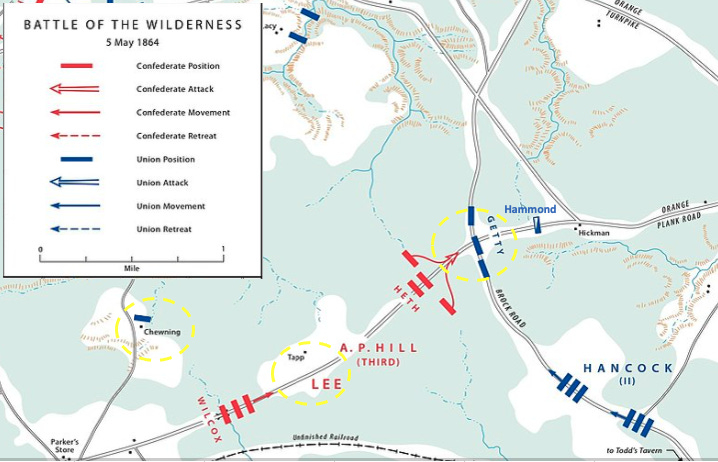
The Pennsylvanians press forward, driving Heth’s skirmishers back. Lewis Grant’s Vermont Brigade files past the advancing Pennsylvanians and begins to form their own line of battle to the south. They too push forward into the tree line and clear out Confederate skirmishers. Men begin to hack down trees and stack them on the far side of the Brock Road, building protective breastworks from which to fire on any advancing Confederate force.
George Getty, through his will and luck alone, has prevented the Brock Road from falling into the hands of Robert E. Lee. The nearest fallen Confederate lies less than 30 yards from Getty’s horse. The sacrifice of the 5th New York Cavalry and the determination of a single Union commander have bought just enough time to close the gap between Hancock and the rest of the Army.
Private Phil Crites, Company B, 25th Virginia, peers over the edge of the breastworks to stare at the dead Yankees in the middle of Saunders Field. His eyes are drawn not to the corpses, but to the stuffed haversacks on top of them. Crites is hungry, so much so that his empty belly is driving him to madness.
For several hours, no Yankee has emerged from the far tree line, and the men of the Second Corps have continued to shake themselves into a line of battle extending into the tangled morass of tree and brush either side the Turnpike and Saunders Field. Officers warn their men not to venture into the no-man’s land of the field, for it is too dangerous to make such a dash under the waiting muzzles of Union skirmishers.
Crites does not heed the warning. He springs over the wall of timber and dirt and sprints down the slope, reaching the small swale where the dead Yankees lie. He drops to one knee, arms outstretched greedily for the haversack of the nearest dead Yankee.
A shot rings out. A bullet takes Crites in the thigh.
Sam Lynch, also Company B, recoils as Crites’s leg is kicked out from under him by an unseen force. The bullet strikes him so hard that it lifts the Virginian off his legs, which kick and flail as he crashes to the earth on his back. A cry of pain wafts from the thrashing Crites. Sam and three comrades volunteer to retrieve him.
“Sam,” pleads Private John King, his best friend. “Please, don’t go.”
Lynch does not heed King’s pleas. He and three others dash into the corn stubble field and spring down the hill. No shots ring out from the tree line of the far end. The small party reaches Crites, who is gasping with pain and who clutches his bloodied leg.
The four men grab the thrashing Crites by his arms and legs. They start to lug the mortally wounded man back up the slope. John King, watching intently from the cover of the breastworks, cannot take his eyes off the spectacle. He begins to hope the Yankees will allow his friends to get Crites off the field of battle.
A swarm of bullets take the party as they begin climbing the hill. In horror, John King watches as Sam Lynch drops Crites, grabbing his own stomach, and looses a shriek of such pain that King can scarcely believe a human being can utter it. The other three men drop Crites and run back up the slope, chased all the way by Yankee bullets.
John King cannot look away. He wants to jump over the breastworks and drag his wounded friend to safety but knows that it is impossible. The two men have been close friends since the beginning of their service in the army. They have shared the hardships of three years and many campaigns. The animalistic shrieks of the gutshot Lynch pierce John King’s ears. Helpless, he grips the edge of the breastworks until his knuckles turn white.
John puts his head on the log in front of him, closes his eyes, and begins to weep as the hellish chorus of Sam’s agony continues. He hears Sam plead for help, hears him call his name, hears Sam call out to his mother, and hears Sam beg for water, for mercy, and then for someone to shoot him.
John King will survive the Civil War. He will walk out of the hellish Elmira Prison Camp in June 1865, make his way home, and try to rebuild his shattered life. A few years after the war, King will marry and have children. He will live a long and somewhat prosperous life, dying in his nineties in 1920.
Yet, in his dreams and moments of quiet and solitude, he will be tormented by the sound of Sam Lynch’s screaming. When he closes his eyes, he will be taken back to this May morning, back to Saunders Field, where he will see Sam’s legs thrashing in the air, where he will see Sam clawing at his belly — as many gutshot men do — with such force that he rips the buttons of his jacket clean off and tears his undershirt to ribbons. He will hear the pitiful wailing of his dying friend and will remember the terror and helplessness he felt on that day.
No one saves Sam Lynch, and no one puts him out of his misery. The sight of his best friend helplessly writhing between the lines and the sound of his ugly death will stay with John King until the day he dies.
Gouverneur Warren is having one of the worst mornings of his military career.
A morning that started disagreeably with the discovery of the Second Corps bearing down on him has turned frustrating, and now humiliating. It has been a nightmare to get his other divisions into a line of battle. James Wadsworth’s division struggles through the tangled Wilderness to connect with Griffin’s southern flank. Sam Crawford, ensconced on the hill at Chewning Farm, refuses to move and continues to report the presence of columns of Confederate infantry marching down the Plank Road to his front.
Warren would have liked to attack that morning, but with only Griffin’s division deployed correctly, it would be fruitless. Every few minutes, Griffin’s skirmishers can hear the low groan of falling trees as Ewell continues to carve a fortress on the high ground at Saunders Field.
Ulysses Grant loses his patience shortly after noon. He had expected, and hoped, that Meade would pitch into Lee immediately upon discovering the movement of Confederate troops along the Turnpike. Yet, news of the advance on the Plank Road and the near-sundering of Hancock’s 2nd Corps from the rest of the army seems to have unnerved George Meade.
Grant can feel the men around him slipping into a defensive mindset, letting their caution and, frankly, fear of Robert E. Lee overtake their sense. He will not suffer such caution in his presence.
In front of the headquarters staff at the Lacy House, Grant not-so-subtly questions the bravery of Meade’s army and orders him to launch an immediate assault on the Rebels in Saunders Field with whatever force can be brought on hand.
Meade, shocked and smarting, tries to point out the obvious: Warren is still getting the 5th Corps in line, and Sedgwick’s 6th Corps has not made it through the morass of pine and briars to form a line of battle or even connect with Griffin’s exposed northern flank.
Grant does not care.
After receiving curt orders to push Warren into the enemy, Meade departs to find the 5th Corps commander. When he delivers Grant’s order, Warren protests. He correctly points out that such a piecemeal assault, with only half his strength and no support from Sedgwick’s tardy command, would be doomed to fail.
Meade’s temper flares at Warren’s intransigence. He launches into a profanity-laced tirade at Warren, in front of the man’s staff and nearby soldiers. Finishing his reprimands with an order to attack now with whatever force is on hand, Meade ends the conversation by stating, “We are waiting for you.”
An embarrassed and equally smarting Warren overrules the objections of General Charles Griffin when he conveys the order to him. Against the better judgment of every man from the Army’s commander to the brigade commanders assigned to carry it out, the 5th Corps prepares to charge across Saunders Field.
The attack will be made by the divisions of Griffin and Wadsworth. Griffin will assault across Saunders Field, with Roman Ayres’s brigade advancing on the north side of the Orange Turnpike and William Bartlett’s brigade advancing on the south side. In the trees to their south, Wadsworth’s division will pick its way through the Wilderness until it finds Ewell’s trenches, somewhere out to the west.
Leaving their trenches, Ayres’s and Bartlett’s brigades pick and pry their way forward the hundred or so yards to the edge of the tree line on the eastern end of Saunders Field. By the time they arrive at the edge of the clearing, order in the ranks is gone. A storm of lead and iron spits out of the Confederate breastworks on the western side of the field. Rifle and cannon shot shred the air above the Union line as it emerges from the Wilderness. The men lie down on the ground and wait.
The fire deforests the canopy above their heads. Shells splinter trees and branches, causing a steady rain of sawdust and chippings to drift onto the backs of the prone men in blue. The suspense is almost unbearable. Every man looks across the quarter-mile field, takes note of the swale at its center, gazes up the slope on the swale’s far side, and at the crest of the hill now sheathed in smoke and afire from end to end with muzzle blasts.
Both Romeyn Ayres and Joe Bartlett do not want to do this. They do not want to make this assault. They stare across that agonizing expanse of corn stubble and briars, up that deceptively gentle slope a quarter-mile away, and know they are about to sacrifice the lives of their men for no gain. They view what is about to happen as insanity; Ayres cannot fathom why they are being forced to march into a killing ground. They will have no support on their right flank; Sedgwick is nowhere to be seen. There is no telling how thick those woods are with Rebels.
But they can do nothing to stop what is coming. The decision has been made; the order is given. It is not the first time in this conflict that officers in command of a body of men have balked at such an order, to charge a position strongly held by the enemy without support or expectation of success.
And it will not be the last.
At once, bugles sound, the melody carrying above the crashing din of shot and shell. The prone Yankees rise, shoulder arms, and dress their ranks. Then, at the behest of their commanders, three lines of men in blue step out of the shade of the trees, into the corn stubble field, and begin their quarter-mile march toward death.
Next: “Armageddon in the Dark Forest, Part III: The World Burns”
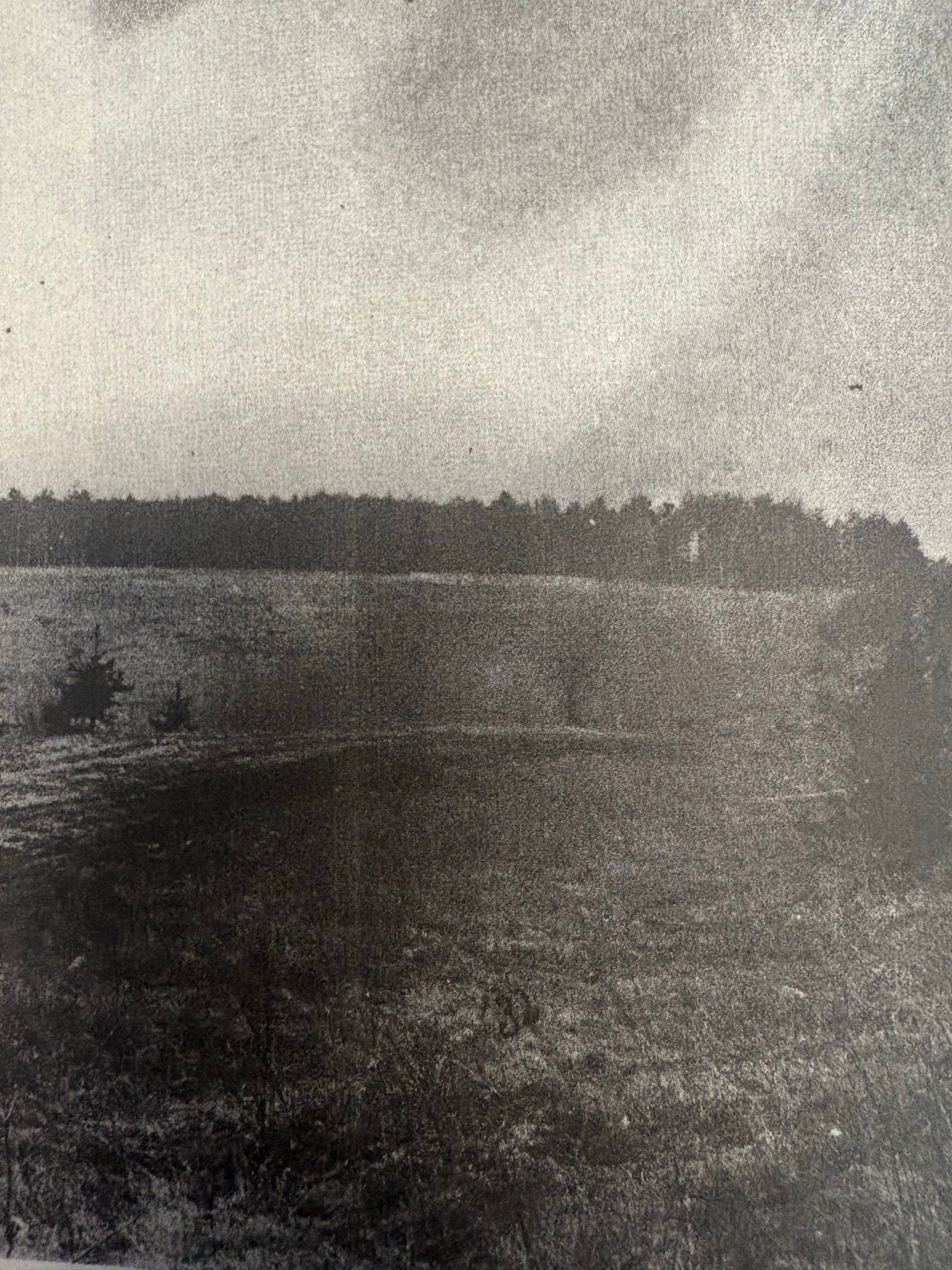
Thumbnail image: The rolling hills of Saunders Field are visible from the Wilderness Exhibit Shelter (National Park Service)
No posts
Comments
Nothing yet. Say the first thing.
Sign in to join the conversation.