
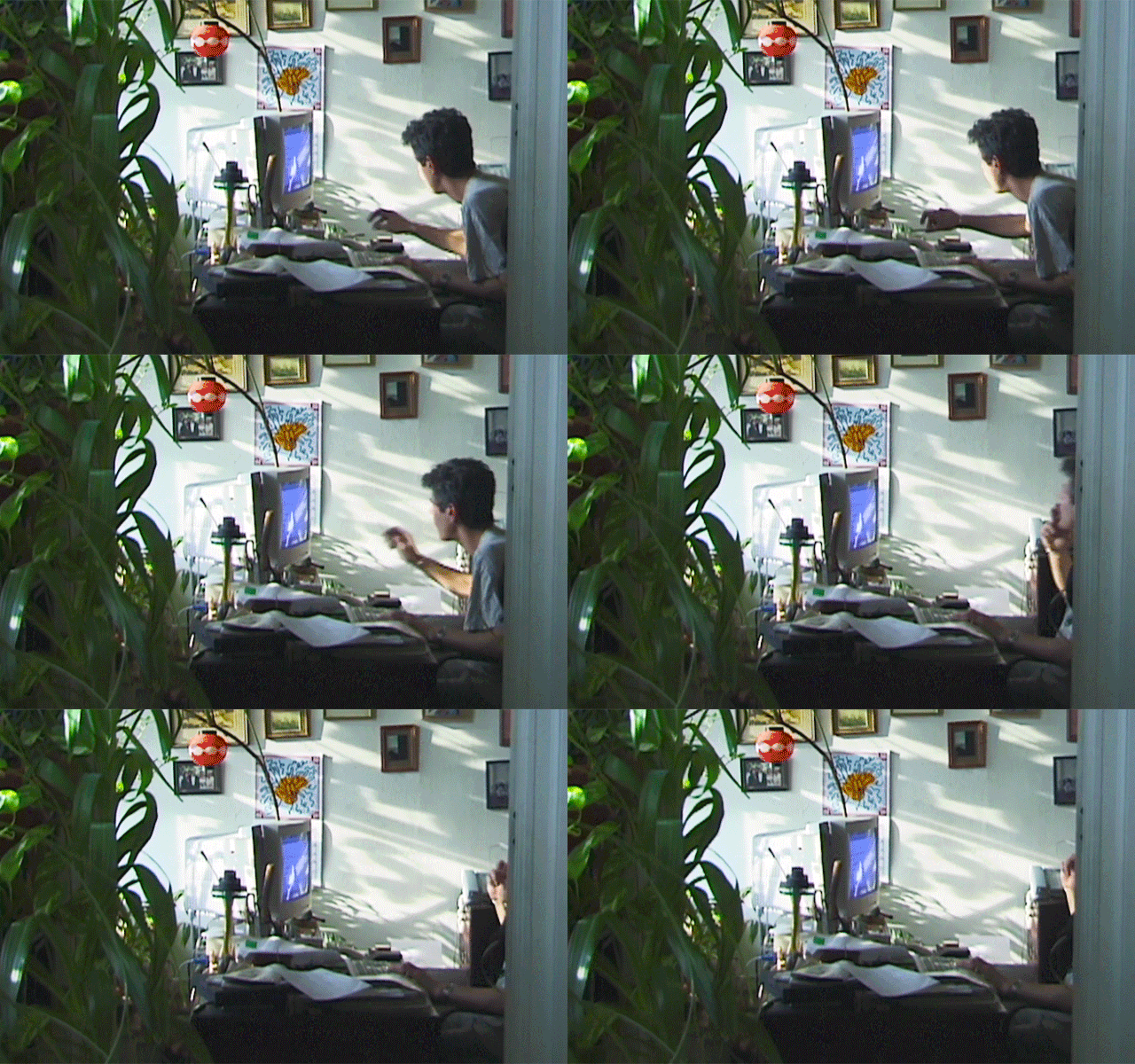
“In 1973, unhappily in love, I graduated high school a year early so I could chase the object of my desire to Vassar College — the less said about that part of my life, the better, believe me. Let it suffice to say that by the age of eighteen I was a thoroughly undisciplined young man, blithely flunking or fading out of college (I couldn’t be bothered to attend classes). I was angry at myself and everyone else. Essentially, I treated the world as my ashtray. I spent most of my waking hours drinking, smoking pot, scheming and doing my best to amuse, outrage, impress and penetrate anyone silly enough to find me entertaining. I was — to be frank — a spoiled, miserable, narcissistic, self-destructive and thoughtless young lout, badly in need of a good ass-kicking. Rudderless and unhappy, I went in with some friends on a summer share in Provincetown, Cape Cod. It was what my friends were doing and that was enough for me.” — Anthony Bourdain, Kitchen Confidential (2000, Bloomsbury)
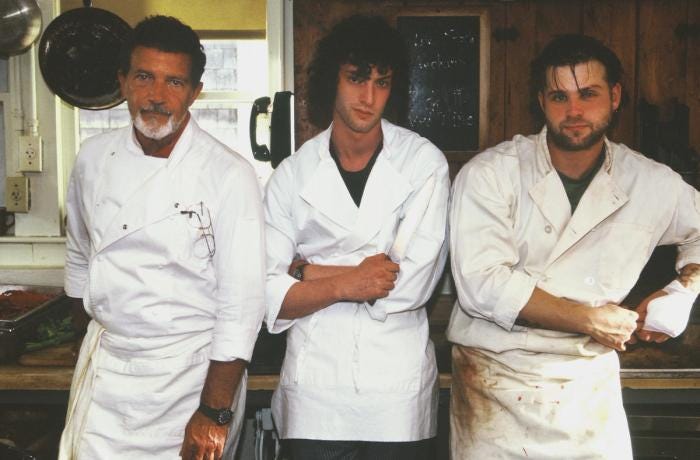
I have been trying to write up my thoughts about Tony, Matt Johnson’s new coming-of-age biopic based on the life of teenaged Anthony Bourdain all week. The film opens with a highlighted citation from the above passage from Bourdain’s breakout memoir. It uses this statement as a sort of thesis for which it crafts its version of Tony, the angry young man who would grow up to become the iconoclastic bad boy of the culinary world, best-selling author, television host, and world traveler professionally known by his full name Anthony Bourdain.
While I admired Johnson’s film and had a lot of fun with it, I also have a lot of issues with it. I agree with what Clara Cuccaro said about the film in her conversation about the film with Elissa Suh:
I think it’s better for someone who doesn’t have an intense relationship with Bourdain.
I am so grateful that this film is not the unmitigated disaster that was Morgan Neville’s reprehensible documentary Roadrunner (2021). You can read my whole thoughts on that film in this piece at RogerEbert.com, but I’ll leave you with the kicker:
In the end, all of the emotion displayed by participants rings hollow. It’s not that the tears for Bourdain’s life aren’t real, but the way the filmmakers elicit them from the participants and package them feels less like a loving tribute to a man no one ever fully knew, and more like vultures picking the last meat off his bones.
From what I’ve read, it seems Johnson’s aim with Tony was to add more nuance to the unknowable aspects of Bourdain and also leave audiences on a happy note, despite everything we know about how Bourdain’s story really ends. That’s an admirable aim, sure, but the more I think about the film the more it comes off as a Cliff Notes version of what Bourdain shared with his readers in his books. If you haven’t read his books, now is as good a time as ever to start. They are so sharp and dark and funny.
For Tony the script, which has four credited screenwriters — Matthew Miller, Todd Bartels, Lou Howe, and director Matt Johnson — is a reimagining of a few chapters from Kitchen Confidential, which make up roughly 15 pages of Bourdain’s 300-page book. I do love that it focuses on such a small, pivotal timeframe in his life. Sometimes it works wonderfully, like Spencer (2021), other times they are a mess like Springsteen: Deliver Me from Nowhere (2025). Tony falls somewhere in the middle.
As I was watching it, I really felt the energy that comes from those pages in the book. The excitement that young Bourdain felt from his experiences working the line and getting to know all the guys who made up P-Town’s culinary scene. However, when I got home and re-read the chapters (which I hadn’t read in about a decade), looking for the stories I had remembered to see how they transmuted them to cinema, it hit me that despite the many nods to the stories in the book there’s just something off about this take on the events. Not just because they took several years’ worth of experiences, combined them into one, added stuff that came from other years, and then also made a lot of stuff up, but also in Tony’s attitude, which is just self-centered enough to be rare stuff in a biopic, but not nearly as arrogant or sometimes downright mean that he himself writes that he was. The movie likes its Tony a lot more than Bourdain sure seemed to like himself at this time in his life.
Which, again, is par for the course with this kind of biopic. At times, it feels like a throw back to the kind of studio-made biopics that Hollywood used to make that starred Jimmy Stewart and barely had anything to do with actual history. But as I re-read the pages, I wondered why they couldn’t just stick to Bourdain’s actual stories? They’re so much more interesting! I imagine part of this has to do with not wanting to pay the rights to actually adapt the book1. The relative lack of true self-loathing I feel comes from this idea that we have to have a rooting interest in a film’s protagonist and I guess you can’t make a feel-good film led by a man cloaked in self-loathing.
Comments
Nothing yet. Say the first thing.
Sign in to join the conversation.