
Faith and identity are not the same thing, though a settled life rarely has occasion to notice where one ends and the other begins. The distinction becomes visible only under strain, when the believer’s faith becomes questionable to himself. It is at this point that both elements become sources of tension, rather than reflection.
Two Old Believer writers, one a living Belokrinitsa writer, and the other a Fedoseev nastavnik who died almost a century ago, each considered this strain in its sharpest forms, and the sharp contrast between their perspectives offers a chance to look substantively at what is behind this strain.
We have entered a time in which faith is wholly overtaken by pretense, by a mere likeness of faith. The believer has been replaced by an actor playing the believer. In my view, no period of religious apathy can compare with our present age in its sheer quality of godlessness. Outward signs of religiosity, the self-identification of being a believer, religious identity itself, have displaced a deeper, true spirituality - a mystical union with God, and the search for that union. The external trappings of religiosity now proclaim themselves to be ends in themselves, possessing intrinsic worth.
The spirit of this age has substituted the attributes of faith for faith itself, and has replaced believers with imitators of belief. And these imitators talk, debate, argue, and try to prove things. They construct entire worlds beneath the emblems of a faith to which they are only formally connected. And one cannot expose them -because this imitation of faith has penetrated the very layers of the psyche.
Kirill Mikhailov. Faith and Identity
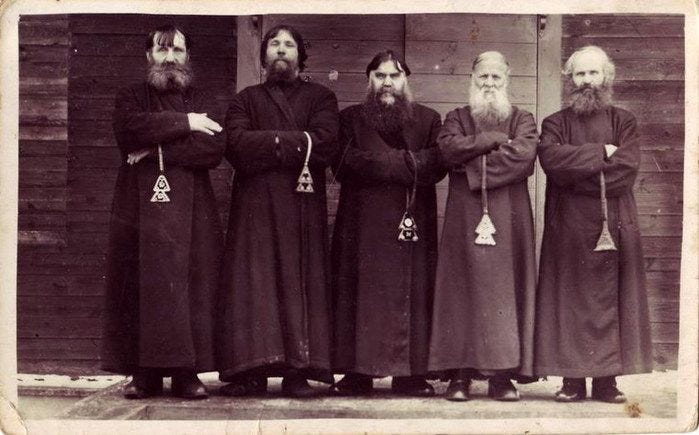
We call ourselves Old Believers, but our outward appearance testifies to the contrary. Often, people respond, “One must keep the covenants of piety in the soul.” But this is merely an excuse. Is your impious appearance forced upon you by someone else, or is it your own desire? Clearly, it is not forced but stems from your own will, from your attachment to everything new and corrupt. Your appearance clearly reveals the emptiness of your inner content. You wear not the uniform of Christ’s army but that of the Antichrist. Meeting such an “Old Believer” causes the heart to ache with bitterness - “What is old about you? Why do you call yourself an Old Believer?”
Gavriil Frolov. Covenants of Antiquity
The two quotes above represent, as it were, two charges leveled at the modern Christian. Of course, both are aimed squarely at the modern Old Believer - but I think with some imaginative muscle you can apply these bitter reflections to the modern Christian of any confession, even if the particulars are different.
The modern Nikonian may not be as cognizant of his appearance in the temple - but simply replace the outward marks of identity with the frequency and manner of his outward participation in the temple rites and the same indictment will be delivered.
Mikhailov’s charge is the more because there is no easy way out. He is not accusing the age of laziness, of having simply let its piety lapse - he is accusing it of a forgery, a sustained and largely successful project of substitution, in which the outward marks of faith have been kept, while the faith which it reflected starved to death.
For Mikhailov, trying harder does not help. The imitator can talk, debate, argue, construct whole intellectual edifices beneath the sign of a faith he has never actually entered, and no one - not his neighbors, not his fellow believers, not even, most disturbingly, the imitator himself - can be relied upon to notice the difference from the outside. If this is true, then a man cannot establish his own sincerity by inspecting his own diligence. The diligence is precisely what the imitation is made of.
Frolov permits no such despair, and for that reason offers no such refuge either. His charge is narrower: he will not accept the inner man as a place to hide. Told that a man may let the outward form lapse while keeping the covenant “in the soul,” he answers that this is merely an excuse - that a slack or corrupted appearance is not evidence of some deeper inward failure, it is the failure.
Set beside one another, these two claims do not cancel out. A man could satisfy Frolov completely - beard, rule, fast, dress, every visible requirement met without exception, and still be exactly the actor Mikhailov describes, performing a part he has rehearsed so long he no longer recognizes it as a performance. And a man could take Mikhailov’s warning fully to heart, distrust every one of his own outward observances as potential vanity, and in doing so simply confirm Frolov’s verdict by degrees, his appearance thinning as his caution grows, until what is left of him differs from ordinary apostasy only in the style of its excuse.
It may seem, at first glance, that the two quotes by Mikhailov and Frolov, are in direct conflict. They are not, though there is certainly tension between them.
Frolov asserts that an Old Believer must preserve his identity, boldly. That allowing the marks of those on the “outside” to permeate your existence is a sign of timidity before a world spiritually antithetical to the faith.
He is right, of course.
Simply put - preserving the established Christian identity is a necessary condition for faith, because the abandonment of that identity is a form of denial of the faith that produced it.
Mikhailov, however, in his treatment of today’s masses of Christian zombies - going through the motions of faith without the burning need for Christ, or the willingness to sacrifice one’s place in the world to follow Him, while retaining the outward signs makes one an impostor. Chaff waiting to be burned away. Mikhailov makes clear in his essay that identity is not a sufficient condition for faith.
Necessity and sufficiency describe the shape of the problem; they do not yet describe its history. Scripture supplies two paradigmatic converts, and it is worth noting at the outset that they do not face the same problem, because they are not undergoing the same experience.
In the Old Testament - the father and the greatest example of faith is Abraham. But, in his paternity through faith - God separates him from his land and from his people, as if to distinguish faith from posterity:
Now the Lord said unto Abram, Get thee out of thy country, and from thy kindred, and from thy father’s house, unto the land that I will shew thee.
Genesis 12:11
The command asks for a threefold departure - land, kindred, father's house - and offers, in exchange, only a single hidden destination: "a land that I will shew thee." Abraham is not being asked to join anything. There is no people yet to join. Abraham's faith could not have been received through an inherited religious culture, because none existed for him to inherit. He is not a convert in the ordinary sense.
There are those who are called by the law of love, which is in their nature, and which the original Good implanted in them at their first creation. The Word of God came to them, and they, without the slightest doubt, followed it with readiness, like the forefather Abraham - for when the Lord saw that it was not by instruction from men that he had learned to love God, but by the law implanted in his nature from the very moment of his conception, the Lord appeared to him and said: "Get thee out of thy country, and from thy kindred, and out of thy father's house, into the land which I will show thee." And he went, without doubting or delaying, but ready for his calling. He is the pattern of that disposition of soul which even to this day abides in all who walk in his footsteps. Laboring and seeking the fear of God in patience and stillness, they attain to the true manner of life, since their souls are ready to follow the love of God. This is the first kind of calling.
Anthony the Great, Letters, Revue de l’Orient Chrétien 14 (1909), p. 289.
St. Anthony refers to Abraham’s movement as the “first kind of calling”. Unassisted by any surrounding witness or culture, it is offered as the earliest and most extreme instance of faith's arrival, not as the only shape it can take. Most who come to faith afterward, Ruth among them, come by a different road - through attachment to a people who already carry the faith and identity Abraham first received.
And she said, Behold, thy sister in law is gone back unto her people, and unto her god: return thou after thy sister in law. And Ruth said, Entreat me not to leave thee, and to return from following after thee: for whither thou goest, I will go; and where thou lodgest, I will lodge: thy people shall be my people, and thy God my God: where thou diest, will I die, and there will I be buried: the Lord do so to me, and more also, if aught but death part thee and me.
Ruth 1:15-17
Where Abraham had nothing to join, Ruth has everything to join, and this changes the character of her renunciation considerably. She performs, in miniature, what Abraham performed - leaving land, people, and, implicitly as a Moabitess, her father's household gods - but she does not walk out into an empty destination. She walks toward an already-established people, an already-given law, a set of customs she has had no part in shaping and will have no standing to alter. Abraham's obedience is creative. Ruth's is submissive.
St. John Chrysostom compares Ruth to us:
Observe also how the events of Ruth’s life correspond to our own... And just as she would never have entered into such a marriage had she not first left her father, and disdained her house, her kindred, her fatherland, and her relations, so too the Church, when she left behind her ancestral customs, then became beloved of the Bridegroom Christ. Concerning this the prophet also, addressing the Church, says: “Forget also thine own people, and thy father’s house. So shall the King desire thy beauty” (Ps. 44:11,12). Thus also did Ruth, and thereby became the mother of kings, just as the Church did too, since from her David was descended.
St. John Chrysostom. Homilies on the Gospel of Matthew, 3.4
Chrysostom is not merely praising Ruth’s fidelity as an instructive individual case. He names her the type of the Church itself. Every convert who leaves “ancestral custom” for Christ is not, on this reading, doing something like what Ruth did - he is repeating the very gesture that constituted the Church as such. The Bride becomes so only by first ceasing to be at home.
Taken together, Abraham and Ruth are not two contrary models but two stages of a single one. A faith received without any surrounding culture to house it will not remain uncultured indefinitely - culture is what obedience produces, given time and descendants and a land actually possessed. But a faith received into an already cultured inheritance - Ruth’s condition, and the condition of anyone converting today into an existing confession - does not get to skip the first stage to reach the second. Ruth still had to leave Moab. The joining does not excuse the leaving; it follows it. This is the precise point at which a convert is tempted to reverse the order - to seek the belonging Ruth found in Bethlehem before performing the renunciation that made her fit to receive it.
But, this renunciation is complicated by the fact that today, it is not easy to identify what must be renounced. The complicating inputs of history and political philosophy make unclear what must be abandoned. Is it really necessary today to leave one’s land? From my perspective - it cannot be, as there are no Old-Believer lands to move into, beyond small communities which rarely enjoy complete isolation.
And it must be stated that Moab, and the land of Abraham’s fathers were openly pagan. The Old Testament does not give any examples of rigorous examinations of the spiritual, philosophical, or political ideologies of a land, when deciding that one must leave it, physically. What mattered was whether or not the land worshipped false gods, or the true one.
Who, today, lives in lands that have not, as part of their histories and cultures, the belief in the one true God, and Jesus Christ at that? There is no formula in Scripture by which one must be burdened act as judge for his culture beyond the simplest. The choice to stay or leave cannot be answered with confidence.
Ruth's obedience answers whether an existing identity must be joined rather than bypassed. It does not answer the harder question: what, within that identity, is actually binding, and why. But here, we are only looking for the principles which to apply to our own circumstances. The case of the Law of Moses is quite different in nature from the cultural precepts of the lands today. Our precepts, our rules of piety were not handed down by God directly, and the binding power of them cannot be held to the same standard.
Ye shall therefore keep all my statutes, and all my judgments, and do them: that the land, whither I bring you to dwell therein, vomit you not out. And ye shall not walk in the customs of the nation, which I cast out before you: for they did all these things, and therefore I abhorred them.
Leviticus 20:22-23
This is a moral and cultic prohibition first - the “customs” in view are practices already condemned. But the mechanism is deliberately broad: Israel is forbidden not merely the specific abominations of the surrounding nations but their ways as such, treated as a totality capable of contaminating by proximity, independent of whether any single custom, examined alone, is itself sinful. The logic is preventive rather than case-by-case. Distance is required because assimilation, left unchecked, rarely stops at the boundary either party intended.
For thou art an holy people unto the Lord thy God, and the Lord hath chosen thee to be a peculiar people unto himself, above all peoples that are upon the face of the earth.
Deuteronomy 14:2
Here the ground shifts from prohibition to identity as an established fact. The peculiarity is asserted prior to any specific commandment being kept.
The harder question is whether this peculiarity was ever meant to extend to what a man wears, or only to what he believes and does. Frolov, arguing for the former, cites two witnesses:
The Venerable Theodore writes: “Each person reveals themselves by their own appearance.” And Basil the Great said that “on a Christian, even in their clothing, there is some distinctive mark.”
But retaining a distinctive appearance, even among outsiders, does not explain if there is an underlying principle at work - or if the distinction is its own end. For Ven. Theodore, the Studite, the effect of the appearance is in what it reveals. It is a direct benefit to the “other”.
In Deuteronomy, chapter 22, it is said, “Thou shalt not wear a mingled stuff, wool and linen together. Thou shalt make thee fringes upon the four borders of thy vesture, wherewith thou coverest thyself.” (v. 11-12)
Ephrem the Syrian interprets the purpose, saying “The Lawgiver wished that his people should be distinct from the pagan nations even in their very clothing.”
On the fringes - God commands Moses:
Speak unto the children of Israel, and bid them that they make them fringes in the borders of their garments throughout their generations, and that they put upon the fringe of each border a cord of blue: and it shall be unto you for a fringe, that ye may look upon it, and remember all the commandments of the Lord, and do them; and that ye go not about after your own heart and your own eyes, after which ye use to go a whoring.
Numbers 15:38-39
While the first function of appearance is revelatory, the second is mnemonic, that is - it is meant for inward remembrance. One function is external, the other is internal.
The text does not say the fringe distinguishes Israel from the nations who observe it. It says the fringe exists so that Israel, looking at her own garment, will remember - will not “go about after your own heart and your own eyes.” The marker here is not a signal sent outward; it is a device fixed to the body to interrupt the wearer’s own forgetfulness, placed exactly where his own eyes will fall on it. Cyril of Alexandria draws out the same logic allegorically:
St. Cyril of Alexandria, in his commentary on this passage, says:
The law, then, provided beforehand that jacinth threads should hang both upon the garments and upon the hand, as if proclaiming thus: let the proclamation from the heavens be to you a garment of the mind and a vesture of the reason, and the determiner of right deeds - the law! … For it is, I think, very plain that he in whose mind the Divine law abides will surely be both well established and steadfast in virtue … Therefore, prolonged and constant care for the law leads to the right path, or, what is the same, to the path pleasing to God, driving away from the human soul, as it were, a certain mist and fog - forgetfulness.
On the beard, we can see another example of the religious marker of identity as a mark meant to distinguish the faithful from those around them, “Ye shall not round the corners of your heads, neither shalt thou mar the corners of thy beard” (Lev. 19:23). Ephrem the Syrian says that by this command, “The law restrains the Hebrews also from another pagan custom [that is, shaving]” (Commentary on Levitius).
Ephrem's comment on this text, that "the law restrains the Hebrews also from another pagan custom," places the beard alongside the fringe's outward-facing function rather than its inward one.
Everything considered so far presumes a single lineage of blood and faith. The apostolic church confronts something neither Abraham nor Ruth had to face: a mass of converts arriving with no claim on that lineage at all, asking whether marks given to one people for reasons rooted in that people’s own history are owed by inheritance to those who share none of it. Ss. Peter and Paul, and the council at Jerusalem answer this question directly, and not with one voice.
It cannot be overstated just how radical the condescension was to the masses of Gentiles who were converting and being baptized. The entire 15th chapter of Acts is relevant:
But there rose up certain of the sect of the Pharisees who believed, saying, It is needful to circumcise them, and to charge them to keep the law of Moses… Peter rose up, and said unto them, Brethren, ye know how that a good while ago God made choice among you, that by my mouth the Gentiles should hear the word of the gospel, and believe. And God, which knoweth the heart, bare them witness, giving them the Holy Ghost, even as he did unto us; and he made no distinction between us and them, cleansing their hearts by faith.
Acts 15:5, 7-9
If God "made no distinction between us and them, cleansing their hearts by faith," then the mark of belonging to Abraham's line is no longer descent, circumcision, or Law, but that which Abraham alone possessed before any of those existed: faith, unaccompanied by inheritance. The council does not extend Jewish identity to the Gentiles. Instead it treats both peoples as born of the same root of pre-Mosaic faith, which, had the Isrealites displayed in their flight from Egypt, might have even made the Law itself unnecessary.
Continuing in Acts, James, acting as the leader of the council, and passing confirming judgment on the words of Peter, decries the impractical burden of taking on the Law of Moses for masses of Gentile converts.
Wherefore my judgment is, that we trouble not them which from among the Gentiles turn to God; but that we write unto them, that they abstain from the pollutions of idols, and from fornication, and from what is strangled, and from blood.
Acts 15:19-20
This is not a distillation of the Law. Neither does the council ask Gentiles to become partial Jews. It asks them to become, for the first time in Israel's history, simply righteous Gentiles admitted whole.
This minimalism must not be mistaken for the whole of what Christian identity would become. It is soil, the first, thinnest possible condition in which a wholly new culture would, over the following centuries, grow. But any Christian identity that would grow could only be nurtured by God in response to their genuine faith.
Faith in God cleanses the heart; a clean heart sees God. But since faith itself is sometimes so defined by people who deceive themselves, as though it were enough merely to believe - some who believe, while living sinfully, promise themselves even the contemplation of God and the Kingdom of Heaven… Will they too, then, see God? He shall be seen by the pure in heart. And who would call unclean spirits pure in heart? And yet they believe, and tremble. We must distinguish our faith from the faith of the devils. For our faith cleanses the heart; but their faith renders them guilty. Let us, then, distinguish our faith; it is not enough merely to believe. That is not the faith which cleanses the heart. It is said: cleansing their hearts by faith (Acts 15:9). But by what faith, if not that of which the Apostle Paul speaks: faith which worketh by love (Gal. 5:6)? This faith is distinct from the faith of the devils, distinct from the faith of worthless and lost men. He says: faith. What faith? That which worketh by love, and hopeth for what God promises. There is nothing more precise or more perfect than this definition.
Blessed Augustine, Sermons 53.10-17. PL 38:368.
Augustine's distinction here is Mikhailov's distinction, fourteen centuries early, and stated with a precision beyond Mikhailov's: not all belief is the same belief. What separates saving faith from devils' faith is not its object or its intensity but its fruit: faith "which worketh by love."
An imitator, in Augustine's own terms, is not merely lying about believing. He may believe sincerely, and still possess exactly the devils' faith, devoid of love, rather than Abraham's.
About 100 years after the council at Jerusalem, a letter of disputed authorship was written to a certain Diognetus, wherein the writer comments that the Christian man of his time, like those Christian pilgrims of today, has no homeland and still no established culture to call their own. But they did not need it, in his eyes, for their faith, proved by their lives, was sufficient:
Christians are not distinguished from other men either by country, or by language, or by the customs which they observe. They do not inhabit cities of their own anywhere, they do not use some strange dialect, and they lead a life in no way different from others. Only their doctrine is not the fruit of thought or the invention of men seeking novelty; they are not attached to any human doctrine as others are. But dwelling in Greek and barbarian cities, wherever it has fallen to each, and following the customs of the local inhabitants in dress, in food, and in everything else, they display a wonderful and truly incredible manner of life. They live in their own homelands, but as sojourners; they share in everything as citizens, and endure everything as strangers. Every foreign country is to them a homeland, and every homeland a foreign country. They marry, as do all men; they beget children, but they do not cast away their offspring. They have a common table, but not a common bed. They are in the flesh, but they do not live according to the flesh. They pass their time upon the earth, but they are citizens of heaven. They obey the established laws, but by their own lives they surpass the laws themselves. They love all men, and are persecuted by all. They are unknown, and yet they are condemned; they are put to death, and yet they are made alive. They are poor, yet they make many rich; they are in want of all things, and yet they abound in all things. They are dishonored, and yet in their very dishonor are glorified; they are slandered, and are justified; they are reviled, and they bless; they are insulted, and they render honor. Doing good, they are punished as evildoers; being punished, they rejoice, as though thereby they were given life. The Jews war against them as against foreigners, and the Greeks persecute them, and those who hate them cannot say the reason for their hatred.
It would not have occured to the aurthor of the letter that in a few centuries - Christians themselves would control the very empire which persecuted them, and that their own civilizations would grow, cementing their own ways, creating their own precepts, their own laws of piety. The sufficiency of the abandonment of sin, a necessary condition for faith, is present behind the words of Peter and the Letter to Diognetus, and Augustine.
The establishment of the Christian kingdom on earth was never to be permanent. St. Paul, speaking of the eventual fall, spoke of what would come in his second epistle to the Thessalonians:
Let no man beguile you in any wise: for it will not be, except the falling away come first, and the man of sin be revealed, the son of perdition, he that opposeth and exalteth himself against all that is called God or that is worshipped; so that he sitteth in the temple of God, setting himself forth as God. Remember ye not, that, when I was yet with you, I told you these things? And now ye know that which restraineth, to the end that he may be revealed in his own season. For the mystery of lawlessness doth already work: only there is one that restraineth now, until he be taken out of the way. And then shall be revealed the lawless one, whom the Lord Jesus shall slay with the breath of his mouth, and bring to nought by the manifestation of his coming; even he, whose coming is according to the working of Satan with all power and signs and lying wonders, and with all deceit of unrighteousness for them that are perishing; because they received not the love of the truth, that they might be saved. And for this cause God sendeth them a working of error, that they should believe a lie: that they all might be judged who believed not the truth, but had pleasure in unrighteousness.
2 Thessalonians 2:3-12
It is worth noticing what kind of knowledge Paul assumes here. He does not spell out the restrainer's identity, "for ye know" already - the meaning was never meant to travel by text alone, but by living presence, spoken once and held afterward in a community's memory rather than committed to writing at all. Identity, on this same principle, has always depended on something beyond the individual holding it: a form of life legible to, and confirmed by, a community that carries what no single believer, however sincere, can carry alone. Where such a community exists, identity has a check outside itself. Where it does not, the check disappears with it.
Interpreting this passage, Blessed Augustine is perhaps more personal and forthright in his simple understanding, saying:
But in saying: "And now ye know that which restraineth, to the end that he may be revealed in his own season." - that is, you know what restrains him, what is the cause of his delay - he gave to understand that they indeed knew it, but that he himself was unwilling to speak of it openly. And so we, who do not know what they knew, are not able, however much we might wish it, to make clear to ourselves what the Apostle meant; the more so since his subsequent words obscure this sense still further.
Bl. Augustine, De Civitate Dei 20.19.
It is enough for Augustine to admit that he does not know what this passage means, or to what St. Paul is referring.
Theodoret of Cyrus is more explicit:
By "that which restraineth" some have understood the Roman Empire, and others the grace of the Spirit - that is, that Antichrist will not come while the grace of the Spirit still abides. But it is impossible that the grace of the Spirit should altogether cease, for how could men, deprived of spiritual help, overcome his devices? … the divine Apostle, as I think, speaks neither of the Roman Empire nor of the grace of the Spirit; on the contrary, I acknowledge as true what is affirmed by others. It is pleasing to God that Antichrist should appear at the time of the consummation. Therefore the decree of God does not permit him to appear now.
As a support for faith, as proof, or rather, a sincere reflection of a real faith, the Christian identity is seen only by another. There is a communal presupposition to identity.
But the presence of the Antichrist, and to our belief, the wide nearness of the malignant Spiritual Antichrist, must act as a kind of worldwide solvent which unbinds those Christian manners and pious acts, and lures an already weak faith unto the abandonment of its duty to abandon sin.
The effect of the Antichrist is not the visible violent assault on a people, but their dispersion, a general loosening of the bonds that let identity be witnessed at all. Left without the community that once held it accountable, a weakened faith does not simply lapse; it reaches for justification, and finds one ready to hand in the very words we have just read from Diognetus - that the marks were never essential to begin with, that the Christian was always a stranger unmarked by any particular custom. What was, in the second century, an honest description of a young Church without a homeland becomes, in the solvent influence of the antichrist, a convenient alibi for a Church that once had a homeland and simply let it go.
Babylon has long served as an image of the world-power that swallows the faithful into its own order. Read this way, Daniel’s exile is not merely an historical hardship but a rehearsal of the very condition of the reign of the Spiritual Antichrist: a faithful remnant, without temple, without native land, often without the ordinary supports of an intact religious culture, required to go on being what it was called to be inside an empire that has no particular interest in destroying it, only in absorbing it.
But Daniel purposed in his heart that he would not defile himself with the king’s meat, nor with the wine which he drank… that he might not defile himself.
Daniel 1:8
Of significant relevance to Daniel’s fidelity to God is the food that he eats.
It is not simply a matter of fasting or dietary laws in this example. Instead, the act of eating the food of the oppressor is itself defiling. This recalls the story of St. Theodore Tyron who warned Christians through a vision not to eat food that was intentionally defiled in the market. Even an unknowing consumption would have defiled! Nevertheless, the matter of dietary rules and fasting rules occupies a central place in the Christian’s own sense of obedience to God’s commandments.
Only later, however, does Babylon supply an image to bow to and a den to be thrown into, and here the same principle holds at greater cost:
But if not, be it known unto thee, O king, that we will not serve thy gods, nor worship the golden image which thou hast set up. (Daniel 3:18)
And when Daniel knew that the writing was signed, he went into his house; (now his windows were open in his chamber toward Jerusalem;) and he kneeled upon his knees three times a day, and prayed, and gave thanks before his God, as he did aforetime. (Daniel 6:10)
“As he did aforetime”. This shows that Daniel’s actions were the very retention of his Hebrew identity. At every state, his resistance takes the same form: the deliberate retention of a distinguishing practice opposed to a culture opposed to his identity.
The empire could absorb a thousand such men without noticing the loss, and it very nearly did.
Of Daniel’s own people, few besides his small company are named as having kept any part of their identity at all. The empire’s confidence was precisely in the fact that identity, retained or abandoned, made no practical difference to its rule.
Daniel’s resistance was aimed, in other words, not at an empire that demanded his conformity, but at one that was simply indifferent to whether he conformed - until, at three specific moments, it was certainly not indifferent.
This is where Daniel is nearer to the present condition than the contrast with a certain visible enemy first suggests. Nebuchadnezzar’s Babylon, unlike the solvent that dissolves without confrontation, could still be provoked into declaring itself - an image could be erected and a den could be prepared.
The present dispersion offers no such moments to look forward to, however rarely they came even for Daniel. Daniel had the possibility that indifference might, at any time, sharpen into confrontation, thereby giving him a clear enemy to resist - the solvent age withholds even as a possibility. Daniel’s food observance and his orientation at prayer to Jerusalem are still the correct model for what fidelity looks like on the ordinary days. It is only the hope of an eventual furnace, clarifying the matter once and for all, that the present condition does not suggest.
The devil simply no longer needs the furnace.
The partial conditions of identity were kept “as aforetime,” in Bablyon, by the few, on the great majority of days when no den was waiting and no watching empire cared. If this is the correct model for preserving identity under an indifferent power, then the diaspora condition itself may not be just a diminished version of Daniel’s trial. It may simply be its usual experience.
To be a stranger in a strange land was acknowledged and perhaps even spoken well of by St. Peter:
Peter, an apostle of Jesus Christ, to the strangers scattered throughout Pontus, Galatia, Cappadocia, Asia, and Bithynia. (1 Peter 1:1 - King James Version)
Dearly beloved, I beseech you as strangers and pilgrims, abstain from fleshly lusts, which war against the soul; having your conversation honest among the Gentiles: that, whereas they speak against you as evildoers, they may by your good works, which they shall behold, glorify God in the day of visitation. (1 Peter 2:11-12 - KJV)
The Epistle to the Hebrews states the same thing more starkly:
These all died in faith, not having received the promises, but having seen them afar off, and were persuaded of them, and embraced them, and confessed that they were strangers and pilgrims on the earth. For they that say such things declare plainly that they seek a country. And truly, if they had been mindful of that country from whence they came out, they might have had opportunity to have returned. But now they desire a better country, that is, an heavenly: wherefore God is not ashamed to be called their God: for he hath prepared for them a city.
Hebrews 11:13-16 - KJV
The text does not describe foreignness as an obstacle the patriarchs endured on the way to something better. It describes foreignness as the very substance of what made them commendable - “these all died in faith, not having received the promises.”
Wandering, scattered, without a land to call their own. This is named here as the condition proper to faith as such, not a defect awaiting correction once circumstances improve.
If diaspora is not, on these terms, a deficient mode of the faith but among its oldest and most native conditions. So what, concretely, is still owed under it?
Not every practice this essay has examined can survive the loss of Muscovy intact - the kaftan and kosovorotka and sarafan were never grounded in anything beyond a particular people’s history. But, at the very least, those elements of piety and identity described in the New Testament should be unfailingly observed.
Paul’s argument for the covering of women’s heads and the prohibition against men with long hair and women with short hair, is instructive:
But every woman praying or prophesying with her head unveiled dishonoureth her head: for it is one and the same thing as if she were shaven. For if a woman is not veiled, let her also be shorn: but if it is a shame to a woman to be shorn or shaven, let her be veiled... Doth not even nature itself teach you, that, if a man have long hair, it is a shame unto him? But if a woman have long hair, it is a glory to her: for her hair is given her for a covering.
1 Corinthians 11:5-6, 14-15
Paul does not appeal to Corinthian custom, nor to Mosaic law, nor to any inherited ethnic practice. He appeals to the order of creation itself and to “nature,” itself.
The Muscovite’s dress was always local and historical, with clear Byzantine origins. But the covering’s authority is claimed as creational - which is exactly the kind of principle a scattered, culturally severed people could still be bound by without needing Muscovy, or any particular nation, standing behind it.
Fasting carries the same double edge more sharply still, because scripture itself supplies both halves of the necessity/sufficiency tension.
Moreover when ye fast, be not, as the hypocrites, of a sad countenance: for they disfigure their faces, that they may be seen of men to fast. Verily I say unto you, They have received their reward. But thou, when thou fastest, anoint thy head, and wash thy face; that thou be not seen of men to fast, but of thy Father which is in secret: and thy Father, which seeth in secret, shall recompense thee.
Matthew 6:16-18
Christ does not abolish fasting; He assumes it will continue, while relocating its intended witness from our neighbors to the Father who “seeth in secret” - the same tension between revelatory and mnemonic function already traced in the fringe and the beard, now stated by Christ Himself.
Isaiah’s oracle on fasting is a fuller treatment of the necessity/sufficiency structure applied to to fasting:
Is such the fast that I have chosen? the day for a man to afflict his soul? Is it to bow down his head as a rush, and to spread sackcloth and ashes under him? wilt thou call this a fast, and an acceptable day to the Lord? Is not this the fast that I have chosen? to loose the bonds of wickedness, to undo the bands of the yoke, and to let the oppressed go free, and that ye break every yoke? Is it not to deal thy bread to the hungry, and that thou bring the poor that are cast out to thy house? when thou seest the naked, that thou cover him; and that thou hide not thyself from thine own flesh?
Isaiah 58:5-7
The fast is not annulled by this passage - it is presupposed throughout. The Shepherd of Hermas, writing in the sub-apostolic period, gives the same principle a more concrete form:
First, avoid every evil word and every evil desire, and cleanse your heart from all the vanities of this world. If you keep these things, this fast will be perfect. Do this: having fulfilled what is written, on the day you fast taste nothing but bread and water; compute the cost of the food you would have eaten that day and give that amount to a widow, an orphan, or someone in need. Thus you will humble your soul, and the one who receives will be filled and will pray for you to the Lord.
Hermas does not treat the abstention itself as the substance of the fast at all - he treats it as an occasion for calculating a debt owed to the poor, in addition to the benefit afforded by the fast itself. Fasting kept purely as abstention, without this transfer, is named elsewhere in the same parable as no fast to the Lord whatsoever, however completely the food is refused.
But, I must pause and say shame to those false shepherds who tempt their flocks by reminding them of the good works (with the intention of avoiding “Phariseeism”), but asking no fidelity from the stomach, who seem to occupy churches everywhere. I believe that these are agents of the dissolver. But, I digress.
When it comes to the style of clothing itself - almost all cultures already have native styles that retain the principles of modesty seen in the sarafan and kaftan. Only, the carefully preserved practicality of the Muscovite dress should not be discarded lightly. The cut and length of the mens’ shirts, and the looseness of the sarafan both give modest cover and comfort in the literal worship of God through prostrating.
The man who, like Ruth, burns with a desire to cling to the ancient faith, has a certain comfort that allows him to conclude that his isolation is not a poverty to be endured but a fulfillment to be recognized..
Mikhailov’s charge, in retrospect, was never that outward markers alone constitute pretense - it was that the self, denied one avenue of confirmation, will locate another, and that the search for confirmation can survive any change of vocabulary, including a thoroughly scriptural one.
A man who has quietly begun to admire his own plight, unsupported by the culture of fellow believers - who has begun to find in his isolation not a hardship but a distinction earned, a proof that he, unlike those comfortable in the deadness of their communities, has attained the stranger’s authentic portion - has not escaped the trap this essay opened with.
He has found its subtlest form.
The lone remnant, congratulating itself on being remnant enough to need no congregation, is not obviously different in kind from the bearded man Mikhailov accuses of “cosmic pride” in his essay.
He also has no solace in his isolation because the world today offers him everything. He cannot claim that the external identity of the Old Believers is truly beyond him, for in the modern world, one may take on any appearance they wish, with little notice.
Neither can those few among the Old Believers who seriously strive to retain the expressions of pious Christian life look to their achievements as proof of anything but shallow vanity when they have no love for their fellow man, no knowledge of the Scriptures, no living faith they cannot contain from spilling over.
The tension between the inner, spiritual faith, and the outer, visible identity, is not only a tension that cannot be released. It is an essential condition of inner conflict that should always serve as a reminder - not after the fashion of the tassle, the reminder of the law, but of man’s own insufficiency before God, and the constant struggle for sincere faith in a world governed by insincerity.
All Scripture quotations are taken from the 1895 Revised Version - the last major revision of the King James to retain an archaic style. Quotations taken directly from the King James will be noted.
Comments
Nothing yet. Say the first thing.
Sign in to join the conversation.