
These four sections from Peter of Damascus’ “A Brief Summary of Sacred Sobriety. Book 1”, can be found within the complete work on our website. This work, from the 12th century Byzantine monk, features prominently in the Greek Philokalia.
Among Old Believers, Peter of Damascus is also well-known, due to the fact that he references the two-finger sign of the cross in the last section of this work, when he is praising the symbols of the Church - which is the last section in today’s post.
The second section - on not falling to despair over our sinfulness, is a classic expression of hope unto repentance, and should be essential reading.
Speaking of the sign of the cross, I have started a video channel to share short videos on the basic elements of Ancient Orthodox Christianity, beginning with a video on how to make the sign of the cross (thank you for the inspiration, Levi!). The link can be found below, after the article.
Also, I would like to invite anyone who wishes to engage on any of our articles, or translations, through discussion or through more general inquiries, to join our small, free Telegram group: The Old Believers. It is not a group meant for debating, but for friendly discussion - we do not judge those who come from other traditions. But we love our own, and know it to be true and beneficial for the soul - and we seek to share our perspective. Beyond the terms of our tradition - we make no claims.
The one who has received, by the grace of God, the gift of discernment, out of great humility of mind, must guard this gift with all his strength, and must by no means do anything without discernment, lest, sinning knowingly through negligence, he fall under a still greater condemnation. And the one who has not yet received this gift must by no means insist upon his own understanding, word, or deed, without inquiring of the experienced, without firm faith, and without pure prayer - without which he cannot attain to true discernment.
This gift is born of humility of mind, and to the one who possesses it gives birth to foresight, as Moses and the author of the Ladder say - that is, the ability to foresee the hidden stratagems of the enemy and to cut off, before their time, the occasions that lead to them, according to the word of David: “mine eye hath looked upon mine enemies” (cf. Ps. 91:12). The signs of discernment are these: unerring knowledge of what is good and what is contrary to it, and then knowledge of the Divine will in every undertaking. The signs of foresight are: knowledge of one’s own future falls, before they take place in deed - including those arising, through hidden cunning, from the demons - and then knowledge of the mysteries hidden in the Divine Scriptures and in sensible creation.
Their mother, humility, has her own signs as well, as was said of her before, but she is known also by this: the one who is humble-minded must possess every virtue, and, all the more, as a debtor in all of this, must truly believe himself lower than all creation. But if he is not such, this very fact proves that he is indeed worse than all creation, even should he think that he leads a life equal to the Angels - for even a true Angel, with so many virtues and so much wisdom, could not please the Creator without humility. What, then, shall be said of the one who imagines himself an angel, yet lacks humility - the cause of all good things that exist and are to come, from which discernment is born, illumining the very ends of the earth, and without which all is darkness?
Discernment is light, and is called light, and for this reason we have need of this light before every word and every undertaking, so that we might be able to see everything else and marvel at it. We marvel, too, at God - how, on the first and sovereign day, He created light before all else, so that the creatures that followed might not remain unseen, as though they did not exist, says Damascene. So then, discernment, as has been said, is light, and the foresight born of it is the most necessary of all gifts. For what is more necessary to a man than to see the hidden stratagems of the demons and to guard his own soul, with the cooperation of grace? Also necessary, above all other labors, is purity of conscience, says St. Isaac, and the sanctification of the body, without which, according to the word of the Apostle, no man shall see the Lord (Heb. 12:14).
Yet we ought not to despair, if we are not what we ought to be. It is a bad thing, O man, that you have sinned; but why do you go on to offend God, and, in your unreason, consider Him powerless? Can He who made a world such as you see it, for your sake, not save your soul? And if you say that this - His condescension - will only serve to condemn you further, then repent, and He will accept your repentance, as He accepted the prodigal son and the sinful woman.
But if you cannot even do this, and sin out of habit, in things you would not wish to do, then have the humility of the publican (Luke 18:13), and this will be enough for your salvation. For the one who sins without repenting, yet does not despair, must of necessity consider himself lower than all creation, and does not dare to condemn or reproach any other person; rather, he marvels all the more at the love of God for mankind, is well-disposed toward his Benefactor, and can possess much other good besides.
Though he has listened to the devil in sinning, yet again, out of the fear of God, he disobeys the enemy who urges him toward despair; and for this reason he belongs to God’s portion, possessing prudence, thanksgiving, patience, the fear of God, and the non-condemnation of others, so that he himself might not be condemned - which is altogether necessary. As Chrysostom says of Gehenna, that it does us good almost more than the Kingdom of Heaven does, for by it many enter the Kingdom of Heaven, while by the Kingdom itself, few - yet both by the love of God for mankind: the one compels through fear, the other receives into its embrace, and by both we are saved, through the grace of Christ.
For just as those beset by many passions of soul and body, if they endure this without giving up their self-governance through negligence, and do not despair, receive crowns - so too the one who has attained dispassion, with rest and ease, quickly falls away from it again, if he does not always confess it to be grace, and does not refrain entirely from condemning others. But if he dares to do so, he shows thereby that he supposes he has acquired his riches by his own strength, says St. Maximus. And just as one who is still subject to the passions, and has not yet received illumination in knowledge, faces great danger if he is placed in authority over others, as Damascene says, so too does the one who has received dispassion and spiritual knowledge from God, if he fails to bring benefit to the souls of others.
Nothing benefits the weak so much as withdrawal into stillness, and nothing benefits the passionate and the ignorant so much as obedience within it. There is nothing better than to know one’s own weakness and ignorance, and nothing worse than not to know this. No passion is so hateful as pride, and none deserves so much ridicule as love of money, which is “the root of all evil” (1 Tim. 6:10) - for men, having made money from earthly metal with great labor, then bury it uselessly in the earth once more.
For this reason the Lord says: “Lay not up for yourselves treasures upon earth,” and so on; and again: “for where your treasure is, there will your heart be also” (Matt. 6:19–21). For the human mind is drawn, by strong desire and by habit, toward whatever it lingers upon for a long time - whether earthly things, or the passions, or heavenly and eternal blessings. A long-standing habit, as a rule, acquires the strength of nature, says St. Basil the Great.
When someone is sick, he ought above all to attend to the testimony of his conscience, so as to free his soul from every condemnation - lest, perhaps, the end of his life should come, and then he repent in vain, and weep eternally. So then, whoever cannot endure sensible death for Christ’s sake, as He endured it for us, must at least endure it mentally, through his own free will, and he will be a martyr in conscience, when he refuses to submit to the demons or desires warring against him, but overcomes them - as the holy martyrs and venerable fathers did, of whom some were martyrs sensibly, and others mentally.
The one who compels himself a little conquers the enemy; the one who is negligent a little and grows darkened perishes.
Nothing so customarily darkens the thought as cunning, says Basil the Great, and nothing so illumines the mind as reading in stillness. Nothing so quickly produces sorrow of soul as the remembrance of death, nor unseen progress as much as self-reproach and the cutting off of one’s own wishes, nor unseen ruin as much as self-conceit and self-satisfaction. Nothing is so much a cause of offense to God and of punishment to man as murmuring, and nothing so easily leads to sin as agitation and excessive speech.
Nothing so helps toward the acquisition of virtue as solitude and lamentation; nothing so helps toward prudence and thankfulness as reflection on the gifts of God and on our own evil deeds; and nothing so helps the growth of these benefits as praising them, nor grants involuntary salvation so much as temptations do.
There is no shorter way to Christ - that is, to dispassion and the wisdom of the Spirit - than the royal way, which turns aside in all things from excess and deficiency. No other virtue can grasp the will of God so well as humility of mind, and the abandonment of every judgment and will of one’s own. Nothing so assists every good work as pure prayer, and nothing so hinders the acquisition of the virtues as vain cares and distraction, however small.
To the degree that anyone has purity, to that degree he sees himself as sinning much - precisely because he sees clearly; and to the degree that he sins much, to that degree he is darkened, even though he still sees himself as possessing purity. And again: to the degree that he has knowledge, to that degree he considers himself ignorant; and to the degree that he does not know his own ignorance and the smallness of his spiritual knowledge, to that degree he considers himself knowledgeable.
To the degree that the one who struggles endures sorrows, to that degree he conquers the enemy. And whatever good a man strives to do in a single day, he must do the same on every day of his life, says St. Mark - that is, if it was accomplished by his own strength and zeal; but if it was the grace of God, and it was on account of that grace, when it visited him, that he succeeded in doing it, then what praise does he deserve? For he supposes he can do good by himself, and unjustly condemns others who cannot do the same - but the one who demands something of his neighbor ought to demand it of himself all the more, for this is more just.
Just as sinners are debtors, since they provoke God to anger, so too those who are covered by His grace, on account of their own weakness and their nearness to despair, ought to tremble all the more, as great debtors. And just as ignorance of the Scriptures is a great precipice, according to the word of St. Epiphanius, so too transgression committed with knowledge is a great evil. Doing good to a soul by word is greater than doing so by prayer alone; and when someone bears with his neighbor, so as not to offend the one who wrongs him, but strives instead to calm his will in the time of his agitation, such a one, says St. Dorotheus, shows mercy to his soul, bears his burden, and prays for him, wishing him salvation and every good thing for body and soul - and this is pure guilelessness, which purifies the soul and raises it up to God. For the healing of a man is better than every other labor and virtue.
Nothing among the virtues is greater or more perfect than love for one’s neighbor. Its sign is not only refraining from possessing what another needs, but also being willing to suffer death for him with joy, according to the commandment of the Lord, and considering this one’s own duty. And rightly so; for we ought to love our neighbor, even unto death, not only by the right of nature, but also for the sake of the most pure blood shed for us by Christ, who commanded this (Jn. 15:13).
Do not be self-loving, says St. Maximus, and you will be a lover of God; do not be self-satisfying, and you will be a lover of your brethren. This is born of hope, and hope is the unwavering belief, with the whole mind, that we shall certainly receive what we hope for. And hope, in turn, is born of firm faith - of a man’s utter unconcern for his own life or death, but casting all his care upon God - as was said before, concerning the one who wishes to attain the signs of dispassion, whose foundation is faith. The one who has it must reflect that, just as God made all things, and us together with all, out of nothing, by His boundless goodness, so also He will order our soul and body in every way, as He alone knows how.
Among thoughts there is much difference in every respect, and some of them are without sin, while others are not. What is called the “provocation” of a thought - that is, a thought of something good or evil - deserves neither reward nor blame. Then comes coupling - that is, conversing with the thought, whether toward consent to it or rejection of it - which deserves praise, though only slight, if it is pleasing to God, and likewise slight reproach, if it is wicked.
After this comes what is called struggle - either the mind’s victory or its defeat - which brings a crown or punishment, once it is carried out in deed. Then also assent - that is, the soul’s inclination toward what has appeared, joined with pleasure in it - from which comes captivity, which forcibly and against one’s will draws the heart toward carrying the thing out in deed. And when a passionate thought remains long in the heart, what is called a passion is formed, which, through habituation, willingly draws the soul along and properly delivers it over to being carried out in deed.
Such a passion is, without doubt, in every case subject either to proportionate repentance, or to future torment, says the author of the Ladder - that is, on account of failure to repent, not on account of the battle itself; for if it were otherwise, many could not obtain forgiveness without complete dispassion. As the same author of the Ladder says: though not all can be dispassionate, yet it is possible for all to be saved and reconciled to God.
So then, the discerning laborer rejects the wicked provocation, the mother of evils, so as to cut off at once everything evil that arises from it; while the good provocation he must always be ready to carry into deed, so that body and soul might attain a settled habit of virtue, and be freed from the passions, by the grace of Christ. For we have nothing at all that we have not received from Him, and we can offer Him nothing except our own free will alone - without which we find neither the knowledge nor the strength to do good. And this is itself a work of God’s love for mankind, that we might not fall under condemnation for idleness; for idleness is the beginning of every evil (Sir. 33:28) - and not only this, but the very doing of good, as it is said in the sayings of the elders, requires discernment.
Thus the virgin who fasted six weeks, six days each, and constantly studied the New and Old Testaments, did not receive the difficult and the easy in equal measure - though it would have seemed she should have gained the fruits of dispassion from such labors, this did not happen, for even what is good is not truly good, if the intention with which it is done does not agree with the will of God. For we often find in the Divine Scriptures that God, in certain cases, showed displeasure with someone who did a deed that seemed good to everyone, and, on the contrary, accepted another who did what seemed to be evil.
Witness to this is that prophet who said to the man he met: strike me - yet the man who refused to obey him, thinking he was thereby doing good, was himself killed by a wild beast, as is written (1 Kings 20:35–36). And Peter refused to have his feet washed, thinking he was doing well, but was restrained from it. And so we must, with all our strength, seek out and carry out the will of God, even when it does not seem good to us. For this reason, too, the doing of good is not without labor, so that we might not be deprived of the reward for the free exercise of self-compulsion.
And simply: everything that God orders in His providence is wondrous, and beyond our mind and thought. So that the mind ought to marvel not only at what is accomplished in the Church of the Orthodox, but at its very symbols as well. For through holy baptism we become sons of God by grace (Jn. 1:12; Gal. 3:26), having done nothing before this and nothing after it, except the keeping of the commandments. And how these fearful things - holy baptism and holy communion - are not accomplished without the priesthood, says the divine Chrysostom. In this is shown the authority given to Peter, the chief of the apostles; for unless the gates of the Kingdom of Heaven are opened through the sacred rite, no one can enter them, as the Lord said: “Except a man be born of water and of the Spirit” (Jn. 3:5), and again: “Except ye eat the flesh of the Son of man, and drink his blood, ye have no life in you” (Jn. 6:53).
And just as the old temple was, in its outer part, an image of this world, and the priests performed sacrifices there, while within was the Holy of Holies, where they offered incense of four compounds - frankincense, I mean, myrrh, stacte, and cassia - by which the four cardinal virtues were signified: what was performed outside the temple was then a work of God’s condescension, so that the Jews, still infants in understanding, might not, through song and luxury, turn aside to idols. But the new Church is an image of the age to come, and for this reason what is accomplished within it is heavenly and spiritual. And just as in the heavens there are nine ranks, so too in the Church - that is, patriarchs, metropolitans, bishops, priests, deacons, subdeacons, readers, chanters, and monks.
For the two fingers and the one hand represent the crucified Lord Jesus Christ, known in two natures and one hypostasis; and the right hand recalls His boundless power and His sitting at the right hand of the Father; and, beginning from above, through His condescension to us from the heavens, and again moving from the right side to the left, it shows the driving away of enemies - that by His invincible power the Lord conquered the devil, who is on the left, powerless, and dark.
And so, again, through the tracing of the honorable and life-giving Cross, demons and manifold sicknesses are driven away; and this is accomplished without any expense and without labor. And indeed, who could number the praises of the holy Cross?
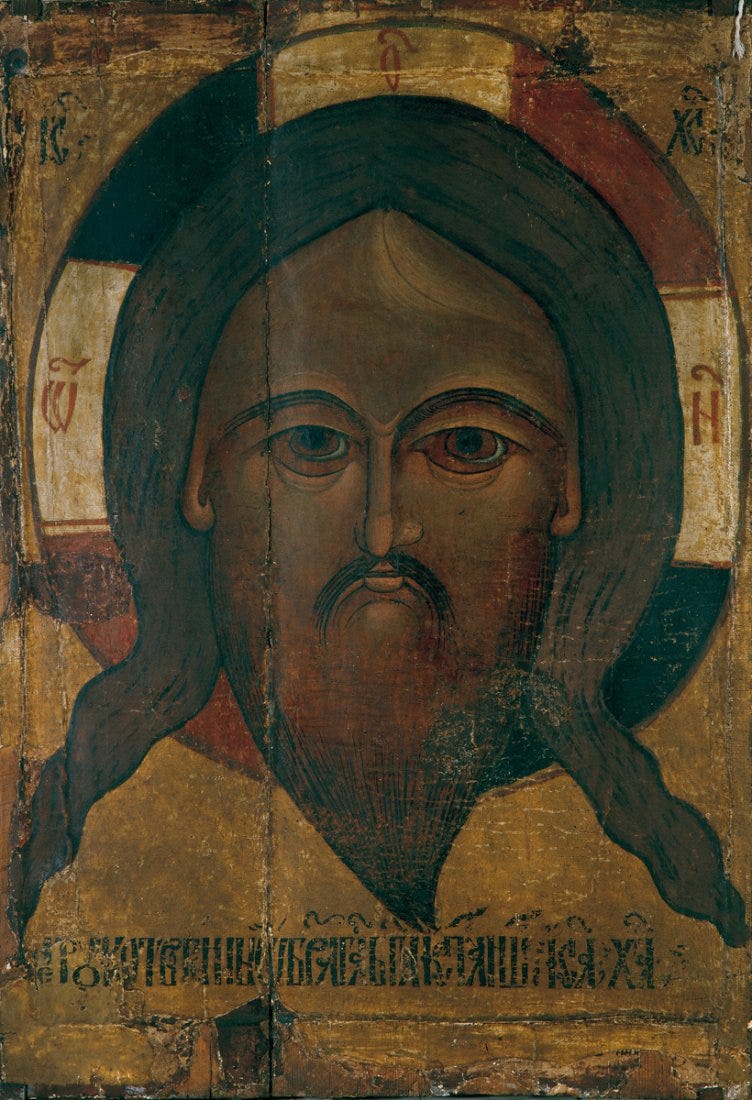
And how, again, through mere small pigments, the art of icon-painting sets before us, as though happening now, such great wonders, worked so long ago by the Lord and by all the saints, by the providence of God - so that we, seeing this with our own eyes, might be kindled all the more with desire, as the holy Peter, chief of the apostles, says in the account of the martyrdom of St. Pancratius, his disciple.
Everything we have mentioned from the beginning of this discourse brings no benefit without right faith, nor indeed does it exist at all, just as faith cannot exist without works. Many of the holy fathers have written concerning faith and works; but I, for the sake of reminder, will say briefly that we ought to have our deeds set down in writing, each in its proper order, and our faith Orthodox - such as we have received from the saints already mentioned - so that, together with them, we too might receive the eternal blessings, by the grace and love for mankind of our Lord Jesus Christ, to whom belongs all honor and worship, together with His Father without beginning, and His All-holy, Good, and Life-giving Spirit, now and ever, and unto the ages of ages. Amen.
Having finished, I said: “To Thee, O Christ, belongeth glory!”
Comments
Nothing yet. Say the first thing.
Sign in to join the conversation.