
We know that with baby boomers aging and younger adults having fewer children that our population is aging. The median age of the United States is now 39, having increased by four years from 35 years in 2000.
Clearly, this will have increasing effects on the US economy as baby boomers leave the workforce and there are fewer workers behind them to take their places. An older population will also need increasing levels of health and other care. But what will all this mean for the economy as a whole?
The Federal Reserve Bank of Chicago is seeking to answer that question, so far in two reports, the first examining where older Americans live and the second, the world of elder care. The third will examine the state of nursing homes today.
The first report, “Where Older Americans Live and Why It Matters,” starts by observing that most adults in their sixties and seventies live independently in their own homes, but that that changes around age 80 when “the likelihood of needing assistance with daily activities rises sharply and living arrangements begin to diverge.” The residential choices they then make “matter because they determine who provides care, how much that care costs, whether family caregivers remain attached to the labor force, and which public programs ultimately finance support.”
They observe some broad trends: A lower percentage of Americans aged 72 and above are living in nursing homes or assisted facilities today than were in 2011, dropping from 4.4% to 1.9% of the older population in nursing homes and from 7.6% to 5.3% in assisted living facilities.
To some extent, this is a result of a change in the make up of this older population — with so many baby boomers getting into their seventies, 72 and over cohort is skewing younger and, thus, less likely to move into an institutional setting. But the Chicago Fed says it also reflects a broader trend away from institutional care and towards “aging in place.”
But there are significant differences based on gender, ethnicity and region of the country. There are many more women than men in both assisted living facilities and nursing homes, no doubt because they are more likely to outlive their spouses. Whites are more likely to move to assisted living and Black Americans to nursing homes.
And seniors in the Northeast and Midwest are more likely to move nursing homes or assisted living facilities than are those in the South in West. Especially striking is the low level of nursing home use in the western United States as is reflected in the following graph.
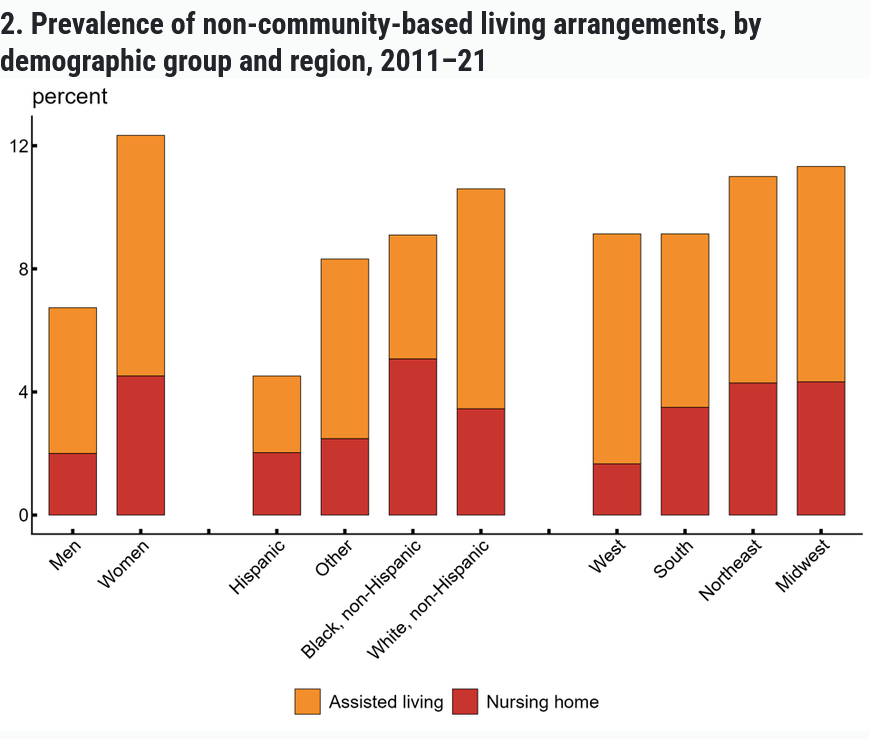
There’s also great variation by state, ranging from 8% of older adults living in nursing homes in the Dakotas to less than 1.0% in Nevada.
The authors, Kelli Marquardt and Aryan Safi of the Chicago Fed and Anthony Lo Sasso of the University of Wisconsin, point out that since most long-term care in the community is provided by family members, especially daughters, it results in fewer work hours, less job mobility and lower lifetime earnings for caregivers. “As aging in place becomes more common,” they say, “the economic value of unpaid caregiving—and the associated opportunity cost in forgone labor—will continue to grow.”
At the same time, home health and personal care services has been one of the fastest growing segments of the labor market. While it’s generally been work with low wages and limited benefits, as “demand for caregiving services increases, labor shortages may place upward pressure on wages in these sectors, with implications for service availability, state Medicaid budgets, and ultimately prices.”
In addition, aging in place increases demand for home modifications, transportation services, meal delivery and medical equipment. This will have a greater effect in communities with older populations and less reliance on institutional care.
The authors also discuss the so-called “elderly dependency ratio,” the number of adults age 65 and older for every 100 working-age individuals in the population. (Working age is defined as ages 15 to 64 which probably understates the elderly dependency ratio since few teenagers are in the workforce, but it dates back to times when fewer Americans were going to college or even finishing high school.)
Nationwide, the elderly dependency ratio has increased from 19 in 2011 to over 25 in 2023. In other words, in 2023, there were 25 Americans aged 65 and over for every 100 between the ages of 15 and 64. That number will continue to increase at least for a few more years as the last of the baby boomers turn 65. In 2023, the youngest baby boomers were 59 years old. Now they’re 62 and by 2029 they’ll be 65.
The elderly dependency ratio varies considerably by state, from a low of 18 in Utah to a high of 35 in Maine, as the result of birth rates, people moving for work and retirement, and levels of immigration, since immigrants on average are younger than non-immigrants. “These differences matter,” the authors say, “because regions aging more quickly will experience the economic consequences of elder care demand sooner and more intensely.”
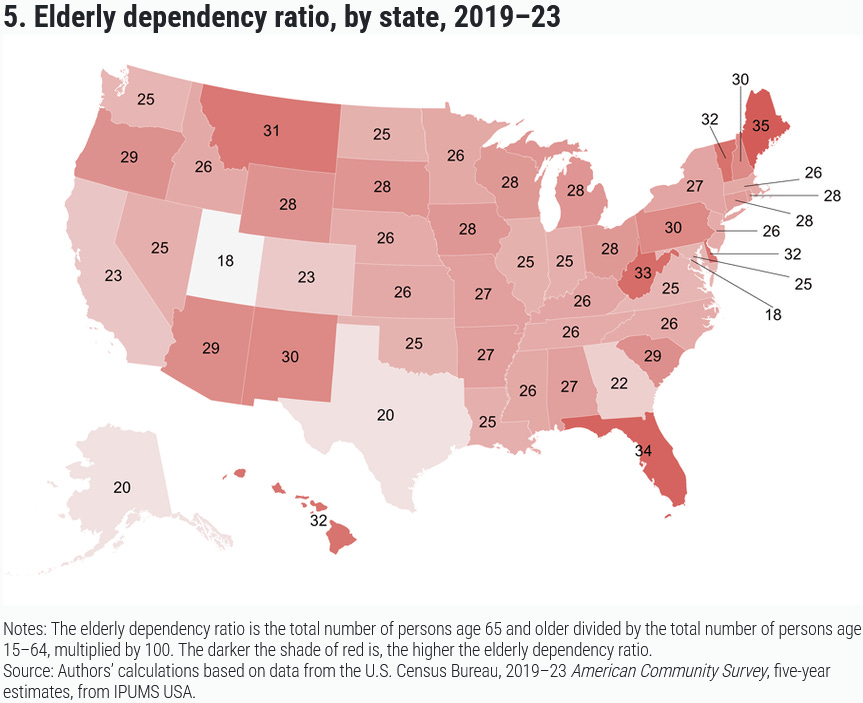
Interestingly, the authors comment that the presence of more immigrants not only improves the elderly dependency ratio but also allows more seniors to stay in their homes “[R]esearch shows an increase in the share of lower-education foreign-born people in the labor force leads to a reduction in institutionalization among older adults by making home-based services more available and less costly — with positive effects on overall health.”
Both rates of institutionalization and the elderly dependency ratio affect state budgets, especially Medicaid costs. While nursing homes are more expensive than community-based care on average, the latter “may involve more beneficiaries, particularly if families cannot meet rising caregiving demands.”
On the local level, a rising number of older taxpayers may decrease tax revenue to the extent they receive more favorable tax rates or exemptions. As they retire, income tax receipts are also likely to fall. As a result, states may well see their tax revenues drop just as their elder care expenses increase. This effect is likely to be especially severe as baby boomers age in those states with high elderly dependency ratios.
No posts
Comments
Nothing yet. Say the first thing.
Sign in to join the conversation.