
“You can’t increase taxes on the wealthy, that’s just punishing success!”
Yeah, that depends entirely on what you call success. And no, I’m not talking about defining success by money vs. happiness.
I’m talking about how we define wealth itself.
And no point articulates the problem today better than this simple fact: in 1950, individual income taxes made up 40% of total federal revenue, while corporate income taxes were 26.5% of total federal revenue.
Do you want to guess what those numbers are in 2025?
Individual income taxes rose from 40 percent to over 50 percent of federal revenue, while corporate income tax dropped from 26.5 percent to only 8.6 percent of federal revenue.
Individual vs. corporate income tax
as a share of federal revenue
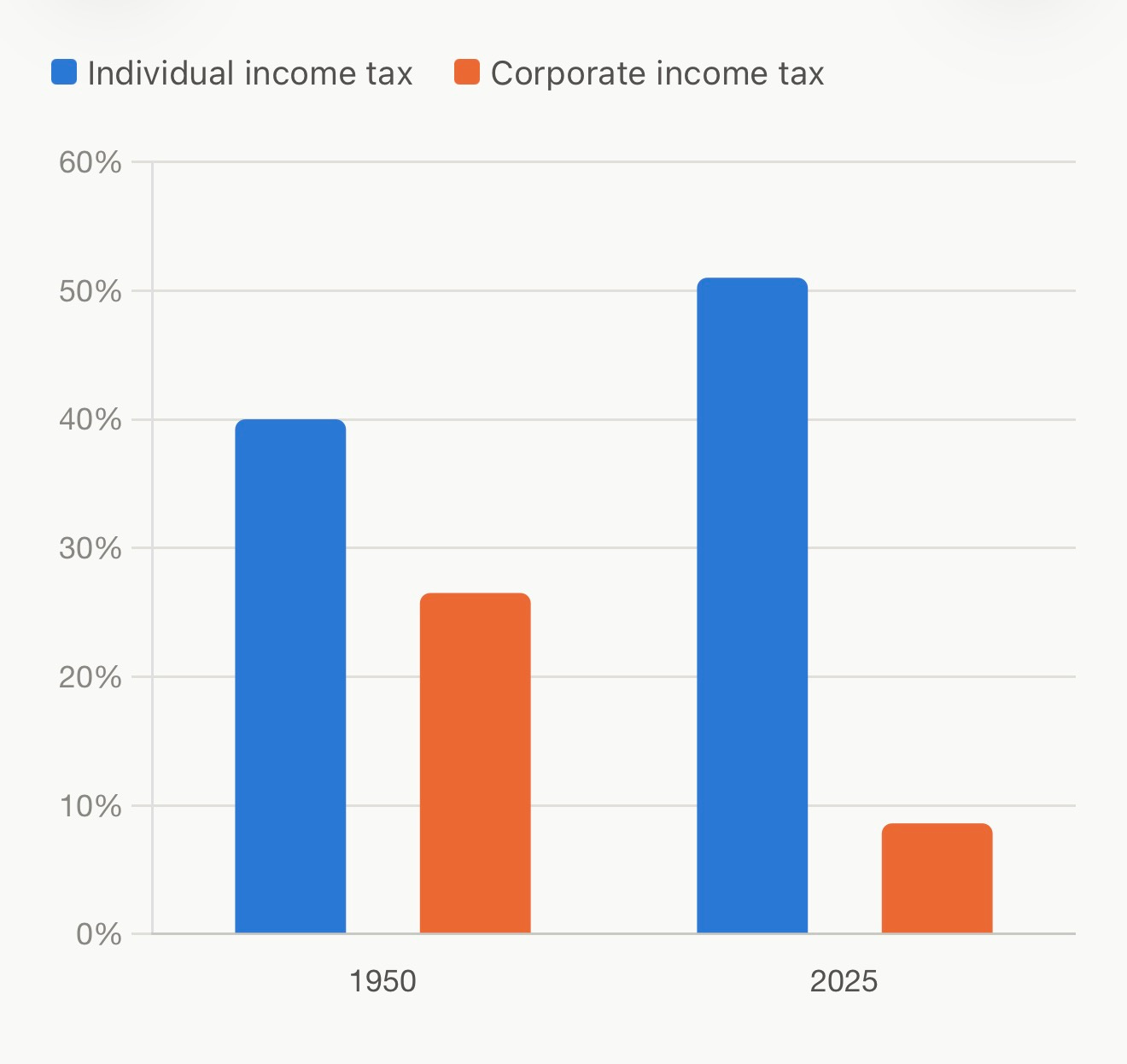
Which means as Republicans destroyed our wages by dismantling unions, they simultaneously shifted the burden of funding the federal government to our individual labor, freeing up the virtually tax-free accumulation of capital for the wealthiest 1 percent of Americans.
Then, to kick us while we’re down, they tell us that the programs we need when we’re struggling—like food stamps, Medicare, Medicaid, and Social Security—are too expensive. Instead, they say we should cut those programs to pay for deeper tax cuts for those same corporations and shareholders who, you can see from the chart above, aren’t paying for those goddamn programs in the first place.
What’s even more insane? If we never cut the corporate tax rate, our national debt could theoretically be half what it is today. And if we had maintained the same individual income tax brackets from that era, we could have potentially seen balanced budgets every year for the past 70 years.
After all, our total national debt—which didn’t really explode until Ronald Reagan—is $40 trillion; a full $16 trillion less than the combined net worth of just the wealthiest 1 percent of Americans.
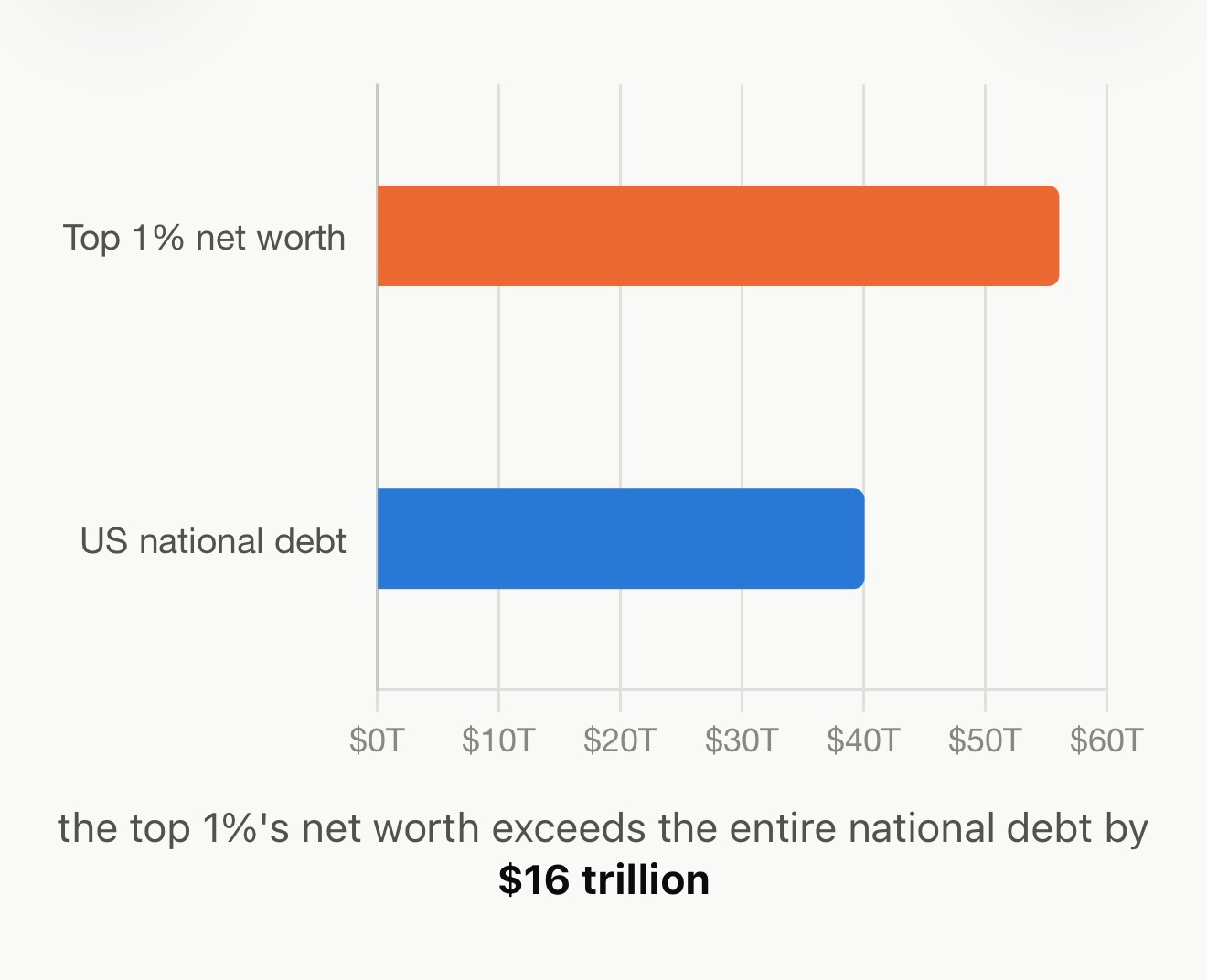
Which brings me back to my original point: raising taxes on the wealthy is only punishing success if your definition of success is the disproportionate accumulation of massive stock and real estate portfolios.
Because when we say “tax the rich,” we aren’t talking about labor, because virtually nobody in the United States actually works to get rich.
We are talking about taxing the capital they’ve consumed, which was both built and grown by—you guessed it—the working class.
Comments
Nothing yet. Say the first thing.
Sign in to join the conversation.