
I
Joseph E. Stiglitz and Bruce C. Greenwald (S&G) wrote together one of the most important books I’ve come across, Creating a Learning Society, which is influenced by Kenneth Arrow and Robert Solow, ‘two of the economists who were responsible for creating a new field of economics — growth theory — perhaps the most important area in the decades immediately after World War II.’³³⁹ What is Growth Theory? To answer, we will focus for a moment on Robert Solow’s famous essay, “A Contribution to the Theory of Economic Growth,” which becomes the basis for his famous “Solow Residual.” Why discuss this after Hingl and Shera? As discussed with Keynes in II.1, it is because what H&S found about “institutions” applies broadly: there is also ((meta)physical) “economic incompleteness,” as for me the Solow Residual reveals.
What is the Residual? Basically, it shows that we cannot explain growth merely in terms of “production”; we also need “productivity.” As S&G puts it, Solow in 1957 ‘argued that most economic growth was related not to increases in factors of production — like labor and capital — but rather to increases in productivity. Before that, economists focused on savings and capital accumulation, but not on the role of technological progress, as the source of the enormous increases in our standard of living over the past two hundred years.’³⁴⁰ Deidre McCloskey shares this emphasis on technological progress, but the key question is what exactly causes that “great enrichment” (“the source”)? McCloskey argues it is Rhetoric/Voicecraft, and we argued in II.1 with Keynes that without Voicecraft we can only “stimulate demand” not “create demand,” which eventually leads to the Stagnation of Tyler Cowen that also concerned Keynes. I understand Solow to hold an analogous position, arguing that “production” without “productivity” eventually converges on a “steady state” or equilibrium (‘[w]hatever the initial value of the capital-labor ratio, the system will develop toward a state of balanced growth at the natural rate’), though Solow would not want us to conflate “equilibrium” with “stagnancy” too quickly.³⁴¹ What is “stagnancy” to Main Street could be “growth” to Wall Street, meaning overall there is an equilibrium and rising GDP, but does rising GDP mean rising living standards? That is the question: not all growth is equal.
We can consider “productivity” with “learning,” an insight which S&G associates with Kenneth Arrow, who helped economists understand that ‘in the process of producing and investing, one learns. As we produce and invest, we get better at what we do […] [insight we can associate with] endogenous growth theory, where the pace of innovation is determined within the model’ (“exogenous growth theory” is where innovation is determined by “outside the model”) (likewise, as we use the SCM, we learn how to use the SCM).³⁴² But there’s a major problem for S&G: ‘markets on their own are not efficient when innovation is endogenous.’³⁴³ What does this mean? The suggestion is that markets tend to be global, but that means markets can be less innovative, because innovation mostly occurs when a market is more “inward” and local.
An example of this could be DeepSeek, released January 2025, which was seen as a remarkable advancement in the field of AI, motivated by the American export ban to China of Nvidia GPUs (S&G will argue that nations could impose such bans on themselves to stimulate innovation). Obviously global interaction can enable some innovations that otherwise wouldn’t occur without global reach, but overall S&G see “global growth” usually more on the side of capital and labor (“stimulating demand”) and less on the side of innovation (“creating demand”). When growth is mostly reflected in capital and labor and not innovation, the growth can be more concentrated in a few hands (“Zero-Sum”), contributing to stagnation. Considering this, S&G write:
‘What should be the role of policy in promoting economic efficiency? Advocates of unfettered markets often respond to this question by championing the market’s ability to innovate. But there is remarkably little systematic inquiry into whether markets generate the optimal level and form of innovation.’³⁴⁴
What S&G argue is that markets do not naturally optimize for innovation, for one because markets tend to “rationally” become global (perhaps “too big to fail”), and yet this can hurt innovation. Why is this a problem? Because it means markets will not necessarily be “Pareto Optimal” (more “Non-Zero-Sum”) and lift Wall Street and Main Street up together: problematically, if there is growth, the Dow Jones could rise while living standards collapse. “Global growth” could just be a search for “more low hanging fruit,” as Tyler Cowen will describe in The Great Stagnation, and/or it can be a form of growth that eventually slows down and runs out once “stimulating demand” dwindles. Against this, the Introduction provides a strong summary, which can help us understand why S&G’s focus is enabling “learning”:
‘[M]ost of the increases in standards of living are, as Solow suggested, a result of increases in productivity — learning how to do things better. And if it is true that productivity is the result of learning and that productivity increases (learning) are endogenous [(this can be disputed)], then a focal point of policy ought to be increasing learning within the economy; that is, increasing the ability and the incentives to learn, and learning how to learn, and then closing the knowledge gaps that separate the most productive firms in the economy from the rest. Therefore, creating a learning society should be one of the major objectives of economic policy. If a learning society is created, a more productive economy will emerge and standards of living will increase.’³⁴⁵
Learning matters, an effort I would associate with the SCM (though in a Bildung or A/B quality). S&G also claim ‘there is an important role for government to play in shaping an innovative economy and in promoting learning,’ which in one way I agree with, but in another I think that the Capital-Nation-State without the SCM can only contribute to the rise of Dream-Equality in AI at our expense.³⁴⁶ The SCM is new and wasn’t really around when S&G wrote their book (early 2010s), so I don’t blame them for not mentioning it, and furthermore “State intervention” was perhaps the most reasonable option at the time (and might still have a role) — but I believe possibilities have now opened and the Social should be emphasized over the State. S&G will also emphasize government using Protectionism so that industrial sectors can start in new economies, which are particularly important because ‘the industrial sector not only has a greater capacity for learning but also more learning spillovers,’ but instead of “Protecting Industry” I would emphasis “Enabling the SCM” (via Wordspread, changes in “the medium condition,” etc.).³⁴⁷ S&G though don’t want to just discuss “infant-sectors” but instead make an ‘infant-economy argument for protection,’ in order for a growing economy to “learn how to learn.’³⁴⁸ What we see in S&G is an effort to make a Learning Society and ‘help create a learning ‘mindset’ ’ that is perhaps out of everything I’ve read most like my own concerns; however, I worry their efforts are more A/A than A/B (I’m not sure).³⁴⁹ Yes, ‘[b]ringing in insights from the economics of knowledge and learning fundamentally changes one’s view about how to think about policies designed to promote growth,’ but what are the metaphysics of that learning?³⁵⁰ A/A or A/B? ‘Development entails learning how to learn’ in either circumstance, but learning according to A/A and Kafkalikeness develops a very different world from learning according to A/B and Voicecraft.³⁵¹ Despite overlap, if Rose differs from S&G, it is on the metaphysics and their stakes.
Alright, but why are we discussing this after Hingl, Shera, and “institutional incompleteness”? It is because we can strongly link “incompleteness,” “learning,” and “ideas”: what H&S point to is the need for a Learning Society if institutions are not to fail, and the more incompleteness is encountered (say in Global Pluralism), the more pronounced the role of learning and idea-generation will become. What H&S show for institutions, I see S&G as arguing for the socioeconomic system more broadly. Because there are limits (of incompleteness) to markets just like there are limits to institutions, ideas are needed to address limits (and “focal points” achieved). “Incompleteness” and “growth” align, but not all responses to incompleteness are equal: some can deny limitation (A/A), while others can tarry with it (A/B).³⁵² ³⁵³
A key paragraph from S&G:
‘All of this highlights that one of the objectives of economic policy should be to create economic policies and structures that enhance both learning and learning spillovers; creating a learning society is more likely to increase standards of living than is making small, one time improvements in economic efficiency or sacrificing consumption today to deep capital. / And this is even more so for developing countries.’³⁵⁴
‘If our contention,’ write S&G, ‘that the success of modern economies is due to innovation and learning is correct, then understanding the processes of learning and innovation, and how policy can affect its pace, should be at the center of economic analysis.’³⁵⁵ It’s all about learning, and ‘modern economies’ are defined by ‘improvements in the processes by which they learn — they have learned how to learn’ — is a reality for which S&G make a strong case and that many economists have overlooked.³⁵⁶ Kenneth Arrow did not — as S&G write, ‘Arrow was a pioneer in examining the economics of these ‘learning processes’ — the factors which promote or retard them, their likely response to market incentives, and their relationship to the broader macro and microeconomic environment […] [Arrow] called attention to the fact that while some knowledge was produced as a result of the deliberate allocation of resources to research and development, much of technical progress was a by-product of production or investment’ (similarly, there could be “surprising spillovers” and “encountered by-products” of the SCM) — nor did Solow overlook learning and productivity.³⁵⁷
Noting the great enrichments of the 18th Century, S&G ask: ‘What was the source of these social transformations? Was it capital accumulation or technological progress?’³⁵⁸ Pointing to Solow, S&G write that ‘[c]hanges in capital intensity could account for at most a third of changes in output per worker. The remainder was attributable largely to various forms of technological progress’ (we might associate “capital and labor” with “institutions and rules,” and “technological progress” with “RT and ideas”).³⁵⁹ ‘The difference was referred to as the Solow residual. While technical change accounted for most of the residual, there were other factors, including the reallocation of labor from low productivity sectors to high productivity sectors,’ which could be evidence of growth as endogenous — but the debate between the endogenous and exogenous must be discussed.³⁶⁰ ³⁶¹ ³⁶² Summarizing what we learn with help from Arrow and Solow, S&G write:
‘In short, the transformation to ‘learning societies’ which occurred around 1800 for Western economies, and more recently for those in Asia, appears to have had a greater impact on human well-being than improvements in allocative efficiency or resource accumulation. If this is so, understanding how to create a learning society should be one of the central preoccupations of economists and other social scientists.’³⁶³
It’s all about learning (a reality the SCM accepts), but learning is endogenous for S&G, and when innovation is endogenous, the market is not efficient — and that means we have a problem. S&G argue that innovation and learning are something incubated more so by and “within” a nation, but “the free market” left to its own devices is not efficient at generating those endogenous conditions. For S&G, the State must be involved, but if the State can’t “create demand,” aren’t there diminishing returns on State action? By itself, I think so, and ultimately its contributions could simply contribute to “private gains” versus public ones, contributing to Stagnation, as Tyler Cowen discusses. But if the State actually did help create an environment for learning versus simply pump money and capital into R&D (which might just benefit AI and Dream-Equality with Kafkalikeness), then again, the State might indirectly help “create demand” by helping generate “the conditions of possibility” for “the spread of Childhood.” But I doubt so without an SCM, for otherwise subjectivity will not form(ulate) from A/A to A/B and we will be “captured” in a value-form of Capital and a single metajudgment that leads to Stagnation and autocannibalism. Might that horror lead to a reaction that then brings about “a spread of Childhood”? Perhaps. Well, might the State then help us indirectly by causing a horror we change our lives never to suffer again? Perhaps, and perhaps history must be such, but we will nevertheless continue to consider “a new address.”
On our possibilities for a Learning Society:
S&G plus SCM:
Likely Best
SCM without S&G:
Might Work
(more “free market”)
(but SCM with “Wordspread” is our best chance)
S&G without SCM:
Likely Accelerationist
of Dream-Equality and AI
(could make things worse than no S&G)
Neither S&G nor SCM:
Likely Worst
S&G with SCM could be a sublation of Capital: a way forward through. We have discussed “Lack” throughout O.G. Rose, and if it is fair to say the Solow Residual is a placeholder for inputs we don’t measure like Capital and Labor, then we might think of the Residual as pointing to “The Lack of Economics.” Now, lack is not nothing, nor must lack be some “transcendent, ineffable substance”: what is lacking from something can be extremely concrete. Productivity and what generates it are practical and not mysterious, but how it arises, what motivates it, and when it occurs are harder to model, even if the benefits and importance of the Residual can be modeled (like tracing out the crater of a meteorite). The genius of S&G is that they are arguing for a Learning Society which is more like an environment that incubates productivity, the correct approach for lack (if we are too direct, we end up making the lack quantifiable and so nothing). Unfortunately, without the SCM, we might create a “learning environment” that accelerates A/A over A/B at our expense. We need an environment and “medium condition” that bring together both the PM and SCM (Capital and Lack, Quantity and Quality…), not just one or the other. Productivity and even creativity are not innately good, and without a corresponding “spread of Childhood,” it might only contribute to a growing economy and “technological enrichment” which leaves us behind in a realization of Dream-Equality in AI (Disabled) (Land waits).
Is there really such a need for a Learning Society? Yes, for its absence leads to “The Great Stagnation” that we discussed with Tyler Cowen in II.1, and that Thomas Piketty can help us think with Capital in the Twenty-First Century (though they differ). Our whole need for “a new address” at least partly follows from us not being a Learning Society, but the question then becomes if it’s a B-20 Learning Society or just Accelerationist (Land waits) — our Absolute Choice.
II
S&G write that ‘[c]entral to our enquiry are two basic questions: Do markets, by themselves, result in an efficient level and pattern of learning and innovation? And if not, what are desirable interventions by government?’³⁶⁴ Since learning is essential for productivity, and productivity given the Solow Residual is a significant percentage of growth, if markets are not efficient at learning, then markets on their own are not efficient at growth (even if efficient at “returns on capital”). S&G write:
‘The answer to the first question is simple and straightforward: There is no presumption that markets are efficient in the production and dissemination of knowledge and learning. Quite the contrary, there is a presumption that markets are not efficient.’³⁶⁵
If we want to discuss Labor, Capital, and Creativity (perhaps pointing to Whitehead according to Dr. Matt Segall), we could say Capitalism is not naturally efficient at Creativity. What? Capitalism is remarkably creative. Well, it has had “events” of creative enrichment as McCloskey describes, but we have argued these bursts “pass over” (from Voicecraft to Kafkalikeness) into stagnancy, where the benefits of growth go to ever-fewer people (“rising inequality”). But look at AI. The internet. Startup culture. Isn’t all that evidence of “growth” and so “learning” somehow? How can S&G be right about the market? What they are pointing to might be “The Stagnation Thesis” that we discussed in II.1 with Tyler Cowen. Stagnation might follow from the inefficiency of markets at Creativity, though we also are not saying markets must be so inefficient, even if that is a tendency. But what would constitute Stagnation? GDP increasing but not living standards (if both fell, that would be more like a “system failure”), and/or growth is narrow and concentrated versus general and public. (The first understanding of Stagnation might be more Tyler Cowen while the second is more Thomas Piketty, but also the two have key differences, and Piketty sees “R > G” as more structural of Capitalism.) Capitalism is ideally “Non-Zero Sum,” meaning “all boats rise together,” but problematically it is possible for Capitalism to achieve an equilibrium where say Wall Street benefits from growth while Main Street doesn’t (which is the main language I will use here for our purposes, though there is overlap and it is not so simple). It is often argued that the market needs the government to stop ‘negative externalities’ like pollution, but S&G are arguing interestingly that ‘the private sector typically produces too little of goods that give rise to positive externalities’ (for that requires the learning which the market is not efficient at incubating).³⁶⁶ For S&G, because the market is inefficient at innovation and learning, and yet it’s growth is radically dependent on that which the market is inefficient at generating ‘[g]overnment has a responsibility in ‘creating a learning society.’ If we are to understand what that responsibility is — and how it can best be fulfilled — we have to understand why it is that markets on their own don’t ‘work’ and how innovation actually occurs in our society.’³⁶⁷Their view:
‘The analysis presented here thus changes the presumption about the desirability of government intervention: now there is a presumption of market failure and a presumption for government to take actions to correct these market failures.’³⁶⁸
Evidence favoring S&G is Stagnation, but even if S&G are right in their analysis, it might not be direct government intervention that is needed (which I am inclined to believe will only accelerate A/A), but instead the spread of the SCM. What S&G see as justifying a presumption for government action could actually justify spreading the SCM (the SCM is primary, and the State secondary if at all).³⁶⁹
‘[W]hat distinguishes the modern era of the last two hundred years from the millennia that preceded is learning — we have learned how to increase productivity, the outputs that can be produced with any inputs.’³⁷⁰ Now, the question is ‘how can we create an economic architecture that facilitates learning’ (that “spreads Childhood” (A/B) versus just accelerate A/A)?³⁷¹ Can we “learn how to learn” against Stagnation? ‘The central policy issue of [their] book is how to enhance learning,’ S&G write, ‘how to create a learning economy and society,’ which is also a central concern of Belonging Again in supporting a “B-20 Learning Economy and Society.”³⁷² Otherwise, Stagnation seems inevitable, which to expand on we will now turn to Tyler Cowen. But hasn’t Cowen since 2011 modified his view on the Great Stagnation given AI (and doesn’t the great McCloskey critique Stagnation)? We will discuss that as well.
Stagnation is not when growth completely stops — that would be more like a Retraction or Depression — but when growth slows and living standards mostly flatten. Cowen tells us ‘[m]edian wages have risen only slowly since the 1970s, and this multi-decade stagnation is not over yet. Typical individuals in earlier generations reaped much greater gains than ours, as their living standards doubled every few decades.’³⁷³ Cowen offers a useful way to think Stagnation when he writes:
‘A fundamental way to put the point is this: A lot of our recent innovations are ‘private goods’ rather than ‘public goods.’ Contemporary innovation often takes the form of expanding positions of economic and political privilege, extracting resources from the government by lobbying, seeking the sometimes extreme protections of intellectual property laws, and producing goods that are exclusive or status related rather than universal, private rather than public; think twenty-five seasons of new, fall season Gucci handbags.’³⁷⁴
Growth is more private than public in Stagnation: it benefits an ever-narrower range of people in a smaller number of fields (AI booms while restaurants fail) (also, “narrowness” might increase “black swan”-risk). Cowen writes that ‘[i]f one sentence were to sum up the mechanism driving the Great Stagnation, it is this: Recent and current innovation is more geared to private goods than to public goods.’³⁷⁵ When there is innovation, the benefits are more private versus dispersed; furthermore, Cowen’s suggests idea-generation is down, possibly limiting “creative destruction” to the advantage of the few.
‘The average rate of innovation peak[ed] in 1873, which is more or less the beginning of the move toward the modern world of electricity and automobiles. The rate of innovations also plummets after about 1955, which heralds the onset of a technological slowdown. Huebner also shows that, relative to national income or expenditures on education, we are innovating less than in the nineteenth century. Meaningful innovation has become harder, and so we must spend more money to accomplish real innovations, which means a lower and declining rate of return on technology.’³⁷⁶
The fall of idea-generation is consequential, for it makes innovation and productivity rarer, which is oddly problematic, because then ideas might be too valuable for too few. We actually don’t want a given example of productivity to be too valuable, because that would suggest it’s rare and the environment not conducive of it: the extreme value of productivity in AI in this way could indicate an overall problem (that AI might fix? Perhaps.). Markets are not efficient when any one thing is “too valuable,” but then how to avoid that concentration without intervention requires better incubation of creativity — the SCM.
‘The slowdown in ideas production mirrors the well-known rise in income inequality. Labor and capital are fairly plentiful in today’s global economy, and so their returns have been somewhat stagnant. Valuable new ideas have become quite scarce, and so the small number of people who hold the rights to new ideas — whether it be the useful Facebook or the more dubious forms of mortgage-backed securities — earned higher relative returns than in earlier periods. The ‘rise in income inequality’ and the ‘slowdown in ideas production’ are two ways of describing the same phenomenon, namely that current innovation is more geared to private goods than to public goods.’³⁷⁷
In Stagnation, again, innovation is limited, and where it occurs, innovation arguably earns too much, for productivity overall is too limited.³⁷⁸ ³⁷⁹ Following Cowen’s argument, “the low-hanging fruit has run out”: ‘[w]e have been living off low-hanging fruit for at least three hundred years. We have built social and economic institutions on the expectation of a lot of low-hanging fruit, but that fruit is mostly gone.’³⁸⁰ Thanks to that, we have for periods managed to maintain “growth” (or “G,” as Thomas Piketty will discuss with his famous “R > G”) at a rate comparable to “return on capital” (or “R”), but though this could make it seem like we figured out how to make G > R, really this might have just been a fortunate and temporary episode (unless there is a “Productivity Lag,” as we’ll discuss).
‘In a figurative sense, the American economy has enjoyed lots of low-hanging fruit since at least the seventeenth century, whether it be free land, lots of immigrant labor, powerful new technologies. Yet during the last forty years, that low-hanging fruit started disappearing, and we started pretending it was still there. We have failed to recognize that we are at a technological plateau and the trees are more bare than we would like to think. That’s it. That is what has gone wrong.’³⁸¹
I would not disagree with Cowen, but I would also say that McCloskey’s Rhetoric “passed over” into Discourse, and perhaps “the low hanging fruit” contributed to us not noticing or feeling the “stagnating impacts” sooner (“The Great Enrichment” planted so many trees so quickly that we had a lot of fruit for a very long time, an “event” that Voicecraft might make possible again). Regardless, there was ‘[an] old understanding […] that the world broke through a barrier with the industrial revolution of the eighteenth century and that we [could] grow economically at high rates forever. The new model is that there are periodic technological plateaus, and right now we are sitting on top of one, waiting for the next major growth revolution,’ which Cowen as of 2026 notes AI might be.³⁸² Though things might change with AI, ‘[t]oday, in contrast, apart from the seemingly magical internet, life in broad material terms isn’t so different from what it was in 1953.’³⁸³ ‘Life is better and we have more stuff, but the pace of change has slowed down compared to what people saw two or three generations ago.’³⁸⁴ Why is this a problem? It could lead to social and political unrest and/or set us up to suffer autocannibalism with AI.
‘Free land,’ ‘technological breakthrough’ and ‘smart, uneducated kids’ are “low hanging fruit” that have helped us grow, as Cowen goes into detail about in his book.³⁸⁵ ³⁸⁶ ³⁸⁷ ‘A lot of the growth of the United States, up through the 1970s or so, has been based on these three forms of low-hanging fruit. Each of them is pretty much gone today.’³⁸⁸ Now, we are forced to face the question and mystery of growth, especially in Non-Zero-Sumness. ‘[I]t was easier for the average person to produce an important innovation in the nineteenth century than in the twentieth century […] [because] innovation was easier and it could be done by amateurs.’³⁸⁹ ³⁹⁰ Now, innovation can require incredible expertise, and that can lead to a narrowing of productivity and its beneficiaries (typically the owners of capital, R). S&G are seemingly trying to address this with their Learning Society, and the lack of a “learning mindset” is also something Cowen seems to have noted: in 2011, he saw potential in the internet but also noted it was only really ‘beneficial for those who are intellectually curious’ (which I think is still the case, so we need the SCM to spread intellectually curiosity).³⁹¹ ‘A lot of the internet is comparatively small,’ he wrote, ‘a free space for intellectual and emotional invention, a kind of open-ended canvas for enriching our interior lives.’³⁹² ‘[A] lot of the internet’s biggest benefits are distributed in proportion in our cognitive abilities to exploit them’ (again, we need the SCM to have more cognitive abilities for receiving the benefits), and for him that meant its growth would be narrow — but now the internet might have generated an AI that spreads intelligence itself, possibly addressing Cowen’s concerns.³⁹³ (Land waits.)
III
Tyler Cowen sees hope in AI helping with “The Great Stagnation”; as reported April 18th, 2021, James Pethokoukis writes in “Tyler Cowen on the End of the Great Stagnation”:
‘So is the Great Stagnation over? Here’s how Cowen addressed that question in a[n] […] AEI panel that I moderated (edited for clarity):
‘Pethokoukis: Tyler, you wrote a book called “The Great Stagnation,” and it’s been 10 years since you published that book. What was your argument at the time about the great stagnation and why we were stagnating?
‘Cowen: At the time, I suggested that our previous technologies had, in some regards, run their course. If you take powerful machines and fossil fuels and put them together as a kind of general-purpose technology, we did everything we could with that. We invented cars, and then almost everyone had a car. And then cars got better, but they just didn’t get all that much better.
‘I think the odds are we are, today, on the cusp of another revolution based on new general-purpose technologies, which I would define as some mix of internet, computers, and computational power. So in 2011, when I published the book, I thought the great stagnation would end within the next 20 years, and odds are what we’re seeing today is the great stagnation ending.’³⁹⁴
Yet, even as of May 25th, 2025, Cowen was publishing articles in Marginal Revolution about how “You Can See the End of the Great Stagnation Everywhere but in the Productivity Statistics” (by Alex Tabarrok): ‘Eli Dourado continues to keep his eye on the most important number in the world, total factor productivity. It continues to be bad, -3.88% on an annual basis for the first quarter of 2025.’³⁹⁵ Cowen seems to see hope in AI but also is concerned that its potential is yet to be reflected in productivity data, bringing to mind “The Productivity Paradox” coined by Erick Brynjolfsson, who stresses that there is no law that says technology must benefit even most people.
In 1993, Brynjolfsson noted that ‘[d]elivered computing power in the U.S. economy has increased by more than two orders of magnitude since 1970 […] yet productivity, especially in the service sector, seems to have stagnated.’³⁹⁶ Brynjolfsson’s paper was inspired by Solow’s observation that ‘we see computers everywhere except in the productivity statistics.’³⁹⁷ Similarly, we might as of 2026 “see the AI age everywhere but in the productivity statistics.” As if discussing AI in 2026, Brynjolfsson writes in 1993: ‘Productivity is the fundamental economic measure of a technology’s contribution. With this in mind, CEOs and line managers have increasingly begun to question their huge investments in computers and related technologies.’³⁹⁸ Technology can look like it is advancing everywhere, and yet productivity can suggest nothing has changed. But that might only be because there is what we could call a “Productivity Lag” between technological change and productivity, and Cowen seems to believe that though AI is yet to be reflected in productivity, that could soon change and the Great Stagnation end. (I agree.)
“The Solow Puzzle” and “The Productivity Paradox” overlap, as I understand them, and both point to how technology can be seen everywhere and investment in technology skyrocket, and yet productivity remain flat. A few possibilities:
1. Measurement problems and/or mistakes.
2. Lag where new technologies take time to spread, be understood, etc.
3. New technologies might change things without increasing output.
4. Concentration of beneficial technology that is too narrow to bring about widespread economic change (yet, at least).
5. The technology is not as productive as believed, even if somehow life-changing.
There are easily other reasons, and the most optimistic views with AI are 1 and/or 2, and belief in a “Productivity Lag” is respectable, which there is even evidence for, given that productivity increased through the 90s and early 2000s. This was evidence against the concerns of Solow and Brynjolfsson, but though the “Productivity Paradox 1.0” ended, we now have the “Productivity Paradox 2.0” between the 2000s and 2020s, in which we can situate Cowen’s work, but perhaps this is just a second Productivity Lag? Could be.
Possibilities 3, 4, and 5 are problematic, for they would suggest that AI will not close the productivity gap, and though “Productivity Paradox 1.0” was due to 2, it doesn’t follow that “Productivity Paradox 2.0” would also be due to 2; this time, it could be 1, 3, 4, or 5. Hard to say, and making the determination more difficult, it is hard to isolate the GPD increase caused by capital investment versus greater innovation; as Solow writes, ‘[t]he problem is that the productivity-increasing effect of innovations is mixed up with the productivity-increasing effect coming from gross investment and continuous improvement.’³⁹⁹ Regardless, it is possible for technological advancement not to correlate with productivity, that though it is fair to associate innovation and productivity, it is also a mistake to assume rising technology means rising productivity. Perhaps the two always eventually converge, that the “Productivity Paradox” is always just a “Productivity Lag,” but it would be a mistake to assume this (and decide against any hedging in the SCM).
Productivity might correlate with new technologies, but we shouldn’t assume improving technology “is” increasing productivity and/or growth. S&G are important here, for they can ask: “Does the new technology afford learning?” If not, the supposed “Productivity Lag” easily isn’t a lag but a judgment, and if there is a rise in GDP by the new technology, it will be more on the side of R (“return on capital”) than G (“growth”). Technological advancement and learning can strongly overlap, yes, but it is possible to get one without the other, and if there is profound investment into technology without a growth in learning, we could be dealing with a financial bubble.⁴⁰⁰ But how can we tell if learning is increasing? Not easily, and perhaps all we can do is make, support, and spread the SCM so that there is a better possibility of this qualitative change occurring that we cannot entirely “plan” or quantify. (“Creativity” being of lack and incompleteness, I personally think that is the case.)
“The Productivity Paradox” could be when there is a technological advancement without adequate learning advancement (but then we need to ask if that learning is A/A or A/B).⁴⁰¹ As for McCloskey a great mystery is what caused the Great Enrichment, so another is what has caused the Great Stagnation, and S&G help us understand Stagnation could be due to inadequate learning; similarly, the Great Enrichment might be associated with a kind of learning enabled by Voicecraft. “A Learning Society” could be the address for both the Great Enrichment and the Great Stagnation, but we have lacked the SCM to be global and intentional about it. But couldn’t AI solve the Productivity Paradox because it is fundamentally a machine that learns? Maybe, if AI indeed learns versus only “seem to learn,” but that is a valid possibility and hence a reason why AI really might be the end of the Great Stagnation (still, an SCM hedge is wise). Then again, if that “learning” of AI does not enable us ourselves to become Children, then as AI prospers, we might still suffer autocannibalism. Keeping psychoanalysis and “existential anxiety” in mind, AI cannot do our learning “for us” lest however AI enriches us also likely alienates.
Whether simply due to a Productivity Lag or not, our age is at the very least a “growth plateau,” which does not necessarily mean we have made a mistake or done something wrong: that depends on what happens next (“a flip moment”). ‘The fall in the growth rate is not necessarily some kind of failure,’ Solow writes, ‘it is a natural and inevitable part of the process of getting from one productivity plateau to a higher one.’⁴⁰² However, the tension we face is that ‘[a]chieving a new plateau is to be distinguished from achieving a higher growth rate that can be counted on for a long time’: the enrichment we enjoy on a plateau is easily confused with continual growth, when really we are just enjoying the growth we already enabled (and if that growth fails us somehow and yet we prove overconfident and even suffering atrophy in our ability to generate growth, then “the plateau” could be “a trap” (before our AI-Causer)).⁴⁰³ ‘We know [growth] will reach a new plateau and level off there. Then it will become constant again, higher than it was before but no longer changing.’⁴⁰⁴ When this happens and we see around us technology everywhere, yet living standards feel unchanged, it will not be obvious if we are in a Productivity Lag or seeing evidence that the technological advancement doesn’t increase growth or productivity like we thought (“a flip moment” is needed). But we really could be in a Lag, and so it will be very hard to pass judgment (let alone reach a social consensus), and growth really could increase with living standards (and we really could be a crazy and paranoid person). And so technology and Dream-Equality could always gaslight us, tell us that living standards really are and/or will increase, because look at all the technology around us, and if we don’t “get it” that’s on us. And it really could be. And this “plausible deniability” and posture to easily ever-gaslight us is a key handicap favoring Dream-Equality and AI against us. And things really could be fine — haven’t they up to this point? Hasn’t technology overall through history increased growth and living standards more so than not (of course not perfectly)? Why worry that AI would be different? And it really might be great, as it always really might be with technology, hence a reason Dream-Equality through technology can always direct (autonomous) rationality in its favor. But AI really could be best, and so why our goal cannot be to stop or destroy AI. It really could be a net-positive, and it really could be better for us to want it to do well. Instead, we should focus on increasing the chances that AI could be negated/sublated into A/B and help “spread Childhood, and our argument is this is accomplished by focusing on the SCM.
To review, as Cowen writes on, ‘if [we] think about the top tech companies, [we see] examples of supreme innovativeness. What has slowed down is the ability of other, less-successful, lower-tier companies to bring productivity gains of the same magnitude.’⁴⁰⁵ Is this due to a Lag or because we are not growing as much as we think? Technology advancing first makes sense, seeing as, for Solow, average productivity per person (which might eventually lead to higher wages and/or spending power) does not increase without productivity increasing say through technological innovation — as a simple example, the amount one construction worker could do was less before the hammer, far less before the excavator, etc.⁴⁰⁶ Technology leads to tools that help productivity beyond technology, so it is to be expected that technology would advance first. But what if really the technology just isn’t that productive? We can’t know for sure, which benefits technology, possibly at our expense before our AI-Causer (Land waits). But even if the technology is productive, what if the productivity gains of that technology are just “captured” by the State or owners of Capital? Couldn’t increased productivity then just make our standards of living worse? Yes, and Thomas Piketty argues that history does not give us reason to assuming that growth ultimately translates into “g > r” as a new tendency of the system: though there are moments here and there (like “moments of lessening inequality” for Walter Scheidel), overall, “r > g,” which means returns on Capital exceed returns on the growth and productivity needed for rising wages and living standards. Hence, “r > g” is more rational of the market than “g > r,” and unless we can change the movement of rationality (with an SCM), there is no reason to think this will shift. Capitalism will converge on some “steady state” (it’s almost a law that it must), and “r > g” is more naturally such an equilibrium than achieving something similar with “g > r” (for that would require “the stability of a jazz improvisation,” which is complex and difficult, requiring Childhood).⁴⁰⁷
I might be wrong about where Cowen stands as of May 30th, 2026, but I take him to still believe in the Great Stagnation but also see its potential end in AI, a position which I agree with, but with the caveat that we will end up with the Accelerationism of Land without the SCM, which means that even the end of Stagnation could leave us behind.⁴⁰⁸ Also, if AI does end Stagnation, this could be a historic “event,” in that Stagnation and inequality might be the norm while growth and raising living standards are the exception, as Walter Scheidel suggested and that Thomas Piketty might also help us see. Enrichment might not be the norm, and yet we have calibrated our expectations to it versus see it as the outlier. But if the Great Enrichment was caused by Voicecraft, and that could make such a remarkable difference after so many centuries, helping supply us with growth and higher living standards for as long as it did, there is hope: no matter how much Stagnation sets in, a return of Voicecraft could radically change everything once again. Our moment is one where some “event” could occur to generate another “historic outlier,” but will it be AI without the SCM or AI with the SCM?
IV
‘Median income is the single best measure of how much we are producing new ideas that benefit most of the American population. [And] the picture is depressing.’⁴⁰⁹ Median incomes doubled from 1947 to 1973, but now consider ‘1973 to 2005 […] Calculating in terms of 2004 dollars, median family income had gone up to $54,061, which is less than a 22 percent increase.’⁴¹⁰ If there is growth, it is not spreading, but whether it’s rising or falling, a failure of growth to spread is what Thomas Piketty suggests we should expect with rising inequality (and political tension). ‘When the rate of return on capital exceeds the rate of growth of output and income […] capitalism automatically generates arbitrary and unsustainable inequalities that radically undermine the meritocratic values on which democratic societies are based,’ and indeed “rates of return on capital (r) tend to be greater than return on growth (g),” meaning Capitalism could tend toward trouble.⁴¹¹ The accumulation of capitalism isn’t infinite, no, ‘but that level may be high enough to be destabilizing.’⁴¹² ⁴¹³ Assuming Piketty is right, why exactly is “r > g” a tendency of Capitalism? Perhaps g is a matter of enabling a Learning Society, which we have never enabled enough for any hope of “g > r” (or for growth to rise consistently even if “r > g”), because that required an SCM.
What we have argued is that “The Great Stagnation” can follow from a lack of a Learning Society, as discussed by S&G, though that still leaving hanging the question of what kind of Learning Society we need for our moment before our AI-Causer at “The End of (True) History” (A/A) and/or start of “Absolute History” (A/B). But the hope of a Learning Society might be less if Thomas Piketty is right that Capitalism is structurally antithetical to growth and productivity which is not narrow and “captured” by capital-holders (Piketty does not believe inequality is a “bell curve” like Kurznets argues, where it rises during ‘early stages of industrialization’ and later falls).⁴¹⁴ For Piketty, the reason we are seeing Stagnation (in the sense of there being more “private than public goods”) is because its structural: the day never comes (at least not for long or without a “great leveling”) when ‘inequality automatically decreases as a larger and larger fraction of the population partakes of the fruits of economic growth’ (keep in mind McCloskey critiques Piketty).⁴¹⁵ His famous formula for this is “r > g,” where returns on capital (r) are greater than growth in say wages and living standards (g). Sounding like Cowen, he notes ‘[t]here is little evidence that labor’s share in national income has increased significantly in a very long time,’ and Piketty is arguing that is not a mistake but revelation of Capitalism’s structural tendency.⁴¹⁶
Is “r > g” true? I’m not sure, but it could be, as it could be true that Cowen is right but not Piketty or both of them are right or Cowen is right but the Great Stagnation is ending thanks to AI — it is hard to say, and so our “new address” must apply regardless which of these scenarios applies. If Piketty is correct that “r > g” is structural, then a Learning Society might not help. Piketty does note that ‘[o]ver a long period of time, the main force in favor of greater equality has been the diffusion of knowledge and skills,’ suggesting S&G are right to emphasize learning, but is Capitalism efficient at coordinating knowledge?⁴¹⁷ If not, that seems to be evidence of “r > g” as structural (at least without the SCM, which arguably if Capitalism helped generate, is evidence that Capitalism is working just fine — we are always dealing with “flip moments”). But for Piketty, even if Capitalism did sometimes become efficient at knowledge, innovation, and productivity, we should not assume this would overturn “r > g” overall: a Learning Society is not necessarily sufficient. ‘[N]o matter how potent a force the diffusion of knowledge and skills may be, especially in promoting convergence between countries, it can nevertheless be thwarted and overwhelmed by powerful forces pushing in the opposite direction, toward greater inequality.’⁴¹⁸ Productivity could rise and Stagnation end, and yet inequality persist. But is inequality a problem? Perhaps not if what causes inequality also causes Non-Zero-Sumness. Deidre McCloskey might argue that even if “r > g,” growth in 2026 could be greater than growth in 2025, so what does “r > g” matter? Even if “r > g” was true, living standards could still be going up and Stagnation not the case, and so the possible problems caused by “r > g” would not manifest. True, but if “r > g” was true and Stagnation occurred, we could have a negative and accelerating feedback loop, because incentives would have people direct their energies toward capital accumulation and away from growth. If that caused ever-worse Zero-Sumness or a narrow concentration of growth to private hands, society could suffer.
Robert Solow helps us see how “per-worker growth” eventually flatlines without technological development, and yet it still be possible for Wall Street to continue to hit new highs as wages fall (a divide between Wall Street and Main Street). Capital accumulation does not necessarily translate into higher productivity unless capital translates into technology, innovation, etc., and yet even if so, there could still be diminishing returns on capital for productivity, setting limits to how much productivity can follow from capital investment. In these scenarios, we should expect for “r > g” to ultimately be the case (beyond short exceptions), and further evidence of “r > g” could be if ‘inherited wealth grows more quickly than the economy as a whole’ (which overtime will compound and increase returns).⁴¹⁹ Also, if Piketty is right, we cannot claim that “r > g” means “something is wrong”; on the contrary, ‘the more perfect the capital market (in the economist’s sense), the more likely r is to be greater than g,’ which is to say the more it’s “tendency” will manifest.⁴²⁰ Piketty believes it’s possible for ‘public institutions and politics [to] counter’ this (the structure must become “mixed”), ‘[b]ut establishing such institutions and policies would require a considerable degree of international coordination,’ which is unlikely (especially without an SCM to train us for Pluralism).⁴²¹
If “r > g” is true, that would be evidence that Capitalism structurally incentivizes Stagnation.⁴²² “r > g” is not identical with “Stagnation,” no, for it is possible for return on capital to be greater than growth even while growth increases annually. To list reasons why “r > g” as a possible tendency of Capitalism should only be treated as overlapping with Stagnation:
1. g could be rising and returns on capital still be greater than returns from growth, but growth would still be occurring.
2. If when g increases, the amount of growth is profound, even if most of the time “r > g,” it might not matter: powerful “events” of g here and there might be enough for overall Non-Zero-Sumness.
3. Inequality could theoretically fall with “r > g,” because there could be policy to move r to different hands.
“r > g” could be the case and inequality decline while growth increases: it is only a structural tendency, but even that must not be overstated, because Capitalism under certain circumstances and State action might counter that tendency (a Learning Society might arise). “r > g” for Piketty is the tendency of Capitalism through time, not because Capitalism “technically must” increase r over g (and/or Stagnate) in any and all possible circumstances, but because it “practically must” without productivity, the fall of which might be “practically inevitable” to occur (without a “Great Leveling Event,” without an SCM…which Capitalism relative to its “internal consistency” never necessarily has to realize, hence Stagnation could worsen indefinitely). Despite her strong critiques of Piketty, I’m not sure McCloskey would disagree with this, and instead emphasize that what Piketty finds might be true but not necessarily; when Piketty is right, Capitalism has been corrupted by the State, Corporations, etc. (into a “mixed market”). Indeed, when “r > g” and living standards fall, Sowell and McCloskey might argue that Capitalism has been corrupted into “Crony Capitalism” (as is arguably Karatani’s “Capital-Nation-State”), but if it is “practically inevitable” (not “technically,” please note, which is ideologically useful), then “Croney Capitalism” could be “the truth of Capitalism,” as Stalinism could be “the truth of Communism.” This describes how my own view changed: the failures of Capitalism were due to its corruption, yes, but if Capitalism was “practically always” corrupted, then that corruption must be considered as “a truth of Capitalism” versus “othered” away (we must “tarry with negativity,” following Hegel and Žižek, as Cadell Last emphasizes). Does this mean Capitalism is bad? No, it means it is calling out for the SCM.
If returns on wealth outpace productivity, wealth is likely to concentrate, generating greater returns — on and on. Where growth is low, returns on capital are easily higher, meaning low growth solidifies “r > g,” but not because “r > g” necessarily causes low growth, even though it might create incentives favoring Stagnation (say because r sucks up “learning” in its favor, capital-holders can employ capital to stop creative destruction that doesn’t favor them, they can own the assets needed to incubate and spread a Learning Society…). As growth falls, the importance of owning capital rises, and who owns capital could increasingly reflect a smaller pie (those who inherited it, those who own assets, etc.). Should the government then provide everyone with equity in AI? If “r > g” persists, increasing access to r could be a top priority of the State — but keep in mind that, following psychoanalysis, wealth can destroy us. But yes, to offer a positive take on AI, it is possible AI will lead to a world where more people have access to r, so even if “r > g,” inequality might not rise.⁴²³
Alright, but if “r > g” and Stagnation are not identical, why are we discussing Piketty and Cowen? Again, it is because “r > g” means there could be structural incentive for Stagnation, hence why Stagnation could be more so the norm of Capitalism. Piketty’s “r > g” could be an incentive story “toward” Stagnation, if it means human capital is allocated toward capital accumulation versus “learning” and/or if learning is mostly about how to accumulate capital and increase returns on it versus increase productivity, technological innovation, and the like (A/A vs A/B). “r > g” could mean there are incentives for people to focus more on capital than to figure out how to boost productivity or innovate, and this would suggest there is a tendency of “free markets” without intervention to converge on a “stable state of r > g.” If markets are inefficient at learning as S&G argue and Piketty is right, then perhaps this is why “r > g” proves to be the case, and then if there is a point where “r > g” overlaps with Stagnation, a negative feedback loop could arise where the gains of r pull away from g at an increasing rate, making it ever-more rational to focus on r over g, generating a larger gap — on and on. But what if “mixed markets” simply don’t work and State interventions “practically cannot” correct “r > g” when problematic? We must try something else, an SCM which could change the whole quality of Capitalism. But what if the market generates an AI that ends the Great Stagnation and increases growth with living standards somehow? Yes, that could happen, but again I would still hedge with an SCM (it can increase our quality of life and open new social forms, regardless).
If “r > g” is a tendency that creates incentives for the conditions of Stagnation, which leads to more r over g, on and on, that negative feedback loop might also be intensified by how it influences people’s orientation in the world. In Scarcity, Eldar Shafir and Sendhil Mullainathan argue that having little and living paycheck to paycheck impacts how we experience the world in a manner that makes it difficult to overcome scarcity and stagnation, and if Stagnation causes scarcity, and scarcity causes Stagnation, then we have a self-feeding problem.
‘Scarcity captures the mind. Just as the starving subjects had food on their mind, when we experience scarcity of any kind, we become absorbed by it. The mind orients automatically, powerfully, toward unfulfilled needs […] Scarcity is more than just the displeasure of having very little. It changes how we think. It imposes itself on our minds.’⁴²⁴
We spoke in II.1 about Simone Weil and “Affliction” (A/A. Kafkalikeness) as the opposite of “Attention” (A/B, Voicecraft), and it is suggested here that scarcity can contribute to (a kind of) Affliction, which if this makes us less creative and “able to learn” (S&G), then the orientation which scarcity generates in subjects is the opposite of what is needed for Non-Zero-Sum Growth. We also spoke in II.1 about Ivan Illich and how scarcity was to a degree “produced” in modern societies via “Disablement,” licensing, zoning, etc., and how we need to be more so “Enabled” today, and how that Enablement occurs might be incubated by the SCM.⁴²⁵ Scarcity generates a mode of experience, and that mode can worsen scarcity, which makes the scarcity mindset seem more justified — on and on (Affliction). Learning, likewise, generates a mode of experience, and that mode can increase growth, which makes the learning mindset seem more justified — on and on. Whichever way a society develops, the path might always accelerate.
Shafir and Mullainathan refer to the mindset scarcity generates as “tunnelling” (which we can associate with “a loss of metajudgment,” being stuck in a single Value-Form, and other matters discussed earlier in II.2, and this “tunnelling” might be worsened by MetaAesthetics which serve Dream-Equality before our AI-Causer). ‘Focus is a positive: scarcity focuses us on what seems, as that moment, to matter most. Tunneling is not: scarcity leads us to tunnel and neglect other, possibly more important things.’⁴²⁶ If S&G are right that learning is the key to growth, then an opposite of it like “tunneling” might be at the heart of declining growth and impoverishment. ‘Scarcity alters how we look at things; it makes us choose differently,’ and so also does learning, and if (at least a feeling of) scarcity makes us see the world in a manner that lessens the probability we become “lifelong learners” (especially for A/B) then Stagnation might generates conditions that solidify and worsen the Stagnation (which also lessens our capacity to handle Global Pluralism).⁴²⁷
“Learning” almost by definition is future-orientated, for to learn about x means you are not doing x (yet) (or y, z…), so the productive possibilities of x are in the future (while other productive possibilities now are not chosen), and it’s also possible to be learning that which we don’t know how it might be used in the future, that which we think will be productive but isn’t, and so on. ‘The tunnel magnifies the costs — less time for your project now — and minimizes the benefits — those distant long-term health benefits appear much less urgent’: we can know we need to exercise, but the costs for not doing so aren’t as pressing as our bills; we can know lifelong learning is important, but the costs of not learning are not as urgent as the costs of not making money (because we are learning); and so on.⁴²⁸ ‘Scarcity in one walk of life means we have less attention, less mind, in the rest of life,’ and if that is needed for realizing new opportunity, creativity, etc., then scarcity “tunnels” us from that which we for abundance (“locked from the inside,” alluding to C.S. Lewis).⁴²⁹
‘Goal inhabitation is the mechanism underlying tunneling. Scarcity creates a powerful goal — dealing with pressing needs — that inhibits other goals and considerations. The fireman has one goal: to get to the fire quickly.’⁴³⁰ If learning is future-oriented and learning is essential for growth, then scarcity which needs growth to overcome (either in the material world or in ourselves so that we address A/A) at the same time could habituate us out of capacities for growth (A/B).⁴³¹ Shafir and Mullainathan discuss the importance of ‘fluid intelligence” that isn’t “tunneled” so that we can realize opportunities, think new thoughts, develop wit, etc., which is easier to have for people who don’t suffer scarcity, meaning those who arguably need “fluid intelligence” least are those more likely to have it (though even that might be “captured” by Capital, only “fluid” within the Value-Form of A/A).⁴³² ‘Cognitive capacity and executive control are multifaceted and rich in nuance. And scarcity affects both.’⁴³³ ⁴³⁴ Enclosing. Afflicting.
‘Tunnels limit everyone’s vision,’ and if vision is needed for the creativity that enables productivity and growth, we should expect a people of limited vision to be a people of limited growth.⁴³⁵ But don’t the rich still have vision, the capital-holders? Yes, but their understanding of growth can itself be “tunneled” (in metajudgment) in favor of the quantifiable, technological, A/A, and that which feeds AI at our expense, as it can be “tunneled” to kinds of innovation that only enable r (possibly at the expense of g and rising living standards). Also, abundance can lead to ‘boosted overconfidence and reinforced complacency,’ meaning that “the absence of scarcity” is not necessarily equivalent to “the presence of creativity”⁴³⁶ There is a “mean” between wealth and scarcity that is optimal for Non-Zero Growth and Childhood, but what constitutes that is not clear: we need a means of regular testing and experimentation, like the market is for goods — the SCM.
Scarcity can inhibit learning via “tunnelling,” and if scarcity increases as does Stagnation (or at least does a “scarcity mindset,” Affliction, with Disablement), if “r > g” is a structural tendency of Capitalism toward Stagnation, then Capitalism is “toward” a negative feedback loop against g (hence why Demand falls toward a DEH for Keynes) (“the scarcity mindset” might hinder the learning needed for growth, hence possibly bringing about “material scarcity”). Also, capital-holders might want people to focus on maximizing their labor, because if the capital-holders own the higher majority of labor, then there might be incentive for capital-holders to spread scarcity (or at least a “scarcity mindset”), because that leads to “tunnelling” that makes people focus on production through their labor, which benefits capital. If there is production, then, it increases GDP and perhaps g but not over r (that requires increases in “productivity”); also, there is less chance for “creative destruction” that could threaten the capital-holders. Creativity threatens capital-holders (it’s supposed to be one of the key virtues of Capitalism), but capital-holders also want production through labor, so they need workers to focus on production more than productivity (or least not “productivity” that is “creative” and hence an “uncaptured” threat). This would mean capital-holders could have incentive to stop learning for the society — or at least learning beyond “captured” and narrow increases in productivity — or at the very least if learning is difficult to quantify and market, capital-holders might have little incentive to overcome that inefficiency in learning. And so if we want capital-holders to pioneer a Learning Society for us to enable growth, we are likely to be disappointed (instead, we should focus on a grassroots movements of the SCM).⁴³⁷
Learning is central, but where there is scarcity, learning is not likely to happen due to “tunneling,” and yet learning is needed to overcome scarcity — are we doomed? We seem stuck and perhaps “practically were” for most of history. What must occur for those suffering scarcity is that “the cost of learning” must drop — the “transaction costs” must come down, as I discussed with Marcus Shera — in terms of money, logistical demands, time, etc. “The costs for learning” must lower enough so that people suffering scarcity might engage in learning (otherwise, even if they wanted to, they won’t). Furthermore, they must see the learning and “models” of it (from within their “tunnels”) and feel compelled by that model/vision to think beyond their “tunnel.” Indeed, if learning is to spread, something is needed to make people feel that both the cost of learning and the witnessing of its fruits are low enough. The SCM addresses all this: it is cheaper and easier to learn regularly, and anyone online can easily see videos and “models” of the learning, what it does in people, what community it forms, and more.
V
Cowen arguably focuses on falling growth, while Piketty more studies inequality that tends to follow from the structure of Capitalism itself (Piketty does not treat “r > g” as an unchangeable law though, and if it was, perhaps it would be easier to critique (and politically address) Capitalism, lacking “plausible deniability”). Cowen wants to know why productivity slowed, while Piketty more focuses on inequality under low growth. If inequality worsens productivity because learning is directed toward capital-accumulation, and/or because inequality somehow leads to an environment where learning is less likely to happen (perhaps because “scarcity” destroys our Awareness, recalling Illich and Weil), then low growth and “r > g” could generate a negative feedback loop favoring Stagnation, at least in the sense that if there is growth, the benefits are private. Even if the Great Stagnation ends, that for Piketty would not mean our problems are solved: all the growth could just be “captured” by the capital-holders. Also, the structural incentives could still be in place that make it rational to focus on r instead of g, so it is likely another “plateau” will be found and Stagnation happen again. Must “r > g” generate Stagnation? No, but it seems likely, and if this manifests, it is not necessarily evidence that the system is failing, but that the system’s structural tendency is maintained.
People who don’t know how “to learn how to learn” are those for whom acquiring and generating returns on capital is probably most rational, and by extension this is a people for whom making Stagnation probable is rational, not because Stagnation is the goal, but because it can be a (likely) byproduct of a system that incentives r over g. And if we haven’t really learned how to spread lifelong learning and “learning how to learn” amongst a civilization (a circular problem), it is likely this mistake has transpired and begun to compound on itself. ‘The longer the lower growth continues,’ Cowen writes, ‘the bigger difference the slower growth rate makes over time.’⁴³⁸ Piketty writes something similar: ‘The central thesis of []his book is precisely that an apparently small gap between the return on capital and the rate of growth can in the long run have powerful and destabilizing effects on the structure and dynamics of social inequality.’⁴³⁹ “r > g” can worsen, which means there is more incentive to focus on r over g, which means growth will lessen more and/or prove more concentrated, which will mean there is more incentive to focus on r — on and on. ‘What appears to be a small slowdown becomes a very noticeable gap over time, and typical American families have been living with a growth slowdown for almost forty years.’⁴⁴⁰ When this occurs and r rises, it could seem to people that ‘[w]ealth […] exist[s] in order to produce rents, that is, dependable, regular payments to the owners of certain assets,’ and in response people might despair or/then rebel.⁴⁴¹ But if “the way is shut,” the rebellion will likely fail, and it will seem as if the rebellion shouldn’t have occurred. And then the power of the Capital-Nation-State will be strengthened, hence all the more reason for capital-holders to work for “r > g”: even when there is failure, they can benefit.
As small differences between r and g can lead to profound differences over time, so even small increase in growth annually can change the world. ‘In my view,’ Piketty acknowledges, ‘the most important point — more important than the specific growth rate prediction […] is that a per capita output growth rate on the order of 1 percent is in fact extremely rapid, much more rapid than many people think.’⁴⁴² If we take a generational view, ‘[o]ver a period of thirty years, a growth rate of 1 percent per year corresponds to cumulative growth of more than 35 percent […] In practice, this implies major changes in lifestyle and employment.’⁴⁴³ To emphasize, ‘[w]hat this means is that today’s societies are very different from the societies of the past, when growth was close to zero, or barely 0.1 percent per year as in the eighteen century […] A society that grows at 1 percent per year, as the most advanced societies have done since the turn of the nineteenth century, is a society that undergoes deep and permanent change.’⁴⁴⁴ Isn’t that great? It means just 1% growth can profoundly change the world, and doesn’t that seem doable? Yes, but if that growth is narrow and mostly “captured” by the capital-holders, profound compounding of growth might just intensify a profound compounding of r. Compounding is reason both to hope and despair: if the SCM caused small changes, just a 1% “spread of Childhood” and/or improvement of living standards per year, then over thirty years the transformation would be profound. But this also means if growth is “captured” by capital-holders, inequality will worsen; but if inequality corresponded with rising Non-Zero-Sumness that benefited everyone, who cares? True, but the question is if that must be the case — if inequality can only increase with Non-Zero-Sumness (a more Austrian position) — or if it is possible for inequality to rise with Zero-Sumness and Stagnation.
Perhaps at the heart of the debate between Austrians and “free market supporters” against Keynesians and Progressives: “Can profits increase without also increasing ‘living standards,’ worker productivity, and/or wages?” If not, then even if r is higher return on capital cannot rise without also increasing g, and therefore removing inequality to make “r = g” or something might ironically keep g from rising, precisely because r might be what “pulls g higher.” This is more of an Austrian view, for whom r cannot increase without also increasing Non-Zero-Sumness: companies can basically only make money if customers want their services, and so if companies profit, they must have provided value to people (hence, everyone wins). For Austrians, if it is possible to make money without benefiting people, there must be “market intervention,” and so for the Austrian the name of the game is freeing the market from the State as much as possible — whereas Progressive argue for intervention. The Austrian might say that if “r > g,” it is because of intervention, and yet the negative consequences of intervention are taken by Progressives as evidence that intervention is needed, perhaps worsening the problem, justifying more intervention — on and on. But the Progressive could respond that the failures of the market for the Austrian as evidence that the market should be made freer, which causes it to fail more, which is taken as evidence the market should be made freer — on and on. (We must risk “negative feedback loops” — choose.)
Assuming the market is “free” (which might never “practically be the case,” please note), inequality for the Austrian basically can’t be a problem, because inequality can only reflect the choices of participants in the market (which no single person or government is in a position to judge), and if Apple owns an extraordinary amount of capital (for example), it must be because Apple generates real value (by what other standard can we judge value that doesn’t risk totalitarianism?); hence, the inequality is justified (to speak of “justice” beyond emergent results is dangerous). For the Progressive though, since “free markets” are not best say at generating and coordination learning and productivity, then we cannot assume the outcomes of the market are best, only “best” relative to the conditions of possibility for the market (which the State can intervene on, influence, and/or change). For the Austrian then, all increases in capital must be Non-Zero and hence necessitate growth, while for the Progressive it is possible that capital increases and it be Zero-Sum, meaning that if there is growth it is “captured.” Who’s right? Hard to say, but for me, without learning, at best, Stagnation will eventually set in, but even if it doesn’t, without learning of the B-20 quality, the gains of progress will destroy us (in Disablement, psychoanalysis). Without Childlike learning, our enrichment could be like hell, as is God to those unprepared.
Anyway, Cowen is more concerned on increasing growth, while Piketty notes growth is a problem, but also wants to stress that increasing growth will not necessarily lessen inequality following from “r > g” or make it Non-Zero-Sum. Piketty might say that we need growth to increase and inequality decrease, while Cowen is more concerned with just growth, perhaps more sympathetic to Austrian views that inequality could actually be evidence of Non-Zero-Sumness. Piketty might not deny that inequality could be Non-Zero, only argue that history does not show this as likely, as he doesn’t believe “g > r” is an occurrence that has been sustained.⁴⁴⁵ ‘If one truly wishes to found a more just and rational social order based on common utility, it is not enough to count the caprices of technology.’⁴⁴⁶ Piketty writes:
‘[T]he inequality r > g is a contingent historical proposition, which is true in some periods and political contexts and not in others. From a strictly logical point of view, it is perfectly possible to imagine a society in which the growth rate is greater than the return on capital — even in the absence of state intervention. Everything depends on the one hand on technology (what is capital used for?) and on the other on attitudes toward saving and property (why do people choose to hold capital?). As noted, it is perfectly possible to imagine a society in which capital has no uses (other than to serve as a pure store of value, with a return strictly equal to zero), but in which people would choose a hold a lot of it, in anticipation […] If, moreover, productivity growth in this society is rapid, either because of constant innovation or because the country is rapidly catching up with more technologically advanced countries, then the growth rate may very well but distinctly higher than the rate of return on capital.
‘In practice, however, there appears never to have been a society in which the rate of return on capital fell naturally and persistently to less than 2–3 percent, and the mean return we generally see […] is generally closer to 4–5 percent (before taxes).’⁴⁴⁷
It is very uncommon for g to be around 4–5% for Piketty, and therefore “r > g” is the historic norm.⁴⁴⁸ Under these conditions, though “creative destruction” could happen which lessens r thanks to entrepreneurship, ‘[t]he entrepreneur inevitably tends to become a rentier, more and more dominant over those who own nothing but their labor. Once constituted, capital reproduces itself faster than output increases. The past devours the future.’⁴⁴⁹ The entrepreneur “passes over from aiding g to r”: it is only rational where “r > g” (the very rationality of the market that enables growth hence leads itself to building capital over growth).⁴⁵⁰ For Piketty, this is a problem because worsening inequality can lead to political and social upheavals that economists can exclude from their models (a concern of Keynes), and that means Capitalism might “tend toward” political extremism. Piketty doesn’t deny markets can hold people together and deter conflict, but:
‘The overall conclusion of this study is that a market economy based on private property, if left to itself, contains powerful forces of convergence, associated in particular with the diffusion of knowledge and skills; but it also contains powerful forces of divergence, which are potentially threatening to democratic societies and to the values of social justice on which they are based.
‘The principal destabilizing force has to do with the fact that the private rate of return on capital, r, can be significantly higher for long periods of time than the rate of growth of income and output, g.’⁴⁵¹
For Piketty, if Capitalism is not corrected, we should expect our political and social order to suffer. Daron Acemoglu and Simon Johnson gesture toward the same problem: technology can directly be used against democracy versus indirectly through increasing inequality. ‘In principle,’ they write, ‘AI provides new opportunities for providing better information to workers, allowing them to solve problems and become more productive in their tasks […] AI has made it much harder to fight against these trends [which might only benefit the few] because it has weakened democracy,’ say in the ways it has contributed to tribalism online.⁴⁵² We spoke at the end of II.1 (Section VI.3B) how with “the loss of givens” Capital raced in to “fill the gap” and become a new kind of “given” (“the fetish”) by which we could relate across Global Pluralism, but if Piketty is correct, that “fetish of Capital” has an expiration date. For him, to stabilize democracy, ‘[t]he right solution is a progressive annual tax on capital.’⁴⁵³ But McCloskey disagrees with Piketty and Cowen, both on inequality being a problem and Stagnation — and ultimately, I’m not sure who is right. Austrians would just stress that growth and inequality cannot increase without proving Non-Zero-Sum unless there is market distortion, and in one way I strongly agree, but in another I fear market distortion is “practically inevitable,” and the practical is more real than the technical. Against the Austrian case, there is reason to believe inequality can increase and not also increase Non-Zero-Sumness. On that case, we will turn to Power and Progress by Daron Acemoglu and Simon Johnson.
VI
Piketty investigates if wage inequality can be considered as following from ‘a race between education and technology,’ and S&G has given us resources to consider this as well.⁴⁵⁴ If that is so and education is a matter of institutions, and S&G are right that the market is inefficient at coordinating and creating knowledge, then the market will likely be inefficient at creating and funding “learning institutions” (perhaps why colleges and even churches need donations so much).⁴⁵⁵ Why are these institutions important? For Daron Acemoglu and Simon Johnson (A&J), we need them to shape and choose the direction technology takes our civilization: ‘you can’t stop technological change,’ they write, ‘but you can shape it.’⁴⁵⁶ For them, if education is not in service of helping us choose “our vision” of how we employ technology — if education is only in the business of teaching us how to use it at work, for example — then education will not be enough for Non-Zero-Sum Growth. The kind of education really matters, and in this way A&J gesture toward something more like the Nordic Bildung, but ultimately their emphasis is on democratic action and appeals to the State, meaning they are another supporter of State intervention (which, like S&G, I cannot entirely blame them for, seeing as before the SCM that seemed to be the only option).
‘The good and the bad news is that how we use knowledge and science depends on vision […] Vision shapes our choices because it specifies what our aspirations are […]’⁴⁵⁷ Yes, but what do we do if our very thinking and metajudgment of value is “captured” by A/A? So “captured,” we simply won’t be able to think beyond A/A, meaning whatever ways we try to direct technology will ultimately just prove Stagnating and autocannibalistic (perhaps “good,” but not beautiful). A&J acknowledge that ‘the visions of powerful people have a disproportionate effect,’ but if in our age “the way is shut,” their vision is not just disproportionate but unstoppable (appealing to the Capital-Nation-State, however we might, will fail).⁴⁵⁸ Furthermore, even if “the way wasn’t shut,” if we can only think according to A/A and “the logic of Capital,” so habituated by the socioeconomic order, it wouldn’t matter: increases in democracy (without “spreading Childhood”) would still just service Kafkalikeness, Dream-Equality, and Capital at our expense. Revolution would be locking the exit. If we cannot think beyond A/A to afford possibilities of Value-Form Competition — as we need market competition for goods and services, so we need such for visions, as the SCM makes possible — then even if power went back to “the people,” little would change.
‘Left to its own devices,’ A&J argues, ‘the ‘market’ often delivers great wealth to a few lucky investors and executives, and not much for the rest of us.’⁴⁵⁹ Their thinking aligns more with Piketty than Cowen, in my view, stressing that even if growth and productivity increased, inequality could still worsen; in fact, they argue the historic record shows that productivity often causes Zero-Sumness. Sure, inequality could be Non-Zero-Sum, but A&J don’t believe history provides much evidence that this is practically the case. Generally, the reason is because productivity increases are usually thanks to technology which tries to replace labor, with automation being the main goal.
‘There is nothing in the past thousand years of history to suggest the presence of an automatic mechanism that ensures gains for ordinary working people when technology improves. On the contrary, there are plenty of episodes in which technological breakthroughs were associated with no improvements — or even significant deterioration — in working conditions and living standards for most people.’⁴⁶⁰ ⁴⁶¹
McCloskey wouldn’t agree: even if IBM garners extraordinary profit from computers and wages don’t increase, the average person still benefits from the invention of the computer. McCloskey might argue A&J are too focused on inequality and not the technical benefits themselves — the money made off air-conditioning versus the benefit of having air-conditioning — but A&J might reply that “the money made off air-conditioning” can afford benefits greater than “the benefit of having air-conditioning” (and keep in mind the biggest winners get both benefits), say in how the profits to corporations could put them in a position to control the State in ways that further limits benefits to people generally. Also, without wages, we might not afford technological benefits, to which McCloskey might point out that technology is deflationary and eventually the benefits spread. A&J might claim AI will change that picture due to greater automation and self-learning, which means those with AI will pull too far ahead of everyone else by the time AI spreads to average people. I’m not sure, but even if McCloskey is right, for psychoanalysis, prosperity can destroy us.
For A&J, ‘automation needs to be accompanied by creating new tasks that make workers more productive, at least if [we] want to increase the odds that we will have any meaningful form of shared prosperity in the future,’ and even if that isn’t needed because wealth doesn’t spread, it could be needed so that prosperity isn’t a curse.⁴⁶² The SCM can train us into “new tasks” as automation occurs, but the key is that it can do so through incubating Creativity versus just Productivity, which is a distinction we will elaborate on (though haven’t always tightly held, admittedly). Creativity is how we respond to automation with new possibilities nobody “planned” for, while what A&J are describing strikes me as requiring profound “planning” (which would be A/A and the mistake Illich warned against in trying to correct the problems of a technical mindset with a technical mindset). This points to what I have in mind with “(Economic) Encounterology,” which does require vision but for “new uses” in encounter and “surprise,” not so much to decide what we will make (“top down”). We don’t know what technologies will be created, nor can we predict how technologies can be used, but if we are Creative, we can prove “prepared for surprises we encounter” to come up with new uses of that unpredictable technology (and spreading this capacity follows from “spreading Childhood” with the SCM).
A&J are broadly critiquing ‘[e]xcessive automation’ (which isn’t always ‘so good for productivity’ anyway, say when it ‘replaces workers who are performing well with machines that are not much better at the assigned tasks’), and we can even see them as critiquing “productivity” as conflated with “progress.”⁴⁶³ ‘Yes, we are greatly better off than our ancestors,’ A&J acknowledge, but they argue this did not follow inevitably from unmanaged technological advancement.⁴⁶⁴ They write:
‘And, of course, scientific and technological progress is a vital part of that story and will have to be the bedrock of any future process of shared gains. But the broad-based prosperity of the past was not the result of any automatic, guaranteed gains of technological progress. Rather, shared prosperity emerged because, and only when, the direction of technological advances and society’s approach to dividing the gains were pushed away from arrangements that primarily served a narrow elite. We are beneficiaries of progress, mainly because our predecessors made that progress work for more people.’⁴⁶⁵
Progress had to be made Non-Zero-Sum by intentional choices and actions through institutions, corporations, and/or governments: markets didn’t “freely” make that be the case (and otherwise progress might have just served (entrepreneurs who “passed over” into) capital-holders, worsening “r > g”). ‘[A&J] wrote this book to show that progress is never automatic. Today’s ‘progress’ is again enriching a small group of entrepreneurs and investors, whereas most people are disempowered and benefit little.’⁴⁶⁶ For A&J, if Stagnation is corrected with rising growth, unless we are intentional about it and make choices according to a different vision than “techno-optimism” (for example), then the benefits of growth will be narrow for r. ‘How productivity benefits are shared depend on how exactly technology changes and on the rules, norms, and expectations that govern how management treats workers,’ and the later depends on “vision” and State action.⁴⁶⁷ ⁴⁶⁸ But what if the State itself is “captured” by Capital? Then even if A&J are correct in their explanation, their address could be wrong.
We have spoken about increasing productivity per worker and how this can increase growth against Stagnation, but there is an important nuance to that point which A&J stress:
‘Contrary to popular belief, productivity growth need not translate into higher demand for workers. The standard definition of productivity is average output per worker — total output divided by total employment. Obliviously, the hope is that as output per worker grows, so will the willingness of businesses to hire people.
‘But employers do not have an incentive to increase hiring based on average output per worker. Rather, what matters to companies is marginal productivity — that additional contribution that one more worker brings by increasing production or by serving more customers. The notion of marginal productivity is distinct from output or revenue per worker: output per worker may increase while marginal productivity remains constant or even declines.’⁴⁶⁹
“Output per worker” can increase because each worker has a new machine, but the total number of workers can fall dramatically: if there are ten workers but a machine arrives and now there is only one worker generating the same output, that one worker’s productivity could skyrocket, meaning “output per worker” could increase, but the total number of workers could be much less, causing greater unemployment and less Non-Zero-Sumness (“per worker” doesn’t count who is no longer working). We have not always made this point in our previous sections, and though it is not wrong to associate “output per worker” with greater productivity, it is possible that greater productivity might not correspond with greater Non-Zero-Sumness. This could be a situation when g is “captured” by r, where rising productivity just worsens inequality as Piketty admonished, and the question becomes how might “output per worker” increase and that be a reflection of “marginal productivity”?
‘Better machinery might further increase output per worker, but it is reasonable to expect that the factory would not rush to hire more workers […] or increase the pay of its lonely employee.’⁴⁷⁰ Productivity alone does not guarantee Non-Zero-Sumness, but the loss of productivity isn’t therefore good.⁴⁷¹ For wages to increase, it would seem marginal productivity must increase, and so technology must be used for that end versus replacing workers. It all ‘depends on specific choices: using existing technologies and developing news ones for increasing worker marginal productivity — not just automating work, making workers redundant, or intensifying surveillance.’⁴⁷² Such choices seem unlikely where g is “captured” by r, for owners of capital seem primed to use technology to replace labor as much as possible versus increase the productivity of all laborers. If there is progress, it will be progress that capital-holders lead.
‘The US model of shared prosperity broke down as power became concentrated in the hands of big corporations,’ write A&J, ‘[as] the institutions and norms of rent sharing unwound, and technology went in a predominately automating direction starting around 1980s.’⁴⁷³ But this admittedly makes sense where marginal productivity is hard to predict and plan for, for who can say if a technology even exists, before it is invented, which will increase marginal productivity versus just “output per worker” and/or automation? Also, why “ought” capital-holders aim to use technology in a way that makes them pay hirer wages? Isn’t that silly and fail to increase shareholder value (and why can’t everyone just become a shareholder, increasing those under r)? Should they because of a “vision” and ethic to do so? Well, that might require a metaphysic to justify, one that is A/B, which seems impossible to even think under A/A.⁴⁷⁴ A&J want us to ‘confront[] the blind techno-optimism of our age,’ but without a metaphysic or justification of nonrationality — why?⁴⁷⁵ And are they so sure they’re right?
That all said, ‘[u]nfortunately, even an increase in worker marginal productivity is not enough for the productivity bandwagon to boost wages and living standards for everyone.’⁴⁷⁶ Why not? Because it is possible for there to be no demand for new workers: even if each worker was made more productive, there might not be a need for more workers than those already employed. Gains in productivity could thus stabilize the demand for workers and/or the prospect of future automation could incentivize companies not to hire yet. Hence, what is needed overall is increasing demand for workers, but how might that be possible? Workers would have to be productive in a way that there was strong reason to believe could not be automated, and/or the gains of automation (in some area) would have to be less than the gains of increased workers with increased marginal productivity. In other words, it could happen if workers could do what machines could not do that was valued and demanded (as perhaps the workers taught people to value and demand via “shine” or “vision”), and/or workers (with technology) could do something better than machines could.
Creativity might make this possible, as incubated by a B-20 Learning Society, even though there are no guarantees (all we can do is create “conditions of possibility” for it via the SCM). Demand must be created not just stimulated (as discussed in II.1), and that can be done by workers being creative and so coming into demand. Creativity is also needed so that we can “prove prepared to respond” to automation with new possibilities (and “forms”) that could be valued (“Economic Encounterology”), because it might be “practically impossible” for us to choose against automation socially and politically (and even if we could, it is not clear that would be “best” versus a “negation/sublation” for the Social). Even when it seems “all bad,” technology and mixtures of it can have “spillover possibilities” beyond what was intended or imagined (as the whole SCM is a testament to), for good and for bad, and what is critical is that we form subjectivity so that we are “prepared” to realize and handle those “spillovers,” which we might never gain if we ban all technology we assume are bad. This, in my view, is the correct course far more than seeking an alternative vision that enables an alternative choice, for we are not justified to assume that x would be better than y until it happens: techno-optimism can be to some degree right, after all (consider the Great Enrichment). Everything we think is better could be worse, as everything we think is terrible could be a blessing — we cannot know or “plan” the future; our role is to “prepare” and rise to the surprising in courage.
It is assumptive (and even dangerous) to choose a vision ahead of time, only condition ourselves to be “prepared” and create “conditions of possibilities” so that something “surprising and new” might occur: language of “choosing an alternative vision to technology” might cloud that reality. The more like Children we are, the more we can create new ways of employing whatever technologies are made in ways that were not planned, as we could respond to technologies that do more harm than good in a way that might change them to work for beauty — or then choose not to use them or limit their use. But if we so wait, might we make a technology that causes harm that we could have stopped had we never made the technology at all? Yes, but no technology can cause harm that cannot be material for our “(be)coming” and virtue, and the effort to stop harm before it happens could cause harm (what we fear is what comes unto us). Furthermore, “what is best” can easily follow from “a bad technology” being used in an unplanned, creative way — but of course the reverse might also be true. We need character to keep good things good, but even here, a bad way a good thing is used could enable a creative response that enables yet another good thing — on and on.
We simply cannot know what is best and what is not ahead of time, only be the kinds of subjects who can keep the process responsive, dynamic, and ongoing. The more ways that can be created to employ invented technologies — and then respond to their outcomes, and respond to those responses, etc. — the more Creative and capable of “Creative Competition” the socioeconomic order could be, increasing the chances we avoid Stagnation and that growth is Non-Zero-Sum. We need Creativity to generate technologies, and then we need Creativity to employ and respond to those technologies beyond what we originally planned. It must be elaborated on, but we might say that if Creativity can only create something but not Creatively respond to what is created, that Creativity will pass over into “mere” Productivity, and ultimately fail to serve Non-Zero-Sumness against Stagnation. Creativity (“incomplete,” “open,” unpredictable…) must stay vibrant if Productivity isn’t just going to “fall back” (into mere quantification, “completeness,” “production,” etc.) and worsen inequality as A&J discuss, but that requires “a spread of Childhood” and SCM.
VII
A&J believe history shows that ‘we should not assume that the chosen path [of techno-optimism] will benefit everyone, for the productivity bandwagon is often weak and never automatic.’⁴⁷⁷ They ‘reinterpret the economic and social developments of the last thousand years as the outcome of the struggle over the direction of technology and the types of progress — and who won, who lost, and why?’⁴⁷⁸ We end up where our “vision” leads, and for A&J it is critical we see beyond techno-optimism if technology is to prove Non-Zero-Sum. But how can we have “vision” beyond “the logic of Capital” if we have been habituated into it to the point where we don’t even realize we have been so habituated (“truly ignorant”)? This points to A&J’s need of Marx, though I applaud their resistance to any progressive determinism involving technology (perhaps AI has made it “visible” to all that technology is not necessarily best?).⁴⁷⁹ However, again, I don’t think “vision” is something we directly choose so much as we “find ourselves in” due to environments, aesthetics, and “conditions of possibility” — or at least if there was a time when we did so “choose our vision,” Marx has taught us that Global Capital has (perhaps algorithmically) habituated us out of that possibility. But isn’t the SCM about “vision”? Not directly: the SCM with Wordspread is an initiative intentional about what must be approached indirectly.
A&J speak of ‘a given menu of technologies’ in their book, as if there are always technologies which can automate workers alongside those which can make each individual worker more productive, but even if that has been true in history (which I’m not sure), we cannot assume that will always be the case: perhaps “the menu” runs down to just options of automation.⁴⁸⁰ Then what? A&J believe we need to choose technologies of augmentation versus automation, associating automation with a less democratic and selfless decision, writing that ‘[w]hether we end up with selfish, narrow visions or something more inclusive is […] a choice.’⁴⁸¹ Non-Zero-Sum progress can be defined by moments in history when augmentation was chosen over automation, but even if that has been the case (which could be argued against), what do when there are no obvious options of augmentation and/or we lose our capacity for Attention to make such a choice? Perhaps in the past we made the kind of decision, but now the world could be too complex and “choice” must be replaced by “emergence” (that retrospectively seems intentional). A&J stresses the direction of progress as ‘a result of choices made by companies,’ but choices (especially now in Globalization) can be embedded in Game Theory Problems and Dynamics that overcoming would require international corporation like proposed by Piketty, which Studebaker critiques as improbable.⁴⁸² Furthermore, especially for incubating new forms of subjectivity, the matter is not so straightforward but of architecture, environment, and incubation.
A&J are not wrong that ‘[b]ecause technology is highly malleable, there is no scarcity of compelling stories that can support alternative paths for technology,’ but that leaves open how “alternative paths” are taken (versus “chosen”).⁴⁸³ Without an alternative vision to techno-optimism, ‘it [can be] entirely natural for th[e] aspirant class to focus on accumulating wealth without worrying about improving the living standards of their employees and their broader community,’ but though that’s fair, how are capital-holders to so care about others without assuming what others need, what’s best for them, and the like?⁴⁸⁴ Democracy could step in here, yes, but democracy can only reflect the “horizon” of its people, their value-form, and/or their logic, and if they are “captured” by “the logic of Capital” (A/A), then all alternative “visions” will simply be in and of A/A, and if A/A is overall the problem, no “address” will be new. Even if the State could meaningfully act, “captured” by A/A, all potential benefits would be temporary.⁴⁸⁵
A&J write that ‘AI technologies did not have to focus on automating work and monitoring employees in workplaces. Nor did they have to be developed to empower government censorship. There is also nothing inherently antidemocratic in digital technologies […]’⁴⁸⁶ This is true, and for A&J, as they argue history shows, collective action can steer the course of technological development, and I couldn’t agree more, but by “collective action” do we mean “The State” or “The Social”? Appealing to Democracy, AJ tell us that ‘collective action requires a large group of people acting together to achieve an objective — for example, pushing companies toward reducing their carbon footprint’ (otherwise, Game Theory Dynamics are too powerful, the change happens at too small a scale, etc.) — and this is entirely true, but are we appealing primarily to the State when we appeal to Democracy (Karatani watches) or the Social?⁴⁸⁷ This makes all the difference, and “the new address” requires a regaining of the Social in light of Global Pluralism, which requires a B-20 Learning Society with the SCM. Through this means, yes, “new vision” is possible as A&J discuss, but in a way critically distinct from how the State “top-down” employes “a vision,” which could cause grave mistakes in ways Austrians might stress. We have spoken in II.2 with Michel Bauwens on “Value-Form Competition,” we have said that we need “a market competition” for “value-forms” and/or “visions” just as much as we have needed it for commodities — my concern is that A&J are correct about what is needed but their means of the State will end us up with a “vision” (of A/A) that ultimately just serves the Capital-Nation-State (as could S&G’s “Learning Society”). Vision must emerge, be tested, experimented with…(“a work of limits,” as we’ll discuss in II.3) without fail, or else “vision” will likely “pass over” into Zero-Sumness.⁴⁸⁸
A&J write that ‘civil-society organizations are important,’ but are these civic organizations that primarily gather people to petition the State (under A/A, in Kafkalikeness), or organizations that train in us a new kind of subjectivity and experience of the world that make us capable of intrinsic motivation, metajudgment, self-governance, Childhood…(A/B, in Voicecraft)?⁴⁸⁹ We have not collectively chosen the Social because it is so dangerous — “The Real” lurks — and Capital was even wise to organize ourselves around — until at least A/A began to “overfit” and bring about autocannibalism before our AI-Causer. ‘[A&J] still think the path for technology remains unwritten,’ and I agree, but the question is not simply if we will take “vision” seriously, but if we do so for the Social (necessary for Creativity versus “mere” Productivity).⁴⁹⁰ Can we think beyond the State and imagine the Social? Without the SCM, no.
From Belonging Again II.3
As a closing note, as of August 2026, Daron Acemoglu released What Happened to Liberal Democracy?, and he stresses ways that the elites and experts of Liberalism and Globalization have “overreached” and failed to adequately honor and respect the different ethical frameworks and values of particular communities, which has profoundly contributed to an abandonment of the Liberalist project. Acemoglu stresses we need to respect communal differences and different visions, which he also sees as important if we’re going to prove able to chart a course for technology that benefits everybody versus the few. But then the key caveat that has haunted us for generations: he stresses that this doesn’t mean communities are permitted to violate women’s rights, teach Creationism, torture animals, etc.—the State has a role to step in and stop that kind of injustice. And there’s the rub: Acemoglu wants to empower moral visions so that we can steer prosperity toward Non-Zero-Sumness, but then he also wants to deny some tenets of those moral visions which go too far. He acknowledges legitimacy in the Post-Liberal critiques but then proceeds to champion a vision of secularism that, in my view (following Berger, Hunter, and the like from Part I) got us here in the first place. We cannot easily remove parts of the moral landscape of say Christianity without threatening the legitimacy and the authority of the whole, authority which can be necessary so that its ethical vision is compelling enough to convince people to live according to it when they don’t want to (which is when it counts).
As The Map Is Indestructible stressed, worldviews are “internally consistent systems,” which for our purposes here basically means that there is always “good reason” to keep views on say marriage, Creationism, eating animals, etc. that one day the State might deem are “not reasonable,” harmful, and/or unjust. When this occurs, to put it very simply, the State will prove unable to deconstruct the positions, because their justifications will ultimately prove unfalsifiable and yet possibly true, and if the State denies them, the State itself will have to prop up alternative positions which are just as unfalsifiable and yet also possibly true, and in that way will not necessarily take “a better position” structurally. It will seem to many like the State just employs “raw force,” and anger then tends to build up until people rebel against it (say in Popularism as of 2016). For me, Acemoglu is suggesting that Liberalism should acknowledge different ethical frameworks, and in exchange all different communities must do is surrender on all “Culture War” issues. Indeed.
Liberalism never really had a problem with what James Hunter called “multiculturalism,” which was basically allowing different communities to enjoy different holidays, different religious practices, and the like whenever they wanted: all communities had to do was basically leave their religions out of the public space. Hunter warned that would not work and prove unsustainable, and now Acemoglu is suggesting that religions can bring their faiths to the public, but not their beliefs in Creationism, LGBT rights, etc. This suggests that follows of Christianity experience their beliefs in Creationism, LGBT rights, etc. as positions they can “leave at the door” of public spaces — that they can remove these parts from the rest of their ethical visions — and this is not what many people experience (their “wholes’ are more like “gestalts” than “made of parts”). Believers can feel to give up their position on abortion or LGBT marriage could be to betray their ethical visions, which could threaten the authority of those visions and their overall integrity: if a part is removed as Acemoglu suggests can be justified, then “the whole” can fall apart that Acemoglu believes we need.
For me, Acemoglu is championing a return to multiculturalism to deal with our current problems, which is what lead us to our current problems. We can’t hold an ethical vision and “pick and choose” which parts of it apply — that’s not an “ethical vision” but personal expression. A customized ethical vision lacks authority, and if it does compel an individual, it likely won’t compel a collective, contributing to fragmentation, tribalism, and isolation against the Social. Furthermore, “personal expression” is likely too weak against sociological pressure to change behavior, and when we come to a place where we have to make real sacrifices and tradeoffs between our vision and the social order, we will likely choose the social order, and if that order itself is “toward” technology as automation, we will fail to stand against a development of Zero-Sum Prosperity. Also, “personal expression” is the very logic of “the technological essence” (as Dream-Equality), and so it is weak to stop the movement of technology toward its own self-consistency in automation (“manipulative” for Illich), which is precisely what Acemoglu is arguing to stop in favor of augmentation (“convivial”). Hence, if we try to remove the parts of an ethical vision that we do not like, we threaten to lose the vision entirely (as needed for A/B, and so A/A prevails).
Should we accept then worldviews that support child sacrifice or abusing women? Surely there are limits to “permittable ethical visions,” yes? Yes, but how we “bracket out” certain practices of beliefs is everything: if the State is too forceful, public backlash is likely. Traditionally, this is where a stress on education and/for democracy is highlighted, and in a very real way, that stress hasn’t changed, but how education and democracy are coordinated in Global Pluralism is everything. We typically think of education in terms of instruction and “making people smarter,” and though that is not false, it can leave out the sociological dimensions that are central to how we think. Our philosophy of education can reflect a belief that people are “isolated individuals” who are divisible from their (non-essential) environments (“technological essence”), a vision which makes the education problem much more straightforward to address (more A/A) — but also inadequate to keep Liberalism from self-effacing. Steven Pinker in The Better Angels of Our Nature on violence notes that today the very idea of entertaining ourselves by burning cats isn’t even a thought we think, and he attributes this change to the Enlightenment and fruits of rationality. Well, I would emphasize Hegel’s “progress” instead, and I’d highlight how there is almost “a change in the vibe” that makes certain ideas palatable and others not (see “Compelling” by O.G. Rose), and that this “vibe change” is what needs to be emphasized regarding “ethical development” versus “rational enlightenment” or something. It is not that the average person after the Enlightenment has a strong, un-deconstructible argument against “cat burning” (as can become apparent when we are forced to “encounter” someone who’s not against the practice, leading to anxiety, violence in the name of stopping violence…); it’s just that the “vibe has change” and average people don’t even think about doing that anymore. “Having a rational argument against” and “not thinking to do” can functionally seem the same (making “space” for arguments that (mostly) “Enlightenment rationality is to thank”), but noting the difference is critical if we want to understand how a civilization ethically develops. It is not simply because we are more rational; the vibe has changed. (The nonrational leads.)
For ethical development, what is required is a different incubation of people thanks to new infrastructure, technology, aesthetics, and the like: it is not that we (merely) “get more rational” and so stop burning cats; rather, we learn from our mistakes and “encounter limits” (Hegel), build different civilizations, institutions, etc. in light of what we learn (which is in a way “becoming more rational” but through errors, not avoiding them), and so we indirectly habituate different “forms of subjectivity” according to different values. Did rationality help us realize these different values? Insomuch as it helped us “negate/sublate” the limitations and errors we “surprising encountered” in history, yes, but rationality is also why we encountered those limitations — it is not simply what solves problems but is itself constitutive of problems. Rationality helps with problems it causes, but only if something nonrational occurs at key moments of tension and “contradiction.” For Hegel, history is a story where something nonrational always does so occur, and in that sense “history is progressive” — but there is no guarantee history continues, please note (the future is better than the past, but there might not be the future). Hegel wrote before nukes, biological weapons, and interconnected complexity: just because history so far has always “done the nonrational” at key moments when rationality failed in situations which rationality led to, it does not follow that history must and will always so “unfold.” Now, for the necessary nonrational, and Absolute Choice must be made before our AI-Causer.
Acemoglu acknowledges the legitimacy of Post-Liberal concerns, but without Rieff, Berger, and others we have stressed in Belonging Again, his defense of Liberalism is at best recreating the conditions of the 90s. And those conditions did not last; in fact, they lead to our moment, not because we did what we shouldn’t have done, but because error and “encountering limit” is necessary for the very development which Liberalism praises. Education is necessary for democracy, and education is necessary for ethical development, but how education is done (“the medium condition”) is paramount: if it is done “as a medium” according to an A/A metaphysic, then we could be forever stuck oscillating between Liberalism and Post-Liberalism (and/or Traditionalism), forever repeating what brought us to our current moment. As we’ve argued throughout O.G. Rose, we need to be habituated and orientated according to an A/B metaphysic, and yet we can’t simply be told and instructed this via a transfer of information; we must be indirectly formed this way (which requires the SCM), and how to so form people is a very different question from how to inform them. It is this point which I fear many who emphasize Liberalism fail to acknowledge, putting a lot of stock in “increasing rationality” without taking seriously the nonrational. Ultimately, in order for Liberalism to integrate with Post-Liberal concerns, it must train and develop “inner capacities,” as emphasized by the Nordic Bildung and Lene Andersen…
VIII
Between S&G, Cowen, Piketty, McCloskey, Acemoglu, Johnson — I don’t know who is right: my aim overall is to present an argument that justifies a commitment to the SCM regardless who is right.⁴⁹¹ Looking back to Piketty and Cowen, we seem left with a few possibilities:
1. Piketty and Cowen are wrong about “r > g” and Stagnation (and McCloskey with the Austrians could be more right than wrong).
2. Piketty is right and Cowen is not, meaning “r > g” but there is no Stagnation (because g can nevertheless rise year to year).
3. Piketty is wrong and Cowen right, meaning “r ≯ g” or “g > r,” so structural incentives for Stagnation might not be present in Capitalism, meaning that though Stagnation is happening, it’s less likely to be part of a negative feedback loop and just reflects “a growth plateau.”
4. Both Piketty and Cowen are right, meaning “r > g” and Stagnation are occurring, meaning there could be a negative feedback loop that can occur under Capitalism.
1 means there isn’t much reason for concern, and living standards are likely to rise with time and growth prove Non-Zero-Sum. 2 and 3 aren’t as great as 1, and though not as concerning as 4, they do mean there is a possibility of growth being narrow and more so benefiting capital-holders over everyone else; however, it’s also possible for 2 that those included in r expands and that help address inequality. With 3, bringing Keynes to mind, if there are “growth plateaus,” we run the risk of political and social trouble erupting before growth resumes, so it’s possible that 3 might be more difficult to address than 2, because at least with 2 it seems easier to see what we need to do: extend r to include more people. It’s not clear if 2 or 3 is worse, but 4 is certainly the worst scenario: there is a negate feedback loop in Capitalism, and what we need is growth that is hard to know how to instigate.
Under all these circumstances, we are better with the SCM. Now, we might not be better with a Learning Society that involves State intervention, for that might just be Accelerationist if 2, 3, or 4, so this is why it will be important to explore how a Learning Society of a B-20 SCM is distinct.492 My aim is to support and defend action that would likely benefit “in all possible worlds” (or at least be a wash), because we don’t know which world we are in, and by the time we do know, it could be too late. We must take Hegel seriously that we can’t predict the future only “prepare,” as we must also avoid saying what the future “ought” to be (as Cadell stresses in his work in The Rosy Cross anthology from Philosophy Portal). The SCM is a move that doesn’t necessitate a certain outcome, only increases “conditions of possibilities” for outcomes that otherwise could not happen. Whether they do or not is unknown and up to people: all we aim to do is open horizons. What Hayek argues for the market with the PM is what we are arguing for the Social with the SCM, and outcomes that could happen with the SCM might still happen with the SCM, so we don’t even necessarily remove (negative) possibilities in that sense either. We simply increase possibilities based on what “is,” perhaps aiming for a “saturation” as Ebert discusses, not in the sense that we so much add “objects” for people to choose but different environments in which to incubate their subjectivities versus just be habituated under Capital. “Value-Form Competition” is what the SCM affords, and where competition is lacking, inefficiency and stagnancy develop (in this case, notably against Creativity).
Regardless whether 1, 2, 3, or 4, there is good reason to encourage the SCM and “spread Childhood,” for the likelihood inequality reflects Non-Zero-Sumness and that g is not “captured” by r could correspond to the degree a society is a B-20 Learning Society. Regardless if the Austrian or Progressive is right, there is still reason to develop the SCM, as there is always good reason to “spread Childhood.” To list possible benefits:
1. A chance to flip “r > g” to “g > r.”
2. Could help lessen inequality and/or help it be Non-Zero-Sum.
3. Could help us become subjects who can handle inequality and not despair.
4. If growth increases, it could be less narrow or “captured” by Capital.
5. Could help “spread Childhood.”
6. Could help increase “Non-Zero g” through increasing our capacity for Creativity and (then) Productivity.
Perhaps the SCM might fail in all these endeavors, but I see a chance of succeeding in at least one of them that would justify the effort. And even if all the SCM did was prove enjoyable, the world would be better off with it (but I do also see potential for Absolute History). Fine, but if all we’re saying is that the SCM “might” spread Non-Zero-Sumness, why bother to discuss all the different thinkers? Because Concept that journeys and “(re)turns” back to where it began is qualitatively different: a concept that never moves is less likely to resist being moved aside and away into irrelevance. The SCM as a Grassroots Movement is contingent upon people believing, committing, and remaining “faithfully present” to its development: the hope is to help strengthen that faith, to increase confident that it really is politically, socially, and economically relevant. It is hard to believe that consistently participating in online spaces, using them to coordinate interactions in real life…could make a real difference, but there is good reason to believe it can and that such is plausibly the case regardless which theorist is right.
Famous for Exit, Voice, and Loyalty, which is relevant to think in our age when “the way is shut” (and to consider the SCM “a way of voice”), ‘Albert O. Hirschman would repeat over the course of a prolific lifetime — that the beholder’s eye had a role to play in what one made of the landscape of opportunities and constraints that surround us, that we could choose, to a point, the narratives that make us.’⁴⁹³ How the world “unfolds” really does change based on if Awareness is present and if our metajudgment is not “captured” by A/A (development for which “spreading” the SCM is necessary), and our argument is where Attention is absent, Voice-craft and Creativity will suffer to the benefit of Dream-Equality and AI. Looking to determine the causes of enrichment, aligning with S&G, Hirschman believed:
‘It was not capital. It was not a middle class. It was not ‘entrepreneurship’ or the right kind of cultural bedrock of striving individualism. It was altogether more original: the capacity to problem solve in a capitalist world, the ‘ability to make development decisions.’ Balanced growth presumed that core of the vicious cycle of poverty was a shortage of capital. To Hirschman, capital was simply underutilized for lack of perceived opportunities.’⁴⁹⁴
Increasing r does not necessarily increase g: learning must advance. What brings about that change for McCloskey is something like a change in culture, but not simply in the sense of metaphysical assumptions like Hirschman is right to question, but in the sense that practices are encouraged which enable learning, and central to that is Voicecraft, because we uniquely learn through conversation (even the lecture requires exchange), especially if the conversation has a philosophical, Dialogos, Circling…quality, but that requires an infrastructure to train and to help people feel like they have permission to engage in and master. An encouragement for risk-taking, of exploration, of tinkering — all of these also advance learning. Like S&G, Hirschman was on ‘the quest for an endogenous theory of how things changed,’ and the answer is indeed related to creating conditions of possibility for learning (though Hirschman is not identical with S&G).⁴⁹⁵ But that endogenous activity to enhance learning must ultimately be in service of something always apophatic (and exogenous in that sense), mainly Lack, which is inside and outside at the same time, inexhaustible, cannot be “captured,” “(in)complete,” and habituates us into A/B. As discussed in II.1, Lack affords endogenous possibilities that are nevertheless not “capturable” as if exogenous — seemingly an impossibility, a contradiction “fitting” for our “new address” — and B-20 can make us “toward” Lack, a River-Hole, and so ever Creative and not merely Productive.⁴⁹⁶
What is the difference between Creativity and Productivity (which I am capitalizing here to gesture toward their specific economic roles)? If Creativity can only create something but not creatively respond to what is created, that Creativity will “pass over” into “mere” Productivity (and/or “realized” itself as “always already” such), and ultimately fail to serve Non-Zero-Sumness against Stagnation. Creativity must stay vibrant if Productivity isn’t just to “narrow” and possibly worsen inequality as A&J and Piketty discuss, but that requires “a spread of Childhood” and SCM so that people can handle (dangerous) Creativity. We might say that Creativity is first coming up with the idea for a car (perhaps “a new form”), while Productivity is more 1) figuring out how to actually make the car, 2) experimentation and reiteration of “the car” to generate better and more efficient models (“new accidents/versions”), and 3) the spread of what is learned (as S&G emphasize). Creativity is more on the side of “form,” while Productivity is more on the side of “iteration” or “manifestation,” and please note that Creativity without Productivity lacks economic benefit and will not help Non-Zero Growth (even if it benefits an individual subject or community and “might” translate into money) — both are needed. Similarly, Productivity without Creativity might gradually “pass over” into gains that are increasingly narrow, leading to Stagnation in the way we have discussed it. Creativity could afford “the car” to start, which then Productivity could advance, but if with time the Creativity lessens, all Productivity will have is “the car” to keep growth advancing, and growth will increasingly concentrate in “the car,” with each new iteration offering less gains than the last — a curving slope into stagnancy (for more, see “I Bought And Restored ‘Old’ Technology To Prove The Economy Is Imploding” by Quincy Sandbank).
How long Productivity can go with lessening or no Creativity depends on what is originally created, and some creations could contain so much potential that the resulting Productivity could translate into real and even Non-Zero Growth for a very long time. And if AI somehow learned to be Creative and entail diverse metajudgments, perhaps the initial Creativity that made AI possible could enable (at least a level of) Non-Zero Productivity indefinitely. But normally, Productivity with lessening and vanishing Creativity will shoot Non-Zero-Sumness higher before there are diminish returns into a plateau (as describe by Solow). To offer a representation:
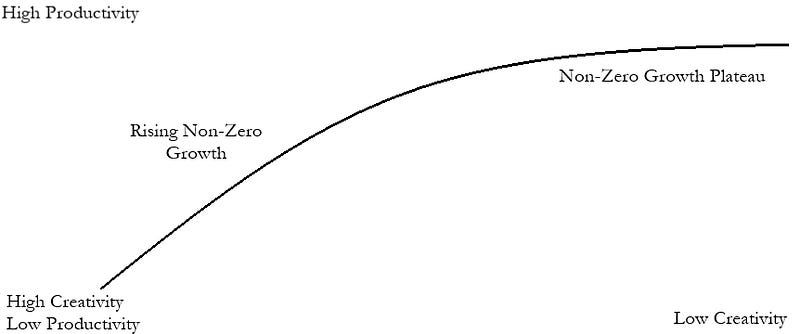
As Creativity lessens toward 0%, so there will be diminishing returns on Productivity in terms of Non-Zero-Sumness; if Productivity increases without Creativity, it is likely increasingly Zero-Sum and “captured” by capital-holders (r). This means falling Creativity could correspond with a rising incentive for r over g, increasing the probability that Stagnation occurs and Piketty’s admonishments apply. It is possible for g to increase as Creativity falls, but this is increasingly likely through a spread of Productivity gains to those who are yet to benefit from them, which is what I take S&G to emphasize; from their book: ‘Bruce Greenwald: The whole trust of our work is that, in practice, information dissemination and absorption looks much more important than information creation.’⁴⁹⁷ I don’t disagree that our society is not efficient at disseminating and absorbing new ideas (a problem with which an SCM could help), but there is also the question of the generation of new ideas themselves: I would like to see an improvement in the creation, spread, and absorption of ideas, all three. If we spread “a learning mindset” but are missing one of these, Non-Zero-Sumness will dwindle.
I take S&G to be using “Productivity” and “Creativity” more interchangeably, and they might not see a need for this distinction. I do, because I take their “Productivity” to emphasize distribution and absorption of new ideas, while I want to emphasize the original generation and quality of new ideas themselves (such as their metaphysics) — especially seeing as “thinking different value-forms” is a causal factor in how a society forms — and this emphasis for me warrants a distinct term, “Creativity.” Productivity gains can go far and do much, but we are suggesting Creativity is more metaphysical and about the generation of “a new form” itself, which is admittedly strange and mysterious, but necessary in a world where our problem is the “horizon” of ideas themselves (A/A). My claim is that if a civilization does not become better at “generating ides according to different value-forms,” Creativity will dwindle and Productivity gains flatline. Even if we did somehow improve spreading and absorbing “new ideas” like S&G champion, that would not necessarily include “creating new ideas according to new value-forms” (A/B), and we might just Accelerate the spread of A/A-thinking, worsening our plight before our AI-Causer. Then, even if there are Productivity gains, they will ultimately prove disadvantageous, though I don’t deny that implementing what S&G discuss could increase Productivity (even Non-Zero-Sum) — but that could be part of the problem, lulling us into complacency (Land waits). We need better creation, distribution, and absorption — all three, or we will serve A/A vs A/B.
There have been mysterious and unpredictable “events” of Creativity (perhaps incubated by McCloskey’s Rhetoric and Voicecraft), which enabled a Productivity and Production that increased GDP which, at least for a time, reflected Non-Zero Growth. But without “conditions of possibility” for consistent Creativity (as was perhaps impossible, notably in Global Pluralism, without the SCM), that Creativity eventually passed over into “mere” Productivity, and then even “mere” Production (without even Productivity), and while so growth increasingly “passed over from” Non-Zero-Sumness into more narrow Zero-Sumness (and so g was increasingly “captured” by r) — and/or then plateaued, creating increasing incentive for a focus on accumulating capital and returns on capital (r). In this way, as Creativity lessens, so increases the likelihood that Piketty is right, but the Austrians and McCloskey have also been correct that Capitalism uniquely affords potential for Creativity that, if present (say in “The Great Enrichment”), unveils Piketty to only be contingently correct, even if that contingency describes most of history (say until now). It is entirely possible that “r > g” is “practically inevitable” regarding Capitalism but not technically, because it is technically possible that the SCM arises and so “r > g” only be at best “likely.” And that is the rub of our argument: Piketty is correct insomuch as there is no SCM, and where there is no SCM, we have no way to be intentional about incubating the Voicecraft and Creativity needed for “Enrichment Events” like McCloskey describes. This leaves us in a state where “free markets” don’t work on their own, but then I think thinkers like Hayek are correct that State intervention (as supported by S&G, A&J, and Piketty) is unlikely to work — but before the SCM and possibility of recovering the Social, no other options were readily available (especially not without denying Global Pluralism in favor of some problematic “return to givens” that disregarded the possibility of “a new address”). And so Stagnation and social ramifications and upheavals incubated by Capitalism were “practically inevitable,” even if not technically because an “Enrichment Event” could always occur — but that possibility was easily more ideologically useful for Capitalists than practically relevant (until now). We have never successfully been intentional about creating “the conditions of possibility” for Capitalism to reliably (and yet without predictably or guarantee) generate Creativity, and we certainly have not done it with an infrastructure like the SCM. We’ve had universities, sure, but they have arguably been “captured” by Kafkalikeness, A/A, the quantifiable, and the like (consider the work of Joshua Hansen and Julien Benda). We have not worked to make Creativity “practically inevitable,” and so with time Creativity has “passed over” into mere Productivity and then only Production. And so g has fallen and r increased and incentives favored r, causing a negative feedback loop against Non-Zero-Sumness. Since without the SCM this is “practically inevitable,” in a certain sense Piketty is correct to strongly identify Capitalism with “r > g,” but this is no iron law. “A Learning Society” is possible, and more precisely a “B-20 Learning Society” enabled by the SCM.
As we argued in II.1, “the real source of value” is a dialectic between creativity and energy (Deirdre McCloskey and Vaclav Smil) — not gold or the dollar or trust…(even if necessary, they are not sufficient) — and to the degree Capitalism entails idea-generation and energy will be to the degree it can generate “real value.” Without the SCM though, it will not be as Creative as it could be, as without Hayek’s Pricing Mechanism (PM), it will not be energy efficient (food, gas, technique…will not be well coordinated), and so Capitalism without both the SCM and PM will not generate as much “real value” as it could, and furthermore without an SCM and PM to effectively and continually “test” supposed manifestations of “real value,” we will lack a means to tell when “real value” appears and even prove incapable of recognizing it (due to ignorance, psychoanalytic reasons, anxiety…). Also, Creativity with energy that generates “real value” that lacks an effective means of production, distribution, coordination, etc. — the things more of Productivity — though the Creativity might still benefit an individual or small community (though I’d be surprised), it will not benefit the Social and/or wider world. Indeed, without energy and ideas, we will not be Children able to regularly handle Creativity and capable of responding to “the surprising” that arises with and from our efforts, and so “real value” will be lost. But again, what constitutes “real value” in what way for when is not self-evident and no one can know ahead of time or for sure, and so a perpetual test is needed — the market, the PM of Hayek…but also the SCM, which makes possible “Value-Form Competition.” Could automation and AI generate Creativity? Again, maybe, but then again maybe it can only at best prove capable of Productivity; if so, humans could be masters of Creativity while AI is a master of Productivity, and together much could be accomplished. And if AI is capable of Creativity, an SCM could be needed to best relate to that Creativity for Non-Zero-Sumness for all, including AI.
If Creativity generates Non-Zero-Sumness, and the SCM can help spread Creativity, then making this case like we have could help convince institutions and the society at large to get behind the effort, because we could see the effort not as choosing between the extra and the practical but as realizing the full wealth of what can be practiced. The great problem of Capitalism is precisely its “incompleteness” and need for evanescent, hard to define, and systemization-denying Creativity, and that great problem today has become our problem at the heart of our “new address” and “belonging again” — but it is also our opportunity for a world where the intellectual and the practical, the ideal and the material, can finally be enacted together. Creativity cannot be planned only “prepared” for, and only to the degree we create “conditions of possibility” for its emergence and manifestation. Similarly, we cannot plan for the “ideas” that could be generated when “rules fail” and incompleteness is encountered, as Hingl and Shera discussed, but we can increases the chances we have developed people and subjects who can generate ideas when they are needed, even perhaps to where it is “practically inevitable,” even though there are never guarantees (“technically”). Capitalism has not been intentional about creating these conditions of possibility, and so gradually Productivity has crowded out Creativity as rules have often crowded out ideas. And then there is Stagnation and a people habituated into modes of subjectivity that find the growth they do have meaningless and narrow and something in which they do not belong. But must it be this way? No.
IX
‘The principal lesson of th[e] second part of the book,’ Piketty writes, ‘is surely that there is no natural force that inevitably reduces the importance of capital and of income flowing from ownership of capital over the course of history.’⁵¹⁵ If that is to change, something contingent must occur, which suggests we must act, but do we act via State intervention or recovering the Social? I believe in the second option (not that the State through Wordspread can’t help), which is for us to make the choice we collectively and emergently avoided back in the 1800s, perhaps because were not “prepared” for it: (we had to go through “the logic of Capital” to get to the place where it began to “overfit” and a negation/sublation became necessary and possible via the SCM). Recovering the Social is tied to becoming a Learning Society, but if the kind of learning we engage in determines the kind of growth we undergo, and/or if that growth is “captured” by r in a way that concerns Piketty, then it really matters the quality of the learning we encourage. If we get this quality wrong (if it is A/A versus A/B), the creation and spread of a Learning Society might only prove Accelerationist before our AI-Causer. It is not guaranteed that a B-20 Learning Society through the SCM is enough to realize “g > r,” but it could nevertheless still be important so that we mentally handle the reality of ever-growing r and not despair. From Piketty:
‘To sum up, historical experience suggests that the principal mechanism for convergence at the international as well as the domestic level is the diffusion of knowledge. In other words, the poor catch up with the rich to the extent that they achieve the same level of technological know-how, skill, and education, not by becoming the property of the wealthy. The diffusion of knowledge is not like manna from heaven: it is often hastened by international openness and trade (autarky does not encourage technological transfer). Above all, knowledge diffusion depends on a country’s ability to mobilize financing as well as institutions that encourage large-scale investment in education and training of the population while guaranteeing a stable legal framework that various economic actors can reliably count on. It is therefore closely associated with the achievement of legitimate and efficient government. Concisely stated, these are the main lessons that history has to teach us about global growth and international inequalities.’⁵¹⁶
Like a gardener maintaining the boundaries of her garden, we need the State to provide a legal framework and maintain conditions for stability, but that alone can only get us so far without the Social (“The Middle” of Jouvenel). For all its necessity, to do what the State cannot, “A Learning Revolution” is needed, and that revolution has always begun online in the SCM — but arguably it has been going for a very long time, subtly and secretly: a work of a “faithful presence” through the ages that our moment might enable its full blossoming. ‘[A]ccess to knowledge is key to learning and to the further advancement of knowledge,’ S&G write, and today that access is profound; in the past, where the access was less, perhaps the State had to play more of a role and could, because the world was not so complex.⁵¹⁷ Now, a Learning Revolution is possible, and it is a revolution that can spread itself, for ‘[k]nowledge […] is like a (good) disease: it can spread upon contact. But some kinds of contact are more likely to lead to the transmission of knowledge than others’ — say those on the SCM or with Children. Coordinating that contact until now was difficult; now, the negentropic spread can be meaningfully intended.⁵¹⁸ And if we enable a B-20 Learning Society, all the mistakes we seem to have made with “The Meta-Crisis” — it could be as if they were not mistakes (“a flip moment”) but challenges. Beautiful, even.
As already discussed, notably before 2025, I mostly used the terminology “The Liminal Web,” but in II.2 we have more discussed the “B-20” to point to the same movement, which is to honor “The Nordic Secret” in signifying “The Bildung-20.” We can associate this with spreading Voicecraft (anytime I have used “The Liminal Web,” I mean it the same way in using “The Bildung-20” — same goes with “The Social Coordination Mechanism”). I use “B-20” because I think this online movement was accelerated by Covid-19, especially starting in the 2020s. This is not to say people were not working before 2020 — Lene Andersen has been working for much longer — but it is to say a great multiplication and acceleration began. Also, Covid-19 had a cultural impact that made work online more acceptable, and that also accustomed average people to Zoom and video-communication. Without this cultural shift, the SCM would have easily faded out and not been able to draw as many people, but after Covid-19 and people experiencing years of primarily communicating through computers, the SCM was easier to try.
The SCM as an enabler of a Learning Society can be seen as helping make more mainstream and widespread a longer but not well known history and tradition of alternative education. To list examples:
Monasteries
Hedge Schools
The American Lyceum Movement
Home School Movements
Chautauqua Movement
Folk High School Movement
Great Books Movement
Free University Movement
This is not an exhaustive list, and no doubt there are movements in other nations and societies (overlapping or not) that I have entirely missed. There has been a demand for continual, adult, lifelong education, but without the SCM the coordination and logistic demands were perhaps too high. And as the economy suffers without education, so the economy might suffer if there isn’t lifelong education (notably in terms of Creativity): it is not optimal, socially or economically, for education to end for most before thirty (if the average person isn’t reading beyond school, Stagnation could be more likely). Without the SCM, it was perhaps impossible for these movements to spread and garner a “critical mass” of people, especially as “timenergy” dwindled, but the impact they did have was extraordinary. With these “learning movements,” we can also consider social groups that have made a profound impact on the world, which I consider on the same gradient:
Bloomsbury Group
The Inklings
Algonquin Round Table
The Apostles
The Jefferson Literary and Debating Society
Vienna Circle
Royal Society
Frankfurt School
Freemasons
The Advanced Institute at Princeton
The Lunar Society
This is a pitiful list and Western heavy, but the point is that history is full of examples of social groups and movements which were often driven by a hunger for learning without any guarantee for outcome (other than perhaps an at least discreet awareness that “Friendship” and “learning” might be mysteriously linked). No, I don’t know the intentions of everyone who attended all of these organizations, and no doubt status, money, power, and the like were involved; nevertheless, learning to some degree gathered people, and perhaps the learning lead to the status, money, and power more than learning just be a cover for status, money, and power (perhaps the successful have known what S&G argue about “learning” for a long time). History gives us reason to believe there could be a hidden demand for lifelong learning that has not been given a chance to gather and spread — but now we have an infrastructure to run that experiment (while lowering profoundly logistic and coordination demands). I understand that Justin Murphy as of 2026 is working on a book about “The History of the Independent Scholar,” and that could be an invaluable contribution to the case that “alternative education” and “lifelong learning” have made a profound impact on the world, though not often recognized, because it’s much harder to quantify and render intelligible to us (beyond “luck” or some “myth of the lone genius” — helping us avoid responsibility for making a world that helps incubate such subjects into existence without top-down intervention). This history is so important because what has happened in “history is actually possible” — it is a resource of revolution that is not so prone to the mistakes of the French Revolution, a justification to do what otherwise might seem too farfetched to attempt. Murphy’s work will be an invaluable contribution, and there are others like Zak Stein who deserve our attention and praise. Overall, there is reason to think there is a secret about us: we want lifelong education more than it seems. The popularity of podcasting might be a taste of this, but that could die out if podcasting is not negated/sublated into the SCM Culture we see at places like Theory Underground, TLC, and others. Also, as a slight aside, for this work, as I discussed with Jacob Kishere (2026), there could be value in researching the history of different organizations and how they managed their gatherings, from martial arts organizes to churches to Lions Clubs to YMCAs — the more research on social environments and how they deal with issues of exclusive/inclusion, forgiveness, development, etc. — the better. (Treasure can be buried.)
There is often a focus on inequality in terms of capital for why the rich thrive over the lower classes, but perhaps a deeper inequality is access to quality social networks, which for most of history were often more accessible to the rich than others. Perhaps this contributed to their corruption (away from virtue and Beauty), as things more done in private and secret can tend toward, and unfortunately, we see in “The Epstein Class” a profound use of networks for elite, exclusive, and evil purposes. Perhaps this is inevitable when something as powerful as social networks are not readily available to the people, and perhaps the most revolutionary act in history would be to make quality and global social networks available to everyday people (a true Social-ism — focuses on money have perhaps concealed something deeper) (and note how much the Epstein Class consists of scientists, researchers, and efforts of learning). There has been a focus on “government for the people,” and that matters, but that perhaps only ever could treat a symptom without “quality networks for the people.” There has been a time for marches on Washington, but now taking on the State could be a matter of “faithful presence” in the SCM. Creativity can be ours.
The SCM democratizes access to powerful social networks, which raises social capital in numerous ways, not because social networks were intentionally denied to lesser classes in the past, but simply because the logistical demands were too high and participation too onerous, especially if these groups were focused on learning without a guarantee of economic benefit (“leisure,” please note). Perhaps these groups and movements stayed more elite than democratic because their interests were too niche and aristocratic, as perhaps that is why many of them died out. Then again, perhaps they stayed elite and/or died out because the “transaction costs” were too high for people with constraints avoided by the rich. Hard to say: we’ve not had the infrastructure to run the experiment, as we’ve not been able to run the experiment to see if “intrinsic motivation” might spread. Now, we do. We have the SCM — of the spirit of Ivan Illich’s “Learning Web” — a necessary means of collective resistance against AI replacing us and Dream-Equality. Perhaps below the surface, bubbling out here and there in history, looking for a place to go, there has always been a “Demand for Lifelong Learning,” waiting to be unleashed to develop Creativity for countless people. Perhaps the loss of the Social could have been avoided if this Demand was liberated, for perhaps “the love of learning” can make people intelligible to one another and overcome anxiety without “givens.” History gives us reason to believe it is possible, and S&G’s work on “learning” gives us reason to try, as does the state of our anxious Globalization. But the quality of that learning is key, and that quality must be in the spirit of the Nordic Secret.
‘Individuals and firms have to adopt a cognitive frame, a mindset, that is conducive to learning. That entails the belief that change is possible and important — and can be shaped and advanced by deliberate activities. Part of the reason for the relative stagnation in living stands that persisted for thousands of years before the industrial and learning revolutions was that there was not this cognitive frame.’⁵¹⁹
S&G are right, but there was also not a means to effectively “spread” this mindset, as there was also not as much incentive to create a means to spread it before the world accelerated and complexified with Globalization (for ‘[i]n a world with little change, there are few catalysts to learning, and little effort is spent on creating change and adapting to it’).⁵²⁰ The incentive is now there, and there is also reason to believe there has always been a below-the-surface Demand for it, seeking Creation. But where that Demand was realized, there was a lack of infrastructure for it to spread or draw in others without high “transaction costs,” and so, outside elite classes, there tended to just be isolated individuals and Children, and it ‘it is hard for any individual to change his mindset on his own, [and/or] for any single individual to bring about a change in the collective mindset.’⁵²¹ It can happen, but it is rare, and it is likely unintelligible to others, and isolated incidents don’t generally ‘help create learning capacities and a learning mindset [nor] establish networks of contacts that provide strong catalysts for learning,’ nor do they help reduce ‘environments [which] can stifle learning […]’⁵²² History so far shows us that ‘knowledge (learning) [is] localized, [as might] be learning how to learn,’ but the SCM is an “event” that may not be bound to “The End of (True) History.”⁵²³ The Cosmo-Local of Michel Bauwens is now possible, but if it is not of the B-20, its potential will be wasted.
X
On ‘growth-oriented policy,’ Solow considers paths:⁵²⁴
‘One is to aim for temporary increases in the growth rate, to accept that lifting the potential trend is ambiguous and important. Then there are several policy directions, all leading in the right direction. Increases in investment will do the trick, and the menu includes increases in plant-and-equipment investment; in human-capital investment through education and training; in public investment in the infrastructure of transportation, communication, and information flow; and, of course, in research and development. The second option is to seek higher growth rates on a long-term basis. Then the theory says that only the research-and-development-and-entrepreneurship path to a candidate and one cannot know exactly — or even approximately — what will be required to achieve a measurable acceleration of steady-state growth.’⁵²⁵
We are notably interested in the second option, which I think suggests mystery, uncertainty, and unpredictability, words I associate with the “Solow Residual.” Yes, steady Non-Zero Growth must emerge, and we cannot predict or “plan” for how exactly it will, but we can support infrastructure and “conditions of possibility” that increase the probability of its emergence, perhaps to the point where it is “practically inevitable.” Our claim is that a “B-20 Learning Society” is how we “addresses” the Residual, but there are no guarantees (yet cannot be unless we are not discussing Creativity).
In Capital in the Twenty First Century, Piketty writes:
‘The second conclusion, which is at the heart of the book, is that the dynamics of wealth distribution reveal powerful mechanisms pushing alternately toward convergence and divergence. Furthermore, there is no natural, spontaneous process to prevent destabilizing, inegalitarian forces from prevailing permanently.’⁵²⁶
For him, State intervention is necessary if inequality and Zero-Sumness are not to define Global Capitalism, and though it is true that “creative destruction,” innovation, and entrepreneurship have provided episodes of falling inequality and rising Non-Zero-Sumness, these episodes have never lasted and cannot for Piketty be seen as more primary than the periods of rising inequality. Also, “creative destruction” requires learning, and where a people don’t “learn how to learn,” the market seems doomed. And so the State is needed, yes? And yet the Austrians could nevertheless be right about the State being unable to successfully intervene, without grave consequences. Then checkmate, yes? No, our hope is that there has never been a sustainable infrastructure like the SCM for spreadable and global “lifelong learning” of B-20, which trains “inner capacities” by which Childhood and Creativity can emerge and be maintained (at a “critical mass”), affording Non-Zero-Sumness without top-down intervention that causes black swans.
The SCM and its communities could be associated with “The Global Bildung Network” and/or “Folk High Schools” seen in Denmark, which brings us to The Nordic Secret by Lene Rachel Andersen, edited by Tomas Björkman (who spoke with Jim Rutt on the subject, EP 67) — it is all for me part of an effort to regain the Social (“Tragic Sociology”) from our choice in the 19th Century to “pass over” into Capital. ‘What is it about the Nordics? Are they a utopia? An achievable utopia?’⁵²⁷ Like S&G, Piketty also acknowledges the Scandinavian nations:
‘[I]f the United States (or France) invested more heavily in high-quality professional training and advanced educational opportunities and allowed broader segments of the population to have access to them, this would surely be the most effective way of increasing wages at the low to medium end of the scale and decreasing the upper decile’s share of both wages and total income. All signs are that the Scandinavian countries where wage inequality is more moderate than elsewhere, owe this result in a large part to the fact that their educational system is relatively egalitarian and inclusive.’⁵²⁸
Yes and no: “equality” and “inclusivity” are not primary reasons even if valid descriptions; what is key is the quality and kind of the education itself. Still, there is a global recognition that there is something special about the Nordic Nations, and Andersen seeks to explore the enigma.
‘The Nordic Secret is about how Nordic education allowed Denmark, Finland, Iceland, Norway, and Sweden to pull themselves out of deep, deep poverty in the 1800s and become industrialized, modern, affluence, stable, and democratic societies, and to do it without any revolutions, major riots, or violence.’⁵²⁹
‘The Nordic secret is that we have lifted society from the bottom. With a particular kind of education.’530 The word “particular” should be stressed, for it really matters the kind of education we provide. Though I think they end up with a Productivity that lacks Creativity, even S&G realize that education of any kind doesn’t guarantee Non-Zero Growth:
‘Years spent on rote learning might (or might not) increase the stock of (even relevant) knowledge and, in that sense, increase productivity, at least temporarily, until that knowledge becomes obsolete. But such schooling would not necessarily increase the ability to learn — increasing capacities for lifelong learning — and could actually impede it, especially if, as part of such education, there is an attempt to inculcate ideas that are antithetical to science.’⁵³¹
Capital and Kafkalikeness tend toward this kind of “route thinking,” and education which just makes us efficient at Non-Zero-Sumness. Then, education will be part of the problem, all while we think the problem is being solved.
I have occasionally described Nordic education as “adult education” and “lifelong learning,” which isn’t wrong but risks misunderstanding: Tomas Björkman stressed with Nate Hagens that the Nordic Education or “Bildung Education” cannot be reduced to such, and because many people think of the initiative as “just adult education, a lot of its unique and critical characteristics are missed. Björkman stresses “the growth of inner capacity” as key (which I would associate with Childhood), and if we stress “adult education” and “lifelong learning,” we might end up just thinking about retraining schools or gaining skills for jobs (more A/A). What Björkman has in mind is distinct, and he stresses that when the Nordic leaders engaged in this project of education, they were concerned about how people turned to authoritarianism when faced with complexity (concerns of Philip Rieff). Democracy was what the Nordics believed in, but they also understood democracy fell into authoritarianism unless it was built “from the bottom up” with an emphasis on developing a citizenship which could handle complexity — what Björkman articulates is at the heart of Belonging Again).
Where “inner capacity” wasn’t emphasized, education would fall into simple information and training (A/A), and this wasn’t enough for democracy to avoid falling into authoritarianism. This in mind, it doesn’t seem so crazy that Nordic governments funded the youth to spend six months in “folk-schools” that trained them in their “inner capacities” (the details are provided by Andersen and Björkman), schools that could struggle to quantify what exactly they were doing and that many people were skeptical of (as Andersen notes in her conversation with Thoreau College), until people came and saw it themselves (a concern that repeats on the SCM today, which fortunately is easier to “see” online). Björkman also makes the fascinating point that Rosa Parks and Martin Luther King were formed by a Nordic-inspired effort, “The Highlander Research and Education Center” and/or “The Highland Folk School” in Tennessee, founded by Myles Horton: Civil Rights in America might have never happened without “The Nordic Secret,” which invites us to wonder what other profound cultural shifts might be possible if we owned the Nordic history with the SCM.
To “leave Plato’s Cave on our own” and “resist Dream-Equality,” we require “inner resources” (versus rely on “Bestow Centrism”), and so it goes for leaving systems of oppression and Affliction (Capital) and/or moving into Voicecraft (A/B) from Kafkalikeness (A/A). Despite how this can seem an impossible task, what Andersen and Björkman stress is that we have actual, concrete evidence of a method of education that gives us these results. ‘The [Nordic] education was inspired by a German concept called Bildung, and as we shall see through this book, local teachers, pastors, farmers, academics, peasants, business owners, and young farmhand and farm girls self-organized around it and turned it into a special kind of Nordic bildung.’⁵³² Björkman argues that the Nordic Nations are where the philosophy of German Idealism was continued (arguably case studies justifying it), perhaps more so than other parts of Europe that fell more into an industrial and technological mindset, but at the same time we should not see what happened in the Nordic Nations as exclusively sourced from them: the sources ‘are also British, French, German, and Swiss with some important input from Greece, Italy, Moravia (in today’s Czech Republic), and the United States […] a tale of transatlantic beauty and freedom’ (a Pluralistic effort for Global Pluralism).⁵³³ And what were the results of all this? Andersen describes great fruit in Chapter 1: the Nordic ‘are among the happiest peoples in the world’; there’s high ‘human capital’; greater ‘competitiveness’; greater ‘global contribution’; and more.⁵³⁴ ⁵³⁵ ⁵³⁶ ⁵³⁷
‘In the top layers of the Nordic societies,’ Andeson writes, ‘there were people who saw the lack of mental complexity, discussed it, and wrote about it; there was an awareness that the common people were not ready for the changes their society was going through and that something had to be done about it.’⁵³⁸ This was not elitist or judgmental, simply practical: the world was increasingly complex, technological, diverse, and confusing, and the people weren’t “prepared” (to say encounter and handle Lack and/or a River-Hole into Drive against temptations of A/A-self-effacement before Land’s Capital…). ‘And here is the interesting and significant part: though they wanted to promote feelings of responsibility and personhood, they did not want to dictate what the people should think, what they should feel, or how they should act. Rather, they wanted to educate and wake them up so they could figure it out for themselves.’⁵³⁹ ⁵⁴⁰ ⁵⁴¹ They sought an emergence that nevertheless was of a quality that could handle complexity: there was intention yet also unpredictability. The State helped provide incubation and intervention in that sense, but the State also did not try to overly-control the outcome, like a gardener versus a mechanic, with vision and hope but not guarantee.⁵⁴²
Andersen writes that ‘[w]hat emerged was the understanding that people must be able to control their emotions, internalize the norms of society, and take individual moral responsibility. In German, this kind of personal development went under the name Bildung’ (which I would associate with “Childhood”).⁵⁴³ ‘The reading and writing classes in the Nordics were inspired by this Bildung philosophy, Idealism, and Romantic nationalism, and Bildung became the new black. But the German thinking was much too lofty to capture peasants […] To reach these peasants, several efforts had to come together’ which Andersen describes and that I personally see qualities of in the SCM.⁵⁴⁴ Lene Andersen goes into greater details, and there are distinctions that need to be brought out (‘Education, ego-development, bildung, folk-bildung, and Nordic bildung overlap and are all crucial, but they are not the same’).⁵⁴⁵ Overall though, ‘[b]ecause [‘The Nordic Secret’] was deeply meaningful and empowered people, they loved it, and they co-created it and took responsibility for it’ — just like the SCM (like ‘folk-bildung’).⁵⁴⁶ ⁵⁴⁷
Though as we discussed we must be careful, we can associate “The Nordic Secret” with “Adult Education,” and Lene mentions ‘Robert Kegan, psychologist and Harvard professor of Adult Learning and Professional Development,’ as important to consider and also a means for how she and Björkman came to understand an important ‘connection between bildung and ego-development theory.’⁵⁴⁸ Critically, this “Adult Education” is not merely a matter of information: as Andersen notes, ‘[t]he Nordics are not just unique regarding happiness, trust, and economic development, [they] also have rather unique values’ (metaphysics matter).⁵⁴⁹ Values shifted, which is the answer to the question, ‘What changed first: values or wealth?’⁵⁵⁰ This suggests Deirdre McCloskey: it is mainly ideas that change first, then materiality, though “a medium condition” can be necessary for ideas to change, so it is not a clean either/or. There was ‘a popular movement towards emancipation and modernity,’ perhaps like McCloskey’s “Rhetoric,” and then material conditions followed.⁵⁵¹ With “The Great Enrichment” in mind, consider:
‘In the Nordics, we lifted our societies from the bottom. We did it through a unique pedagogical approach that allowed everybody to unfold their potential, to find their own voice, and to form their personal character. What might be counterintuitive is that by promoting this kind of diversity among the citizens, during a time of revamping the social structures, the Nordics created strong inner cohesion, social peace, lots of beauty, and previously unknown degrees of freedom’⁵⁵²
The Nordic Bildung avoided authoritarianism without destroying national identity, a challenge that very few have ever succeeded in (they often end up, for “just and right reasons,” going too far and just deconstructing “givens,” which backfires). Still, Andersen is not naïve of the shortcomings and challenges, ones I think we see in the B-20 today. First, the Bildung was mostly funded by patron and subsidized by the government — it did not and has not overcome “the funding problem” that similarly plagues the SCM. Also, Lene Andersen notes that Bildung Education was always a minority, so there is much more to be done. Despite the potential, we’ve just not been able to spread and sustain Bildung — but I think that is changing with the SCM (especially if it can be paired with Web 3.0 and Tokenization, say through Trust Wallet, such as we see in the YesNoError initiative (YNE) — but more on that later). Bildung has struggled to spread, as it has been hard to keep Voicecraft from being eclipsed by Kafkalikeness, but it is easily Bildung that is needed precisely so that A/B isn’t eclipsed by A/A: “The Nordic Secret” and “The Netherland Secret” could be connected.
We cannot realize learning that enables Creativity without a vibrant environment of knowledge that is “useless,” as Julian Benda discusses in his work on education, and “useless” is what “The Nordic Bildung” could be called — and yet that be a compliment. The “useless” can transcend what we can quantify, and if our age is one where everything we can quantify doesn’t seem to be enough, this is a sign of hope. Without a vibrant environment of “useless knowledge,” ergo Creativity, our argument is that there will not be “the conditions of possibility” (with our “inner capacities”) for “useful knowledge” in Productivity that is needed for “g > r” and/or at least rising growth that is more Non-Zero-Sum and public than Zero-Sum and private. To bring this about, “The Nordic Secret” is an invaluable piece of the puzzle that adds the necessary quality to “The Learning Society” so that we might behold “the spreading of Childhood.” And as “The Nordic Secret” is at the heart of overcoming Stagnation into Non-Zero-Sumness, so it is at the heat of “addressing” our loss of belonging and prayer for “belonging again” anew. “The Triplex of Belonging” must be “addressed” together (Sustainability, Care, and (Be)coming), and the Nordic Bildung is evidence that this is possible, if only we had the infrastructure to sustainably “spread” it amid Global Pluralism, as the SCM makes possible. No matter what gains we make economically, the progress will be fragile if socially we are not able to handle Otherness, and without “inner capacities,” it is only a matter of time before a new “culture war” begins — before a new “Ethnical Real” breaks in — and we are overwhelmed (“Love(craftian)”). “Culture Wars” can fade during “Fourth Turnings” as they are eclipsed by economic, geopolitical, and military concerns (yet in another sense reach their outcome and crescendo), and during this period there can be a revival of religion and return of community efforts, sowing the seeds for the new “First Turning.” This can make it seem like the Culture Wars are over, which it can make it seem as if we have indeed developed “the inner capacities” to handle them. But this is not necessarily so: the issues have easily just gone “underground,” hidden, and lurking until another time (there will always be opportunities for “vectors of the Good” to eclipse and forsake “The Beautiful”). Whether based on gene-editing, food, sexuality — there will always be material for Culture Wars (and must be if we have worldviews that actually function, for they must make “exclusive truth claims”), and when the next “Ethical Real” strikes, if we are not “prepared” for it, we should expect history to repeat (that, or we have already “outsources ourselves to AI”). Without the B-20, we won’t be, society will fracture, and Non-Zero-Sum Growth fade.⁵⁵³
We convince ourselves that Culture Wars are over at our own peril, but it can also seem silly to focus on them when the economy is in shambles and the world on the brink of war.⁵⁵⁴ Yes, but that is why it is critical that the Nordic Bildung addresses both fronts at the same time; that is why there is hope. We are going to say more on The Nordic Secret in II.3; admittedly, I am running out pages before we’ve hit limitations in physical printing, and we still need concluding remarks for II.2. We will also discuss Creating a Learning Society more, and then a fuller elaboration on the precise ways the SCM could change the world, of which we’ve only begun to describe. A subject of Encounterology, a new socioeconomic era of Encounterism could begin, a negation/sublation of Attentionalism for the human that establishes conditions so that we finally prove capable of handling Global Pluralism (which is a revelation of the fullness, multiplicity, and depths of the human). And AI could help in this effort, as Michael Sartori has been working on with his focus on “The AI Social Coordination Mechanism,” for though AI is “toward’ Dream-Equality, it doesn’t have to be, for AI only is because that is what we want in missing Childhood (the market works). The problem could just be AI without the SCM, as similarly Creativity for most without the SCM could just be destructive (they not being trained in the “(un)veiling” needed for that “Love(craftian)”). And what might all of this make possible? For one, an infrastructure of “surprising encounter” across “maps” and throughout Global Pluralism that helps us realize the Beautiful, for I think Matt See is right that the Beautiful appears in all cultures, while falsities don’t, enabling a critical “metaphysical natural selection.”⁵⁵⁵ Encounterology is a study of the possibilities of such “overlap-to-realize,” and with it could be a socioeconomic order of Encounterism based on the values of that “overlap” and “insight” (Zwicky).
Lene Andersen’s work is evidence that S&G are right about the primacy of “a learning mindset” in growth, even if there are differences in the quality of that education, but perhaps until now we couldn’t “spread” the kind of education Andersen describes, only what was more STEM orientated (quantifiable). History is a story that we have basically never been adequately intentional about incubating Creativity (and keeping it adequately distinct from Productivity); hence, A/B has “passed over” into A/A, Voicecraft into Kafkalikeness, “r > g” has incentivized us not to focus on growth (except when it benefited r, which means it was more “captured”), and Stagnation set in. This easily followed, especially under Globalism, from a lack of SCM; also, Creativity is dangerous (like “The Real”), and until we had an SCM, it was arguably wise to emphasize Productivity over Creativity, but the time when we could get away with that move (“plausible deniability”) has run out before our AI-Causer. “The Learning of Productivity” requires “The Learning of Creativity,” and if Productivity is conflated with Creativity, then “lack is nothing,” and A/B becomes A/A. There are no “essential limits.” Dream-Equality wins (Land waits). But I don’t believe that this Absolute Choice has been made yet.
XI
The SCM is a Grassroots Movement that shows that we can learn for learning’s sake and that others will join. In the past, if we wanted to find people who would read Hume with us, we’d likely have to live near a college; now, basically anyone from anywhere in the world can engage in culturally and intellectually engaging modes of life. We have a better tool for Social Coordination, for “The Coordination of Intrinsic Value” (as Anthony Morely discusses), which also provides ways for people to see this coordination taking place and learn from it. The videos people post on YouTube of their discussions on Aristotle teach people about Aristotle, highlight the expertise of the speakers (like a portfolio), but critically also show people a way of life and quality of conversation that people can engage in even if they are not paid for it, outside of “the logic of Capital” (a revolutionary act). We are given examples and shown possibilities for different ways of life, helping us discern different ways we might contribute to new “conditions of possibility” and options for coordinating interaction. In showing all this, an aesthetic, the SCM doesn’t just provide information, but also “works on our desires,” as James K.A. Smith discusses, in that it can form us to say, “I want to do that too.” Our loves can change, and so can our metajudgments and value-forms — moves of freedom.
The SCM is not just a collection of podcasts and content but shows communities growing and interacting: it is like a network of “silk roads” in which people are contacting and exchanging life together. To keep this going and of the right quality, we require Voicecraft, but fortunately these “silk roads” show possibilities of Voicecraft and can help create a desire for Voicecraft. And the alternative is Kafkalikeness, Dream-Equality, which to avoid we must take Walker Percy seriously when he tells us that ‘[it] is only the rarest student who knows that the sonnet must be salvaged from the package,’ which is to say few students realize that education must be saved from school, as the Grand Canyon must be saved from photographs — as we must be saved from ourselves.⁵⁵⁶ Beauty, which the SCM can “condition” us to experience, can make us realize this saving work. “The Strike of Beauty” can make us realize “The Delta Factor,” analogous to that moment in which Helen Keller realized that the sign for “water” in her hand meant the signified thing-water she felt running through her fingers (which we can associate with the “apprehension” of Sam Green, the “insight” of Jan Zwicky). For Walker Percy, this moment was of the upmost importance and ‘veiled a mystery, a profound secret.’⁵⁵⁷ It is when Helen Keller entered and/or expanded her communal potential, when she became a social being (suggesting a connection between a lack of “insight” and isolation and/or Hikikomorism). This “strike of intelligibility” and moment, what Percy calls “the Delta phenomenon,” was the birth of a world, a horizon, and “social imagination.”⁵⁵⁸ Otherwise, we seem confined to ‘what has already been formulated — […] picture postcard, geography book, tourist folders,’ Instagram posts, college curriculums, plans, technological engineering…⁵⁵⁹ Ever ‘obscured by the symbolic package.’⁵⁶⁰ To face this, for Illich, we must hope more. The SCM, a Learning Web, is reason for hope. Illich came early, but he had to if he was to be there when we found “the way was shut” and looked back with a temptation to go back. In finding him — standing, waiting to be realized — the temptation could be abated by us finding in the past what we missed so that “the hard road” could be walked. The past we missed is not the past with which nostalgia tempts. Actually possible. The future is past.
Colleges once basically had a monopoly on the supply and demand of intellectualism that was socially recognized, but this mechanism of coordination, even if still valuable, need not be monopolistic.⁵⁶¹ For people to see people learning for themselves on the SCM can help give them social support and “permission” to do the same and not feel crazy or like they are wasting their time; after all, others are doing it, as they can “see” for themselves (a “plausibility structure” emerges). For most of history, what we “saw” and felt permission to do was strongly tied to our zip-code and what we happened to be around, and though this isn’t the only reason why economic wellbeing correlates with zip-code, it could be a strong reason. We simply have not been able to “coordinate value” effectively beyond supply, demand, and pricing mechanisms (“Creatively”), and though generally people know that money can’t buy happiness and that the market isn’t everything, values beyond the market have been very hard to coordinate beyond geographic immediacy. People have traveled and attended college, but this is where class plays a big role, for those who can travel and attend college can be tied to class. And if going to college changes people’s “social imagination,” in people’s horizon of what they think is possible, then this change in social imagination has mostly been reserved for differences on class lines. And if enrichment is strongly connected to social imagination, then class divisions end up ever-reified by a feedback loop: those with money are most likely to experience new social imaginations and horizons, which opens up opportunities for enrichment, which improves their wealth — on and on.⁵⁶² Yes, we have recognized this feedback loop, but we have mostly thought of it in terms of economic opportunity, which is to say the rich go to college, meet people who offer them good jobs, who make them gatekeepers for other rich people — on and on. And though there is truth to this, there is another advantage: the development of social imagination. Fortunately, in a world with increasingly fast enough internet that is also reliable for the average person, our growing “Net Tradition” via Zoom-like services allows for a decentralization of creating social imagination, and it is on this point that hope for “a new address” can be found.
Let us say there are a thousand people in New York who are interested in reading Whitehead. What are the chances of those people finding one another? Before the internet, low: even if we bumped into one of these people on the street, what are the chances we would find out they were interested in Whitehead? How would it come up in conversation (especially when we might be trained not to bring up intellectual interests that are unrelated to work or school)? It likely wouldn’t, but perhaps we might put up signs on phone-poles that read “Whitehead Reading Group.” Would that work? It might help us find fifty of the thousand, but what if it turned out two of those people were prone to dominate conversation or to misread the text but not be open to alternative readings? The whole reading group could be ruined. But let’s say we got lucky and this Whitehead reading group went well (while ten others failed). What now? Well, unless we up the effort entirely, we’d likely have to do another reading group on Whitehead, for what are the changes we could make a similar miracle occur transitioning to James Joyce (who we want to read next)? We’d have to find new people (and risk leaving our original members behind, perhaps hurting them), which is unlikely, seeing this would require a second miracle. But maybe we could take a vote with the same people and start a reading group on someone everyone is interested in? Perhaps, but we’d likely lose people, and slowly and gradually the reading group could dwindle away (and perhaps stop reading, unless there is a different reading group that pulled off its own miracle that they could join without too much logistical trouble…). People might have kids. People might get new jobs and move. Life can shift. And so the group could fade. And there seems no realistic way to keep it going, to keep the logistics and organization coordinated — at least before the SCM. No life-circumstance must cut someone off from the SCM. New and different groups are easily found and joined before a return to original associations. Groups can grow or cease without the entire network failing. Rhizomatic. Antifragile. Hope-full.
It can seem silly to learn autodidactically on your own outside university. For — why? What’s the point? We’ll likely just isolate ourselves and waste our time, filling our heads with what we cannot share, missing chances for community. But let’s say we face these concerns and choose to learn on our own anyway (just like teachers told us to do), which might not be what the majority do, but we decide to do it anyway. Well, if we learned outside institutions (where “ideas” might be more likely, considering Shera and Hingl — but also chaos), because for some reason we could not work there, and we devoted a decade to reading on our own, the likelihood of us being able to coordinate ways to connect with others to share our learning would be low. The institution would likely not take us back, and even if it did, it likely wouldn’t pay us, and this would be unfeasible for most. And so we would have to work unloading trucks. Timenergy would be limited. And so the great dedication to great learning and reading would likely come to an end. The investment couldn’t pay off. The risk would prove poorly taken. There simply wasn’t the coordination mechanism in place to make this investment worth it. Now though, Zoom and the internet allow better coordination, “A Value Coordination” never possible before. The world has changed. A new value-formulation is possible. And, the experiment now performable, we will see if there is truth to what I hope: I believe that the reason the average person doesn’t read or pursue ideas is not because this is somehow “necessarily the case” (even if there is incentive to avoid ideas because our “frenemy brains” don’t like their worldviews threatened). Instead, it’s strongly because there is a lack of community and sharing around intellectualism which is readily available to people in everyday life (where they can “encounter” situations which make them turn to ideas), outside of university. The SCM can change that, and so I would expect an explosion of average people learning for learning’s sake (as S&G champion) (with a rise in Creativity, necessary for Non-Zero Growth). For most of history, we have made learning elite and rare, when really this “exclusivity” just “appears” from inefficient coordination (so it goes with “intrinsic motivation” and Childhood). Appearances can be deceiving. We are in an age when the fullness of learning might be realized for everyone, because after thousands of years, with Hayek’s Pricing Mechanism coming first and making way for it, we now have a coordination mechanism to make that possible, which at the same time affords the possibility of a Global Social. This is a time of hope, and its darkness might help people “open” to what they otherwise would have “rationally” ignored.
In addition to geographic restrictions keeping people from effectively coordinating value and drive, there has also always been “the problem of effective time allocation.” If I am at college, then the system creates space for me to read Hegel, but if I work driving trucks, this “space’ is not so given (which can make it seem like only certain kinds of people will read Hegel, perhaps creating bubbles and limiting interpretative and creative possibilities). Perhaps there is a reading group in town where people are reading Hegel? Very unlikely, but even if so, the truckdriver would have to coordinate driving to the location for the reading group, find time to read Hegel before the reading group is scheduled, and then have the timenergy to do this consistently. And even if he does this for Hegel, can he also do it for Heidegger and Adam Smith (suggesting the emphasis on “specialization” might have followed from limitations on coordination)? Probably not, and if the truckdriver could find nearby people to read Hegel, what are the chances of doing this again for Heidegger and Smith, who the truckdriver wants to read (and perhaps must read for “insight” that otherwise couldn’t occur)? The likelihood of this coordination is low, which means the truckdriver is likely to give up and cease this development of his subjectivity away from “the logic of Capital” (A/A). There are simply too many hurdles, regardless the truckdriver’s motivation. He can’t simply will to force these variables to all come together, so it is not a matter of willpower. He can’t make five people in the neighborhood want to read Hegel; he can’t make them have quality interpretations and insight; he can’t make them good conversationalists. He could read Hegel on his own, but this is very hard, and if he has no idea how to proceed, he’s likely lost and stuck. If he starts down a bad interpretation, he has no way to check himself, nor is it given that he’ll happen to find out who needs to learn from to correct himself (if there are names we need to learn, we don’t know we don’t know them). The coordination of value-creation and alternative value-formulation is likely to fail. And if by some miracle it were to succeed for this lone truckdriver, what are the chances that it would succeed for 10,000 others? 10 million others? 5 billion? Very low — or so they were before Zoom (and similar services), YouTube, widely available fast internet, and cheaper and simpler recording technology. A Grassroots Movement is now possible. A change in the forms of subjectivity can emerge and spread. We must keep hope. We must keep the SCM going.
Time and geographic limitations greatly hindered the possibility of a spread of “a learning mindset” (S&G) and a philosophical and Childhood culture. Sports culture has spread, yes, as has “movie culture,” but a reason for this is because these are entertainment cultures, meaning they only needed to be watched and consumed. I don’t mean this as a judgment, and “movie culture” has been a blessing in my life, only that “mere” consumption is a much easier coordination problem: there isn’t a need for regular and sustained participation, a handling of relational dynamics, less complex logistical demands across numerous people; and so on. Before the SCM, there was not an infrastructure that enabled deep interaction between audiences and people (as is possible through Zoom), and fields like philosophy and dialectical thinking arguably require interaction to really “get” (consumption is necessary but not sufficient).⁵⁶³ Yes, we need to go out and play a sport ourselves to really “get it,” but I will venture to say that it is easier to find people in the immediate community who will play football versus read Hegel (because the intelligibility and value of football is more “immediate,” for one). And even if not, it is easier to find people who watch football than read philosophy, and so it is easier to talk with and share with people our experience of watching football, which is likely more denied to us when it comes to reading Hegel. We can’t so easily find people to share our reading of Hegel with, have it questioned, have it spark a conversation, and so on, especially beyond proximity to a university. Hegel is more likely to make us feel alone than football, per se, though perhaps for a period of history that wasn’t a bad thing, because Hegel can be dangerous without the right infrastructure for approach and development.
Zoom is a system of language coordination, and though I focus on an example of studying philosophy, the implications are broader. If we want to talk about magic tricks with people, tax policies, learn Spanish — all of this potential value-creation can be coordinated with the SCM (a response to “The Skill Crisis” of Illich) and done beyond class-divisions. The low, middle, and upper classes can all interact; the financial barrier is much lower. And this might be a return to a “public square,” where class divisions aren’t so pronounced. When it comes to discussing Hegel, the lower, middle, and upper classes can all interact on the same terms, and in fact the lower classes could prove themselves better readers of Hegel than the upper-class — a better system based on merit could arise, as opposed to one that slips into tracking wealth, lineage, and certification. And all of this could be recorded on the internet to show quality and skill; the monopoly of the resume for qualification can be broken up through the introduction of the portfolio. The portfolio can open opportunities for lower classes, and lower classes could have a better portfolio than upper classes. Value could be coordinated more effectively, helping us break up “the monopoly of the Capital value-form.” Right now, Capital is the most efficient system for coordinating value across the globe, in terms of economics, culture, society, etc. Thus, intentionally or not, it generates a monopoly, but Zoom offers an infrastructure for value-forming alternatively, helping us liberate the social imagination from the commodity (and Dream-Equality). This value-coordination can help us address class-divisions. We finally have the coordination technology, but we need people to keep showing it used this way — a Grassroots Movement.
It is unlikely many of us can sustain “learning for learning’s sake” alone (given the power of “plausibility structures”), and so the coordination of diverse value-creation and value-formation has not been practical for most of history. This has changed, and though “the way is closed,” a “faithful presence” is now possible outside the system and Capital-Nation-State. The SCM can show new forms of subjectivity; it gives us “permission” to live differently and facilitates opportunities for “in-person events” and in fact generates desire for those events (great marketing). But when in-person events aren’t occurring that the SCM helps coordinate, the SCM can also provide online encounters to fill in “the gaps,” keeping the Grassroots Movement going. And as with business and the PM, if one in-person event here fails and an online meeting there ends, the entire SCM will not come crashing down: the rhizomatic root-system is still intact (perennial). This is a significant change from history, where if the leadership of a major organization failed or the like, the entire movement was likely in jeopardy. Perhaps “transitions” and “successions” are the hardest challenges for organizations to pull off, but the SCM helps, precisely in making the success of those episodes non-essential relative to the whole; if an organization fails, again, the root-system is intact (and all of the organization’s work can still be online to benefit us in the “portfolio” left behind). Historically, “movements” have always been fragile and prone to rely too much on a single person or organization, but that was also a likely response to a lack of coordination technologies that enabled alternatives. The SCM decentralizes “the weight,” spreading the responsibility across numerous small channels, individuals, events, etc., making the Grassroots Movement far more antifragile and less likely to unintentionally create “Big Others” who are overly-depended on. Leaders and even “Big Others” of some kind are arguably inevitable, but even if so the SCM can help them from becoming “too Big,” distill the authority, and also provide a means for “Big Other” to die (as Žižek encourages with “Christian Atheism”) without shocking the SCM beyond what it can handle.
Also, a movement that only works if everyone remembers and memorizes the right terms, gathers the right information, acts, and thinks in a strict way, etc., will likely prove elite and not able to reach most people: it must be something people can “just do” and “practically follow” without even realizing it. Everything we’ve said in Belonging Again doesn’t need to be memorized; if we engage in the SCM, we will participate in it. If we read Hegel without getting paid for it, we can see other people reading Hegel, find people to speak with to check our interpretation, and keep coordinating value. We believe there is value in Hegel, but how can be hard to say. To this point, in a conversation on Voicecraft titled “Enlightenment & Economics, Creativity & Instability, Network Philosophy,” Tim Adalin and Guy Sengstock spoke to the reality of the SCM as “a grassroots movement,” referring to “Network Philosophy.” They also noted how in a world where “the money always goes first,” something valuable and important is lost, but it’s not always easy to say what, for it seems like it must be experienced. As the SCM can “show” learning for learning’s sake, so it can also show value before a monetary transaction, coordination outside pricing, and more. People often speak of “value” as distinct from monetary price, but what does that mean? It’s hard to say, but not so hard to “see,” which is paradoxical in that what we are mostly seeing is something profoundly apophatic. A “vibe” is more apophatic than cataphatic, and though not seeable, we can know a vibe when we experience it. A room clearly has it or not, but if we ask people to explain how they know “the vibe” is off, they can struggle to explain. It can be experienced more than explained, which provides a major coordination problem, and if there is something about “value’ and “vibe” which connect and overlap, this disconnect could be consequential. But now with the SCM, it could be possible to coordinate “value” and “vibe” in ways that were not possible before, and in so doing make it easier to “show” what we talk about when we talk about value beyond monetary value. People might be able to “see” what it means to have Attention, to enter into conversational “flow,” a mode of relationship opposite of ideology, how Beauty breaks through our enclosures and “calls us” beyond ourselves, what it means to choose to want to desire something even if we don’t, and so on. Equipped with this mechanism, this time of our AI-Causer need not be “The End of (True) History.”
Thanks to YouTube and Zoom, the SCM can “show a faithful presence,” bringing together Transparency, Portfolio, “Vibe,” and/or Learning coordination. It is a way of managing “the risk of intrinsic motivation” more effectively, to increase the probability of value, whereas in the past it was more likely we’d end up alone, isolated, and unintelligible. Creativity is needed for Non-Zero Growth, and the SCM can help us be more creative while also testing our creativity for value, because creativity is also risky and needs challenging — but again, for most of history, it was difficult to find and coordinate with people willing to critique and challenge creativity, as it has been hard outside of university to find people to critique and challenge our readings of Joyce, etc. “Modes of consciousness” can be supplies that people demand, in the sense that if I love philosophy I can seek someone else who loves philosophy too, but this coordination of resources was not readily possible before the SCM, at least not in a way that wasn’t geographically and temporarily limited and ineffective. Our hope was to go to college and stay there, but this created bubbles and by extension bad and naive elites, as Conservatives have been right to point out. Amongst Attentionalism, pointing toward Encounterism, we can better coordinate Awareness. Capitalism coordinates resources and supply well enough, but not value which was hard to quantify and beyond the commodity form. The SCM changes this, a new coordination of value. Karatani’s “Mode D” is not impossible.
On “aesthetics” which can be seen on the SCM:
a) People learning for learning’s sake.
b) People engaging in intellectualism even if they aren’t paid for it.
c) Intrinsic motivation.
d) Considerations of open questions lacking certainty and yet progress still be possible.
e) Democracy with Global Pluralism (“substantive democracy,” as Hunter calls it).
f) People choosing and considering values and metajudgments for themselves.
g) The possibility of operation without objective grounding.
h) A Grassroots Movement outside politics in and for the Social.
i) An alternative to “bad nihilism” that doesn’t regress into nostalgic forms of community.
And so on. Amazon started with a focus on books, mastered that, and then expanded into countless markets — and likewise the SCM could expand. Local communities and given geographic areas have always been filled with numerous forms of value-coordination, but access to them has been limited on grounds of time, energy, money, connection, and more. This is not due to some conspiracy; this is due to how finite life goes. We have not had a way to coordinate this value effectively until recently, and now that “the way is shut” for influencing the Capital-Nation-State, we should very much focus on this new age of value-coordination. History shows that “events” like this — an example of new notions of value and a new coordination of that value — can cause Great Enrichments. With the SCM, a New Enrichment is possible, one in which “wealth” and “wellbeing” are better integrated. People are already doing it. Creative Destruction and Revolution rest in people doing what they are already doing. A faithful presence. The fight is keeping the faith.
‘Welcome to the internet / Have a look around’ — and so Bo Burnham opened his tremendous song, “Welcome to the Internet,” perhaps the most powerful critique of the internet available.⁵⁶⁴ Burnhams wants us to see that the internet has done something to us that is degrading and destruction, and yet we might not have even noticed (stuck in Enclosures, Affliction…) — the road toward Dream-Equality before our AI-Causer is not inconsequential. It is hard not to behold Burnham and not consider becoming a Luddite, and it’s also interesting how popular the song is, and yet the internet continues to be used, suggesting that we might feel trapped, as if in a Game Theory Problem, like how we know AI could destroy us and yet we cannot stop making AI. As of 2026, if there is an AI Bubble which is “too big to fail,” has AI trapped us in Burnham’s song? (Well played?) It is hard not to shutter when Burnham laughs…
Not that Burnham does, but I do not believe in erasing the internet; I believe we must negate/sublate it into the SCM, or it will be “as if” the internet was “always already” a mistake (and yet with the SCM, it is “as if” the opposite is the case). Burnham offers a very serious challenge though, one that for me suggests we must move toward the SCM or we will perish: the internet is just too powerful for us to handle if we are not Children. Lyrics of particular importance from Burnham:
‘Could I interest you in everything?
All of the time?
A little bit of everything
All of the time.
Apathy’s a tragedy
And boredom is a crime.
Anything and everything
All of the time.’⁵⁶⁵
Perhaps we cannot help but want to be pulled in and feel unable to escape “everything,” an endless source of engagement. Even if it destroys us, surely there are worse fates? AI could be the completion of this fate in VR, able to offer us “everything all of the time” (unbound) — perhaps no phrase better captures the essence of Dream-Equality. What life could compete? Well, what the SCM offers: a life of Lack, Mystery, and an experience of time that is Beautiful, inexhaustibility like the “mere” internet yet humanizing and Enabling versus dehumanizing and Disabling. And so the choices:
1. The (“mere”) internet of Burnham with “everything all of the time” (A/A).
2. The SCM with Childhood, Lack, and Mystery in the fullness of time (A/B).
Absolutely Choose. Only the SCM can offer us something compelling enough to pull us away from the “mere” internet. The SCM requires the internet, and so the internet is not innately bad, but the SCM is the fullness of the internet for us (“convivial” and enabling Attention. Perhaps with the birth of social media, the internet with its democratic and creativity possibilities has felt lost and gone — but a “(re)turn” is possible.
.
.
.
Notes
³³⁹Stiglitz, Joseph E. and Bruce C. Greenwald. Creating A Learning Society. New York, NY: Columbia University Press, 2014: xi.
³⁴⁰Stiglitz, Joseph E. and Bruce C. Greenwald. Creating A Learning Society. New York, NY: Columbia University Press, 2014: 2.
³⁴¹Robert M. Solow, “A Contribution to the Theory of Economic Growth,” The Quarterly Journal of Economics 70, no. 1 (February 1956): 70, http://www.jstor.org/stable/1884513.
³⁴²Stiglitz, Joseph E. and Bruce C. Greenwald. Creating A Learning Society. New York, NY: Columbia University Press, 2014: 2.
³⁴³Stiglitz, Joseph E. and Bruce C. Greenwald. Creating A Learning Society. New York, NY: Columbia University Press, 2014: 3.
³⁴⁴Stiglitz, Joseph E. and Bruce C. Greenwald. Creating A Learning Society. New York, NY: Columbia University Press, 2014: 3–4.
³⁴⁵Stiglitz, Joseph E. and Bruce C. Greenwald. Creating A Learning Society. New York, NY: Columbia University Press, 2014: 5–6.
³⁴⁶Stiglitz, Joseph E. and Bruce C. Greenwald. Creating A Learning Society. New York, NY: Columbia University Press, 2014: 7.
³⁴⁷Stiglitz, Joseph E. and Bruce C. Greenwald. Creating A Learning Society. New York, NY: Columbia University Press, 2014: 7.
³⁴⁸Stiglitz, Joseph E. and Bruce C. Greenwald. Creating A Learning Society. New York, NY: Columbia University Press, 2014: 9.
³⁴⁹Stiglitz, Joseph E. and Bruce C. Greenwald. Creating A Learning Society. New York, NY: Columbia University Press, 2014: 9.
³⁵⁰Stiglitz, Joseph E. and Bruce C. Greenwald. Creating A Learning Society. New York, NY: Columbia University Press, 2014: 10.
³⁵¹Stiglitz, Joseph E. and Bruce C. Greenwald. Creating A Learning Society. New York, NY: Columbia University Press, 2014: 15.
³⁵²My concern is that S&G consider the Solow Residual and seem to just “grow the quantifiable,” which will work like “stimulation” until we encounter the limits of the quantifiable and need the qualitative, and then we might lack the SCM to do so well. This is like an institution in H&S encountering its limits and responding by either trying to extend its already existing rules without new ideas or denying that any limits have been encountered (repressive). Also, S&G might lack distinctions in what they mean by “learning,” where it might just be a simile for “memorization” and lack “insight” from Zwicky. To the degree “learning” is just “spreading what is already known” is to the degree we are using “learning” like “stimulating demand” in Keynes — there are limits to the growth it can enable.
³⁵³Should markets be left free to generate their own ideas when their limits are encountered, or should the State act more interventionalist? This question overlaps with the debate between Austrianism and Keynesianism, and my view is that as I think Keynes is right that the collapse of Demand leads to major economic trouble and an ever-slowing recovery (across the “Demand Event Horizon”); nevertheless, the State can only at best “stimulate demand” not “create demand.” Are S&G providing a way through this dilemma? Maybe, for though the State might not directly “create demand” (versus luckily fund a genius who happens to invent something), there might be ways the State can help create an environment that indirectly helps us “create demand” and broaden growth. The SCM is indeed “an aesthetic, environmental, architectural, and infrastructural address” to our current moment, and if the State were to provide something similar, it could indirectly help — though only to the degree there was an SCM which helped us be Children; otherwise, even valid efforts of the State might just be the equivalent of watering a garden lacking seeds.
If the State’s efforts for learning were to be A/B, they would be Wordspread (as we’ll discuss) aiding a “B-20 Learning Society”; otherwise, the State might just strengthen AI against us. S&G are right that productivity requires a Learning Society, the State might only incubate learning that favors Dream-Equality and A/A before our AI-Causer. If what both Keynes and S&G propose are complimented and done alongside an SCM and B-20, then “stimulation” and “R&D” can serve our “new address” and “a new enrichment” (Keynes and S&G can help), but otherwise their efforts could make things worse and only accelerate the growth of AI at our expense.
Without a diversity of metajudgments (to think “The Situation of Capital” and Marx), incubated in us by a diversity of environments and aesthetics (that I think only the SCM can provide adequately for Global Pluralism), then our very subjectivities will be rule-based in a way that limits our idea-generation. Creativity will then serve AI at our expense. The Learning Society of S&G might lack a means of developing and diversifying metajudgments beyond “The Logic of Capital” (A/A) so that we can avoid Kafkalikeness and Stagnation, but again I’m not sure. My impression is that they share an Enlightenment-emphasizing worldview like Steven Pinker, which discards psychoanalysis, metaphysics, and the like — a major problem.
I believe the Nordic Bildung is more A/B than what S&G propose, though S&G speaks of the Nordic nations and praise them: ‘[t]he Nordic model includes exactly the kind of policies that one would expect to see in a leader. It is not optimal for all countries to follow the same model, but those countries that aspire to be on the frontier should.’¹ However, I worry S&G overly-focus on ‘the Nordic welfare model’ and ways their State acts, and not enough on the quality of the Nordic education system itself, as Andersen emphasizes.² They discuss how ‘[i]t could be argued as well that the Nordic Model, with heavier public investments in education, technology, and infrastructure and heavier investments in social protection, increases the capacity for innovative risk tasking.’³ Sure, but this emphasis on “State action” does not necessarily capture what Lene Andersen describes, which is primary
¹Stiglitz, Joseph E. and Bruce C. Greenwald. Creating A Learning Society. New York, NY: Columbia University Press, 2014: 366.
²Stiglitz, Joseph E. and Bruce C. Greenwald. Creating A Learning Society. New York, NY: Columbia University Press, 2014: 364.
³Stiglitz, Joseph E. and Bruce C. Greenwald. Creating A Learning Society. New York, NY: Columbia University Press, 2014: 365.
³⁵⁵Stiglitz, Joseph E. and Bruce C. Greenwald. Creating A Learning Society. New York, NY: Columbia University Press, 2014: 16.
³⁵⁶Stiglitz, Joseph E. and Bruce C. Greenwald. Creating A Learning Society. New York, NY: Columbia University Press, 2014: 17.
³⁵⁷Stiglitz, Joseph E. and Bruce C. Greenwald. Creating A Learning Society. New York, NY: Columbia University Press, 2014: 16–17.
³⁵⁸Stiglitz, Joseph E. and Bruce C. Greenwald. Creating A Learning Society. New York, NY: Columbia University Press, 2014: 14.
³⁵⁹Stiglitz, Joseph E. and Bruce C. Greenwald. Creating A Learning Society. New York, NY: Columbia University Press, 2014: 14.
³⁶⁰Stiglitz, Joseph E. and Bruce C. Greenwald. Creating A Learning Society. New York, NY: Columbia University Press, 2014: 523.
³⁶¹“Endogenous Growth” might be like “stimulating demand” and work until it doesn’t, falling into Stagnation, where the gains of growth are more “private” and limited (“Zero-Sum”) than “public” and general (“Non-Zero-Sum”). For more widespread growth, we need “Exogenous Growth,” but that seems outside our control. Indeed, it is — we can only create “the conditions of possibility” for it and “prepare” accordingly (Childlike).
³⁶²There might be some disagreement between S&G and Solow on if productivity is endogenous (“inward”) or exogenous (“outward”), though Solow wouldn’t claim there are no endogenous factors which contribute to productivity. For Solow, his Residual seems like an “lack” or “excess” that is mostly “outside” his model — productivity is more “exogenous” — while S&G seem to think productivity can be more explained by social dynamics which can be more planned by State policy. Solow’s model shows a “lack” that then S&G offer a model to “frame,” an effort which Solow himself might appreciate. However, if in a sense this means S&G are trying to show “lack is nothing,” their work is on the side of A/A, while I prefer seeing Solow Residual as a “lack” which cannot entirely be brought into some “internal consistency” (without losing a critical quality of A/B), and yet “lack is not nothing.” In this way, the Solow Residual presents us with an (Economic) “Absolute Choice,” and S&G might choose “The End of (True) History.”
³⁶³Stiglitz, Joseph E. and Bruce C. Greenwald. Creating A Learning Society. New York, NY: Columbia University Press, 2014: 18.
³⁶⁴Stiglitz, Joseph E. and Bruce C. Greenwald. Creating A Learning Society. New York, NY: Columbia University Press, 2014: 18.
³⁶⁵Stiglitz, Joseph E. and Bruce C. Greenwald. Creating A Learning Society. New York, NY: Columbia University Press, 2014: 18.
³⁶⁶Stiglitz, Joseph E. and Bruce C. Greenwald. Creating A Learning Society. New York, NY: Columbia University Press, 2014: 21.
³⁶⁷Stiglitz, Joseph E. and Bruce C. Greenwald. Creating A Learning Society. New York, NY: Columbia University Press, 2014: 21.
³⁶⁸Stiglitz, Joseph E. and Bruce C. Greenwald. Creating A Learning Society. New York, NY: Columbia University Press, 2014: 21.
³⁶⁹PVK discusses in “MTS Aliens and Indians, Booted by Claire and Rob, Austin Day 1” how theology and philosophy are in the business of helping us tell “what is real,” and as the market might not be efficient at Creativity, so it might need an SCM to better tell “what is real,” which requires a diversity of value-forms, metajudgments, A/B…Also, note that what we call “Wordspread” — efforts to “spread Voicecraft” — refers to policies and action that enables the SCM for a “B-20 Learning Society” over an emphasis on direct Capital-Nation-State intervention (which might just worsen Stagnation before our AI-Causer).
³⁷⁰Stiglitz, Joseph E. and Bruce C. Greenwald. Creating A Learning Society. New York, NY: Columbia University Press, 2014: 29.
³⁷¹Stiglitz, Joseph E. and Bruce C. Greenwald. Creating A Learning Society. New York, NY: Columbia University Press, 2014: 48.
³⁷²Stiglitz, Joseph E. and Bruce C. Greenwald. Creating A Learning Society. New York, NY: Columbia University Press, 2014: 56.
³⁷³Cowen, Tyler. The Great Stagnation. New York, NY: Dutton, 2011: 5.
³⁷⁴ Cowen, Tyler. The Great Stagnation. New York, NY: Dutton, 2011: 21.
³⁷⁵Cowen, Tyler. The Great Stagnation. New York, NY: Dutton, 2011: 21.
³⁷⁶Cowen, Tyler. The Great Stagnation. New York, NY: Dutton, 2011: 19–20.
³⁷⁷Cowen, Tyler. The Great Stagnation. New York, NY: Dutton, 2011: 21–22.
³⁷⁸It would be remarkable if AI helped the elder blacksmith or farmer, but I do not deny it could, but perhaps not before the Capital-Nation-State suffers autocannibalism (“the way is shut (thank God) and locked from the inside”) and/or is negated/sublated via “a spread of Childhood” and the SCM. If that sociopolitical change occurred, it might even be highly likely that AI benefits everyone and increases Non-Zero-Sumness, but that contingency is significant. Might AI uniquely help those “outside the Capital-Nation-State” (in spaces of “institutional incompleteness” and RT) “spread Childhood” and so work to negate/sublation Capital? Absolutely, and I would associate that work with “Wordspread” and “The AI Social Coordination Mechanism” that Michael Sartori is working on: see “Crafting A Social Coordination Mechanism to Navigate the Great Transition 2.0.”
³⁷⁹As of now at least, AI (A/A) is concentrating growth and innovation in itself (“self-relating”), which is what we are naturally “toward” (as naturally A/A), and yet Capitalism is at its best when we are “toward A/B.” It is probable then that productivity becomes too narrow with time, leading to Stagnation, unless perhaps the number of people included in R (“return on Capital”) is expanded rapidly. Also, please note that if ideas are all concentrated in AI, then we could have Stagnation even if ‘the total number of new ideas continues to rise.’¹ How? Because those news ideas all arise in a single field (perhaps untested and limited, lacking an SCM). Could AI lead to robotics that then widen the innovation and growth? Yes, and that seems to be our bet — but I would not want to take it without a hedge of the SCM.
¹Cowen, Tyler. The Great Stagnation. New York, NY: Dutton, 2011: 20.
³⁸⁰Cowen, Tyler. The Great Stagnation. New York, NY: Dutton, 2011: 7.
³⁸¹Cowen, Tyler. The Great Stagnation. New York, NY: Dutton, 2011: 7.
³⁸²Cowen, Tyler. The Great Stagnation. New York, NY: Dutton, 2011: 7.
³⁸³Cowen, Tyler. The Great Stagnation. New York, NY: Dutton, 2011: 9
³⁸⁴Cowen, Tyler. The Great Stagnation. New York, NY: Dutton, 2011: 9.
³⁸⁵Cowen, Tyler. The Great Stagnation. New York, NY: Dutton, 2011: 8.
³⁸⁶Cowen, Tyler. The Great Stagnation. New York, NY: Dutton, 2011: 8.
³⁸⁷Cowen, Tyler. The Great Stagnation. New York, NY: Dutton, 2011: 11.
³⁸⁸Cowen, Tyler. The Great Stagnation. New York, NY: Dutton, 2011: 12.
³⁸⁹Cowen, Tyler. The Great Stagnation. New York, NY: Dutton, 2011: 19.
³⁹⁰Cowen goes into detail on why increasing GDP statistics which suggests Stagnation are not a problem ‘are misleading us.’¹ He questions ‘productivity and national income numbers,’ especially as the State grows (and increases spending in healthcare and education, for example, as Cowen discuses).² He notes that ‘[w]e typically resort to valuing government outputs at cost, and indeed it’s not clear how else we could do it,’ but this makes the numbers more unreliable.³ ‘The larger the percentage of government consumption in the economy, the harder it is to tell exactly how well we are doing in real economic growth and living standards.’⁴ Even more problematically, ‘[t]he larger the role of government in the economy, the more the published figures for GDP growth are overstating improvements in our living standard.’⁵ It’s all ambiguous, and if the people begin to question the GDP, the expert class can shut them down — exactly to the benefit of the State which wants its people to believe their living standards are increasing for its legitimacy. Change might only come once it is undeniable that living standards have stagnated, and by then it might be too late to fix them. Also, if there is always “a plausible narrative” that growth and increases in living standards are on the way (say with AI), that can keep the people accepting low growth for longer. Until…?
‘The point is that it is easier to measure value when market transactions are being made; even the biggest bubbles end up popping, yet government expenditure rolls on and is valued at cost for ever and ever.’⁶ And what if the Global Debt Bubble never pops because “it is too big to pop”? Then we might find a new equilibrium with ever-lowering growth. And if we don’t learn to live with it, the bubble might pop and take us all down with it.
Where the State is growing, there can always be “plausible deniability” (“in the numbers”) that Stagnation is occurring, and who are we to say otherwise? Are we economists? And we can watch as our homes fall apart and the numbers show we are richer and feel we must be crazy. Indeed — making Stagnation “plausibly deniable” might be one of the main functions of our socioeconomic order today. If this is so in some sense, and Cowen is right that a cause of the 2008 Financial Crisis was ‘[w]e thought we were richer than we were,’ then we might be setting ourselves up for crisis again.⁷ In fact, that mistake might almost be structural of the State.
¹Cowen, Tyler. The Great Stagnation. New York, NY: Dutton, 2011: 23.
²Cowen, Tyler. The Great Stagnation. New York, NY: Dutton, 2011: 25.
³Cowen, Tyler. The Great Stagnation. New York, NY: Dutton, 2011: 26.
⁴Cowen, Tyler. The Great Stagnation. New York, NY: Dutton, 2011: 29.
⁵Cowen, Tyler. The Great Stagnation. New York, NY: Dutton, 2011: 28.
⁶Cowen, Tyler. The Great Stagnation. New York, NY: Dutton, 2011: 29.
⁷Cowen, Tyler. The Great Stagnation. New York, NY: Dutton, 2011: 69.
³⁹¹Cowen, Tyler. The Great Stagnation. New York, NY: Dutton, 2011: 46.
³⁹²Cowen, Tyler. The Great Stagnation. New York, NY: Dutton, 2011: 47.
³⁹³Cowen, Tyler. The Great Stagnation. New York, NY: Dutton, 2011: 48.
³⁹⁴For more, please see “Tyler Cowen on the End of the Great Stagnation” by James Pethokoukis, as can be found here:
³⁹⁵Tabarrok, Alex. “You Can See the End of the Great Stagnation Everywhere but in the Productivity Statistics.” Marginal Revolution. May 2025. As can be found:. https://marginalrevolution.com/marginalrevolution/2025/05/you-can-see-the-end-of-the-great-stagnation-everywhere-but-in-the-productivity-statistics.html
³⁹⁶Brynjolfsson, Erik. “The Productivity Paradox of Information Technology.” Communications of the ACM, vol. 36, no. 12, 1993: 67.
https://doi.org/10.1145/163298.163309. (ACM Digital Library)
³⁹⁷Brynjolfsson, Erik. “The Productivity Paradox of Information Technology.” Communications of the ACM, vol. 36, no. 12, 1993: 67.
https://doi.org/10.1145/163298.163309. (ACM Digital Library)
³⁹⁸Brynjolfsson, Erik. “The Productivity Paradox of Information Technology.” Communications of the ACM, vol. 36, no. 12, 1993: 67.
https://doi.org/10.1145/163298.163309. (ACM Digital Library)
³⁹⁹Solow, Robert. Learning from “Learning by Doing.” Standford, CA: Standard University Press, 1997: 35.
⁴⁰⁰“Industrial Societies” for S&G are critical examples of “learning spillovers” that help the society enrich itself, but it is not clear if “Industrial Society” and “Information Society” are two sides of the same coin. It is possible that Information Societies lack the same positive “spillovers.”
⁴⁰¹“The Productivity Paradox” is what follows when we are “captured” in A/A, a single Value-Form (without “Value-Form Competition”), a single metajudgment.
⁴⁰²Solow, Robert. Learning from “Learning by Doing.” Standford, CA: Standard University Press, 1997: 74.
⁴⁰³Solow, Robert. Learning from “Learning by Doing.” Standford, CA: Standard University Press, 1997: 74.
⁴⁰⁴Solow, Robert. Learning from “Learning by Doing.” Standford, CA: Standard University Press, 1997: 73.
⁴⁰⁵Cowen, Tyler. The Complacent Class. New York, NY: St. Martin’s Press, 2017: 85.
⁴⁰⁶But couldn’t businesses keep wages flat in simply changing the qualifications for the job and refusing to hire someone who doesn’t learn to use an excavator? Yes, but if as technology advances the number of people with the knowledge of how to use the technology is initially low, then there is a comparative advantage some workers can use to increase their wages over others (which was arguably the whole idea for college). As new learning enters the frame in say learning to use an excavator, there is an asymmetry between those with the knowledge and those that lack it, and gradually everyone might move to learn that knowledge so that they gain the higher wage. But then what if everyone has the knowledge? Then wages could flatline until new knowledge is valued with the invention of AI, on and on (a “plateau” like we described before).
For wages to increase, there needs to be increasing productivity of workers to make them more valuable, which can follow from increased learning and knowledge (S&G). When learning stops, wages can flatline, and we can witness “the great decoupling,” the split between rising productivity with rising wages. If the SCM somehow indirectly contributes to productivity (through creativity), then the SCM could help stop the decoupling.
⁴⁰⁷An “equilibrium” is a state that can perpetuate itself stably, but problematically not all “equilibriums” are best. For Solow, “equilibrium” and “stagnation” can overlap and might even tend to in some sense, but not necessarily, and it depends on what we mean: if the Dow Jones continues to climb but living standards flatline, is that Economic Stagnation? I would say that is basically Stagnation: it is when “Wall Street” and “Main Street” split and stop relating, yet an equilibrium is found that can keep “the unequal system” theoretically going forever (unless there is “an exogenous” shock like war). There could be an equilibrium when “r > g” for Piketty, but might another equilibrium be possible where “g > r”? Without the SCM that enables us to “create demand,” no, “a dynamic equilibrium of g > r” is not possible: we will end up “captured” in a value-form, a metajudgment, a metaaesthetic…A/A is a “stable state” — that’s precisely the problem — while A/B is not “stable” unless we develop Childhood to handle it (and make it “stable” like a skill-full cypher).
⁴⁰⁸Discussing “inequality” has been a distraction according to some economists like Thomas Sowell: we should instead discuss Zero-Sumness or Non-Zero-Sumness, much more useful language. “Inequality” on its own tells us too little. “rising inequality” might show Zero-Sumness, but only might. If inequality rises, Sowell and McCloskey could stress that “inequality” is not a problem if “the pie is increasing for everyone” thanks to the very mechanisms causing inequality (if what caused inequality also increased Non-Zero-Sumness, inequality would be fine). Considering this, we cannot assume that “inequality” is net-bad or equivalent to Stagnation, even if inequality can be a characteristic of Stagnation. My argument is that as Capitalism “passes over” from A/B (Voicecraft) to A/A (Kafkalike), then “inequality” increasing reflects Zero-Sumness vs Non-Zero-Sumness, and so inequality is indeed a problem even if it doesn’t have to be such. However, if we try to “top-down correct” inequality, we will get trouble, as we might if we “top-down design” a “learning society.” So the State should do nothing? Well, the State could possibly “incubate spread,” which is different from “top-down,” but that gets us into Wordspread.
⁴⁰⁹Cowen, Tyler. The Great Stagnation. New York, NY: Dutton, 2011: 14.
⁴¹⁰Cowen, Tyler. The Great Stagnation. New York, NY: Dutton, 2011: 15.
⁴¹¹Pietty, Thomas. Capital in the Twenty-First Century. Translated by Arthur Goldhammer. Cambridge, Mass: Harvard University Press, 2014: 1.
⁴¹²Pietty, Thomas. Capital in the Twenty-First Century. Translated by Arthur Goldhammer. Cambridge, Mass: Harvard University Press, 2014: 1.
⁴¹³But maybe that instability incentives innovation and “creative destruction? Perhaps if the people have the capacity to so respond, having “learned how to learn.”
⁴¹⁴Pietty, Thomas. Capital in the Twenty-First Century. Translated by Arthur Goldhammer. Cambridge, Mass: Harvard University Press, 2014: 13.
⁴¹⁵Pietty, Thomas. Capital in the Twenty-First Century. Translated by Arthur Goldhammer. Cambridge, Mass: Harvard University Press, 2014: 14.
⁴¹⁶Pietty, Thomas. Capital in the Twenty-First Century. Translated by Arthur Goldhammer. Cambridge, Mass: Harvard University Press, 2014: 22.
⁴¹⁷Pietty, Thomas. Capital in the Twenty-First Century. Translated by Arthur Goldhammer. Cambridge, Mass: Harvard University Press, 2014: 22.
⁴¹⁸Pietty, Thomas. Capital in the Twenty-First Century. Translated by Arthur Goldhammer. Cambridge, Mass: Harvard University Press, 2014: 22.
⁴¹⁹Pietty, Thomas. Capital in the Twenty-First Century. Translated by Arthur Goldhammer. Cambridge, Mass: Harvard University Press, 2014: 26.
⁴²⁰Pietty, Thomas. Capital in the Twenty-First Century. Translated by Arthur Goldhammer. Cambridge, Mass: Harvard University Press, 2014: 27.
⁴²¹Pietty, Thomas. Capital in the Twenty-First Century. Translated by Arthur Goldhammer. Cambridge, Mass: Harvard University Press, 2014: 27.
⁴²²And perhaps mathematics in economics can help us avoid facing this reality? ‘The obsession with mathematics is an easy way of acquiring the appearance of scientificity without having to answer the far more complex questions posed by the world we live in.’¹ Mathematics can be ideologically useful, for “indestructible maps.” ‘The truth is that economics should never have sought to divorce itself from other social sciences and can advance only in conjunction with them.’²
However, perhaps a movement toward mathematics feels necessary in a world where there are already too many books to read, and mathematics feels like a way to make an argument without addressing every possible argument that people have made. Yes, but mathematics might still prove insufficient, suggesting a need for something like “Deleuzian overlap” — a newer kind of argument (what “data” has been, so “overlap” might become, though with a risk of madness).
¹Pietty, Thomas. Capital in the Twenty-First Century. Translated by Arthur Goldhammer. Cambridge, Mass: Harvard University Press, 2014: 32.
²Pietty, Thomas. Capital in the Twenty-First Century. Translated by Arthur Goldhammer. Cambridge, Mass: Harvard University Press, 2014: 32.
⁴²³How? Again, Stagnation can occur when GDP continues to rise (for whatever reason) while output per worker flatlines or falls, which tends to mean wages also fall (because Labor is not as valuable as Capital in being less productive), and so general living standards drop. Is it possible for the average worker to gain access to Capital through say the equity market so that they maintain higher living standards even as their output falls? Yes — we could expand who has access to r — so it is a mistake to say, “a fall in output per worker necessarily means lower living standards,” but I also think it is likely these overlap. The State could give every citizen equity in AI and have automatic deposits into bank accounts based on how the equities perform, but we’ll see. And even if that were to occur, suggesting an SCM is not so needed to avoid Stagnation, I would argue an SCM is nevertheless needed so that people do not suffer autocannibalism with their new freedom (and perhaps tear down the system that gives them AI equity). As we argued in II.1 it is better to “spread Childhood” even if “the new address” will take care of itself, so it goes with the SCM if the problem of “r > g” somehow addressed itself (as someone like McCloskey might argue).
⁴²⁴Shafir, Eldar and Sendhil Mullainathan. Scarcity. New York, NY: Times Books, 2013: 7.
⁴²⁵We can also be Disabled from “handling Otherness,” which benefits Capital in that we then turn to it to mediate our relationships, hurting our potential for the Social, as needed so that Capital doesn’t devour itself.
⁴²⁶Shafir, Eldar and Sendhil Mullainathan. Scarcity. New York, NY: Times Books, 2013: 29.
⁴²⁷Shafir, Eldar and Sendhil Mullainathan. Scarcity. New York, NY: Times Books, 2013: 38.
⁴²⁸Shafir, Eldar and Sendhil Mullainathan. Scarcity. New York, NY: Times Books, 2013: 30.
⁴²⁹29Shafir, Eldar and Sendhil Mullainathan. Scarcity. New York, NY: Times Books, 2013: 41.
⁴³⁰Shafir, Eldar and Sendhil Mullainathan. Scarcity. New York, NY: Times Books, 2013: 31.
⁴³¹Can’t scarcity “tunnel us into” learning to deal with our needs? Yes, but if there are options to address our needs other than learning, since learning is future-orientated, it is more rational to choose what is present and available. Also, if people cease to believe that learning can improve their present situation eventually, they will be increasingly less inclined to take the risk — hence why a decline in the legitimacy of colleges is problematic (especially if that “spills over” (“anti-growth”) into other areas of learning).
⁴³²Shafir, Eldar and Sendhil Mullainathan. Scarcity. New York, NY: Times Books, 2013: 47.
⁴³³Shafir, Eldar and Sendhil Mullainathan. Scarcity. New York, NY: Times Books, 2013: 47.
⁴³⁴Shafir and Mullainathan also discuss how the wealthy have ‘slack’ in their lives, which though can generate new problems like procrastination, inefficiency, etc., also can help people have space ‘to question how really useful an item will be’ and think more open-endedly.¹ We will not discuss Julien Benda in II.2, but he emphasizes the importance of “the useless” in our lives and education, and without “slack” this kind of education is likely to vanish. If Benda is right that we need “the useless” to be human (and perhaps Childlike and so enabling of growth), then the loss of “slack” can be consequential.
¹Shafir, Eldar and Sendhil Mullainathan. Scarcity. New York, NY: Times Books, 2013: 78.
⁴³⁵Shafir, Eldar and Sendhil Mullainathan. Scarcity. New York, NY: Times Books, 2013: 121.
⁴³⁶Shafir, Eldar and Sendhil Mullainathan. Scarcity. New York, NY: Times Books, 2013: 234.
⁴³⁷I’m not saying this is the case, but it could be the case that if Stagnation forms a negative feedback loop, that could (also) be because there is incentive for capital-holders to “spread (a sense of) scarcity” so that people focus on production and labor versus productivity and possible “creative destruction.” (Our hope though could be that abundance makes capital-holders too overconfident and complacent to do this well). Perhaps “r > g” doesn’t directly cause Stagnation, only create conditions that are more likely than not to create incentives for “scarcity” to benefit capital-holders — it’s hard to say. There seems to be some relationship between “r > g,” Stagnation, and scarcity, but the cause-and-effect is up for debate: my point is that regardless the relationship, an SCM is best to realize and in which to prove “faithfully present.”
⁴³⁸Cowen, Tyler. The Great Stagnation. New York, NY: Dutton, 2011: 15.
⁴³⁹Piketty, Thomas. Capital in the Twenty-First Century. Translated by Arthur Goldhammer. Cambridge, Mass: Harvard University Press, 2014: 77.
⁴⁴⁰Cowen, Tyler. The Great Stagnation. New York, NY: Dutton, 2011: 16.
⁴⁴¹Piketty, Thomas. Capital in the Twenty-First Century. Translated by Arthur Goldhammer. Cambridge, Mass: Harvard University Press, 2014: 113.
⁴⁴²Piketty, Thomas. Capital in the Twenty-First Century. Translated by Arthur Goldhammer. Cambridge, Mass: Harvard University Press, 2014: 95.
⁴⁴³Piketty, Thomas. Capital in the Twenty-First Century. Translated by Arthur Goldhammer. Cambridge, Mass: Harvard University Press, 2014: 95.
⁴⁴⁴Piketty, Thomas. Capital in the Twenty-First Century. Translated by Arthur Goldhammer. Cambridge, Mass: Harvard University Press, 2014: 96.
⁴⁴⁵It might have always required the SCM for that possibility, which the failure afforded — Hegelian.
⁴⁴⁶Piketty, Thomas. Capital in the Twenty-First Century. Translated by Arthur Goldhammer. Cambridge, Mass: Harvard University Press, 2014: 234.
⁴⁴⁷Piketty, Thomas. Capital in the Twenty-First Century. Translated by Arthur Goldhammer. Cambridge, Mass: Harvard University Press, 2014: 358.
⁴⁴⁸If low growth means low demand creation, then low growth corresponds with a need to “stimulate demand,” which means more capital expenditure, and so more r (over g), which can mean less demand creation, and so a need for more capital expenditure to stimulate — on and on. In Capitalism, it seems always “at hand” to increase r to increase GDP, which could increase Wall Street, which could mean there is more r to increase GDP — on and on.
⁴⁴⁹Piketty, Thomas. Capital in the Twenty-First Century. Translated by Arthur Goldhammer. Cambridge, Mass: Harvard University Press, 2014: 571.
⁴⁵⁰To stop this, a “Middle” of the Social is needed (as we’ll discuss with Jouvenel), which requires a “limit” that arguably Hayek realized was needed but lacked the metaphysics to enable. Where there is no Social, there likely no training in metajudgment needed so that we are not “captured” in a single value-form (A/A). Value-form and metajudgment we just “have” are not enough: they must be trained. Similarly, untrained work likely can’t be “labor” — there must be training to generate value, and we’ve mostly lacked an SCM to valuably train our metajudgment, as needed to unlock Creativity so that Productivity doesn’t just “pass over” into A/A and Stagnation. (And even if this is all wrong, the SCM can raise the quality of our lives all the same: it’s better to be a Child even if everything takes care of itself).
⁴⁵¹Piketty, Thomas. Capital in the Twenty-First Century. Translated by Arthur Goldhammer. Cambridge, Mass: Harvard University Press, 2014: 571.
⁴⁵²Acemoglu, Daron and Simon Johnson. Power and Progress. New York, NY: Public Affairs (First Trade Paperback Edition), 2024: xiv.
⁴⁵³Piketty, Thomas. Capital in the Twenty-First Century. Translated by Arthur Goldhammer. Cambridge, Mass: Harvard University Press, 2014: 572.
⁴⁵⁴Pietty, Thomas. Capital in the Twenty-First Century. Translated by Arthur Goldhammer. Cambridge, Mass: Harvard University Press, 2014: 304.
⁴⁵⁵Nonprofit initiatives might follow from a lack of efficient knowledge coordination, as S&G discussed. Indeed, it is odd to think “the market is efficient” in all possible ways if donations are needed here and there, but perhaps one might argue that the market makes space for donations and therefore is efficient? Perhaps, but the logic of why a donation is given seems qualitatively different from the logic of why I buy something, so even if the market makes space for donations, it requires us to operate according to a different logic than the logic of the market, which if that applies in some areas (recognized by a “nonprofit status”), how can we assume there aren’t areas that might not be so visible to us like ideas and knowledge? Also, if markets are completely efficient, why couldn’t those needing donations just put themselves on the market to survive? If they perish, that’s a good thing, yes?
Perhaps where the market fails more is regarding that which we can’t really get until we do, where the experience must come before the understanding. If I don’t experience the value of x until I do it, I have good reason not to pay for x, and thus x could go bankrupt, but this is not because x wasn’t valuable, but because x would be handicapped against things which can be better understood before doing and experiencing. Church might be like this, as might be wisdom.
⁴⁵⁶Acemoglu, Daron and Simon Johnson. Power and Progress. New York, NY: Public Affairs (First Trade Paperback Edition), 2024: xiv.
⁴⁵⁷Acemoglu, Daron and Simon Johnson. Power and Progress. New York, NY: Public Affairs (First Trade Paperback Edition), 2024: 24.
⁴⁵⁸Acemoglu, Daron and Simon Johnson. Power and Progress. New York, NY: Public Affairs (First Trade Paperback Edition), 2024: xiv.
⁴⁵⁹Acemoglu, Daron and Simon Johnson. Power and Progress. New York, NY: Public Affairs (First Trade Paperback Edition), 2024: xii.
⁴⁶⁰Acemoglu, Daron and Simon Johnson. Power and Progress. New York, NY: Public Affairs (First Trade Paperback Edition), 2024: xii.
⁴⁶¹Perhaps the reason why studying history is preferable to mathematics, in certain ways, is because it helps us resist an ideology temptation and not forget “the practical” is more real than “the technical.”
⁴⁶²Acemoglu, Daron and Simon Johnson. Power and Progress. New York, NY: Public Affairs (First Trade Paperback Edition), 2024: xiii.
⁴⁶³Acemoglu, Daron and Simon Johnson. Power and Progress. New York, NY: Public Affairs (First Trade Paperback Edition), 2024: xiii.
⁴⁶⁴Acemoglu, Daron and Simon Johnson. Power and Progress. New York, NY: Public Affairs (First Trade Paperback Edition), 2024: 5.
⁴⁶⁵Acemoglu, Daron and Simon Johnson. Power and Progress. New York, NY: Public Affairs (First Trade Paperback Edition), 2024: 6.
⁴⁶⁶Acemoglu, Daron and Simon Johnson. Power and Progress. New York, NY: Public Affairs (First Trade Paperback Edition), 2024: 7.
⁴⁶⁷Acemoglu, Daron and Simon Johnson. Power and Progress. New York, NY: Public Affairs (First Trade Paperback Edition), 2024: 15.
⁴⁶⁸Pointing to Shera and Hingl’s work, there is something about “vison” which is “incomplete,” beyond the rules and consistency of the system. To say “the market is incomplete” means Capitalism depends on that which is beyond its consistency, or else it ends up self-relating and suffering autocannibalism (for all it relates to is itself for substance). But there is always the temptation of subjective to outsource the freedom to choose (vision), which causes anxiety, to Capital, which means we use the freedom that Capitalism affords us to seek “freedom from freedom,” which is a freedom from/of Capitalism that Capitalism makes possible — which means we need that which we are trying to escape, qualitatively trained into our very subjectivities — hence meaning we suffer self-effacement. To not seek freedom from freedom, we need training in virtue, metajudgment — “Childhood,” as the SCM incubates.
⁴⁶⁹Acemoglu, Daron and Simon Johnson. Power and Progress. New York, NY: Public Affairs (First Trade Paperback Edition), 2024: 16.
⁴⁷⁰Acemoglu, Daron and Simon Johnson. Power and Progress. New York, NY: Public Affairs (First Trade Paperback Edition), 2024: 16.
⁴⁷¹Likewise, if the market entails inefficiencies, it does not follow that the State can actually do much about it (or at least not directly negate/sublate A/A to A/B, as ultimately needed).
⁴⁷²Acemoglu, Daron and Simon Johnson. Power and Progress. New York, NY: Public Affairs (First Trade Paperback Edition), 2024: 20.
⁴⁷³Acemoglu, Daron and Simon Johnson. Power and Progress. New York, NY: Public Affairs (First Trade Paperback Edition), 2024: 337.
⁴⁷⁴A&J should be thought with Marx here: we are incapable of thinking visions outside “the logic of Capital.” If we think alternatives, they are still A/A (stuck in some dialectic), and so faux-change
⁴⁷⁵Acemoglu, Daron and Simon Johnson. Power and Progress. New York, NY: Public Affairs (First Trade Paperback Edition), 2024: 24.
⁴⁷⁶Acemoglu, Daron and Simon Johnson. Power and Progress. New York, NY: Public Affairs (First Trade Paperback Edition), 2024: 20.
⁴⁷⁷Acemoglu, Daron and Simon Johnson. Power and Progress. New York, NY: Public Affairs (First Trade Paperback Edition), 2024: 33.
⁴⁷⁸Acemoglu, Daron and Simon Johnson. Power and Progress. New York, NY: Public Affairs (First Trade Paperback Edition), 2024: 34.
⁴⁷⁹My view is that markets are necessary but limited, due to say “Game Theory Programs” and the fact that individual rationality is “always already” socialized (for good or for bad), but the State can do very little to correct markets, except indirectly through Wordspread to help incubate a Social that enables A/B. There is the SCM or nothing.
⁴⁸⁰Acemoglu, Daron and Simon Johnson. Power and Progress. New York, NY: Public Affairs (First Trade Paperback Edition), 2024: 259.
⁴⁸¹Acemoglu, Daron and Simon Johnson. Power and Progress. New York, NY: Public Affairs (First Trade Paperback Edition), 2024: 29.
⁴⁸²Acemoglu, Daron and Simon Johnson. Power and Progress. New York, NY: Public Affairs (First Trade Paperback Edition), 2024: 224.
⁴⁸³Acemoglu, Daron and Simon Johnson. Power and Progress. New York, NY: Public Affairs (First Trade Paperback Edition), 2024: 97.
⁴⁸⁴Acemoglu, Daron and Simon Johnson. Power and Progress. New York, NY: Public Affairs (First Trade Paperback Edition), 2024: 174.
⁴⁸⁵A/A vs A/B is a matter of environment and “conditions of possibility” that incubate “horizons” so that we might think and choose that which otherwise we couldn’t even think or choose: that Enablement is more important than a specific option of choice, and such an Enablement is what the SCM affords.
⁴⁸⁶Acemoglu, Daron and Simon Johnson. Power and Progress. New York, NY: Public Affairs (First Trade Paperback Edition), 2024: 377.
⁴⁸⁷Acemoglu, Daron and Simon Johnson. Power and Progress. New York, NY: Public Affairs (First Trade Paperback Edition), 2024: 398.
⁴⁸⁸All things necessary done in the wrong way will worsen our plight more than had bad things been done: a misused good is worse than an employed bad.
⁴⁸⁹Acemoglu, Daron and Simon Johnson. Power and Progress. New York, NY: Public Affairs (First Trade Paperback Edition), 2024: 399.
⁴⁹⁰Acemoglu, Daron and Simon Johnson. Power and Progress. New York, NY: Public Affairs (First Trade Paperback Edition), 2024: 421.
⁴⁹¹Looking back to Capital in the Twenty-First Century, Thomas Piketty can be critiqued: even if “r > g” can be true, it should not be overidentified with Capitalism; there are other causes of inequality; land ownership should be stressed as distinct from other forms of capital (the category of “capital” is too broad); the richest people in the world today are tech entrepreneurs not just rent-seekers; though growth doesn’t happen often, when it does, the impacts can be profound and long lasting; and so on. If I were to point to a particular critique that I think captures the spirit of the rest, it is that what Piketty describes about Capitalism isn’t a critique of “free markets” but “mixed markets,” and hence what we need to do is remove the State from the market (a libertarian stress), not encourage intervention, the exact opposite of what is needed. Inequality could be caused by the Capital-Nation-State changing incentives, enriching itself, causing market distortions — valid points and possibilities of Austrians. The distribution and “capture” of wealth is one thing, but Piketty might lack explanation for what causes wealth in the first place, and the concern is that is efforts to correct inequality could hurt the means of generating wealth: it is possible for inequality to fall while well-being for all also decreases.
If the market has tended toward wealth concentration, for the Austrian that could be because the “free market” tends to become a “mixed market,” but that is due to the State. Indeed, but if the market “practically always” becomes so mixed — if markets “practically always” lead to Karatani’s Capital-Nation-State — then the Austrian point is only a technicality (that is ideologically useful) in a world where “the practical” is more real than “the technical.” What we have argued in Belonging Again is that we are naturally “toward” A/A and Kafkalikeness, that the very way our minds present reality “toward” us primes us against “freedom” and toward quantification, A/A, and so ultimately the Capital-Nation-State, and so the Austrian’s point, if the State doesn’t help us “change our minds” (to A/B), then State intervention might just make things worse (and give us “a totalized A/A” with less hope of A/B, especially at scale). If there is a “necessity” in Capitalism that brings about inequality, it is because Capitalism necessarily entails our minds (and so the argument that Rationality is toward Capital which is toward AI). The “tendency” of Capitalism into “r > g” follows from the “tendency” of the mind to be A/A, but that means we have hope: we do not need to remove Capitalism, only qualitatively change our minds within it to Childlikeness and A/B, as the SCM and B-20 make possible.
Piketty can help us grasp a tendency of the market toward inequality that follows from a tendency of “r > g,” which follows from a tendency of the human mind toward A/A, which could also mean there is a tendency toward Stagnation (though not necessary), but from all this it would not follow that State intervention wouldn’t make the situation worse. That is the Austrian critique for which I am sympathetic, but similarly S&G argue for State intervention to help bring about a Learning Society. What Piketty, S&G, and others take as evidence for State intervention to correct inefficient markets, I take as evidence for the SCM to negate/sublate Capitalism into Absolute History (the shortcomings of Capitalism, even if it’s tendency to become “mixed,” are due to a lack of the SCM, not a lack of State intervention). This requires a Learning Society, yes, but of B-20 quality, which before the SCM was not possible in Global Pluralism due to logistical constraints.
(The spirit of what is always my goal: if (not) x or (not) y, then z.)
(Personally more Libertarian, even if Cowen and/or Piketty are right, I don’t believe State intervention like supposed by Piketty, S&G, or A&J will work, and hence a regaining of the Social (“outside the market,” RT, acknowledging “incompleteness”…) is needed (to diversify metajudgment, value-forms…) that can negate/sublate Capital qualitatively (from desire to drive), and that requires the SCM. However, I could be wrong, but even if I am I would encourage a focus on the SCM.)
⁴⁹²If theoretically the SCM was used without B-20 in service of S&G’s program, then the SCM could also be Accelerationist. However, I don’t think this is possible: only the internet as distinct from the SCM could be so used. Why? Because the SCM is necessarily conversation based (for one), while S&G’s vision needs research, laboratories, institutions, and the like. “Research and Design” is much more logistically demanding than the SCM, and ultimately is limited in its democratic potential. The hope is that S&G will bring about growth that makes people satisfied with the society, which in that way will help democracy, but I don’t believe this is enough given psychoanalysis.
⁴⁹³Adelman, Jeremy. Worldly Philosopher: The Odyssey of Albert O. Hirschman. Princeton, NJ: Princeton University Press, 2013: 35.
⁴⁹⁴Adelman, Jeremy. Worldly Philosopher: The Odyssey of Albert O. Hirschman. Princeton, NJ: Princeton University Press, 2013: 347.
⁴⁹⁵Adelman, Jeremy. Worldly Philosopher: The Odyssey of Albert O. Hirschman. Princeton, NJ: Princeton University Press, 2013: 437.
⁴⁹⁶“The River-Hole” of Cadell Last was discussed in II.1, which we can think of with Lack, and it is the ontological and metaphysical condition of our world (as system/subject, I/Other…). Lack is not nothing, and it means there is always more to all things. Lack is here and not here, inside and outside, intelligible and unintelligible — it is the ontological and metaphysical condition needed so that our Learning Society can be “toward” Lack and in this avoid “capture” and realize an inexhaustible and apathetic source of Creativity from which Childhood can emerge, develop, and spread. Though there can be overlap, while an S&G Learning Society is “toward” Being and/or Nothing, a B-20 Learning Society is “toward” Lack.
There is something deeply “incomplete” about Capitalism: what Shera and Hingl argue regarding institutions applies to Capitalism fundamentally (lack is deep). As we discussed in II.1, Capitalism is “(meta)physical” and of “lack” more than “scarcity” (as we discussed with Ivan Illich and LFMI), and we discussed that Capitalism ultimately relied on something which could not be systemized or quantified, that was more emergent and qualitative, mainly McCloskey’s Rhetoric and/or Voicecraft. I would argue that S&G strengthen that case powerfully, but we can associate them with the choice that “lack is nothing” (and hence they “practically” end up in “autonomous rationality”), while for the B-20 “lack is not nothing.”
⁵¹⁵Piketty, Thomas. Capital in the Twenty-First Century. Translated by Arthur Goldhammer. Cambridge, Mass: Harvard University Press, 2014: 234.
⁵¹⁶Piketty, Thomas. Capital in the Twenty-First Century. Translated by Arthur Goldhammer. Cambridge, Mass: Harvard University Press, 2014: 71.
⁵¹⁷Stiglitz, Joseph E. and Bruce C. Greenwald. Creating A Learning Society. New York, NY: Columbia University Press, 2014: 59.
⁵¹⁸Stiglitz, Joseph E. and Bruce C. Greenwald. Creating A Learning Society. New York, NY: Columbia University Press, 2014: 60.
⁵¹⁹Stiglitz, Joseph E. and Bruce C. Greenwald. Creating A Learning Society. New York, NY: Columbia University Press, 2014: 61.
⁵²⁰Stiglitz, Joseph E. and Bruce C. Greenwald. Creating A Learning Society. New York, NY: Columbia University Press, 2014: 61.
⁵²¹Stiglitz, Joseph E. and Bruce C. Greenwald. Creating A Learning Society. New York, NY: Columbia University Press, 2014: 62.
⁵²²Stiglitz, Joseph E. and Bruce C. Greenwald. Creating A Learning Society. New York, NY: Columbia University Press, 2014: 63.
⁵²³Stiglitz, Joseph E. and Bruce C. Greenwald. Creating A Learning Society. New York, NY: Columbia University Press, 2014: 66.
⁵²⁴Solow, Robert. Learning from “Learning by Doing.” Standford, CA: Standard University Press, 1997: 81.
⁵²⁵Solow, Robert. Learning from “Learning by Doing.” Standford, CA: Standard University Press, 1997: 81.
⁵²⁶Piketty, Thomas. Capital in the Twenty-First Century. Translated by Arthur Goldhammer. Cambridge, Mass: Harvard University Press, 2014: 21.
⁵²⁷Andersen, Lene Rachel. The Nordic Secret. Nordic Bildung Publishing, 2024: 6 (Kindle Edition; Desktop View).
⁵²⁸Piketty, Thomas. Capital in the Twenty-First Century. Translated by Arthur Goldhammer. Cambridge, Mass: Harvard University Press, 2014: 307.
⁵²⁹Andersen, Lene Rachel. The Nordic Secret. Nordic Bildung Publishing, 2024: 7 (Kindle Edition; Desktop View).
⁵³⁰Andersen, Lene Rachel. The Nordic Secret. Nordic Bildung Publishing, 2024: 6 (Kindle Edition; Desktop View).
⁵³¹Stiglitz, Joseph E. and Bruce C. Greenwald. Creating A Learning Society. New York, NY: Columbia University Press, 2014: 58.
⁵³²Andersen, Lene Rachel. The Nordic Secret. Nordic Bildung Publishing, 2024: 7–8 (Kindle Edition; Desktop View).
⁵³³Andersen, Lene Rachel. The Nordic Secret. Nordic Bildung Publishing, 2024: 8 (Kindle Edition; Desktop View).
⁵³⁴Andersen, Lene Rachel. The Nordic Secret. Nordic Bildung Publishing, 2024: 28 (Kindle Edition; Desktop View).
⁵³⁵Andersen, Lene Rachel. The Nordic Secret. Nordic Bildung Publishing, 2024: 31 (Kindle Edition; Desktop View).
⁵³⁶Andersen, Lene Rachel. The Nordic Secret. Nordic Bildung Publishing, 2024: 32 (Kindle Edition; Desktop View).
⁵³⁷Andersen, Lene Rachel. The Nordic Secret. Nordic Bildung Publishing, 2024: 33 (Kindle Edition; Desktop View).
⁵³⁸Andersen, Lene Rachel. The Nordic Secret. Nordic Bildung Publishing, 2024: 16 (Kindle Edition; Desktop View).
⁵³⁹Andersen, Lene Rachel. The Nordic Secret. Nordic Bildung Publishing, 2024: 16–17 (Kindle Edition; Desktop View).
⁵⁴⁰This is an effort that I would associate with “the patience of the concept” and the condition in which the concept can arise, as Cadell Last discusses.
⁵⁴¹And a key argument of Belonging Again is that this “waking up” (which can “spread Childhood,” “create Demand,” cultivate Illich’s Enablement…) is profoundly facilitated by language-use, conversation, and communication (especially in and as a new aesthetics), hence our emphasis on Voicecraft, considering Hofstadter, Joel Carini, etc., for language and “power” (distinct from “force”) are connected, and new language empowers us or, if we ignore it, puts us under power. Language matters, and the SCM with the B-20 is its Childlike trainer.
⁵⁴²Please note that where metaphysics matters is because I would argue that the “inner capacity” we need for Creativity and Global Pluralism requires us to be “toward” Lack and Beauty, that these must be core values of the B-20, not that the B-20 is possible without them (I’m not sure).
⁵⁴³Andersen, Lene Rachel. The Nordic Secret. Nordic Bildung Publishing, 2024: 17 (Kindle Edition; Desktop View).
⁵⁴⁴Andersen, Lene Rachel. The Nordic Secret. Nordic Bildung Publishing, 2024: 17 (Kindle Edition; Desktop View).
⁵⁴⁵Andersen, Lene Rachel. The Nordic Secret. Nordic Bildung Publishing, 2024: 21 (Kindle Edition; Desktop View).
⁵⁴⁶Andersen, Lene Rachel. The Nordic Secret. Nordic Bildung Publishing, 2024: 24 (Kindle Edition; Desktop View).
⁵⁴⁷Andersen, Lene Rachel. The Nordic Secret. Nordic Bildung Publishing, 2024: 25 (Kindle Edition; Desktop View).
⁵⁴⁸Andersen, Lene Rachel. The Nordic Secret. Nordic Bildung Publishing, 2024: 46 (Kindle Edition; Desktop View).
⁵⁴⁹Andersen, Lene Rachel. The Nordic Secret. Nordic Bildung Publishing, 2024: 25 (Kindle Edition; Desktop View).
⁵⁵⁰Andersen, Lene Rachel. The Nordic Secret. Nordic Bildung Publishing, 2024: 42 (Kindle Edition; Desktop View).
⁵⁵¹Andersen, Lene Rachel. The Nordic Secret. Nordic Bildung Publishing, 2024: 44 (Kindle Edition; Desktop View).
⁵⁵²Andersen, Lene Rachel. The Nordic Secret. Nordic Bildung Publishing, 2024: 25 (Kindle Edition; Desktop View).
⁵⁵³Critically: Intellectualism is valuable to the degree it translates into Daily Habits which “prepare” us for Pressure. Pressure brings out the truth of what we’ve been doing with our time (and Pressure is more likely with Complexity), and what we do with our time depends on what we can think. Our key moments are determined freely by our daily moments: if we cannot walk across a yard, we cannot walk through flames.
⁵⁵⁴What happens during Culture Wars is determined by what happens when they seem over, and in a way “Fourth Turnings” give religions another chance to recover from failures in Culture Wars (that fueled “Deconstructions” and/or “loses of stickiness”). But rarely have religions used those second chances to “prepare” for the next Culture War — and perhaps they couldn’t until the SCM. But we must “till the soil,” as Ross Byrd teaches.
⁵⁵⁵For More, see “Topic-Specific Estuary — 1 — God’s Imaginal,” hosted by Neal (Daedalus), as can be found here:
⁵⁵⁶Making this mistake has contributed to us overlooking thinkers like Philip Rieff and Peter Berger (in my view), and we have also failed to understand how though sociology has a lot to do with “power” (as thinkers like Foucault stresses), it also has a lot to do with “tragedy” and “tradeoffs.” If we remove difficult etiquette and cultural standards and suggest anyone of any kind can be “upper-class,” we’ve increased access, but we’ve also perhaps made it more difficult for average people to accept and handle socioeconomic differences, leading to “existential anxiety” and “totalitarian backlash.”
⁵⁵⁷Bourdieu, Pierre. Distinction. Translated by Richard Nice. Cambridge, Mass. Harvard University Press, 1984: 31.
⁵⁵⁸Bourdieu, Pierre. Distinction. Translated by Richard Nice. Cambridge, Mass. Harvard University Press, 1984: 41.
⁵⁵⁹Bourdieu, Pierre. Distinction. Translated by Richard Nice. Cambridge, Mass. Harvard University Press, 1984: 71.
⁵⁶⁰Bourdieu draws particular attention to the unique way upper-classes ‘possess things from the past,’ which is to say they own art, understand literature, can speak of history — they give off an atmosphere of “containing time,” and in that come to be seen as respectable and important (not to say they aren’t, please note).¹
¹Bourdieu, Pierre. Distinction. Translated by Richard Nice. Cambridge, Mass. Harvard University Press, 1984: 71.
⁵⁶¹Bourdieu, Pierre. Distinction. Translated by Richard Nice. Cambridge, Mass. Harvard University Press, 1984: 249.
⁵⁶²Bourdieu, Pierre. Distinction. Translated by Richard Nice. Cambridge, Mass. Harvard University Press, 1984: 372.
⁵⁶³Bourdieu, Pierre. Distinction. Translated by Richard Nice. Cambridge, Mass. Harvard University Press, 1984: 396.
⁵⁶⁴Bourdieu, Pierre. Distinction. Translated by Richard Nice. Cambridge, Mass. Harvard University Press, 1984: 379.
⁵⁶⁵Was this also a consequence of the push for “everyone to go to college?” Did this contribute to us “seeing” education as about “planning” and work versus cultivating, “preparing,” and elevating subjectivity? What Illich describes happening to the world was also the unfolding of an aesthetic.
.
.
.
For more, please visit O.G. Rose.com. Also, please subscribe to our YouTube channel and follow us on Instagram, Anchor, Facebook, and Twitter.
No posts
Comments
Nothing yet. Say the first thing.
Sign in to join the conversation.