

Quality stocks
Recently I’ve been looking at the monstrous US stock bubble, and potential ways to shelter from it when (not if) it bursts. If you missed them, see:
More reasons to fear the US stock bubble
Diversify, diversify, diversify
In the last one I said that I would provide some analysis of “4 to 6 companies” that both qualify as quality stocks and are “priced reasonably”. After trawling through around 40-50 names, I’ve narrowed the list down to five, all operating in very different businesses.
The ones that I ruled out are mostly great companies. But most were rejected because their valuation multiples are too high at current market prices, and most of those were US stocks.
Others had too much debt with no plans to reduce it, or have been adding to already-high debts, or are committing the cardinal sin (in my opinion) of issuing debt to finance stock buybacks at inflated stock prices (a classic value destroying strategy). A few had excessive exposure to geopolitical risks, such as US import tariffs or heavy reliance on China.
All of the companies that I’ve chosen are long-established leaders in their different fields. Thus the individual analyses will be shorter than I would usually do for less-established or lesser known businesses.
I’ll add them to the stocks that I track on an ongoing basis. In particular, it will be interesting to see how they perform in future as an aggregate group (i.e. a sort of mini portfolio of quality stocks).
These are not the kind of stocks that offer the chance to “get rich quick”. Although the returns can be very attractive when investors don’t overpay, or if the stocks can be bought cheaply.
In general, quality stocks are the kind of solid prospects that can sit at the core of any stock portfolio for many years, or even decades. They should steadily gain in value over time as the underlying businesses grow, and paying dividends along the way. But there will still be short-term price volatility from time to time.
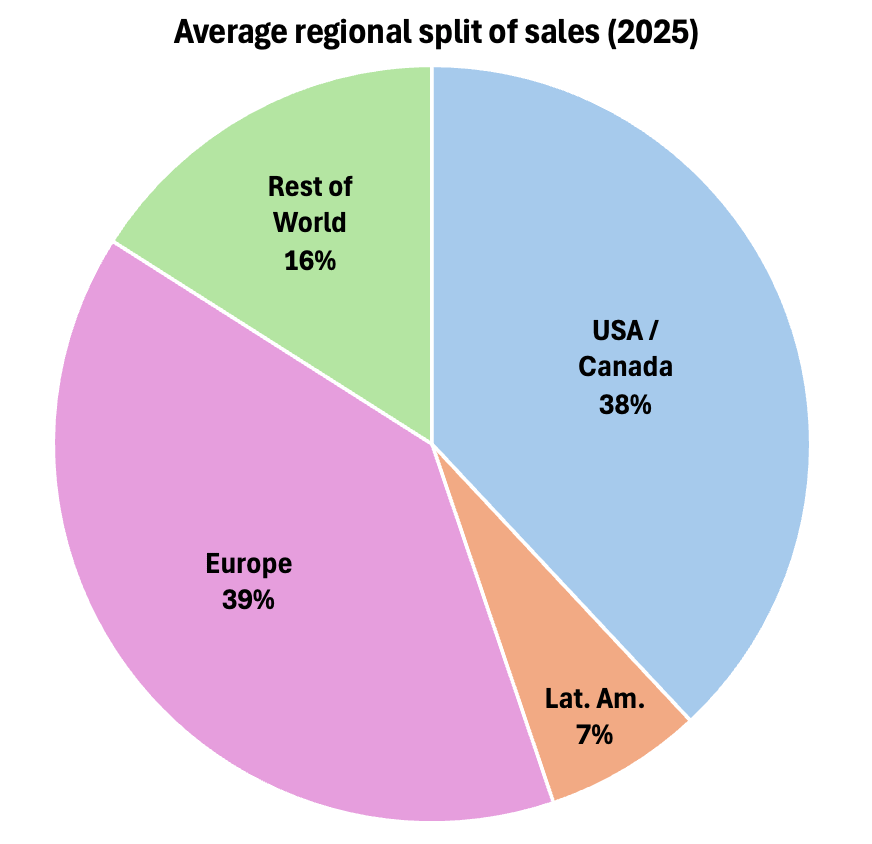
All of my chosen five are headquartered in Europe - mainly for valuation reasons - but have operations spanning much of the globe. For example, I estimate that an average 38% of their top-line sales come from the USA (mostly) and Canada. I’ve deliberately avoided companies with large exposure to China, due to the geopolitical risk for investors.
The main stock listings are in four different European countries, but all of the stocks can be traded easily in the US market. (For those investors with brokers that haven’t yet discovered the rest of the world.)
Before getting into the details, let’s cover some basics.
The following is what I believe fits the bill. Quality stocks should have a strong combination of the following attributes:
A long track record of past performance. Some have been around for decades, others for centuries.
Companies with relatively stable businesses in all economic conditions, with significant moats (barriers to entry by competitors), and a high probability of staying power that will last decades into the future.
Specialisation in a group of similar businesses where the individual company has true expertise and competitive advantages (as opposed to unfocused conglomerates).
Diversification of operations across many countries or regions (usually).
Among the market leaders in their business sector, even if in a very specialised niche. This gives them sustainable competitive advantage and pricing power.
Strong balance sheets, where some debt is okay (due to the business stability), but excessive debt should be avoided.
Attractive and stable profit margins (gross, operating, pre-tax, post-tax).
High cash flow conversion (percentage of reported profits showing up in net cash generation), resulting in strong free cash flow (FCF) to cover dividend payments and/or stock buybacks. Combined with the business stability this reduces the likelihood of dividend cuts at any time (such as during recessions), when weaker companies are most likely to be reining in payments.
Room to expand the business further in future, meaning growth of sales and profits ahead of inflation over time.
Consistent and attractive returns on capital (teens or above), allowing for attractive returns on new growth investments. (As opposed to growth investments at poor rates of return, which represent money down the drain.)
Competent and sensible management that isn’t going to destroy the business. Examples of irresponsible management include pursuing huge corporate acquisitions that are funded with new debt, borrowing to fund stock buybacks at high prices, or engaging in politicised wokery pokery that alienates large numbers of core customers.
Ideally, the businesses are relatively immune from government meddling (e.g. price controls). Where there is exposure, they should be widely diversified across many jurisdictions.
Note that the concept of “quality” is somewhat flexible, and others will have different definitions. The above is mine.
Also be careful of being enticed into supposed “quality” or “quality factor” investment funds (for those that don’t want to pick individual stocks).
I looked at a $5.6 billion “quality factor” fund recently, from a major fund manager. The name suggests that it would be full of quality companies. But 7 of the top 10 investments were technology stocks, which almost certainly fail my criteria on many points (e.g. the high risk of core products becoming obsolete).
Scanning the top 50 or so investments I also saw mining companies, oil & gas drillers, investment firms, utilities, cyclical industrials, pharmaceuticals, and so on. None of those deserve the “quality” moniker, in my opinion.
This is a classic example of mission creep within the investment industry, or even deceptive sales practices.
I’d also rule out banks from the quality bucket. Their profits tend to collapse during recessions, as they take hits from bad loan write-offs. And if they get into real trouble then they have to issue loads of new equity capital, which dilutes existing shareholders. Just because many banks have been around for hundreds of years doesn’t make them quality stocks.
The right quality stock could be something that you own for decades, or even for life. Building a portfolio of them at the right prices thus leaves little more work to do later, if you feel so inclined.
Except perhaps trimming positions a little if prices get too high, or adding more if prices are dragged too low by temporary factors, such as a slightly disappointing annual profit that is unlikely to repeat, or a general stock market crash.
You can also use quality stocks as a good, solid core for any stock portfolio. You can then add around the edges some exciting high-growth stocks, or more opportunistic, shorter-term investments (e.g. temporary deep value, turnarounds, tactical commodity plays), or stocks with higher dividend yields.
If you take a long-term view, and don’t overpay, quality stocks are a relatively low-risk type of stock market investment. There is high probability that the underlying businesses will still be there decades ahead, and will have grown in the size and scope of their operations. Add in dividend income and any (net) stock buybacks and they can be a compelling way to steadily compound wealth over the long run.
Because quality companies tend to be large and well-known, it’s relatively rare that you can buy their stocks at extremely cheap prices relative to fair value. These are the sorts of stocks that are widely analysed and held by big investment institutions that appreciate predictability.
Assuming they are bought at fair value, typical return expectations are likely to be in low double-digit percentages, say 10-12% a year. That’s from the combination of per-sharegrowth and dividend income. A total return of 10% a year means an initial investment would double in value after about seven years, with compounding. That is an attractive outcome, but requires patience.
(For more about compounding, doubling times, and the very useful “rule of 70” see Chapter 4 of my “book-in-progress”: Part 1 here and Part II here.)
By fair value I mean that the valuation ratios - such as price-to-earnings (P/E) or price-to-free cash flow (P/FCF) - are about right at the time of purchase. This means changes to those ratios won’t have much effect on investors’ results over the very long term (i.e. they might go up and down somewhat, but will tend to mean revert to fair value over time).
That said, if you can buy quality stocks when they’re on the cheap side, then there’s potential to boost returns, especially in the initial years of ownership. If the margin of safety (gap between higher fair value and lower market price) is 15%, then the upside to fair value is 17.6% (since 100% divided by 85% equals 117.6%).
Assuming that discount narrows to zero over, say, five years - with the price climbing to fair value - then the result would be an additional compound 3.3% a year. A stock that offers 10-12% at an unchanged P/E (or P/FCF) ratio could now return around 13-15% a year, for a while at least. That prospect is highly attractive. A compound return of 15% a year will double an investment in five years.
Now let’s start looking at the five specific companies that I’ll summarise today.
The five companies that I’ve chosen operate in five completely different business sectors. These are:
Building access (electronic and physical locks, security doors, etc.)
Alcoholic beverages
Branded food & non-alcoholic drinks
Specialised data & analysis
Infrastructure (toll roads, airports, railroads etc., energy, construction)
All five companies are global market leaders in their sectors.
The largest market capitalisation is currently $265 billion and the smallest is $38 billion. The mean (average) is $96 billion and the median (middle) is $57 billion.
All the companies have diversified businesses across countries and regions. I have looked at where they generated revenues during 2025. The average split is shown in the following pie chart.
Sources: company annual reports, OfWealth
“Rest of World” includes Asia Pacific, Africa and the Middle East. Africa & the Middle East is estimated at 3.6%. I estimate that Greater China (People’s Republic, Taiwan, Hong Kong) averages just 2.5%. That leaves 9.9% widely spread across the rest the vast Asia Pacific region (e.g. Japan, Australia, India, Indonesia and so forth).
Europe is 39%, of which the UK is 9%. But this total is skewed upwards by one company with large operations in France. Excluding that company, the average for Europe reduces to 29%, and USA/Canada increases to 46%. Remember that Europe includes everything from Norway to Italy, from Portugal to Poland, from Ireland to Greece. It’s a very diversified region in its own right.
Two companies generate over half of their sales in USA / Canada, despite them both being headquartered in European countries.
For the group, I estimate that average future per share growth should be about 9% a year. That includes the effect of net stock buybacks in two of the companies, with potential for another two companies to reintroduce them in coming years. The approximate average amounts of underlying growth and net buybacks are 8% and 1% respectively. (And I believe that I’ve used relatively conservative assumptions for both.)
Meanwhile, the estimated dividend yield is a little below 3% on average, and that is net of maximum rates of local withholding tax (WHT) levied on dividends in the home countries of three of the companies.
In reality, lower WHT rates may be available where tax treaties exist with investors’ countries of residence. Or it may be possible to deduct the WHT paid overseas from local income tax liabilities (further details below).
The combination of growth and income is therefore estimated to come to around 12% a year, averaged across the five companies. That would be the annual rate of return if valuation ratios remain constant in future. In the real world they will go up or down over time, but I believe that all these stocks are currently priced slightly below fair value.
With that broad overview, let’s now get into some specifics.
Dividend withholding tax (WHT) is an income tax levied at source by many countries. If a company is incorporated in one of those countries, then the tax is deducted automatically before investors receive the cash payments.
Put simply, it’s a pain in the neck. But it’s not necessarily a good reason to avoid all stocks in countries with WHT.
The investment case can still be strong on a total returns basis, such as when the stock is priced very cheaply - meaning there’s a lot of potential upside - or where per-share growth prospects are sufficiently attractive.
Some companies in high-WHT countries deliberately tilt away from dividends and towards stock buybacks, to reduce the effect of WHT on their overseas investors.
The UK has a zero rate of WHT. As best I can tell, the US has a 30% rate, although this is reduced to 15% for residents of countries with appropriate tax treaties (such as the UK). But you should always check such things with a professional tax advisor if in doubt. (I am not one of those.)
Three of the stocks covered today are potentially affected by WHT. Sweden has a 30% rate, Switzerland has a 35% rate, and France has a 12.8% rate, as far as I can tell.
Sometimes, where double-tax treaties exist between countries, WHT payments can be deducted directly from local income taxes due. For example, this UK government pageindicates that Swedish dividend WHT is deductible from UK income taxes.
In other instances, it may be possible to reclaim WHT deductions directly from a foreign government. But this involves form filling. Thus it only may be worth the hassle (time and effort) or cost (e.g. fees paid to an accountant) for very large investments.
The situation will vary depending on where a company is based and where the investor is resident for tax purposes. If in doubt, check the treatment of foreign WHT where you live.
For the purposes of this analysis I’ve assumed maximum rates of WHT apply, to be on the conservative side. But the actual situation may be less onerous for many investors.
Whenever investing in stocks of companies that are headquartered outside your home country it’s a good idea to check whether WHT applies, and whether it can be reclaimed or offset against local income taxes.
WHT is an irritant, but it only has a big effect on investment decisions for foreign companies with high dividend yields (e.g. greater than 5%). Other factors such as growth, buybacks, and value are usually more important.
The companies I’ll look at today are the following:
Comments
Nothing yet. Say the first thing.
Sign in to join the conversation.