
These two poems—one tiny, one supersized—were inspired by what I saw (and didn't!) in the 5th- and 6th-century mosaics of Ravenna and Classe in August 2016.
The Italian word smalti appears in both poems. It's the plural of smalto, a piece of glass in a mosaic. The more familiar Latin term tesserae (plural of tessera) is the universal term for mosaic pieces, but smalti is specific to glass or enamel pieces—including those of gold foil-backed clear glass.
Text within this block will maintain its original spacing when published
ancient
pixels'
fragile
glass
contra-
dicting
"all things
pass"
February 2025, The Asses of Parnassus
NOTES
For those readers too young to remember them, the Las Vegas performers named in Line 17 of the following poem wore flamboyant capes onstage during at least part of their musical careers:
Classical pianist Władziu Valentino Liberace (1919–1987) — cape images.
Rock and roll/country/gospel singer Elvis Presley (1935–1977) — cape images.
Funk/soul singer James Brown (1933–2006) — cape images.
• • •
• • •
Text within this block will maintain its original spacing when published
For years I’ve been your fangirl, from afar.
A hundred million smalti, sparkling gold,
cannot upstage the spectacle you are.
You’re absolutely fabulous—threefold!
You’ve stepped in sync through eras. Strutted. Strolled.
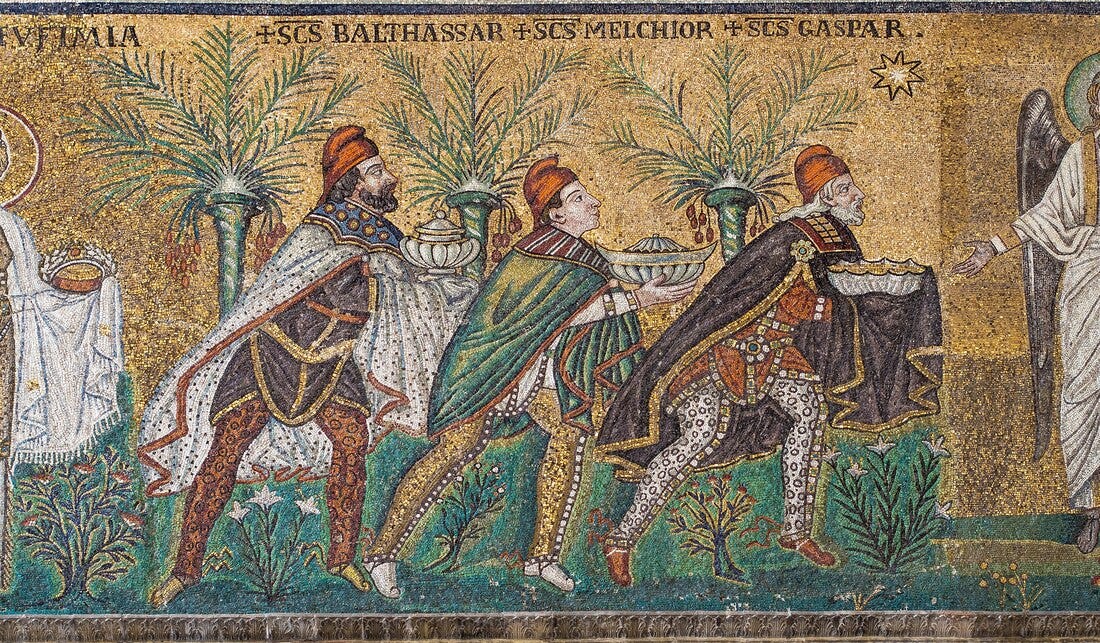
Tight pants in triple shades of leopard skin
show off the way each well-turned calf and shin
remains unique, despite same-swiveled hips.
I’d hoped to see you, live; that’s hit the bin.
Your thrills will have to be another trip’s.
Your Phrygian caps (rust-red, not cinnabar),
said “Persians!” once, though modern eyes are told
“The Smurfs!” or “Santa!”  In the repertoire
of flourishes your cape-hems have unscrolled,
one hears “Magician!”, mostly—but I’m old
enough that my pop-culture-reference din
adds “Liberace!” “Presley!” “Brown!” I grin.
Those Vegas vibes enhance, and don’t eclipse,
your splendor. Sigh. My starstruck smile turns thin.
Your thrills will have to be another trip’s.
Although I’ve failed to see you, au revoir.
Who knows how your finale might unfold?
Christ’s mother might be offered caviar
from those impressive vessels that you hold,
or Tuna à la King, glam-casseroled!
I’ll miss it. Mom is set on turning in.
Blame jet lag. (I admit, to my chagrin,
I’m sleep-starved, too.) Though FOMO whines and nips—
it knows I’ll never pass this way again—
your thrills will have to be another trip’s.
Your Majesties, please tell my friends within
the chorus line of virgin saints you spin
before (Epiphany/Apocalypse?),
“She’s sorry, but she’s short adrenaline.
Your thrills will have to be another trip’s.”
January 2025, The Ekphrastic Review
NOTES
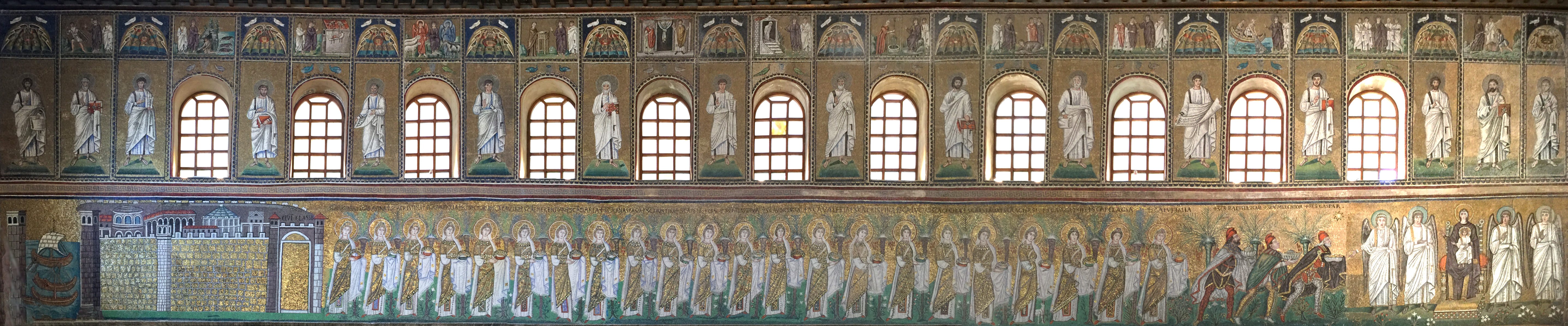
I hope that FOMO (“Fear of Missing Out”) prompts you to click on the source link in the caption of the following photo, so that you can zoom in on the “chorus line” of virgins and martyrs who follow the Three Magi in situ. Saint Agnes is the only one recognizable without a name tag, thanks to the inclusion of her usual lamb attribute (Latin agnus); that's a pun on her Greek name, hagnē (Ἁγνή), meaning “pure” or “chaste.” I've written several other poems about her depictions in art, but I didn't specifically mention her in this one.
Julie Steiner
My poem publications since July 23:
On July 25, I participated in my first-ever reading! See my terror firsthand as I present my Laureates’ Choice-winning sonnet “Anatomical Theater (1594), University of Padua)” as part of the celebration of Maria W. Faust Sonnet Contest winners. My bit starts at 33:02 of the video (I couldn't get the timestamped video link to work here).
My poem also appears on page 17 of the flipbook of contest winners. And here’s a link to a beautiful photo of the anatomical theater itself.
On August 3, I received my contributor's copy of Issue 25 of Stanford University’s Mantis: A Journal of Poetry, Criticism, and Translation. My translation of Maurice-Louis Faure's alexandrine sonnet, “The Death of the Cicada,” appears in a special section called “A Bug's Life.” (I'll wait three months and then will post the full text to the Cicadas & Other Wing-Things section of my Substack, which now has seven translations and a poem of my own.)
Forthcoming:
Blue Unicorn accepted two triolets from my “One-Sided Argument” triolet series.
The Brazen Head has accepted a three-sonnet series titled “SINE ULLA QUERELLA” (Latin for “without any complaint whatsoever”), inspired by my discussion of a memorial plaque at the Basilica of Saint Anthony of Padua with my mother as she waited for confession. (I had gone to the far-shorter line for the French-speaking priest; Mom had joined the line for the English-speaking priest after a whole busload of pilgrims from the Philippines.)
The Ekphrastic Review will reprint my sonnet “Topiary Outside the ER” on September 3. It had previously appeared on the American Arts Quarterly website in 2015, a month before the website was taken down forever. Hooray for second chances!
The New Verse News has accepted my translation of “The Egg” by Jean Amade (20 lines in alexandrine couplets) for its Winter 2027 issue.
Comments
Nothing yet. Say the first thing.
Sign in to join the conversation.