
BY TITLE • BY DATE • BY FIRST LINE
❤️ = TOP 40 FAVORITE. A poem in my personal Top 40.
📜 = SUBSTACK ARTICLE. A poem I've blathered about.
🏅 = HONORS. Prize-winner, nominee, or juried selection.
A || • Advent Carol 🏅 (common meter) • Anacreontea 34—A Little Ode to the Cicada (Ancient Greek, Pseudo-Anacreon) (Anacreontic lines) • August in Provence (French, Arène) (dizain)
B || • Big Hit (sonnet)
C || • The Catch ❤️ (tetrameter quatrain) • Choir Loft Confession (fourteeners/dipodics)
D || • “Dance, you wingèd waif…” (French, Degas) (sonnet) • The Death of the Cicada • Dies Irae ❤️ 🏅 (sonnet)
F || • Faux Pas (sonnet) • Full of Sound and Fury (fourteeners/dipodics)
H || • Harmonics ❤️ 🏅 (sonnet) • High School Drama (Deviant Ballade) ❤️ (ballade)
N || • Now Showing (sonnet)
O || • On Buoyancy (sonnet)
P || • Purple Rain 📜 (ballade)
Q || • Quick Change (Backstage at 'The Nutcracker') ❤️ (sonnet)
S || • San Diego Psalms ❤️ (blank verse) • Spoiler Alert (couplet quatrains)
T || • To the Cicada (Ancient Greek, Meleager) (elegiac couplets)
U || • Unauthorized Version ❤️ 🏅 (tetrameter quatrains)
Y || • You Win, Guys (triolet)
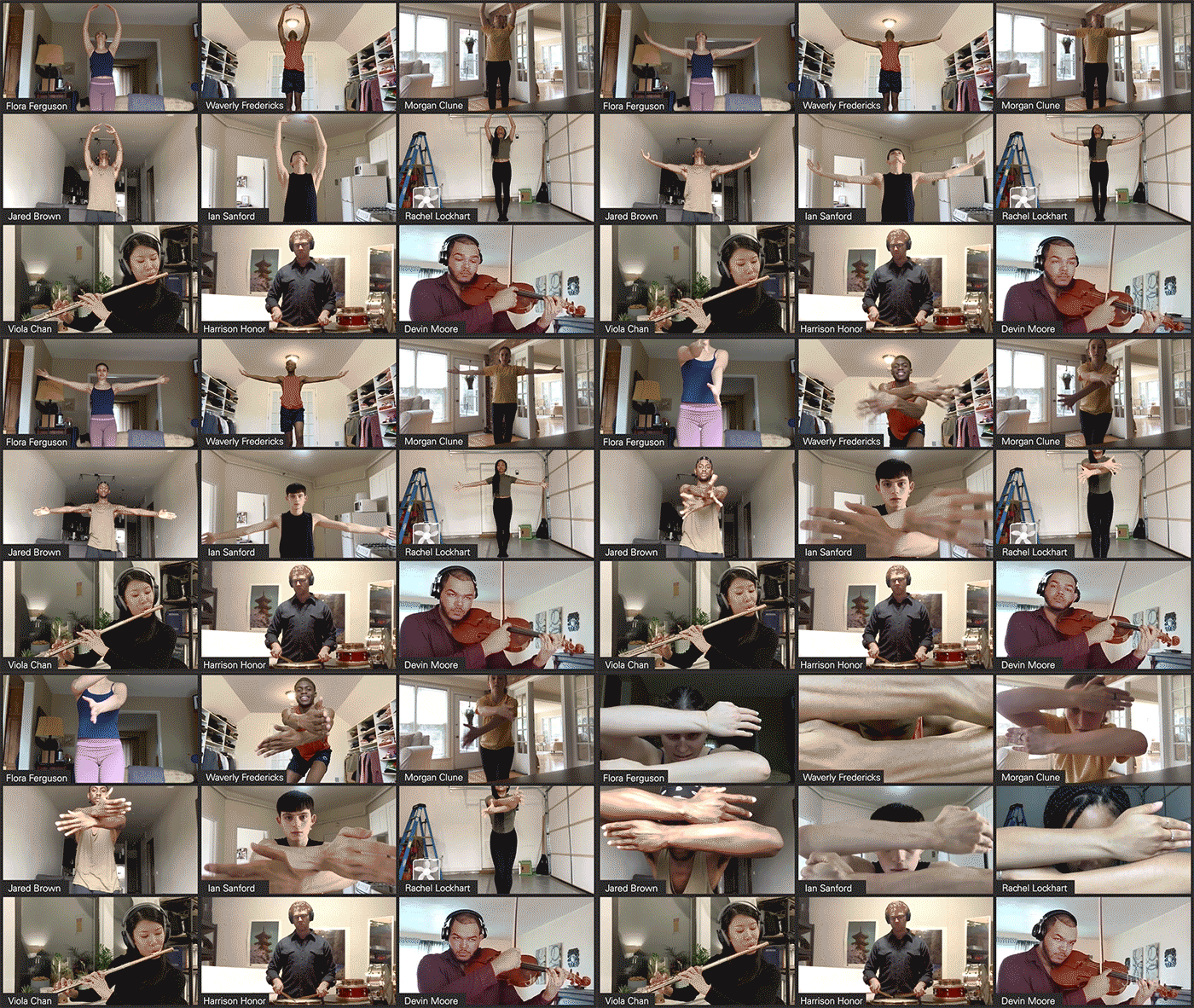
Sonnet 3 from “Variations on a Theme by Perrault”
Text within this block will maintain its original spacing when published
Prokofiev was wrong. The villain comes
without suspenseful minor chords, without
an ominous crescendo from the drums,
without French horns annihilating doubt.
The preacher hums your mother's favorite hymn.
The coach's whistle warbles—birdlike, small.
Your uncle makes his armpit fart. The grim,
suspenseful music never comes at all.
No, Peter's known the villain all along,
and that explains his tendency to roam,
not recklessness. Prokofiev was wrong.
Pete's safer in the meadow than at home
with Grandpa. Look at me. I'm living proof:
I, too, was safe, till under Grandma's roof.
October 2003, Iambs & Trochees
NOTES
• • •
Text within this block will maintain its original spacing when published
“I Sing Because I’m Happy” and “How Can I Keep from Singing?”—
O anthems of my ancestors, if only that were true.
I warble in the choir because I couldn’t keep from wringing
the necks of my descendants if we had to share a pew.
March 2005, First Things (see caveat in NOTES)
NOTES
• • •
Text within this block will maintain its original spacing when published
Hush that anguished hymn you’re humming:
	“Come, O Come, Emmanuel.”
Trumpet Christmas! Fix his coming
	firmly at “The First Nowell.”
He’s already come in glory!
	Why plead, “Savior, come at last”?
Let’s talk Christmas! Tell a story
	safely in the distant past.
Drown out John the Baptist. Edit
          out “Prepare! Make straight the way!”
Cut to Christmas! Buy on credit.
          Square things up another day.
Advent’s dreary. Let’s start living
          Christmas now! Wear red and green!
While we’re at it, skip Thanksgiving!
          Deck the halls at Halloween!
Then, when the Incarnate Verb
          overnight becomes passé,
carry Christmas to the curb.
          Pack the Prince of Peace away.
December 2009, First Things (see caveat in NOTES)
NOTES
• • •
Text within this block will maintain its original spacing when published
The oboe sighs its last insinuation.
Applause. I tense. I ought to hear her bare
feet in the hallway. Flutes start shrilling. There!
The harem-girl trots up for transformation.
I fight the hooks-and-eyes and perspiration
that hold her clothes on. Something rips. I swear.
Applause. No time. I hurriedly prepare
her tights. This music’s much too fast. Damnation!
Applause. Another song is done, and I’m
still fumbling with the buckle of her shoe!
We hoist the massive, domelike skirt in place.
I fasten it. Applause. I paint her face
with Mother Ginger’s clown-lips, just in time.
From gorgeous to grotesque, so fast.
                                                                  So true.
December 2009, Lucid Rhythms
NOTES
• • •
Text within this block will maintain its original spacing when published
“First funeral, eh? You have to disengage
emotionally. That’s the hardest thing.
You cannot sympathize. You’re paid to sing.
Don’t think, I have a nephew just this age.
Your voice will crack and warble, and you’ll bring
no comfort. Know what gets me through these? Rage.
Last night, I saw my daughter’s Facebook page...”
With that, he sets the organ thundering,
an angry father. Awesome. Awful. Wrong
for this occasion. Conversations cease.
The startled mourners wince their way to pews.
My cue. I dare to think (while staying strong,
professionally blaring words of peace),
Composure’s not the worst that we can lose.
April 2011, Measure
NOTES
• • •
Text within this block will maintain its original spacing when published
Written June 7, 2013, during live news coverage
of the Santa Monica College shootings
Four crime scenes. In the backgrounds of them all,
shell-shocked Angelenos mill like sheep.
Live coverage, as cone-shaped flowers fall
continuously. Even as we leap
from lens to lens, the blossoms seem to keep
in sync. We’re told a gunman has been downed.
Meanwhile, jacarandas gently weep
their giant purple teardrops on the ground.
A shaken student tells about her crawl
to safety, as my scalp begins to creep.
She can't describe the shooter: she stayed small
and low, behind a desk, and didn't peep.
The newsman's eyes go hard at that, and sweep
the crowd: less useless witnesses abound.
Meanwhile, jacarandas gently weep
their giant purple teardrops on the ground.
Rumors. Ruminations. Doubts. Banal
summaries “if you've just joined us.” Cheap
speculation. (Mine: Expect 'The Call'?
One victim's died in surgery—the sleep
of brain death? Hope erupts from somewhere deep.
My daughter needs a heart. I feel mine pound.)
Mean, while jacarandas gently weep
their giant purple teardrops on the ground.
I didn't sow this, Prince, but hope to reap.
Your song's I never meants, once un-profound,
mean, while jacarandas gently weep
their giant purple teardrops on the ground.
November 2014, The Rotary Dial
📜 SUBSTACK ARTICLE • NOTES
• • •
Text within this block will maintain its original spacing when published
“Hell hath no fury like a woman scorned,”
you say, as if you think those two compete.
Compared to incels scorned and packing heat,
hell hath no fury! (Like a woman? Scorned?
Express your anger—raw and unadorned—
by shooting random people in the street!)
Hell hath no fury like a woman scorned,
you say? As if! You think those two compete?
July 2015, The Rat's Ass Review
NOTES
• • •
Text within this block will maintain its original spacing when published
I died out there! you say. You mean I froze
onstage. Yes, hostile audiences daunt.
When heckling hits you like a fire hose,
the trick is to deflect it on a slant.
Self-deprecate. If anybody throws
tomatoes, wear one, clown-like, on your nose.
Dignity? The wise prefer détente.
Some things it’s just ridiculous to want.
That’s sick! you laugh. You mean My laughter shows
I’m not contaminated. Jeer and taunt
and carry on like all the other crows.
You’re carrion the moment that you don’t.
Give no one any hint you’re “one of those”
whose hearts are so delicious to expose.
Forgo the comfort of a confidant.
Some things it’s just ridiculous to want:
A shred of sympathy, however gaunt.
A flyspeck of respect. Untrodden toes.
Freedom from the fear and guilt that haunt
you always, thanks to things you never chose.
The sort of specialness that you could flaunt.
The sort of suffering you might disclose.
To be yourself, not Mr. Nonchalant.
Some things it’s just ridiculous to want.
Print slips for fortune cookies. Bold the font.
Such wisdom might be Buddha’s. Or Thoreau’s.
(In fact, concerning eros, it’s Rousseau’s.)
Some things it’s just ridiculous to want.
The repetend is a line from Rose Kelleher's “Rousseau.”
August 2015, The Quarter Day Review
NOTES
• • •
🦒 LONG POEM — 241 lines [skip]
Text within this block will maintain its original spacing when published
I see the boy from forty feet behind.
I'm standing in the back row of the choir—
an orchestra away, if I may coin
a unit of measurement—as Maestro Ling
nods, and this eleven-year-old child
rises from his chair onstage. The crowd
goes absolutely still. Two thousand people
generate a silence so intense,
it's vacuum-like. It hungers to be filled.
His tiny figure's haloed as the lights
strike his face. Of course, he cannot see
that halo; people never see their own.
The audience can't see it, either. I
imagine that, at first, they saw his suit
and thought, "A pint-sized congressman! How cute!"
or some such condescension. Maybe not.
They have their own experience of this.
I heard them laugh and murmur when he first
entered, just ahead of Master Ling,
who shook his hand. The concertmaster, too,
shook hands with him—the concertmaster who
once sang this very solo as a boy.
The audience is unaware of that;
they missed that revelation in rehearsal.
Perhaps they're less aware than we—the choir
and orchestra—that little boys grow up.
The schoolboy took his seat, and we began.
I focused on my score and Maestro Ling
and Bernstein's joyful noise, and nothing else,
until the raucous, boisterous first movement
ended with a bang, and then applause.
This audience, or some of it, at least,
does not know concert etiquette. Who cares?
They liked it, so they clapped for us. I smile.
Maestro Ling looks very happy, too.
•
Text within this block will maintain its original spacing when published
But now the crowd becomes a vast abyss
of silence. Their attention's near-ferocious.
The schoolboy stands and faces it, untrembling.
Two thousand minds are focused on one point,
like Archimedes' fabled concave mirror.
The outline of the schoolboy's head is glowing.
At least on top. At least from where I stand.
That halo is invisible to most,
yet all can sense the sacredness of this
communal concentration. No one breathes.
No one but the boy, who fills his lungs
with harp arpeggio, and then exhales
King David's lyrics: "A-do-nai ro-i."
("Lord," and then "my shepherd." There's no verb
between the two. Our minds supply the "is,"
the being. It's ontology in action.)
Then, higher, "Lo eḥ-sar." ("I shall not want.")
Two lung-shaped harps provide him with the air
he needs. He's breathing music, in and out.
Or so it seems to me, from where I stand.
He has his own experience of this.
I don't know what he's thinking, what it means
to him, to sing these syllables he's learned
by rote, by heart, meticulously; I
presume he found them meaningless at first.
I don't know what it means to him to sing
before so many strangers, and his friends.
Which group is more intimidating? I
am well aware that children can be cruel.
Their cruelty is proverbial, in fact,
though not so much as children's innocence.
That innocence, that purity of tone,
is what arrests us now—especially
those of us who do not understand
each Hebrew word he translates into song.
His nervous imperfections in rehearsal
are mostly gone tonight. A few remain.
I'm sure he's conscious of those little flaws.
How fervently I hope he also knows
how very insignificant they seem
compared to all he's getting oh-so-right.
Reality's imperfect. This is real.
•
Text within this block will maintain its original spacing when published
My cue now. We sopranos start to sing.
We make our low notes louder, high notes soft
and sweet and pure—as pure as we adults
can make them. Bernstein wrote this piece for boys
to sing with men. We women must be boys,
faux-boys, for twenty minutes, more or less.
Suddenly, the words we sing remind me:
I saw another solitary figure
from behind, before a crowd, today
in San Diego, only blocks away.
(On video, and not firsthand. But still.)
A man walked backward, several yards before
the dark-clad dozens of the riot squad.
Three members of them suddenly broke ranks
and ran to take him down. "Yea, though I walk..."
we women sing. (I see him walking backward,
holding up a sign, which they will trample.)
"...through the valley of the shadow..." (Through
a tall-grassed gully in a median,
lined on either side with more police,
like human walls, in blue that's nearly black.)
"...of death..." (To some, that's pure hyperbole,
but I feel sure I'm witnessing a death:
the death of certain freedoms I hold precious.)
"...I will fear no evil," we keep singing,
"for You are with me." Then the irony
nearly makes me smile: "Your rod, your staff,
they," we emphasize, "they comfort me."
(I picture those police batons, in contrast.)
A strict authoritarian utopia
would be a comfort, I've no doubt, to many
who came to hear The Donald speak today.
"The Lord['s] my shepherd," though, I quietly
insist, with all the women of the choir.
Although I've no idea what they're thinking—
they have their own experience of this—
I want to claim this solidarity.
I want a lot of things I do not have.
Then "lo eḥ-sar" again. ("I shall not want.")
•
Text within this block will maintain its original spacing when published
That vow gets interrupted. Human nature
pines for power, aches to be important,
longs to feel superior to others
(morally or not), to harbor grudges,
to smite the ones we hate and call it justice.
The tenors and the basses—rival gangs
from West Side Story now—spit out Psalm Four,
a psalm of lamentation and aggression.
My right ear's ringing: one percussionist
(of many) punctuates their violence
with something loud and wooden, called a whip.
The tenors' and the basses' vicious quarrel
rages on for pages of the score.
How relevant this seems. Just hours ago,
just blocks from here, two other rival groups
were shouting at each other. Tempers flared.
With bad behavior taking place on both
the pro- and anti- sides, a witness claimed
some acts of violence performed themselves:
"Slurs were flung, and water bottles, too."
"Arrests were made," a city spokesman said,
unblamingly. Passivity absolves.
But placing blame's not always helpful, either.
The schoolboy and the women sang of peace;
then warlike men burst in to mess things up.
That seems a tempting paraphrase of this
part of Bernstein's music, but it's far
from accurate. (For one thing, we're not women
now; we're boys.) Of course I'd like to think
the group I'm in is innocent and pure
and on the path of righteousness. Of course
I'd like to say testosterone's the problem.
I can't, though. As I child, I teased a classmate
till she attempted suicide. I know
that innocence and ignorance can be
almost indistinguishable, sometimes.
Men have no monopoly on evil.
We altos and sopranos start to prove it.
We blithely boast of dining in the presence
of those who wish us ill—presumably
to make them eat their hearts out while we feast.
The tenors and the basses go on grumbling;
we celebrate. Our cup is overflowing.
Our childlike trust in God has now become
childishness—a spiteful sort of glee.
Our God provides for us, and not for you.
You don't deserve the blessings we enjoy.
This attitude of smugness isn't David's.
It isn't even Bernstein's, who has written
this part with such simplicity. I know
this misinterpretation is in tune
with neither, and is only in my head.
It's there because so often nowadays
I hear that sort of willful ignorance
of others' wants and needs and grievances—
some of them legitimate. I think of
the rancor flung at refugees this year.
Reality's imperfect. This is real.
This selfishness is who we are, at times.
"Ach, ach, tov," the schoolboy now asserts:
"Ah, ah, goodness—tov va-ḥe-sed—goodness
and mercy" (to be passed along to others,
I'd like to think, not hoarded for ourselves),
"may they pursue me all the days of my life,
that I may dwell in the house of the Lord forever."
We notarize this statement with the stamps
A-do-nai ro-i and lo eḥ-sar.
The orchestra won't let the men's objections
rest, though. It keeps quietly complaining
beneath our would-be-tranquil final note.
It's hard to hold that held-out A on pitch.
Reality's imperfect. This is real.
•
Text within this block will maintain its original spacing when published
The movement ends, to thunderous applause.
The schoolboy sits. I don't know what he's feeling.
He has his own experience of this.
The third and final movement now begins
in agony—a mockery of joy.
The strings are screaming dissonantly, weeping
the same motif we singers had proclaimed
so jauntily to start the suite. A trumpet
sadly echoes what the schoolboy sang:
"Ach, ach, tov" and "tov va-ḥe-sed"—though
it's anything but tov, from my perspective.
I try to weigh that goodness and that mercy
against the Holocaust. And Hiroshima.
Just yesterday, our president acknowledged
what happened there to non-combatants. Children.
The trumpet seems bewildered, not ironic.
•
Text within this block will maintain its original spacing when published
But out of such catastrophe and grief,
the gentle harps awaken. Now the men,
in unison, and legatissimo,
embark on Psalm One Hundred Thirty-One.
Their tenderness and strength unite in ways
appropriate for men. They're neither women
nor children. They're exactly who they are,
and beautiful in that identity.
We women join them, eager to reclaim
a toddler's sense of trust and comfort, lost
in harshness of experience. We sing
together for a while, then soloists
express more individuality.
The orchestra supports them as they float.
And finally the instruments drop out
entirely. The choir is on our own,
levitating—nothing holds us up—
singing pianiss-iss-iss-imo
(yes, four p's): miraculously tiny.
I don't think I can manage it, but do.
My note's so high, yet somehow kept within
the finely-woven fabric of the choir,
so delicate and seamless, top to bottom,
diaphanous and shimmering like silk,
hovering like magic in midair.
"Behold," we sing, we conjurers. We've switched
the psalm on them. "Ma tov—how good [it is]"
(the Being's just implied, again) "and how
pleasant [it is], when brethren dwell united."
To this we sing Amen. The trumpet quotes
the five-note theme that started all of this
across our final word. Maestro Ling
holds it out impossibly, and then
releases it to heaven with his wrist.
Nothing moves. Maestro looks ecstatic.
The crowd's been rendered breathless once again.
Then Maestro blows a kiss to us. Applause.
June 2016, The New Verse News
NOTES
• • •
Text within this block will maintain its original spacing when published
Titanic sinks. His girl was born a guy.
Romeo and Juliet both die.
So do Butch and Sundance, Bonnie and Clyde,
Thelma and Louise, and Jekyll and Hyde.
Private Ryan’s saved, and Nemo’s found.
The cowboy rides the A-bomb to the ground.
Little Sheba, Jimmy Dean, and Shane
do not come back. The narrator’s insane.
The girl’s her sister. And her daughter, too.
He’s his murderous mother. Scout meets Boo.
In everything but Triumph of the Will,
the Nazis lose. Tomorrow comes, for Phil.
He’s Vader’s son. He’s Santa Claus. He’s dead.
She just keeps walking. Rosebud is a sled.
Romeo and Juliet both die.
And someday, so do you. And so do I.
July 2016, Light
NOTES
• • •
Text within this block will maintain its original spacing when published
          This dance ain’t for everybody
          Only the sexy people
               —“Push It,” Salt-N-Pepa, 1987
I should have known she’d cue the birthday stripper
to rip his shirt off right in front of me.
I should have known he’d stay to drag his zipper
down, down, down, and pulse his pelvis free.
I should have known I should have blushed. I should
have known his muscles should have made me melt.
I should have known she’d hoped to have a good
laugh at the dismay I should have felt.
Her “Julie, whatcha think?” meant of his peeling,
I should have recognized, and played along.
I might have lived it down if I’d gone reeling
in shock and shame when forced to face his thong.
But I became a legend by revealing
my cluelessness: “I think I hate this song.”
July 2019, Light
NOTES
• • •
Text within this block will maintain its original spacing when published
I am the very model of an up-in-arms conservative.
Whatever packs my noggin has been pickled in preservative.
Since all that I was taught was free of flaw or superfluity,
It ought to be imparted to the young in perpetuity.
They ought to know that Hamlet was a Dane and not a Hollander.
The quality of mercy isn’t filtered through a colander.
I get so apoplectic that I almost need a coroner
When canons must accommodate the female and the foreigner.
Though one cannot expect of these the glories educational
I reached myself, consider this: unless their generation’ll
Pick up on the allusions that I drop with such authority,
However will they recognize my own superiority?
When I catch wind that, near or far, some expert pedagogical
Has dared to call unquestioning Bardolatry illogical,
Opining Shakespeare’s pedestal should alter by a particle,
I savage “cancel culture” (though I haven’t read the article).
March 2021, Light
NOTES
• • •
Text within this block will maintain its original spacing when published
Look for the helpers, Mister Rogers said.
Whenever you feel sad or scared about
the news, look for the people helping out.
Keep those within your sight. Your heart. Your head.
It’s good advice. On days when all I’ve read
puts basic human decency in doubt,
and all I’ve heard’s what hurtful people shout,
I try to find the helpful ones instead.
But what about when all that’s in the frame
is evidence that helpers never came?
Two long, light-gray balloons, like downturned lips,
say several states withheld their rescue ships.
No helpers in the picture. Not this time.
But we can help bear witness to this crime.
May 2021, The New Verse News
NOTES
• • •
Text within this block will maintain its original spacing when published
“There is no sorrow, pain, or woe…
no suffering He did not know,”
we used to sing. That’s how I knew
the Christ Child was molested, too.
Confused, afraid, and mortified,
He told His mom—who said He lied.
Since mine refused to understand,
I knew He’d known that, too, firsthand.
Each time He said or acted out
what children shouldn’t know about,
she spanked the young Emmanuel
and told Him He was bound for Hell.
That filthy-minded, foul-mouthed kid
reformed, because of what she did.
For decades, she’d congratulate
herself for having laced Him strait.
“I disciplined Him out of it,”
that saint would brag, while He’d just sit—
impassive, passive—and endure
her calling clobbering a cure.
(What “cured” us was we’d moved away
from those who’d made us frequent prey
on seeing no one took our word
for anything we said occurred.)
The current lyrics for that hymn
leave nothing fuzzy, nothing dim,
and nothing to be taken wrong
by snarky teens, who’d say the song
skipped birth pangs, menstrual cramps, and such.
But how I’d sung it was as much
support as victims might derive
back then, for having dared survive.
Let others sing the new, improved,
and ambiguity-removed
text. I can’t. I can’t unknow
the words I needed, long ago.
March 2024, The New Verse News
NOTES
• • •
From the French of Sonnet IV, 1904 version, by Edgar Degas (France, 1834–1917)
Text within this block will maintain its original spacing when published
Dance, you wingèd waif, across these wood-floored meadows. Your skinny arm, when placed in line with strict tradition, connects your weight with flight, to balance those, to wed those. I wish you—I, who know!— a life of recognition. Graces, Nymphs, come down from legend’s lofty shadows; Taglioni, too— Arcadia’s princess. Listen: exalt and train (while chuckling at) my choice for kudos— this little presence, new, of plucky disposition. Montmartre gave to her both cockiness and kin, and Roxelana, nose, and China, eyes; but in your own turn, Ariel, now give to this recruit your lightness, day and night, your lightness on your feet... But still let—to my taste!— her wine smell like her fruit, keeping, in golden courts, the vintage of her street.
•
Text within this block will maintain its original spacing when published
Danse, gamin ailé, sur les gazons de bois.
Ton bras maigre, placé dans la ligne suivie
Equilibre, balance et ton vol et ton poids.
Je te veux, moi qui sais, une célèbre vie.
Nymphes, Grâces, venez des cimes d’autrefois ;
Taglioni, venez, princesse d’Arcadie,
Ennoblir et former, souriant de mon choix,
Ce petit être neuf, à la mine hardie.
Si Montmartre a donné l’esprit et les aïeux
Roselane le nez et la Chine les yeux,
A ton tour, Ariel, donne à cette recrue
Tes pas légers de jour, tes pas légers de nuit…
Mais, pour mon gout connu ! Qu’elle sente son fruit
Et garde aux palais d’or la race de sa rue.
March 2025, The Ekphrastic Review
NOTES
• • •
From the Greek of Meleager of Gadara (1st Century BCE)
Text within this block will maintain its original spacing when published
Echo-producing cicada, you make yourself tipsy on dewdrops,
          belting your back-country song; wilderness warbles along.
Perching up high in the leaves with your serrated legs, you play music—
          brown (as if toasted by fire) skin making sounds like a lyre.
Go and perform some new melody, though, for the Nymphs of the wood, dear.
          Partner with pipe-playing Pan, thereby permitting my plan:
briefly escaping from Eros, I’ll slip into slumber at midday,
          taking my ease where I’ve stayed — under your sycamore’s shade.
•
Text within this block will maintain its original spacing when published
Ἀχήεις τέττιξ, δροσεραῖς σταγόνεσσι μεθυσθείς,
          ἀγρονόμαν μέλπεις μοῦσαν ἐρημολάλον·
ἄκρα δ᾽ ἐφεζόμενος πετάλοις πριονώδεσι κώλοις
          αἰθίοπι κλάζεις χρωτὶ μέλισμα λύρας.
ἀλλά, φίλος, φθέγγου τι νέον δενδρώδεσι Νύμφαις
          παίγνιον, ἀντῳδὸν Πανὶ κρέκων κέλαδον,
ὄφρα φυγὼν τὸν Ἔρωτα μεσημβρινὸν ὕπνον ἀγρεύσω,
          ἐνθάδ᾽ ὑπὸ σκιερῇ κεκλιμένος πλατάνῳ.
August 2025, Literary Matters
NOTES
• • •
From the Greek of an Unknown Author (1st Century BCE–6th Century CE),
in imitation of Anacreon (ca. 573–ca. 495 BCE)
Text within this block will maintain its original spacing when published
Cicada, “blest” we title you,
for when you’ve drunk a little dew
in treetop heights, the way you sing
is reminiscent of a king.
          +14 lines — remainder of translation redacted, due to publication agreement.
          I have a limited number of PDF offprints to share, if you’d like to request one.
•
Text within this block will maintain its original spacing when published
Μακαρίζομέν σε, τέττιξ,
ὅτε δενδρέων ἐπ’ ἄκρων
ὀλίγην δρόσον πεπωκώς
βασιλεὺς ὅπως ἀείδεις.
σὰ γάρ ἐστι κεῖνα πάντα,
ὁπόσα βλέπεις ἐν ἀγροῖς,
ὁπόσ’ αὖ φέρουσιν ὗλαι.
σὺ γὰρ εἶ φίλος γεωργοῖς,
ἀπὸ μηδενός τι βλάπτων·
σὺ δὲ τίμιος βροτοῖσιν,
θέρεος γλυκὺς προφήτης.
φιλέουσι μέν σε Μοῦσαι,
φιλέει δὲ Φοῖβος αὐτός,
λιγυρὴν δ’ ἔδωκεν οἴμην·
τὸ δὲ γῆρας οὔ σε τείρει.
σοφέ, γηγενής, φίλυμνε,
ἀπαθής, ἀναιμόσαρκε·
σχεδὸν εἶ θεοῖς ὅμοιος.
March 2026, The Classical Outlook
NOTES
• • •
From the French of Paul Arène (1843–1896)
Text within this block will maintain its original spacing when published
The air’s so hot that the cicada
(poor cicada, having made a
frugal hobby of her singing)
stops her wobbly ditty’s ringing,
now no more its sounds’ parader.
          +5 lines — remainder of translation redacted, due to publication agreement.
          I have a limited number of PDF offprints to share, if you’d like to request one.
•
Text within this block will maintain its original spacing when published
L’air est si chaud que la cigale
La pauvre cigale frugale
Qui se régale de chansons,
Ne fait plus entendre les sons
De sa chansonnette inégale:
Et, rêvant qu’elle agite encor
Ses petits tambourins de fée,
Sur l’écorce des pins, chauffée,
Où pleure une résine d’or,
Ivre de soleil elle dort.
March 2026, The Classical Outlook
NOTES
• • •
For additional cicada-themed poems, please see:
Index to My Poems about Cicadas & Other Wing-Things.
Text within this block will maintain its original spacing when published
"Peace on earth..." the angels start,
and optimism fills my heart.
But then my hopes for peace diminish:
"...to people of goodwill," they finish.
June 2026, The Asses of Parnassus
NOTES
• • •
Text within this block will maintain its original spacing when published
Vasquez Rocks — my stomping grounds, third grade
until I left for college — got destroyed
as Star Trek’s Planet Vulcan, years ago.
     [+9 lines]
Remainder redacted until one month post-publication.
July 2026, Elsewhere: A Journal of Place
NOTES
• • •
(The Band Perry, 2010)
Text within this block will maintain its original spacing when published
“If I die young,” the country smash begins,
oblivious to the fact it’s being played
within a children’s hospital. [...]
     [+12.2 lines]
Remainder redacted until one month post-publication.
July 2026, Elsewhere: A Journal of Place
NOTES
• • •
From the French of Maurice-Louis Faure (1850–1919)
Text within this block will maintain its original spacing when published
While, bobbing on the plain,   the blond wheat’s ripened ears
bow, burdened, underneath   the giant, sleeping sky,
and seem to make it known   how close the hour appears
when waves of gold, turned grains,   will fully liquefy...
          +10 lines—remainder redacted until three months post-publication.
•
Text within this block will maintain its original spacing when published
Quand les blonds épis mûrs ondoyant dans la plaine
S’inclinent accablés sous le grand ciel dormant
Et semblent annoncer qu’elle n’est plus lointaine
L’heure où ruisselleront les flots d’or du froment,
Comme des condamnés, offrant leur tête pleine
De l’espoir des hivers, un seul enchantement
Les berce dans l’oubli de la moisson prochaine.
Le blé qui va mourir écoute vaguement
La cigale entonnant ses notes frémissantes.
Voici les moissonneurs! Leurs faucilles grinçantes
Abattant les épis découronnent l’été
Et fidèle au destin des blés, triste, muette,
La cigale s’endort, comme meurt un poète,
Lasse d’avoir vécu, fière d’avoir chanté!
August 2026, Mantis: A Journal of Poetry, Criticism, & Translation
NOTES
• • •
| A |
• The air’s so hot that the cicada
| C |
• Cicada, “blest” we title you,
| D |
• Dance, you wingèd waif, across these wood-floored meadows.
| E |
• Echo-producing cicada, you make yourself tipsy on dewdrops,
| F |
• “First funeral, eh? You have to disengage / emotionally. […]”
• Four crime scenes. In the backgrounds of them all,
| H |
• Hush that anguished hymn you’re humming:
| I |
• I am the very model of an up-in-arms conservative.
• ’I died out there!’ you say. You mean ‘I froze […]’
• I see the boy from forty feet behind.
• I should have known she’d cue the birthday stripper
• “I Sing Because I’m Happy” and “How Can I Keep from Singing?”—
• “If I die young,” the country smash begins,
| L |
• Look for the helpers, Mister Rogers said.
| O |
• The oboe sighs its last insinuation.
| P |
• “Peace on earth,” the angels start,
• Prokofiev was wrong. The villain comes
| T |
• ”There is no sorrow, pain, or woe, / no suffering He did not know,”
• Titanic sinks. The femme fatale’s a guy.
| V |
• Vasquez Rocks — my stomping grounds, third grade / until I left for college —
| W |
• While, bobbing on the plain, the blond wheat’s ripened ears
Comments
Nothing yet. Say the first thing.
Sign in to join the conversation.