
ANNOTATIONS—ALPHA LISTS
ANNOTATIONS—BY CHRONOLOGICAL SECTION:
(2003–2015) || (2016–2025) || (2026– )
• • •
This poem's FULL TEXT appears in the following indices:
SPECIAL: • ❤️ TOP 40 FAVORITES
TOPICS: • Faith, Ethics, & Empathy • Language & Literature
ACKNOWLEDGMENTS
First published: Jan 13, 2026, in Pulsebeat Poetry Journal.
Republished, with commentary: Mar 21, 2026, in Form in Formless Times.
TECHNICAL DETAILS
Form: ballad-stanza (4/3) octaves. Rhyme scheme: abababab cdcdcdcd efefefef […] q’r’q’r’q’r’q’r’ (22 stanzas). Meter: alternating lines of iambic tetrameter and iambic trimeter.
• • •
From the Spanish of Manuel Machado (Spain, 1874–1947)
This poem's FULL TEXT appears in the following indices:
FORM: Sonnets
TOPICS: Art & Architecture • Faith, Ethics, & Empathy
ACKNOWLEDGMENTS
Translation first published: Feb 7, 2026, in The Ekphrastic Review. Several subsequent revisions on Off-Piste on Mount Parnassus.
Spanish original: Manuel Machado published this poem in his 1911 ekphrastic collection Apolo, teatro pictórico (Apollo, Pictorial Drama).
TECHNICAL DETAILS
Rhyme scheme: Shakespearean octave + Petrarchan sestet), abab cdcd efg efg.
Meter: iambic pentameter, representing Spanish hendecasyllabic verse (endecasílabo).
CONTEXT
👤 Manuel Machado (1874–1947) and his brother Antonio (1875–1939) were leading figures in the Spanish literary movement known as the Generation of ’98.
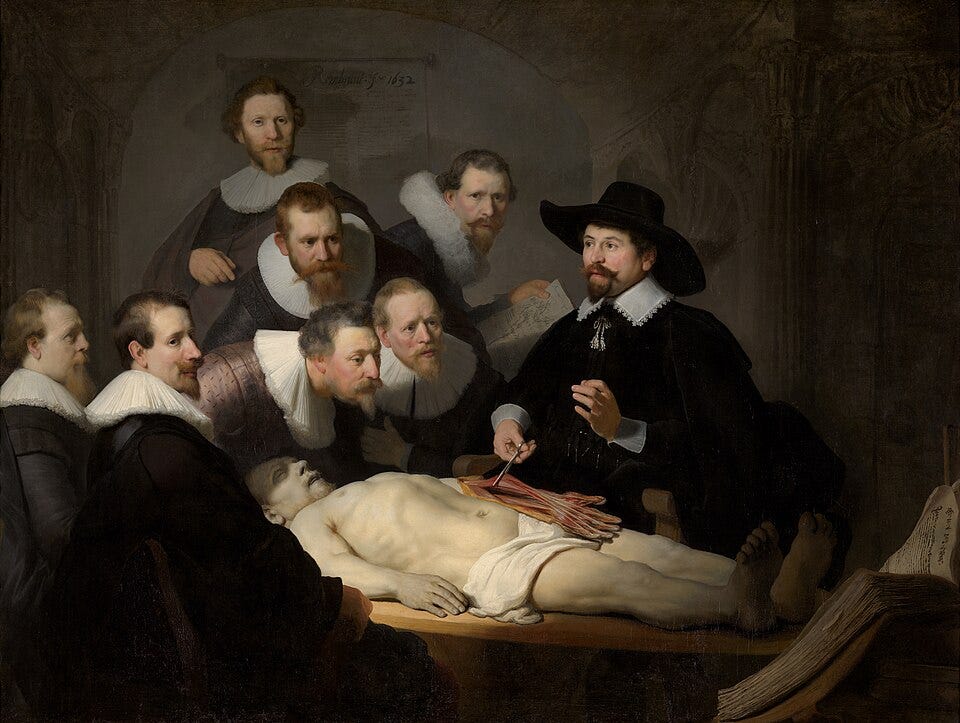
👤 Rembrandt Harmenszoon van Rijn (1606–1669) was still spelling his name “Rembrant” when he signed this 1632 painting.
IMAGES

• • •
This poem's FULL TEXT appears in the following indices:
SPECIAL: • 📜 SUBSTACK ARTICLE • ❤️ TOP 40 FAVORITES
FORM: • Repeating Forms & Other Echoes
TOPICS: • Faith, Ethics, & Empathy • Language & Literature
ACKNOWLEDGMENTS
First published: Feb 12, 2026, in The New Verse News.
Republished, with notes: August 8, 2026, as 📜 SUBSTACK ARTICLE at Off-Piste on Mount Parnassus.
TECHNICAL DETAILS
Lines: 35. Form: ballade suprème. Rhyme scheme: AbA’ abA abA’ abA abA’ abA abA’ abAA’; A and A’ are repetends that rhyme with each other. Meter: iambic pentameter.
CONTEXT
• • •
From the Spanish of José Diego (Puerto Rico, 1867–1918)
This poem's FULL TEXT appears in the following indices:
FORM: Sonnets
TOPICS: • Faith, Ethics, & Empathy • Language & Literature
ACKNOWLEDGMENTS
First published: Mar 3, 2026, in Lighten Up Online.
TECHNICAL DETAILS
Rhyme scheme: Petrarchan, abba abba cdc dcd. Meter: iambic pentameter, representing Spanish hendecasyllabic verse (endecasílabo).
CONTEXT
👤 José de Diego (1867–1918) was a poet and diplomat who advocated for Puerto Rico’s independence, first from Spain and then from the United States.
ALLUSIONS
📚 L1: Vade retro is a Latin phrase from exorcisms, quoting Jesus's rebuke to Peter at Mark 8:33, "Get thee behind me, Satan”; “retro” is also a pun on verse/reverse.
📚 LL3–4: “el dios chiquito” or “the little bitty god” refers to Amor or Cupid; Apollo is the god associated with the lyre and lyric poetry.
📚 L9: coplas are a style of Spanish-language poetry, consisting of four lines of no more than eight syllables. The rhyme scheme is either xaxb (romance, with all lines 8 syllables), xaxb (seguidilla, with lines of 7, 5, 7, and 5 syllables), or abba (redondilla, all lines 8 syllables).
• • •
From the French of Sully Prudhomme (France, 1839–1907)
This poem's FULL TEXT appears in the following indices:
FORM: Sonnets
TOPICS: Art & Architecture • Faith, Ethics, & Empathy
ACKNOWLEDGMENTS
First published: Mar 7, 2026, in The Ekphrastic Review. Slight revisions above.
TECHNICAL DETAILS
Lines: 14. Form: sonnet. Rhyme scheme: Petrarchan, abba abba ccd ede. Meter: iambic hexameter, representing French alexandrine lines. Note the strong cæsuras (pauses), either after the sixth syllable or after syllables four and eight.
CONTEXT
👤 In 1901, Sully Prudhomme (France, 1839–1907) was awarded the first-ever Nobel Prize in Literature. He had pursued engineering studies until an eye ailment forced him to change careers. That engineering background informs the language of drafting, design, and prototypes in this sonnet, which was published in his posthumous collection Épaves (i.e., Flotsam and Jetsam) in 1908.
ALLUSIONS
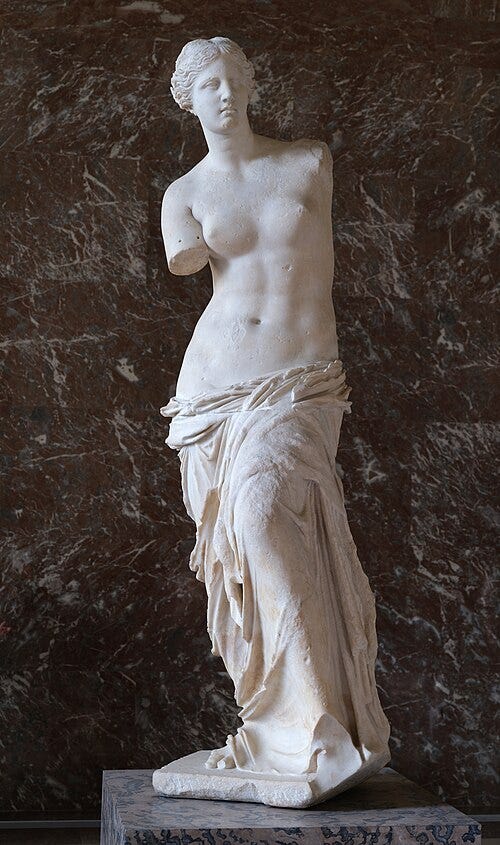
In April 1820, the Venus de Milo was discovered by a Greek farmer on the island of Milos. It was purchased by a representative of the French ambassador, and installed in the Louvre Museum in 1821. Various efforts were made to restore missing parts before the current state was arrived at.
• • •
This prose piece's PARTIAL TEXT appears in the following indices:
TOPIC: Cicadas & Other Wing-Things
ACKNOWLEDGMENTS
First published: Apr 1, 2026, in The Classical Outlook 101.1, pages 37–38. Forthcoming October 2027 in JSTOR. I have a limited number of PDF copies to share—please email me at julie.steiner.poet@gmail.com to request one.
TECHNICAL DETAILS
Form: Brief prose essay introducing my translations of four cicada-themed poems.
• • •
Verse translation from the Greek of an unknown imitator of Anacreon (Ionia and Athens, ca. 100 BCE–500 CE)
This poem's PARTIAL TEXT appears in the following indices:
TOPICS: Cicadas & Other Wing-Things • Music, Dance, Drama
ACKNOWLEDGMENTS
First published: Apr 1, 2026, in The Classical Outlook 101.1, pages 38–39. Forthcoming October 2027 in JSTOR. I have a limited number of PDF copies to share—please email me at julie.steiner.poet@gmail.com to request one.
TECHNICAL DETAILS
Lines: 18. Form: couplets (with two triplets). Rhyme scheme: aabbbccddeeffggghh; the original is unrhymed. Meter: In this translation of Anacreontea 34, English stress-based iambic tetrameter (u – u – u – u –) approximates the eight-syllable, duration-based anacreontic meter (u u – u – u – x) of the unrhymed original.
CONTEXT
👤 Anacreon, honored in later centuries as one of the nine inventors of lyric poetry, was born in Ionia (now coastal Türkiye/Turkey) around 573 BCE, and died in Athens around 495 BCE. A tenth-century CE manuscript titled Anacreontea contains some sixty poems attributed to him, including this one. Since none of these are in Anacreon’s Ionic dialect, scholars now believe that the Anacreontea poems were written by various authors between the first century BCE and the sixth century CE, in imitation of Anacreon’s usual meters and themes (i.e., wine, sexual attraction, and song).
• • •
Verse translation from the French of Jean Aicard (France, 1848–1921)
This poem's PARTIAL TEXT appears in the following indices:
FORM: Sonnets
TOPICS: • Cicadas & Other Wing-Things • Language & Literature
ACKNOWLEDGMENTS
First published: Apr 1, 2026, in The Classical Outlook 101.1, pages 39–40. Forthcoming October 2027 in JSTOR. I have a limited number of PDF copies to share—please email me at julie.steiner.poet[at]gmail[dot]com to request one.
Original: This poem appeared with no title other than the number XXI in Jean Aicard's Poèmes de Provence: Les cigales, 1874.
TECHNICAL DETAILS
Lines: 14. Form: sonnet. Rhyme scheme: couplets, aabbccddeeffgg. Meter: iambic hexameter, representing the French original's alexandrine lines.
CONTEXT
👤 Jean Aicard (1848–1921), who was elected to the Académie Française in 1909, wrote poetry in both French and Provençal / Occitan, in addition to writing novels and plays in French. He was born in the port city of Toulon in southeastern France, and in 1919 he was elected mayor of nearby Solliès-Ville, following a literary career that took him often to Marseilles and Paris. Aicard’s 1874 collection Poems of Provence: The Cicadas (Poèmes de Provence: Les cigales) contains original verse, including this sonnet in alexandrine couplets, as well as verse translations of cicada-themed poems from Greek and Provençal / Occitan.
• • •
From the French of Paul Arène (France and Mauritius, 1843–1896)
This poem's PARTIAL TEXT appears in the following indices:
ACKNOWLEDGMENTS
First published: Apr 1, 2026, in The Classical Outlook 101.1, pages 40–41. Forthcoming October 2027 in JSTOR. I have a limited number of PDF copies to share—please email me at julie.steiner.poet@gmail.com to request one.
TECHNICAL DETAILS
Lines: 10. Form: dizaine. Rhyme scheme: aabbacddcc. Meter: iambic tetrameter.
CONTEXT
👤 Paul Arène (1843-1896) of the Alpes-de-Haute-Provence region (the Alps of Upper Provence) wrote novels, poems and plays in French, as well as a volume of poetry in his native tongue, Provençal / Occitan. He was the founder and president of the Parisian chapter of the Félibrige, a society that promotes the Provençal / Occitan language and culture. One of the group’s symbols is a cicada.
• • •
From the Spanish of Salvador Rueda (Andalucía, Spain, 1857–1933)
This poem's PARTIAL TEXT appears in the following indices:
SPECIAL: • ❤️ TOP 40 FAVORITES
FORM: • Sonnets
TOPICS: • Cicadas & Other Wing-Things • Language & Literature
ACKNOWLEDGMENTS
First published: Apr 1, 2026, in The Classical Outlook 101.1, pages 40–41. Forthcoming October 2027 in JSTOR. I have a limited number of PDF copies to share—please email me at julie.steiner.poet[at]gmail[dot]com to request one.
Original: This sonnet appeared in a 1908 animal-themed pamphlet entitled The Procession of Nature (La Procesión de la naturaleza).
TECHNICAL DETAILS
Lines: 14. Form: sonnet. Rhyme scheme: Petrarchan, abba abba ccd eed. Meter: iambic pentameter, representing the original's Spanish endecasílabo (hendecasyllabic, eleven-syllable) lines.
CONTEXT
👤 Salvador Rueda (1857–1933) received seven nominations for the Nobel Prize in Literature between 1909 and 1915. Born in a small village near Málaga on southeastern Spain’s Mediterranean coast, the poet, playwright, and novelist Rueda eventually traveled throughout Latin America and to the Philippines. Rueda’s collected poems contain forty mentions of cicadas, including three poems—including this one—actually titled “The Cicada” (“La cigarra”).
• • •
This poem's FULL TEXT appears in the following indices:
TOPIC: • Faith, Ethics, & Empathy
ACKNOWLEDGMENTS
First published: May 4, 2026, in Snakeskin 339 (Short Forms Special Issue).
TECHNICAL DETAILS
Lines: 6. Form: biolet. Rhyme scheme: ABbaBA, with the capital letters indicating repetends. Meter: iambic dimeter.
• • •
This poem's FULL TEXT appears in the following indices:
TOPICS: • Faith, Ethics, & Empathy • Language & Literature
ACKNOWLEDGMENTS
First published: May 4, 2026, in Snakeskin 339 (Short Forms Special Issue).
TECHNICAL DETAILS
Lines: 10. Form: tritina. Rhyme scheme: Identity rhymes in the order ABC CAB BCA, plus a one-line envoi containing A, B, and C, in that order. Meter: iambic pentameter.
• • •
This poem's FULL TEXT appears in the following indices:
TOPIC: • Faith, Ethics, & Empathy
ACKNOWLEDGMENTS
First published: May 4, 2026, in Snakeskin 339 (Short Forms Special Issue).
TECHNICAL DETAILS
Lines: 8. Form: triolet. Rhyme scheme: ABaBbaAB, with capital letters indicating repetends. Meter: iambic tetrameter.
• • •
This poem's FULL TEXT appears in the following indices:
TOPICS: Faith, Ethics, & Empathy • Art & Architecture
ACKNOWLEDGMENTS
First published: May 14, 2026, in The Asses of Parnassus.
TECHNICAL DETAILS
Lines: 8. Form: couplets. Rhyme scheme: aa aa aa aa. Lines 3 and 7 use an identity rhyme. Meter: iambic dimeter.
ALLUSIONS
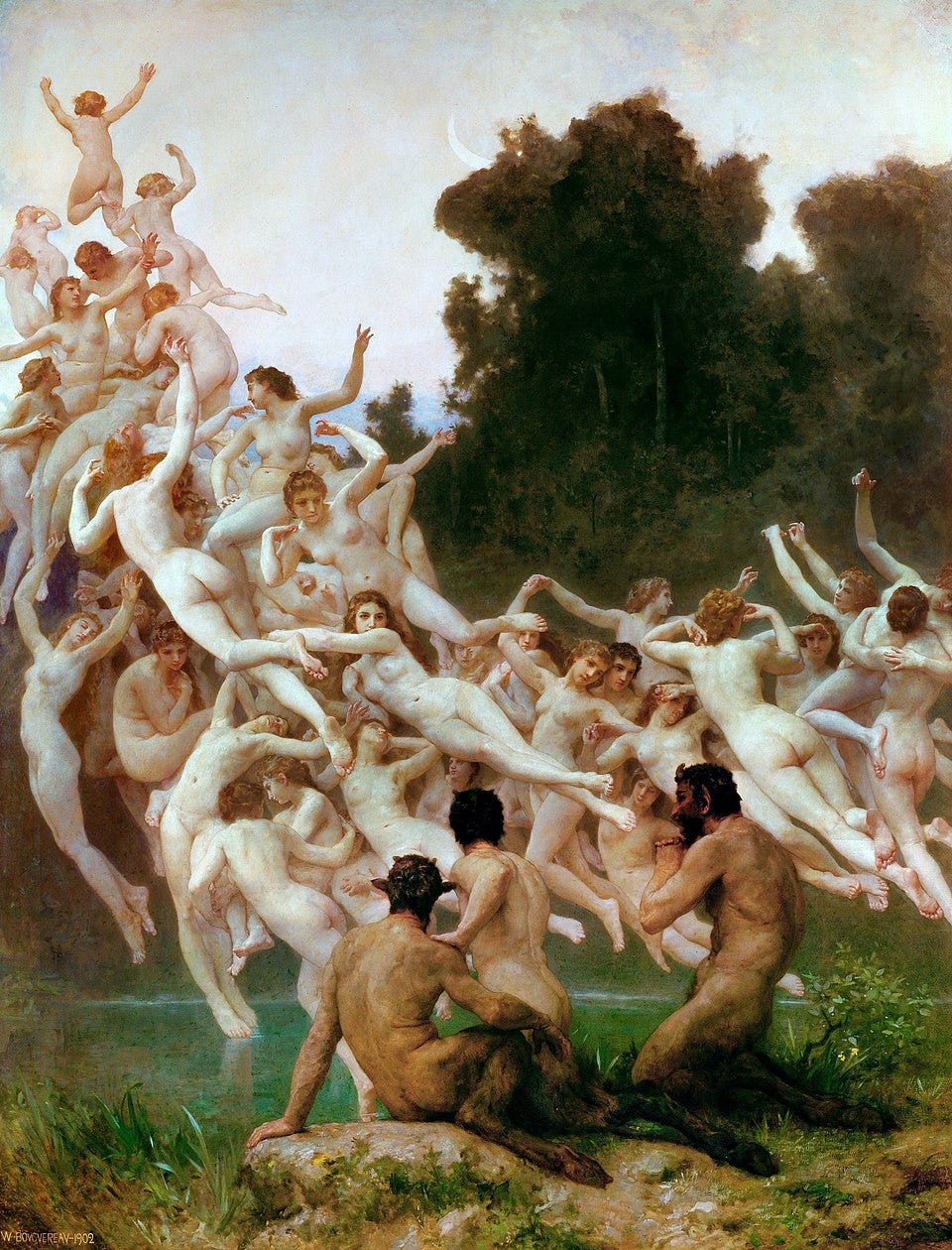
🌄 Les Oréades (The Oreads) is a 1902 oil painting by William-Adolphe Bouguereau (1825–1905).
• • •
News roundup May 1–14, 2026
This poem's FULL TEXT appears in the following indices:
TOPIC: • Faith, Ethics, & Empathy
ACKNOWLEDGMENTS
First published: May 18, 2026, in Light’s Poems of the Week feature.
TECHNICAL DETAILS
Lines: 19. Form: terzanelle. Rhyme scheme: standard (but with reversed repetends in quatrain) — ABA’ bCB cDC dED eFE fA’FA. Meter: iambic tetrameter, but with first iamb of each line headless (missing the first syllable), giving a trochaic feel.
ALLUSIONS
📰 May 1 — Trump describes cognitive test he took: ‘They say, which one is the bear?’ — Yahoo News
📰 May 1 — Poll: Trump’s Iran war reaches Iraq- and Vietnam-era disapproval levels — The Washington Post
📰 May 2 — Trump tells Congress ceasefire means he does not need their approval for Iran war — BBC
📰 May 2 — Trump says US Navy like ‘pirates’ while seizing a ship in Iranian blockade: US president says ‘we took over the cargo, took over the oil. It’s a very profitable business’ — The Guardian
📰 May 2 — Tucker Carlson cornered after denying Trump ‘Antichrist’ comment: The former Fox News host denied ever raising the idea—even when his own words were read back to him — The Daily Beast
📰 May 4 — Trump threatens to blow Iran ‘off the face of the earth’ if it attacks US vessels — The Guardian
📰 May 5 — White House insists war is over, even as missles fly — The New York Times
🎬 May 6 — [Video discussing Trump’s repeated mentions of the animals on his cognitive tests.] — The Daily Show
📰 May 7 — Trump posts chart bragging about how the Iran War is shorter (so far) than WWII or Vietnam — The Independent
📰 May 10 — Could Tucker Carlson hijack the GOP and take the White House? — The Hill
📰 May 11 — ‘Don Colossus’ statue of Trump not a ‘golden calf,’ pastor insists — USA Today
📰 May 11 — Confused Trump, 79, answers simple question with bizarre ramble: The president went off on a tangent when asked about the rising costs of watching the NFL — The Daily Beast
📰 May 11 — Trump Mobile quietly rewrote its fine print to say the gold Trump phone may never be made, a year after taking $100 deposits — Fortune
📰 May 11 — Senate Republicans propose $1B for Trump’s ballroom security as Democrats pledge fight — Associated Press
📰 May 12 — Trump posts late-night social media spree as Iran war drags on: President posted more than 50 times in three hours, attacking on Obama, NY Times and supreme court — The Guardian
📰 May 13 — JD Vance insists Trump never said he doesn’t care about Americans: Unfortunately for the vice president, there’s video — The New Republic
📰 May 14 — Critics warn of “grift” in potential DOJ settlement of Trump’s $10B IRS lawsuit — Truthout
📰 May 14 — Expert warns Trump, 79, over brag he aced three cognitive tests: The president repeatedly insists he’s taking tests, but the number raises questions — The Daily Beast
📚 “2 + 2 = 5” features prominently in George Orwell’s 1948 novel Nineteen Eighty-Four.
• • •
From the Spanish of Sor Juana Inés de la Cruz (Mexico, 1651–1695)
This poem's FULL TEXT appears in the following indices:
FORM: Sonnets
TOPICS: Art & Architecture • Faith, Ethics, & Empathy
ACKNOWLEDGMENTS
First published: May 30, 2026, The Ekphrastic Review.
TECHNICAL DETAILS
Lines: 14. Form: sonnet. Rhyme scheme: Petrarchan, abba abba cdc dcd. Meter: iambic pentameter, representing Spanish endecasílabo (hendecasyllabic, eleven-syllable) lines.
ALLUSIONS
👤 Contemporary admirers of the poetic and musical compositions of Sor Juana Inés de la Cruz (Mexico, 1651–1695) nicknamed this Baroque writer of mixed Spanish and Indigenous Mexican heritage “The Tenth Muse” and “The Phoenix of America.” The title "sor” means "sister” and indicates that she had taken religious vows.
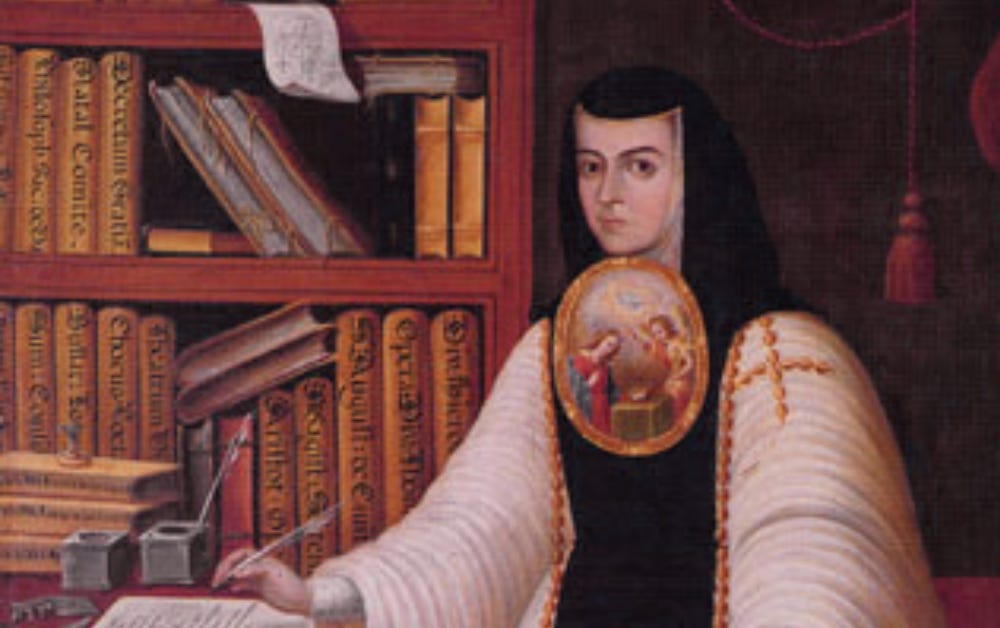
All extant portraits of Sor Juana Inés de la Cruz are believed to be copies for which the original did, indeed, lose its battle against oblivion. Note the prominent words “FIEL COPIA” (“faithful copy”) in the image below.
The large, round "nun's shield" shown beneath her chin, bearing an image of the Annunciation, was part of the Hieronymite Order’s uniform.
 Juana Inés de la Cruz stands dressed in the white habit of the Hieronymite Order, with the "nun's shield" of the order, painted with the Annunciation, under her chin. A long black or brown panel hangs down the front of the habit from neck to floor. A long set of prayer beads hangs in a necklace down to her knees. Her right hand holds a quill pen, with which she is writing in a book on a red, rectangular pillar. Behind her is a bookshelf containing books and scientific glassware. A wimple of the same color as the panel, which widens at the shoulders, hides her hair.")
• • •
This poem's FULL TEXT appears in the following indices:
ACKNOWLEDGMENTS
First published: June 1, 2026, in Lighten Up Online.
TECHNICAL DETAILS
Lines: 40. Form: kyrielle. Rhyme scheme: aabB ccbB ddbB … jjbB. Meter: iambic tetrameter, but with the first iamb usually headless (missing its unstressed syllable), thus giving a trochaic effect.
• • •
This poem's FULL TEXT appears in the following indices:
TOPICS: • Language & Literature
ACKNOWLEDGMENTS
First published: June 15, 2026, in Light (Spring 2026 Issue).
TECHNICAL DETAILS
Lines: 16. Form: triolet series. Rhyme scheme: ABaAabAB CDcCcdCD EFeEefEF GHgGghGH, with capitals indicating repetends. Meter: iambic trimeter.
ALLUSIONS
Cassandra
• • •
This poem's FULL TEXT appears in the following indices:
ACKNOWLEDGMENTS
First published: June 15, 2026, in Light (Spring 2026 Issue).
TECHNICAL DETAILS
Lines: 21. Form: rondelet series. Rhyme scheme: AbAabbA, where the capital letters indicate repetends. Meter: lines of four and eight syllables, which I treat as iambic dimeter and tetrameter.
• • •
This poem's FULL TEXT appears in the following indices:
TOPICS: Cicadas & Other Wing-Things • Faith, Ethics, & Empathy • Music, Dance, Drama
ACKNOWLEDGMENTS
First published: June 24, 2026 in The Asses of Parnassus.
TECHNICAL DETAILS
Lines: 8. Form: quatrain. Rhyme scheme: aabb. Meter: iambic tetrameter.
• • •
From the Italian of Giovan Battista Strozzi and Michelangelo Buonarroti;
answered in English by Julie Steiner
This poem's PARTIAL TEXT appears in the following indices:
ACKNOWLEDGMENTS
First published: June 30, 2026, The Ekphrastic Review.
TECHNICAL DETAILS
Lines: 4. Form: quatrain. Rhyme scheme: abba. Meter: iambic pentameter, representing the Italian originals’ endecasillabo (11-syllable, hendecasyllabic) lines.
CONTEXT
👤 Michelangelo Buonarroti (1475–1564) of Florence carved this figure of Night between 1526 and 1531, for the tomb for Giuliano di Lorenzo de’ Medici (1479-1516) in the Sagrestia Nuova of the Church of San Lorenzo, Florence.
👤 The sculptor’s reply to the epigram by the Florentine noble and songwriter Giovan Battista Strozzi (1504–1571) implies criticism of the governance of the then-current duke of Florence, Cosimo I de’ Medici (1519–1574).
🏺 In Greek and Roman mythology, Night was the mother of several offspring, including in some versions the twins Death and Sleep.
• • •
This poem's PARTIAL TEXT appears in the following indices:
FORM: • Sonnets
TOPICS: • Faith, Ethics, & Empathy • Music, Dance, & Drama
ACKNOWLEDGMENTS
First published: July 24, 2026, in Elsewhere: A Journal
• • •
This poem's PARTIAL TEXT appears in the following indices:
FORM: • Sonnets
TOPICS: • Faith, Ethics, & Empathy • Music, Dance, & Drama
ACKNOWLEDGMENTS
First published: July 24, 2026, in Elsewhere: A Journal
• • •
This poem’s PARTIAL TEXT appears in the following indices:
FORM: Sonnets
TOPICS: Art & Architecture • Faith, Ethics, & Empathy
ACKNOWLEDGMENTS
First published: July 2026, Maria W. Faust Sonnet Contest flipbook and video.
• • •
From the French of Maurice-Louis Faure (1850–1919)
This poem’s PARTIAL TEXT appears in the following indices:
FORM: Sonnets
TOPICS: • Cicadas & Other Wing-Things • Music, Dance & Drama • Language & Literature
ACKNOWLEDGMENTS
First published: August 1, 2026 in Mantis: A Journal of Poetry, Criticism, & Translation, Issue 25 (print only).
TECHNICAL DETAILS
Lines: 14. Form: sonnet. Rhyme scheme: Sicilian — abababab ccdeed (but this poem has a stanza break after Line 7, instead of after Line 8.) Meter: alexandrine lines (rendered as iambic hexameter).
CONTEXT
👤 Maurice-Louis Faure (France, 1850–1919) served in many elected and appointed political positions, including mayor of Saillans, member of the French Senate, and French Minister of Education. He composed poetry in his native Provençal / Occitan as well as in French, and he published a Provençal / Occitan version of this sonnet.
👤 In 1911, the French version of “La mort de la cigale” was set to music by Jules Massenet (1842–1912).
• • •
This poem's PARTIAL TEXT appears in the following indices:
FORM: Sonnets
TOPIC: Travel
• • •
This poem's PARTIAL TEXT appears in the following indices:
FORM: • Sapphic Stanzas
TOPICS: • Art & Architecture • Faith, Ethics, & Empathy
ACKNOWLEDGMENTS
Not yet published.
TECHNICAL DETAILS
Lines: 16. Form: 4 Sapphic stanzas. Rhyme scheme: unrhymed. Meter: Meter: four-line stanzas, each consisting of three 11-syllable (hendecasyllabic) lines called alcaics, followed by one 5-syllable line, called an adonic.
Text within this block will maintain its original spacing when published
        – u – x   – u u –   u – –
        – u – x   – u u –   u – –
        – u – x   – u u –   u – –
                      – u u –    –
KEY:
– = syllable of long duration (in Greek/Latin); stressed syllable (in English)
u = syllable of short duration (in Greek/Latin); unstressed syllable (in English)
x = anceps (in Greek or Latin), which can be either long or short.
• • •
ANNOTATIONS—ALPHA LISTS
ANNOTATIONS—BY CHRONOLOGICAL SECTION:
(2003–2015) || (2016–2025) || (2026– )
Comments
Nothing yet. Say the first thing.
Sign in to join the conversation.