
Hey, Neighbor,
Over the last couple weeks, we hosted a game night, rolled out a new documentary, and began plotting the next one. Oh, and after a CBS producer reached out, we found time to go on the news, too.
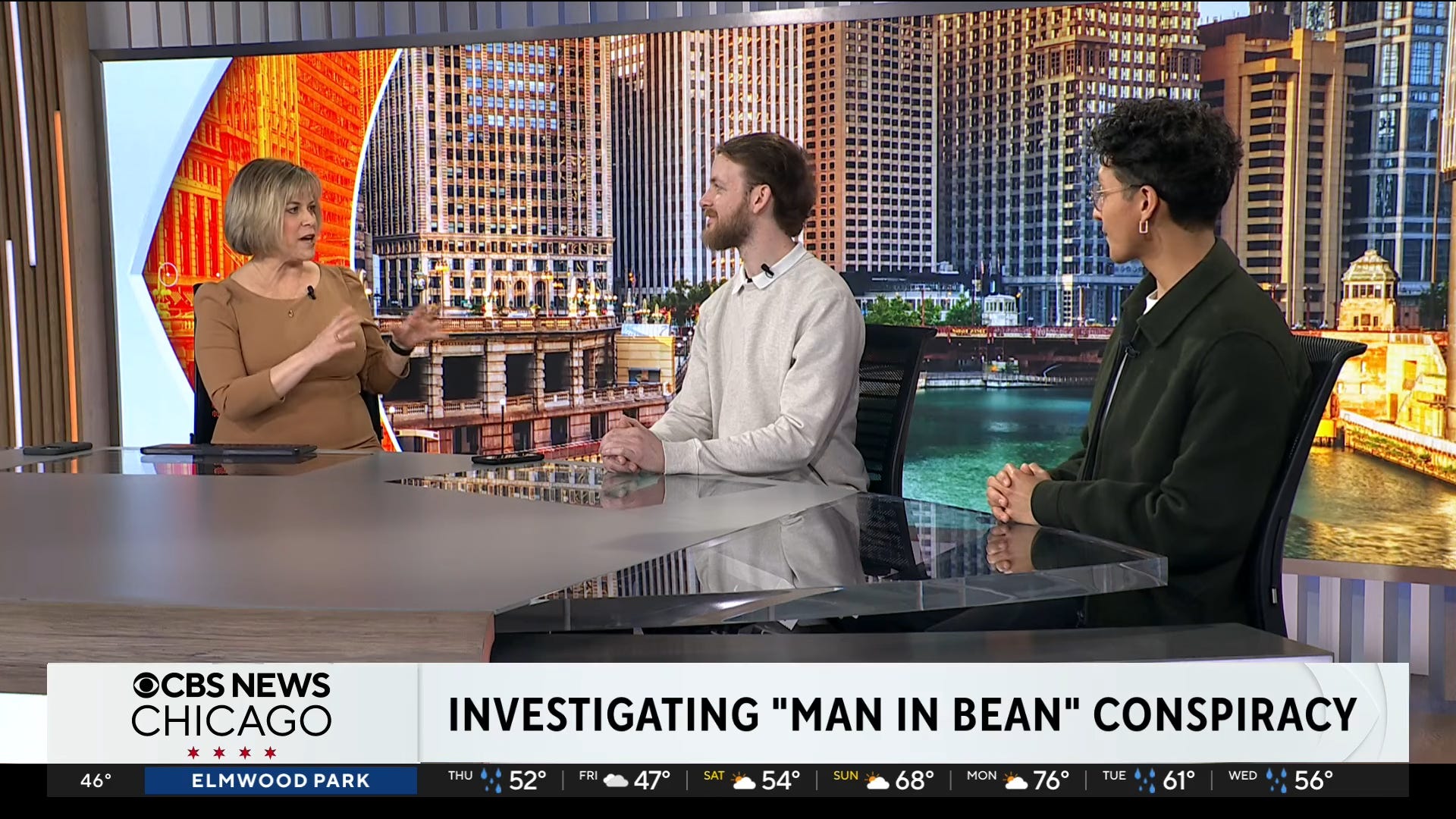
I’m increasingly unsure where the satire ends and the real world begins. Anyway, if you haven't watched The End of the “Man in Bean” Conspiracy yet, you can here.
We put a lot of work into this thing, and (while a little biased) I believe its core themes of obsession, distraction, and media manipulation really shine through. As our neighbor, Angie, described the doc: “It’s a Nathan Fielder-esque investigation of / love letter to Chicago, in the most unlikely but worthwhile ways.”
The last couple production-heavy months have me thinking more about the current state of longform—not only as a unit of creative work, but also as a way of life. More below.
— NGL
P.S. Powder Blue Presents: May Studio Session is this Sunday! Join ten artists, filmmakers, and friends from around the neighborhood for an afternoon of deep work and actionable feedback. RSVP here.

Whether penning magazine profiles or filming podcast interviews, I’ve always been a longform person. This almost certainly rounds out to a career (and life) spent swimming upstream.
It appears, however, that we’ve reached a breaking point, one from which there may be no return. Here’s two reasons why it feels this way—followed by a sliver of hope.
I was recently performing my weekly ritual of hating myself scrolling X when I stumbled upon a viral tweet:
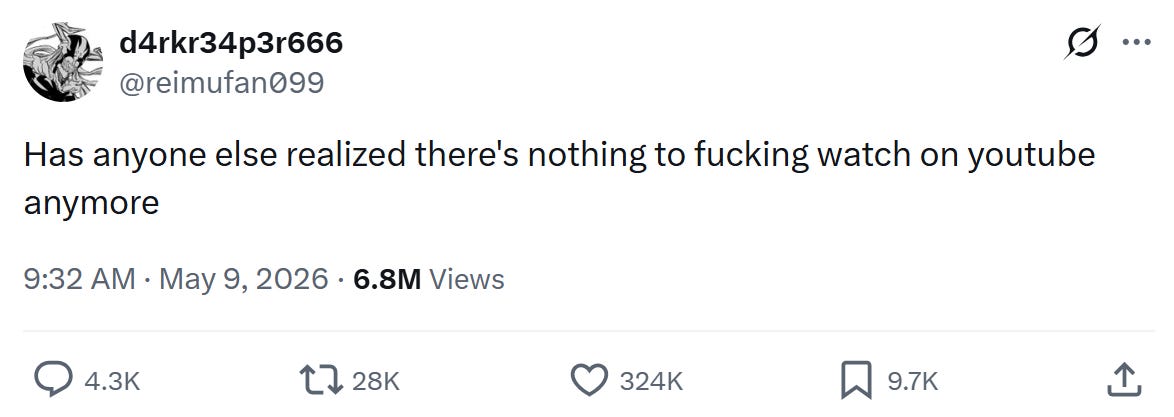
“Has anyone else realized there’s nothing to fucking watch on youtube anymore,” it read.
The user, of course, was not referring to a lack of supply. There are over twenty million videos uploaded to YouTube every day, according to the platform. For more perspective: five hundred new hours of video content are uploaded every minute.
No, the nerve d4rkr34p3r666 clearly struck circled around sentiment shared in the replies.1 Some users blamed YouTube’s algorithm, claiming it “killed discovery.” “The algorithm saw me watch one video about history and decided I now want to become a navy seal entrepreneur,” one reply read. “It traps everyone in endless loops of 20-min filler essays, reactions, and AI slop optimized for watch time instead of actually being interesting,” another added.
Others blamed the incentive structures propped up by the modern creator economy. “everybody is making the same 15-45 minute video essays about the same 10 topics and are getting sponsored by the same 3 companies to do the same three ad reads,” one user replied.
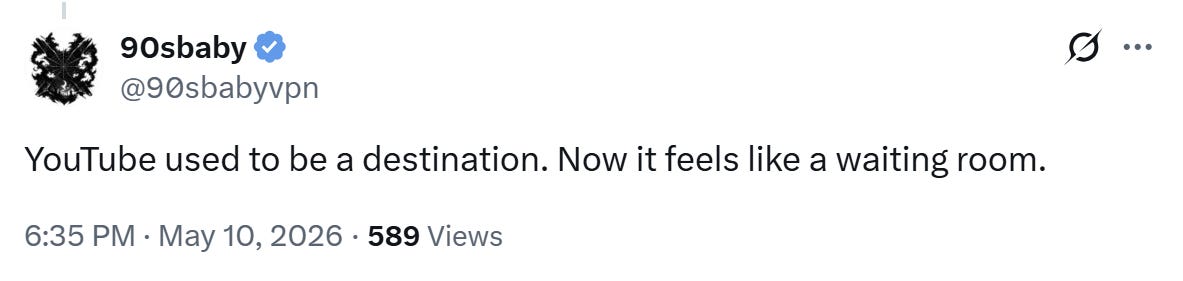
Past those arguments, though, came the cardinal sin any media exec shudders upon hearing. “YouTube used to be a destination,” 90sbaby wrote. “Now it feels like a waiting room.”
When you’re relegated to CNN status, you know something’s up. So what’s going on?
Of course, there are still phenomenal pieces of art and creative expression emerging from the Internet. We review them every Thursday.
But there’s two trends that explain the vibe shift around longform.
Reason Number One: There’s a new king in town. As of 2025, YouTube Shorts have passed two hundred billion daily views.
Longform? Roughly five billion, according to some estimates.2
Shortform continues to dominate eyeballs, but the incentive structure lies in input, too. When I left my last job at the end of 2024 to go full-time on Powder Blue, an advisor and friend encouraged me to focus pretty much exclusively on Shorts. His logic was cut-and-dry: vertical video is cheaper to make, and it allows you to take more shots on goal at a quicker clip.
The majority of your homepage, therefore, has become populated by people taking swings, a second away from a second away from maybe, just maybe, making this thing a career. Shortform, therefore, is often not a unit of creative expression, and it is certainly not a unit of introspection. It has become a unit of billboards and Hail Marys.
But what’s the alternative? After all…
Reason Number Two: Longform is becoming too expensive. There’s an arms race happening on YouTube, and bedroom filmmakers are now competing with legit studios and venture-backed media companies (on top of entrenched creators).
The collapse of cable television has the traditional entertainment industry scrambling—and reallocating wallets accordingly. The former Editor in Chief of Business Insider decided he wanted to create a glorified video essay channel, and (with seemingly the flick of his wrist) raised three-and-a-half million dollars to fund it. At just sixty thousand subscribers, Mark Wahlberg is grinding out his YouTube channel by collaborating with the likes of the Stokes Twins and checks notes Brent Rivera…but he’s still Mark Wahlberg, the third-highest paid actor of 2025.3
If you’re a new entrant, the only way to compete with the rising costs of video production is to create slop—in the form of faceless channels, sheer AI-supported output, or both. That’s before you even consider the cost of marketing your name outside of YouTube. Clipping campaigns ain’t cheap!
Therefore, longform is dead, strangled by its shorter, younger cousin and squeezed to a pulp by conglomerates (and celebrities) cashing in. Right?
On his film podcast The Big Picture, writer and co-host Sean Fennessey often rebukes the laziness of the “cinema is dead” narrative with something along these lines:
If you can look beyond blockbusters and sequels, it’s never been a better time to be a movie fan. Studios like A24, Neon, and Searchlight have helped spark a boom in “middle-budget” indies. And with streaming, international film is available at our fingertips—which was not always the case.
Take this year’s Best Picture race, for example. Three of the favorites for the award (Sinners, One Battle After Another, and Marty Supreme) combined to gross nearly eight hundred million dollars at the box office. Two of these were wholly original screenplays, while One Battle was loosely adapted from a somewhat-successful Thomas Pynchon novel (not exactly Stephen King).
These were not inexpensive movies to make. They took years to produce, and carried loads of risk.
But past just box office indicators, all three projects succeeded on narrative and thematic currency. In other words: Depth matters. And depth gets butts in seats.
When I saw Project Hail Mary at The Music Box Theatre a week after its March 20 release, all seven hundred seats were taken (on a Sunday evening, at that). Music Box can sometimes be an outlier, as cinephiles powered its ninth-place ranking among the best theatres in the world. Nevertheless, when I saw Hail Mary again, at a different cinema, a month later, it sold out…again.
Sure, there’s only so many Ryan Goslings you can hire to market your new movie. Yet Andy Weir’s novels are carefully-constructed, sometimes-tedious epics that lean heavily into scientific explanation. That world he so meticulously builds, though, keeps bringing audiences back.
Word-of-mouth, after all, is the antidote to the slop.4 And I believe the same is true for all forms of creative work.
So what does this mean for you and I?
Well, for starters, the business case for producing creative, innovative longform stories in today’s environment is never easy. If I had all the answers, a movie studio or publishing house would be backing up the Brinks truck outside our door.
What I can say is that putting my head down for two months to tell a story only we could tell, to pull no punches and do it the way we intended—even when seemingly all incentive structures encouraged us to do otherwise—has created opportunities that previously felt oh-so-far away.
Sure, going on the news was fun, and the comment section beneath the doc is overwhelmingly positive. A more important signal, however, came from the premiere we hosted at our studio, three days before dropping the doc. We built out a mini-theater with our projector and backdrop, and the twenty-five of you who attended genuinely loved the project.
An impromptu, thirty-minute director’s Q&A followed, with long discussions around the piece’s themes and inspirations (yes, we did recreate Spike Lee’s famous “Double Dolly” shot). Some of you have even stopped by the studio since, and we’ve proceeded to discuss the project further for hours.
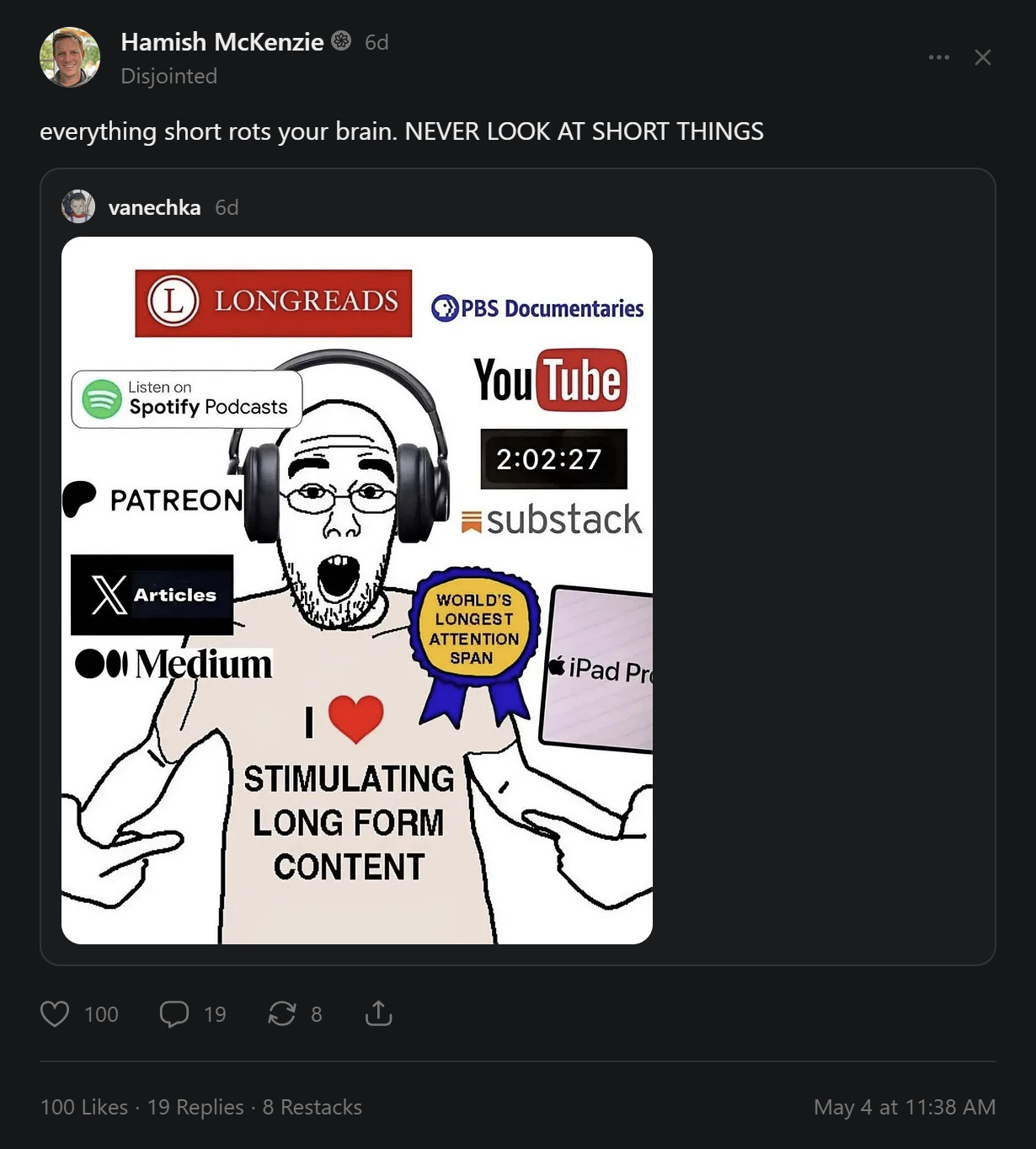
As Substack cofounder and journalist Hamish McKenzie recently joked, “everything short rots your brain,” poking fun at the newfound élitism found in these conversations. At the end of the day, most longform video is still a unit of media, a marketing funnel for something else. At our events, most first-time attendees come up to me and mention they discovered us through our YouTube channel.
But I wholeheartedly believe that longform work is a way of life. It’s a commitment to engaging deeper, to doing the reading and thinking critically and forming original perspectives at a time when streamlining those things has never been easier, or more frictionless. It’s a unit of conversation, of sparking new ideas and pulling at our heartstrings and, quite simply, making something people remember a year later (or even a week later).
YouTube (the company, and dominant streaming platform, at that) is in the business of keeping people interested. While retention and click-through rate have been the platform’s dominant KPIs for years now, all pendulums swing back eventually, and it feels like an overcorrection is in place.
For now, though, I believe word-of-mouth—texting friends and screening projects, actively participating in Discords and screaming from the rooftops—is the most human form of marketing we have left. People still crave meaningful stories; they just can’t always find them. So if that means premiering your next project from your living room, start popping the popcorn and just show the damn thing.
If art can no longer exist sustainably on the Internet, it might as well be enjoyed alongside the people you love. Swimming upstream, together.
You can watch The End of the “Man in Bean” Conspiracy, now streaming @powderblueworld.
Thanks for reading! Shoot us a reply, comment, or DM if anything resonated with you in particular—we respond to them all.
Would I put it out of the realm of possibility that this tweet is from a bot? No, I wouldn’t. Says a lot that it sparked so much discourse regardless, though!
YouTube hasn’t publicly disclosed these numbers.
As it turns out, Mark Wahlberg was the third-highest-paid actor in the world in 2025. If you can’t name a Mark Wahlberg movie since he played a caricature of himself in 2010’s The Other Guys, don’t worry—you’re not alone.
For the statistically-inclined: Word-of-mouth is often measured by a multiplier. Total Domestic Gross is divided by Opening Weekend Gross; in the case of Hail Mary, the multiplier was an astounding 4x (most blockbusters, if lucky, finish between 2-3x).
No posts
Comments
Nothing yet. Say the first thing.
Sign in to join the conversation.