
Be first in line to access the groundbreaking Book 2 of THE GRAND ILLUSION series
Experience the “revolutionary healing science expanding the boundaries of being.” (NEXUS mag) > EVOLVE YOURSELF biofield activations.
Read THE GRAND ILLUSION: A SYNTHESIS OF SCIENCE & SPIRITUALITY - Book 1 📘 10,000 hours of life-changing research—distilled
Grab a paid subscription for full access (includes starting Chat threads, access to all audio versions 🎧 + comments on all pieces). Paid members get direct access to me and priority conversation in Chat.
A growing online movement claims we’re being recycled through a cosmic prison—but when you examine the actual data, what looks like external control begins to resolve into something far more precise, structured, and internally driven.
Spend even a short stretch of time immersed in the afterlife discourse right now—particularly in the more fringe-adjacent spaces where NDE accounts, regression data, and esoteric frameworks are being actively (if sloppily) cross-referenced—and you’ll notice a very specific narrative pattern asserting itself with increasing confidence. It goes something like this:
You die.
You exit the body.
You encounter the light/a being of light.
You are persuaded, processed, or deceived.
And then—whether willingly or not—you are returned.
There are other spins on this, such as automatic soul recycling by a faceless something/someone back into incarnate life. Either way, the existential doom loop is complete.
From there, the conclusion is drawn—often with striking emotional certainty—that what we are dealing with is not a natural transition, but a closed system curated by a demonic-like force. A containment architecture. A recycling mechanism.
The so-called “prison planet” or “Soul Trap.”
Now—here’s the part that most critics get wrong, and where the conversation immediately collapses into shallow dismissal: Like it or not, this narrative is not emerging from nothing.
It is, in fact, an attempt—albeit a crude and often psychologically charged one—to interpret a cluster of recurring experiential data points that do show up with enough consistency across NDEs, OBEs, and certain regression datasets that they demand to be taken seriously.
But—and this is where precision matters—while what’s being detected is real, we need to slow our roll and consider whether the conclusions drawn from it are valid or not.
And the gap between those two is exactly where the distortion (and the opportunity for clarity) lives. Yes, I’m asking people to do exactly what I already know most are not willing to: carefully examine the data through an informed psycho-esoteric-systems lens that might just shift our collective understanding up an octave.
If you strip away the interpretive overlay and just look at the phenomenology—the raw structure of reported experience—there are several elements that come up repeatedly enough that they can’t be dismissed as noise:
A transition out of the physical body with retained or enhanced awareness
Entry into environments that are not chaotic, but highly structured and often hyper-real
Encounters with intelligences—sometimes familiar, sometimes not
A review process that involves re-experiencing one’s life in a non-linear, multi-perspectival way (usually time-reversed)
A threshold event—often symbolised as a boundary, light, or transition point
And, crucially, a return—sometimes accepted, sometimes resisted, sometimes experienced as inevitable or completely spontaneous and seemingly non-causal
Now, if you isolate just those elements—particularly the last three—it’s not difficult to see how a certain interpretation begins to form.
Because from within the constraints of ordinary human cognition, repetition without visibility of underlying mechanism is almost always interpreted as external imposition.
That’s the default move, and it’s exactly the move the Soul Trap theory makes.
Before we go any further, let’s deal directly with the arguments that give this theory its traction—because ignoring them is what leads to the kind of shallow rebuttals that both trap proponents and neutral observers find unconvincing.
One of the most frequently cited elements involves encounters with what are described as “beings of light,” guides, or—in more adversarial interpretations—malicious Archontic intelligences.
A case I reference in Book 2—originally relayed through a third-party account—describes a friend of a writer and trap advocate (I. Greene) who, during an NDE, encountered a luminous “Archontic” presence that tried to persuade and then bribe her friend to do something (whether return to his body or reincarnate).
What’s critical in this case is not just the presence of the being—but the dynamic:
The being presents information
It exerts a form of attempted persuasive influence
The experiencer resists
And ultimately, the persuasion fails; the experiencer moves on “victorious”
From a soul trap perspective, this is framed as:
“An entity attempting to retain control—and failing when resisted.”
And at face value, it does raise legitimate questions. Because we’re not just dealing with passive observation here—we’re dealing with interaction, influence, and apparent agency beyond the experiencer’s own.
But again, the key issue is not the data point, it’s the interpretation of its origin. The data is useful—as all data is—but under-utilised by most. (By the way, what a pathetic excuse for a soul trap if the “overseers” can so easily be resisted and overpowered!)
Another major pillar of the trap narrative comes from reports of what appear to be evaluative environments:
“Councils” or “boards” of judgement
Beings observing or overseeing
A sense of being assessed by a hierarchy
In lower-resolution interpretations, this becomes:
“You are judged and processed.”
But in higher-resolution accounts—including the life review cases outlined in my manuscript—the structure is markedly different.
The experiencer does not report:
External condemnation
Imposed verdicts
Authoritative sentencing
Instead, what unfolds is something far more subtle—and far more difficult to reduce:
A self-referential experiential recursion, in which the individual becomes directly aware of the impact of their actions—not as abstract moral judgment, but as lived, embodied consequence across multiple perspectives simultaneously. Dannion Brinkley’s first NDE provides a spectacular example (discussed in the book).
The “judgment,” in other words, is not coming from the outside. It is emerging from within the system of consciousness itself.
But because that process is often externally symbolised—rendered into forms that resemble councils, observers, or structures—it becomes incredibly easy to misread.
This is perhaps the most compelling—and most emotionally charged—argument.
Many experiencers report some version of the following:
They are given a “choice” to return
The choice does not feel entirely free
There is a pull, pressure, or sense of inevitability
They return despite resistance
From the trap framework, this becomes:
“The illusion of choice masking an enforced outcome.”
And again—this is not an unreasonable interpretation if you assume that all perceived constraint must originate externally. But that exact assumption is precisely what needs to be interrogated.
Let’s tighten the lens on the cases already documented, because this is where the shift from narrative to structure starts to become visible.
The cardiac arrest experiencer who reaches a state of profound stability—described as more real than physical existence—and resists returning, because it’s so blissful.
There is no coercive force and no visible mechanism of enforcement. And yet—the return occurs. The default interpretation becomes:
“Something overrode their will.”
But that interpretation quietly assumes that:
The experiencer had full situational awareness
The decision space was fully visible
The variables influencing the return were external
None of which are actually established. Carl Jung experienced this very thing with his own NDE—and he was quite pissed off to find himself back in the body after being revived (see Book 2). The issue, in part, is that you’re not really “dead” until the fat lady sings—viable biology (the body) acts as an attractor for the mind, and draws it back by default.
The experiencer who undergoes a total, immersive re-experiencing of their life—not as narrative memory, but as distributed consciousness across multiple perspectives.
There is: no judge. No sentence. No imposed moral framework. Just direct, unavoidable comprehension in high fidelity.
Yet when filtered through the manasic layer—the interpretive function of mind attempting to render non-linear data into familiar constructs—this becomes:
“Judgment.”
This is a low-resolution interpretation which is common and which should be subjected to deeper scrutiny. The mind uses its established experiential database to interpret non-physical and abstract modes of existence.
The individual who reports being able to stay—but simultaneously feeling drawn back by something unresolved. A commonly reported transition dynamic in which the experiencer perceives both the possibility of remaining and a simultaneous pull toward return, experienced not as explicit coercion but as an internally arising vector of unresolved continuity. This case is central to distinguishing perceived external force from underlying coherence-based momentum.
And this is where the trap narrative may anchor itself most strongly, because it feels like external force, but “feeling like” is not the same as “being.” Interpretation should not automatically become ontology. That is how we end up with literalist theologies hypnotising us into anti-evolutionary holding patterns.
Here’s the part that almost no one in the mainstream or fringe conversations is adequately accounting for: consciousness is not a neutral observer moving through fixed environments. It is an active, self-organising system with its own internal dynamics.
Which means:
It carries structuring of sorts
It carries pattern
It carries unresolved configurations
And those configurations don’t dissolve at death—they persist. More importantly—they constrain and shape the trajectory of the transition itself. (Hence, some people find themselves in earth-like “heavens”, while others experience dismal “hells,” among many other possibilities.)
This is the piece my CTM framework begins to map—without collapsing into either materialist reductionism or paranoid externalisation. Once you introduce internal coherence as a governing variable, a different class of explanation becomes available:
What looks like:
External control
May actually be:
Internal structural constraint (beliefs, attachments, etc.)
What feels like:
Being pulled or pushed
May actually be:
A system resolving toward stability
What appears as:
Repetition
May actually be:
Unresolved pattern cycling
And this is not to dismiss instances where an NDEr or past-life regression subject reports perception of literally being pushed back into earth life by another entity—in my book I document a case where the NDEr is “pushed” back into earth life by his deceased uncle. Another case study features the NDEr being pushed back to earth life by their dead grandmother. A man in hypnotic regression reports being forced to reincarnate to learn the empathy he so sorely lacked in a previous life. The list goes on.
In the NDE cases, the actors’ behaviour is not malicious, it appears to be focused around necessity—a knowledge that the NDEr’s life span is actually not over yet; this particular journey is not yet complete. (Regression cases are tackled in detail in Book 2.)
The short-sighted move made here is the claim by hardcore Trap advocates that these beings—who actually operate in an overwhelmingly compassionate and caring capacity toward the NDEr—are actually devious Archons in disguise trying to dupe souls back into incarnate life. Positive claims require evidence, but there has been little compelling evidence that has withstood the deeper kind of scrutiny offered in Reverse Engineering the Afterlife.

In fact, the overall tapestry of altered-state accounts flies in the face of that claim, blatantly contradicting it. When people continue the transition into non-physical life and we see a deeper continuity unfold, the “Archontic deception” narrative crumbles faster than my favourite choc-chip cookies in hot chocolate.
Additionally, this unproven claim is a variation of the much older fundamentalist Christian motif of the Devil posing as a being of light—even Jesus—to deceive people away from salvation. Taken seriously, this creates an infinite regress: if any perceived being can be deceptive, then NO perception can be trusted at all.
I provide a deeper treatment of these themes in Book 2 as unpacking them in depth here is beyond our scope. Let’s just say that projecting earth-conditioned survival fears into post-mortem life is a risky game to play.
Now layer on top of all that the second major distortion mechanism:
The translation layer. This is actually a skeleton key of sorts—one overlooked by every single Soul Trap (ST) commentator I’ve been able to find. Even people who reject the ST meme are largely unaware—and I firmly believe in tackling these systemic blind spots head on (in case that wasn’t obvious 😂).
What I’m calling the manasic translation error is not a minor footnote—it is central to understanding why these powerful experiences are so consistently misinterpreted.
Consider: what’s being encountered in these altered states is not inherently human-readable. It is:
Non-linear
Multi-perspectival
High-density in terms of informational content
Highly abstract, at times
And the mind—conditioned by language, culture, belief, and survival heuristics—has to render that into something coherent. It typically manufactures egregorial entities and a narrative format in which they play their parts—be they Archontic or angelic.
So the earthbound mind does what it always does: It maps the unfamiliar onto the familiar.
Distributed awareness becomes → “external beings”
Systemic self-feedback loops such as the life review become → “judgment”
Transition thresholds become → “gates” or “barriers”
Coherence gradients of consciousness become → “hierarchies”
And just like that, a structured internal process becomes an externalised narrative populated with aliens, Archons, angels, demons, intentions, and agendas. Projecting intention or agency onto an apparently external entity is seemingly a fundamental part of the human experience. Children do it all the time, even projecting agency onto cuddly stuffed toys they have built a relational experience with—and yet, we would not, as adults, claim that Buzz Lightyear is insidiously controlling the household, rendering its inhabitants slaves and harvesting their souls.
What if we applied that same scepticism to ST claims and looked at them without the anthropomorphic projections, from a more system-oriented lens?
It does so because it’s operating on accurate signals interpreted through an incomplete model. It sees:
The loop
The return
The interaction
The apparent asymmetry of power
And it draws the most immediately available low-resolution conclusion:
“Something is doing this to us.”
But that conclusion only holds if you exclude three absolutely critical factors:
Internal coherence dynamics
Translation-layer distortion (perceptual mis-interpretation of non-physical data)
Partial awareness within the experience itself
Once you reintroduce those variables, the same data reorganises into something far more coherent—and far less adversarial.
A system that produces repeated outcomes is not necessarily a system that is imposing those outcomes. It may be a system that is:
Consistently responding to the same inputs
If the underlying configuration doesn’t change, the output won’t either. Instead of reading that as entrapment we can instead see it as structure. Repetition can be a signature of structure, as opposed to malicious agentive control.
Here’s why this matters beyond “mere” intellectual accuracy. On a pragmatic level, if you misdiagnose the nature of the system, your strategy becomes misaligned. If you believe:
You are being deceived → you default to distrust
You are being controlled → you default to resistance
You are trapped → you default to fear
A pathological scepticism verging on paranoia becomes the rule. But if the actual mechanics are:
Self-referential
Coherence-driven
Structurally consistent
Then those reactions don’t free you, they actually reinforce the very patterns you’re trying to escape. Operating within those feedback loops, belief then becomes self-fulfilling prophecy.
It’s not:
“How do I avoid the trap?”
But:
“What are the underlying dynamics generating the experience I’m interpreting as a trap?”
That’s where the leverage appears—not in rejecting the system, but in understanding it deeply enough that your interaction with it changes. Find me a single long-running contemplative tradition where combating astral bad actors was deemed the winning strategy. You won’t—they all simply transcended such low-resolution frameworks entirely.
More recently, OBE pioneer Robert Monroe did this in his trilogy’s final instalment Ultimate Journey, when he attained a higher-resolution percept of the system’s intrinsic energy dynamics: from there the “Loosh harvesting” meme from Far Journeys resolved into a multi-self, multi-perspectival energy system in which larger, more fundamental aspects of himself found great value in the emotional experiences garnered during his time-bound earth life. Loosh harvesting was quietly shelved when he realised it was his Oversoul, or what he called his EXCOM/I-There benefitting from his earthly adventures.
Sadly few ST advocates ever read that far.
The Soul Trap theory is not wrong for recognising patterns, but because it stops at the first interpretation that makes emotional sense. And in doing so, it collapses a complex, multi-layered transition process into a single, adversarial narrative that feels powerful—but ultimately obscures more than it reveals.
The irony is this: the closer you get to accurately modelling what’s actually happening, the less the idea of a “trap” even makes sense as a category. (Just as Monroe evidently found with Loosh harvesting.)
And it’s not because everything is “love and light,” but because the architecture you’re involved in is far more precise—and far more internally driven—than the superficial ST meme allows for.
And once you start to see that—even partially—you’re no longer asking how to escape, but how to navigate.
If you’ve followed this far, you can probably feel the gap in the discourse: the data is real but the interpretations are illusory. The gap doesn’t close with better opinions, rather, it closes with a structured model. That’s exactly what I’ve spent the last 14 years building (since Book 1).
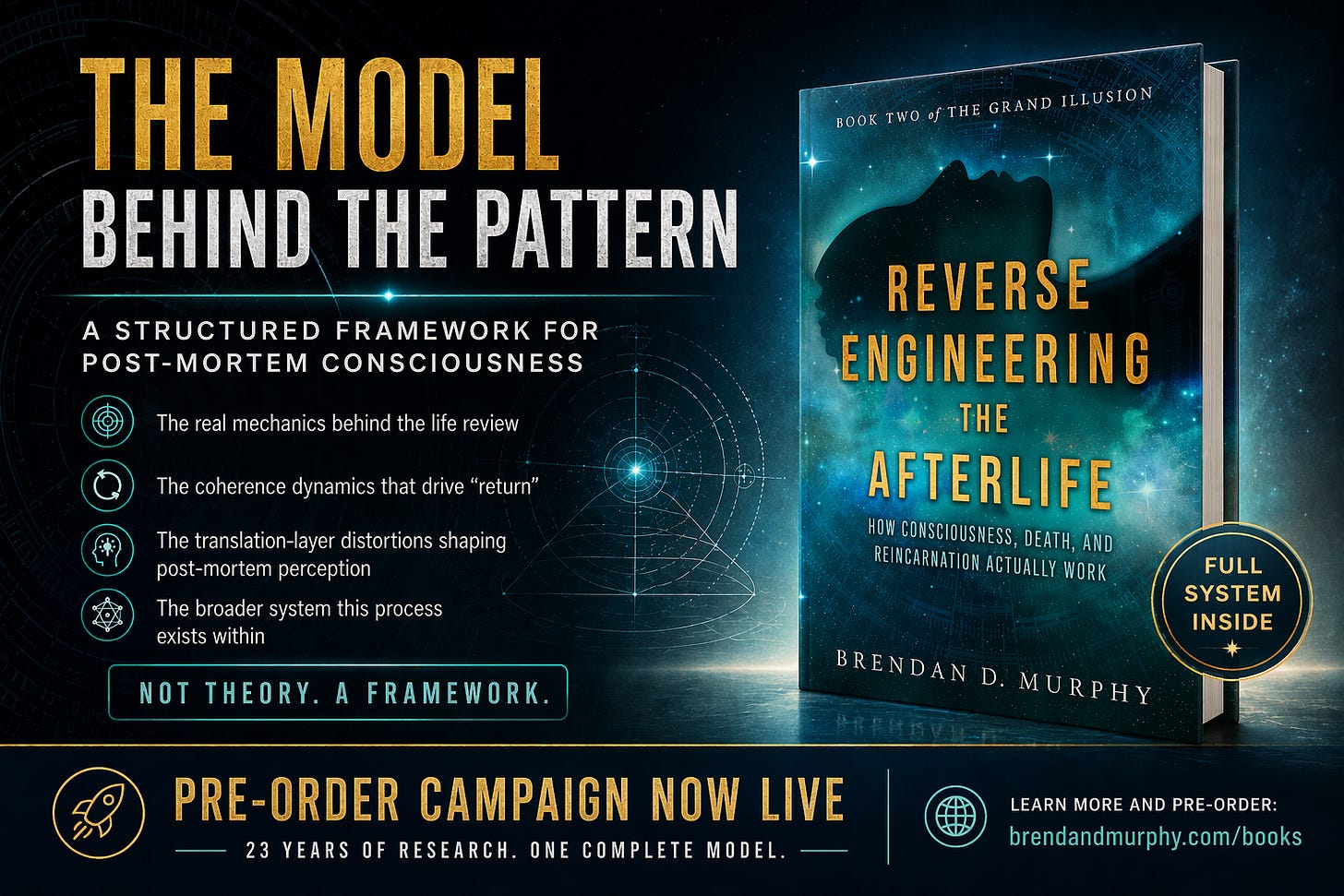
Book 2 lays out the full architecture behind everything you’ve just read:
The actual mechanics behind the life review
The coherence dynamics driving “return”
The translation-layer distortions shaping post-mortem perception and informing Soul Trap theories
And the broader system this process sits within
Not as speculation but as a mapped, testable framework built from cross-referenced data. If you want the full model—not fragments, not interpretations, not recycled internet narratives—you can access the pre-order campaign here
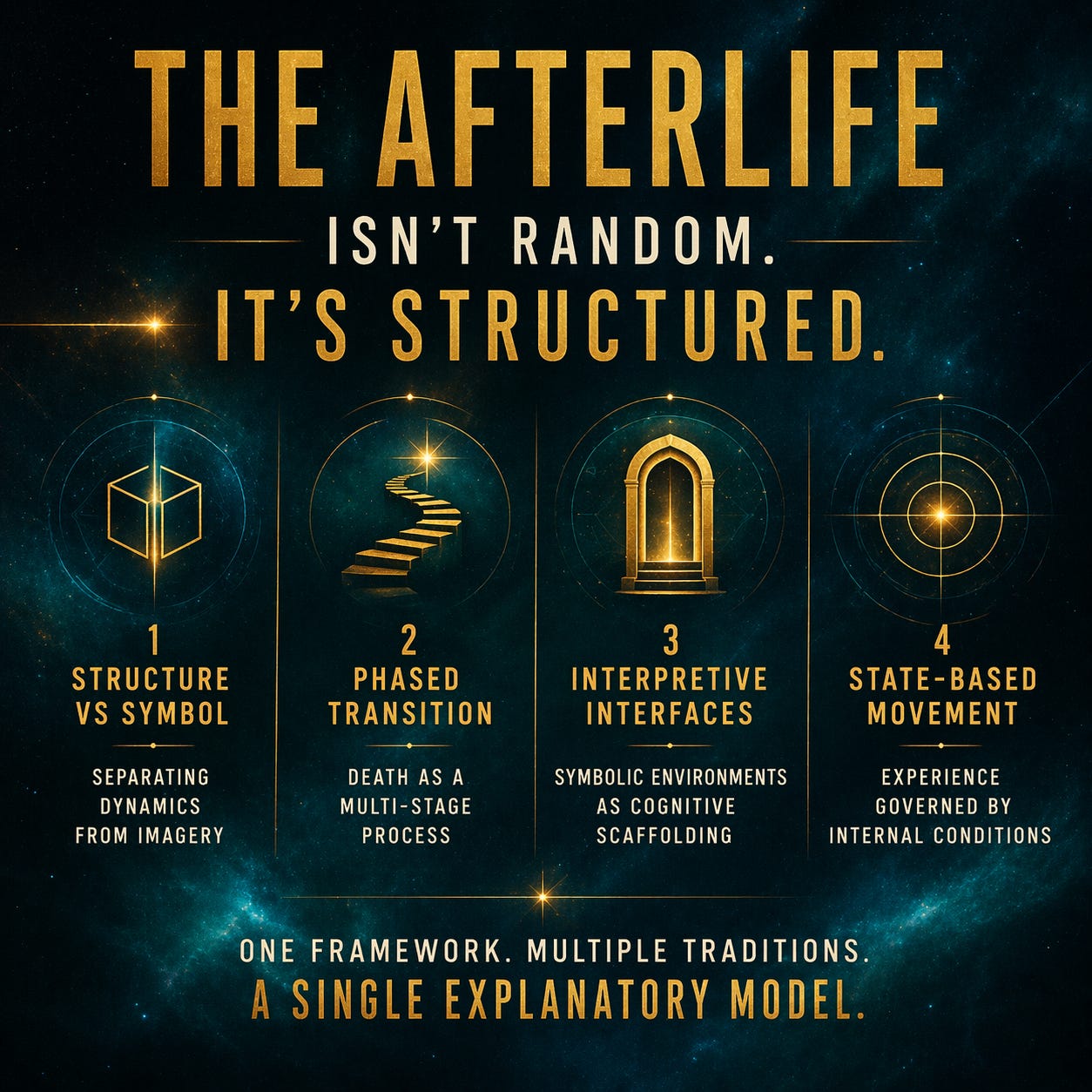
This is where the conversation stops being feeling-driven conjecture and starts becoming a usable framework with coherent metaphysics. This is the only framework publicly available that subsumes all the extant NDE and reincarnation data, along with both ancient and modern myths (including the ST meme). Click the image below for early access 👇
Brendan is architect of the Consciousness Transition Model (CTM), an emerging framework that integrates NDEs, OBEs, and centuries of altered state observational data into a coherent map of post-mortem reality. Brendan researches consciousness and the origins of modern metaphysical narratives.
His work synthesises contemporary data with classical esoteric frameworks, most notably in Reverse Engineering the Afterlife—Book 2 of The Grand Illusion series—a landmark study into the afterlife system and rules of non-physical perception and state changes.
Grab your copy of the first volume “The Grand Illusion: A Synthesis of Science and Spirituality — Book 1”
It’s here. Get on the pre-order list for the astonishing Book 2 of “The Grand Illusion”
UPGRADE YOUR LIFE—watch the free How to Evolve Yourself (WITHOUT Hard Work or Meditation) Masterclass to learn how this transformative evolutionary biofield activation and healing work with sound could change your world. Watch now to register and save your seat for the next live ceremony

Comments
Nothing yet. Say the first thing.
Sign in to join the conversation.