

Beauty people on Substack (myself included) gripe about the lack of a standalone beauty category, but we need only look to the New York Times, Los Angeles Times and Wall Street Journal, who have never had a standalone section devoted to it, to see how long this industry, from lipstick to liposuction, has not been taken seriously.
And yet, now the plastic surgery discourse has become so mainstream that three “normal” people are sharing their facelift journeys in the Way We Live Now section in the New York Times Magazine, along with an incisive essay by Molly Jong-Fast about whether or not she can still be a feminist if she’s done that kind of work. (Her answer is yes, but just don’t lie about it.) In a video accompanying the piece, she says, “I wondered why we talk about plastic surgery the way we do, and why we don’t admit when it works, and why we only really talk about it when it doesn’t work.” Ding ding ding!
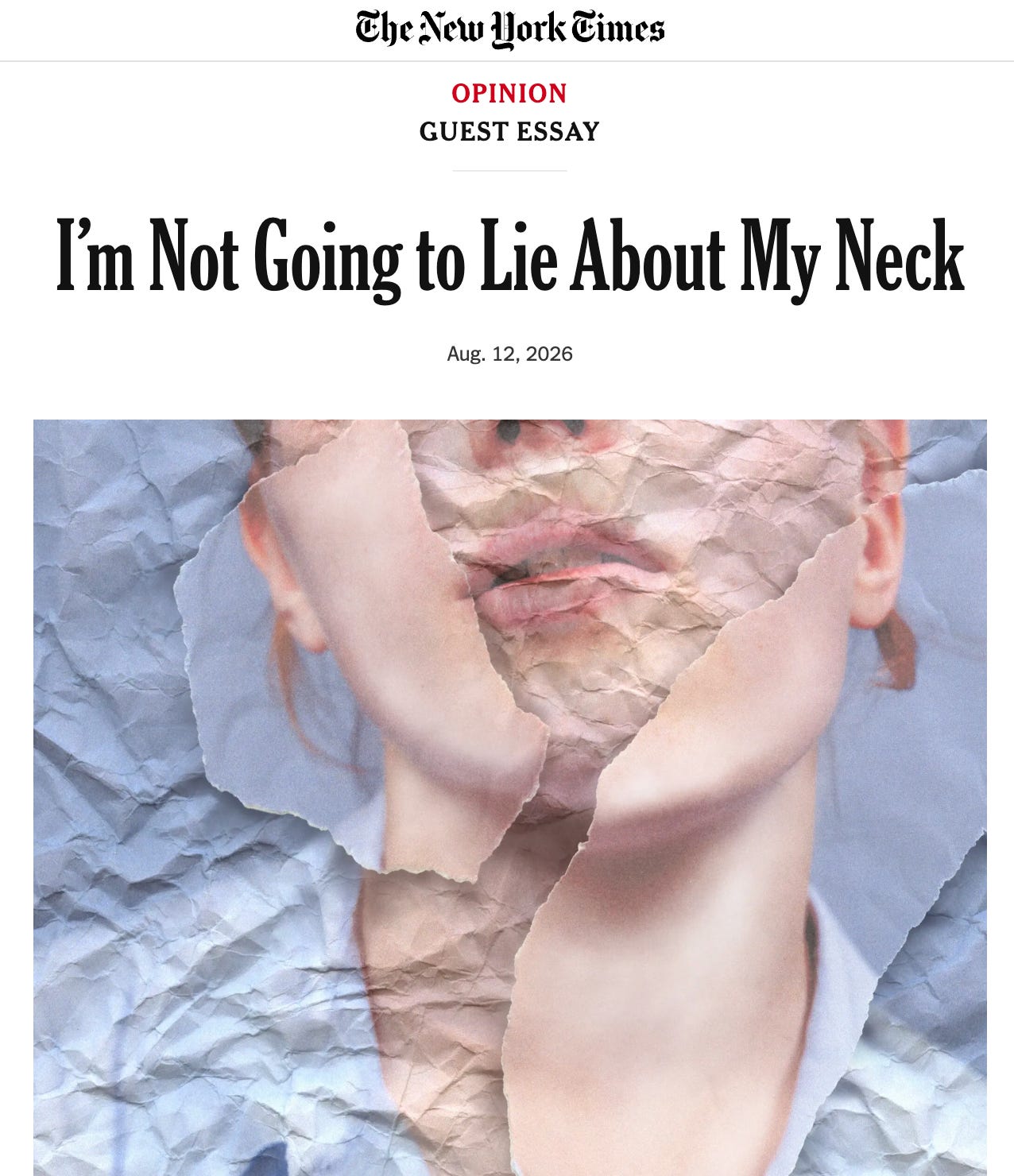
The facelift conversation and the think pieces that follow every public admission have historically been framed as conforming, as caring too much about what other people think, as a form of career advancement or societal acceptance. Are those valid points? Sure. And so are all the other many reasons someone chooses to have a facelift. One has to make sense of elective surgery.
That knee-jerk reaction used to come with assumptions that people will come out looking distorted, crazy, desperate. But…have you seen the work lately? Much of it is unbelievable, in a good way. And there isn’t always a moral handwringing from the patient perspective. In fact, less and less so.
Here’s what I hear most commonly from plastic surgeons about their patients’ reasons for why they want to get a procedure done:
They feel one way inside, and the outside doesn’t match.
They look tired.
They don’t recognize themselves in the mirror.
And more and more, they just say: they want to look better. No caveats.
Better is a subjective term, but that’s why not everyone goes to the same doctor. They see something they don’t like, they want to change it, and for the right price, they can.
If I had a dollar for every plastic surgeon who compared himself or herself to an artist, or is an actual artist with framed pieces in the waiting room to prove it, I’d have around $250. But I have to give credit where it’s due: they are artists. It’s sort of like a game of Operation, but instead of removing organs and trying not to hit the buzzer, they are playing Aphrodite, rearranging the face in millimeters while trying not to confuse the human brain, so that what an individual sees looking back at them in the mirror is balance and harmony, not unnatural distortion. Have you watched Dr.
Carl Truesdale’s videos? Seen Dr Sam Rizk’s noses, or Dr. Sean Alemi’s jawlines?
In California, it’s Dr. Ben Talei, Dr. Rami Batniji, Dr. Amir Karam, Dr. Sarmela Sunder, Dr. Babak Azizzadeh, Dr. Allen Foulad, Dr. Patrick Davis. In New York, I often recommend Dr. David Rosenberg, Dr. Andrew Timberlake, Dr. Melissa Doft, Dr. Haideh Hirmand, Dr. Stafford Broumand, and yes, Dr. Steven Levine, who is now as famous as his patients. I don’t know him, but Dr. Marc Zimbler did an amazing job on Rosie O’Donnell. Lately I keep hearing of people leaving New York because of the astronomical prices and seeing excellent surgeons elsewhere around the country: to Dr. Elizabeth Chance in Charlottesville, Virginia, Dr. Mike Nayak in St. Louis, to Dr. Kevin Cross in Philadelphia, Dr. Mark Hamilton in Indianapolis.
Given how pervasive the conversation is, it’s surprising to see the numbers: only 53,223 partial and full facelifts were done by members of the American Academy of Facial Plastic and Reconstructive Surgery (AAFPRS) last year. It’s a more than 30 percent increase from the year prior, but still infinitesimal in the population. By comparison, almost 10 million neurotoxin (Botox and its competitors) treatments were administered in 2024.
But no matter the procedure, the desire to optimize is nothing new, long predating our current peptide and longevity era. The cultural prevalence of plastic surgery feels like yet another goal post shift. It may not be fair, it may not be accessible, but damn, it does look good. Just don’t call the results ageless.
Happy Weekend!
X
Jamie
Comments
Nothing yet. Say the first thing.
Sign in to join the conversation.