
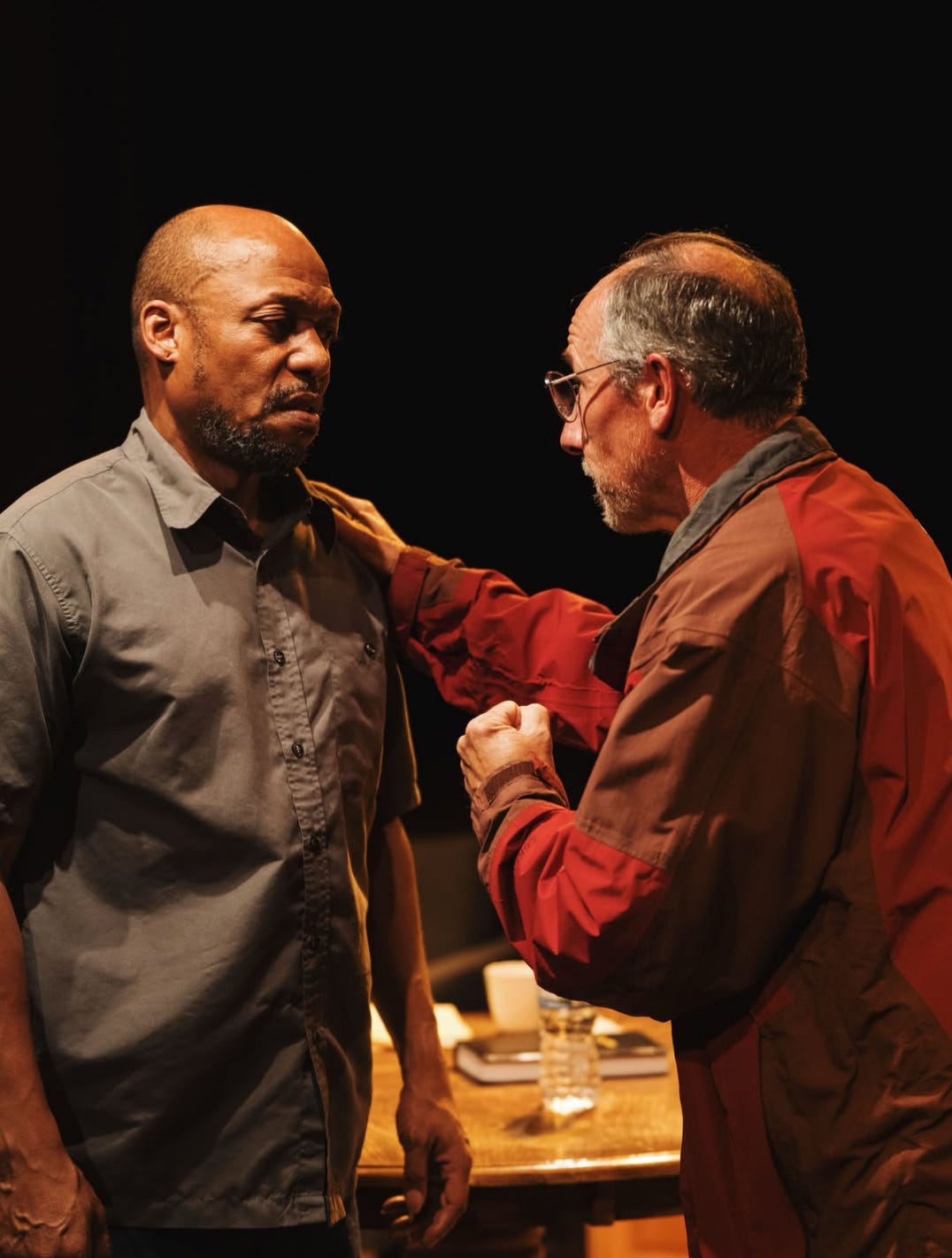
At the end of tonight’s performance of The Sunset Limited, the standing ovation continued long after the actors had left the stage. I joined the applause because it was deserved. But what I really needed was a minute. More than a minute, actually, to process everything that had just happened.
Before the show started, I ran into an old friend.
I was sitting in the center section of the church-turned-theatre space. My friend was seated stage left. I waved. He got up and came toward me, and we met in the middle. I stuck out my hand, but he said he was hugging me. I was happy he did.
I met him thirty years ago. Back then we attended — and later both worked and taught at — the same Bible college. I always thought of him as one of those guys who had it all together. He was cool. Popular. A true leader. A real Christian. I was always just a little intimidated by him, which was not in any way his fault.
I have no idea what he thought of me. I do know that being a closeted gay man in the evangelical world made me hard to get to know, a bit prickly, and in other ways, a little over the top.
I haven’t seen him in at least ten years. A lot has changed in that time. I’ve come out of the closet. I wrote a memoir, Jesus & Me, about deconstructing my faith. He and his wife are still inside the evangelical world, but from everything I can see, they inhabit it with grace and love. They’re the kind of “religious” people I can still sit across from.
Fitting, since we were about to watch two men sit across from each other and argue about God.
Cormac McCarthy called The Sunset Limited a novel in dramatic form. Two men, one room, no intermission, real time. A man named Black has pulled a man named White off a subway platform, seconds before the train hit him, and brought him back to his apartment. Black believes in God. White does not. To say more would spoil the experience.
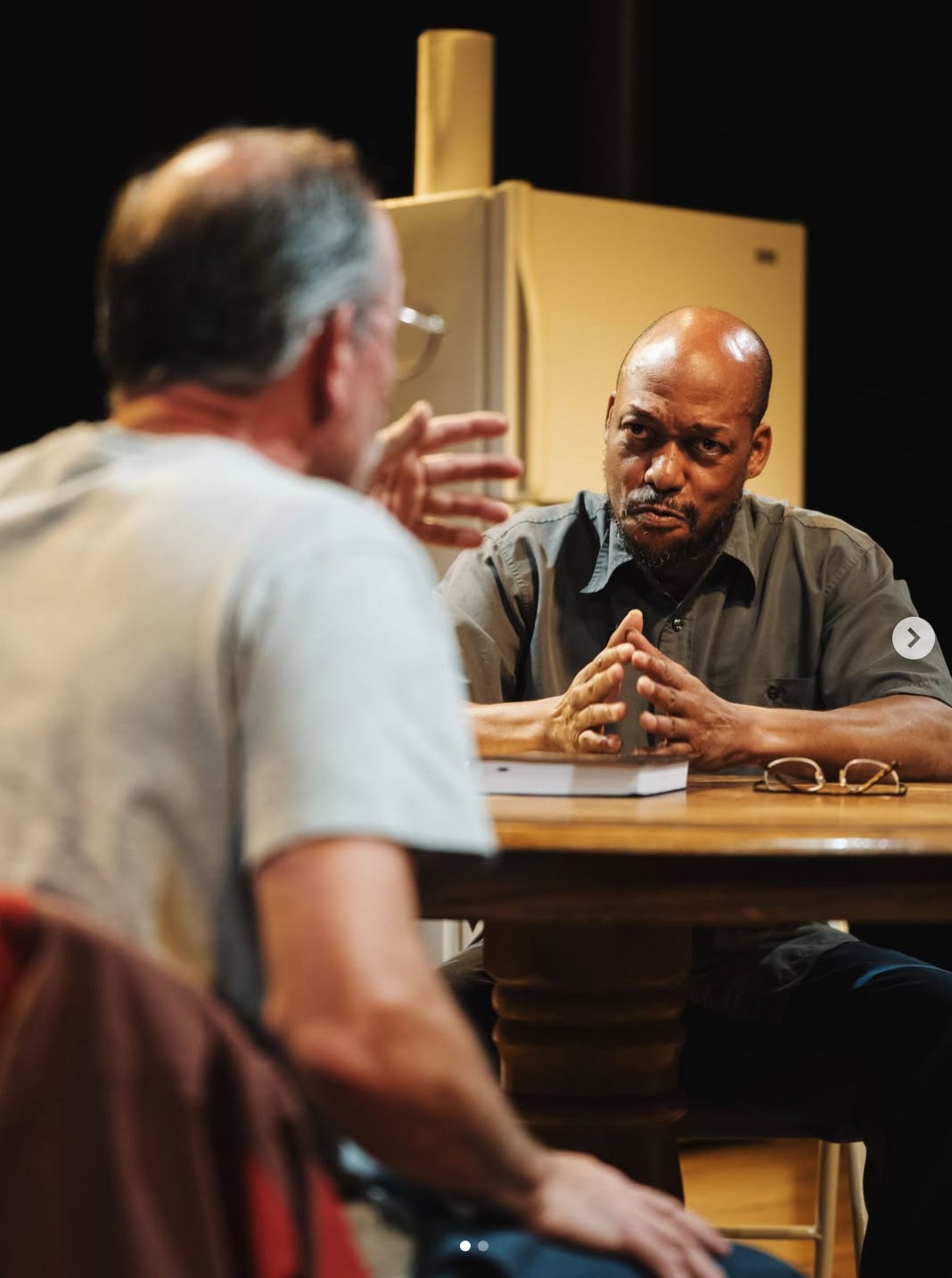
I was a terrible student, but I did learn a few things about apologetics — the art of arguing in defense of faith. And as a therapist with over twenty years of experience, I’ve sat across from people in pain, trying to help them see possibility. Hope.
I think that’s what hit hardest about this play for me; I have sat on Black’s side of the table more times than I can count — across from someone who has decided that their life is over, that there’s nothing to look forward to, no reason to live, while I do everything I can, never entirely knowing whether I’m reaching them.
But I’m sometimes like the character, White, too. I spend my days preaching intimacy and vulnerability, but struggle to engage in it. I have days where everything feels too hard. And while I’ve never stood on a subway platform ready to jump, I understand why someone might. White’s eloquence about all of that terrified me.
Sylvester Little, Jr. plays Black and Michael G. Bath plays White, both appearing courtesy of an arrangement with Actors’ Equity Association. Little’s physicality is subtle but precise. The eye contact he makes with Bath is unflinching, and his eventual breakdown is well-earned. Bath shows great restraint until he doesn’t — and his final rant is perfectly executed. I believed both of these performances, and they are magnificent together.
The script features ninety minutes of dense, lofty, difficult language, and in less careful hands it could just be two guys reciting well-written lines of dialogue. But these two spoke it with intention.
And that’s a result of the direction. Rupert Spraul built this play so that the intensity keeps climbing all the way to the last line, and never lets the literature win out over the people saying it. Together, the entire team made every moment resonate.
After the show I found my friend again. He was quiet. Contemplative, maybe. Me, too. After all, we had reconnected in an old church while watching two men who could not quite reach each other, no matter how strong their arguments were.
The characters are called Black and White. The material is anything but.
One Off Productions’ “The Sunset Limited” runs through Saturday, August 8, at Gabriel’s Corner. More information here.
This play deals directly with suicide. If you’re struggling, the 988 Suicide & Crisis Lifeline is available by call or text, 24 hours a day.
Kirk Sheppard is a proud member of the American Theatre Critics/Journalists Association. He writes about Cincinnati theatre—but mostly about being human. Check out kirksheppard.com for more information.
No posts
Comments
Nothing yet. Say the first thing.
Sign in to join the conversation.