

Over here at Of Boys and Men and AIBM, we’re a positive bunch. We don’t think nice guys finish last. We are super-reluctant to engage in “gotcha” scholarship, pointing out limitations in the work of other researchers.
Today we’re making a slight exception, for what we hope you’ll agree are good reasons.
A recent paper from a trio of scholars from the University of Nebraska writing for the Minneapolis Fed, titled “The Landscape of Parental Leave-Taking”, has been cited as evidence that Dads don’t take leave, even when it’s available to them.
Our friend and preeminent data nerd Emily Oster, for example, described the paper as “our best descriptive evidence to date on parental leave-taking patterns in the U.S.” and highlighted the finding that “fathers take, on average, three days of parental leave.” She adds that the paper “shows that the extent of leave-taking has not changed very much over the past two decades.”
Emily correctly summarizes the findings of the paper. But we don’t think the paper is painting an accurate or timely picture. And we think that on this occasion it’s worth correcting the record, because a misleading impression about rates of leave-taking among Dads could have a chilling effect on the positive moves towards more generous policy provision.
Indeed the authors themselves sound a warning about the dangers of a world where mothers take leave and fathers do not. The very last line of the paper is this (our italics):
In a setting where few fathers take substantial paternity leave—even where benefits are available to them—policymakers must also confront the potential for parental leave policies to exacerbate gender inequality in the labor market.
Over at AIBM we just published a research paper: “Dads are taking more paid leave than the headlines suggest”. This was directly motivated by the Fed paper and provides (we think) much better and more up-to-date evidence showing that leave-taking for Dads is high, rising and very responsive to better leave policies in particular states.
The Fed authors make a strong claim for their paper, describing it as “the most detailed and comprehensive picture to date on the length and timing of parental leave-taking in the United States.”
Among their headline findings are the following:
95% of fathers take zero weeks of leave.
Fathers take an average of just three days (0.6 weeks) of paternity leave—compared with 7.2 weeks for mothers.
Paternity leave duration has remained flat in recent years.
Paid family and medical leave programs have done little to substantially increase fathers’ leave-taking.
We disagree with all four of these. And that’s because we see two big problems with the paper.
First, the measure only counts full weeks of complete disconnection from work: that fits how many mothers take leave, but misses the shorter, intermittent stretches far more common among fathers. In the AIBM paper we provide a visual that one of us (Richard) loves and one of us (Anders) is slightly embarrassed by:
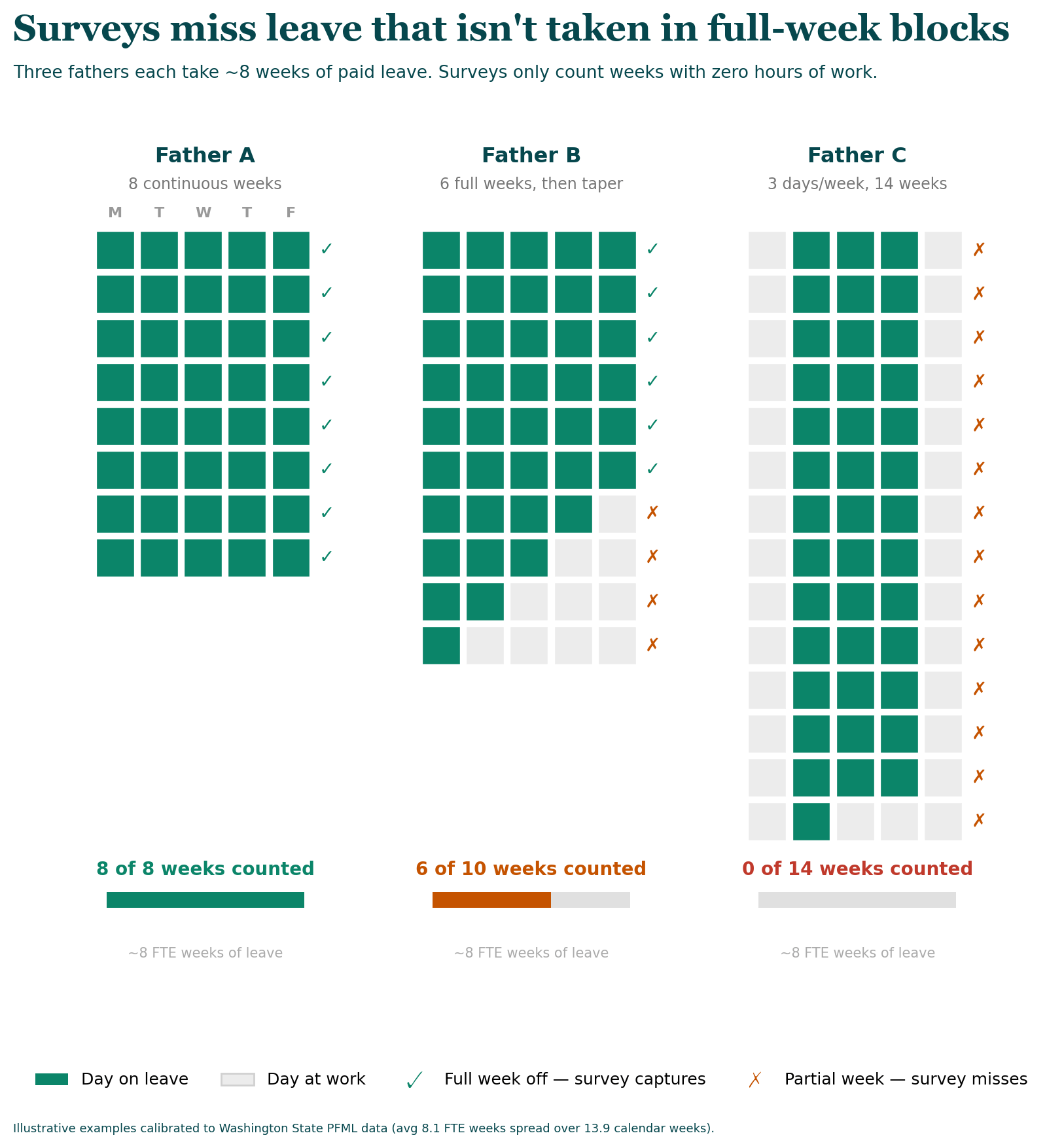
The point is clear. If parents take their leave in increments of less than a full week, working for even an hour or two during that week, it will count as no leave taken at all.
Second, and even more significantly, the ACS data used in the paper only runs up to 2019, thus predating a significant expansion of paid leave programs in the years since. No fewer than 10 states have introduced paid leave programs since 2019:
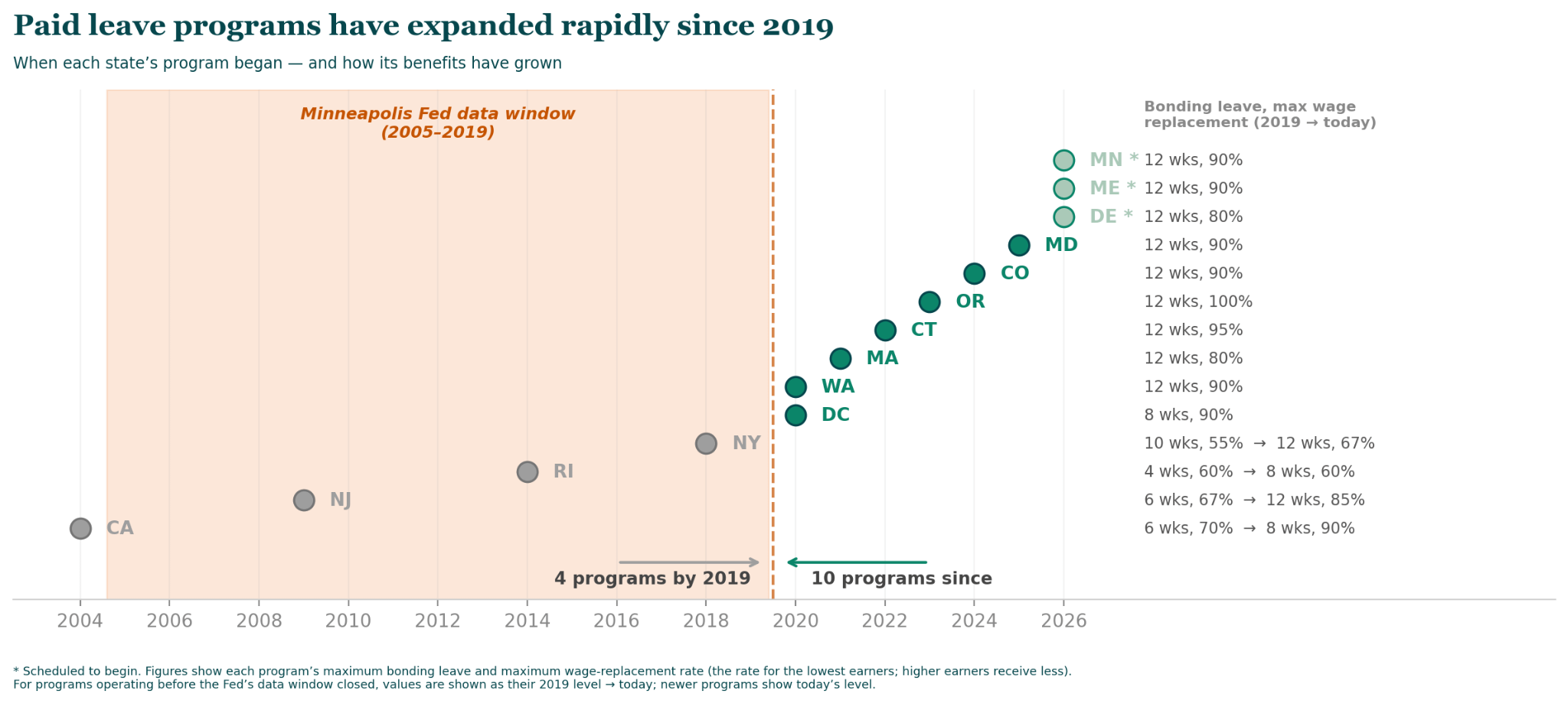
Many of the existing programs have become much more generous since 2019, too. In many areas of policy, 2019 might well count as fairly recent. But in paid leave policy, it is a very long time ago.
In our paper, we draw on more recent survey data and state administrative records, and paint a much more positive picture. We find that fathers’ leave-taking has in fact grown dramatically—and that the gap between fathers and mothers is narrower than standard measures suggest. Specifically, and in contrast to the Fed authors, we find that:
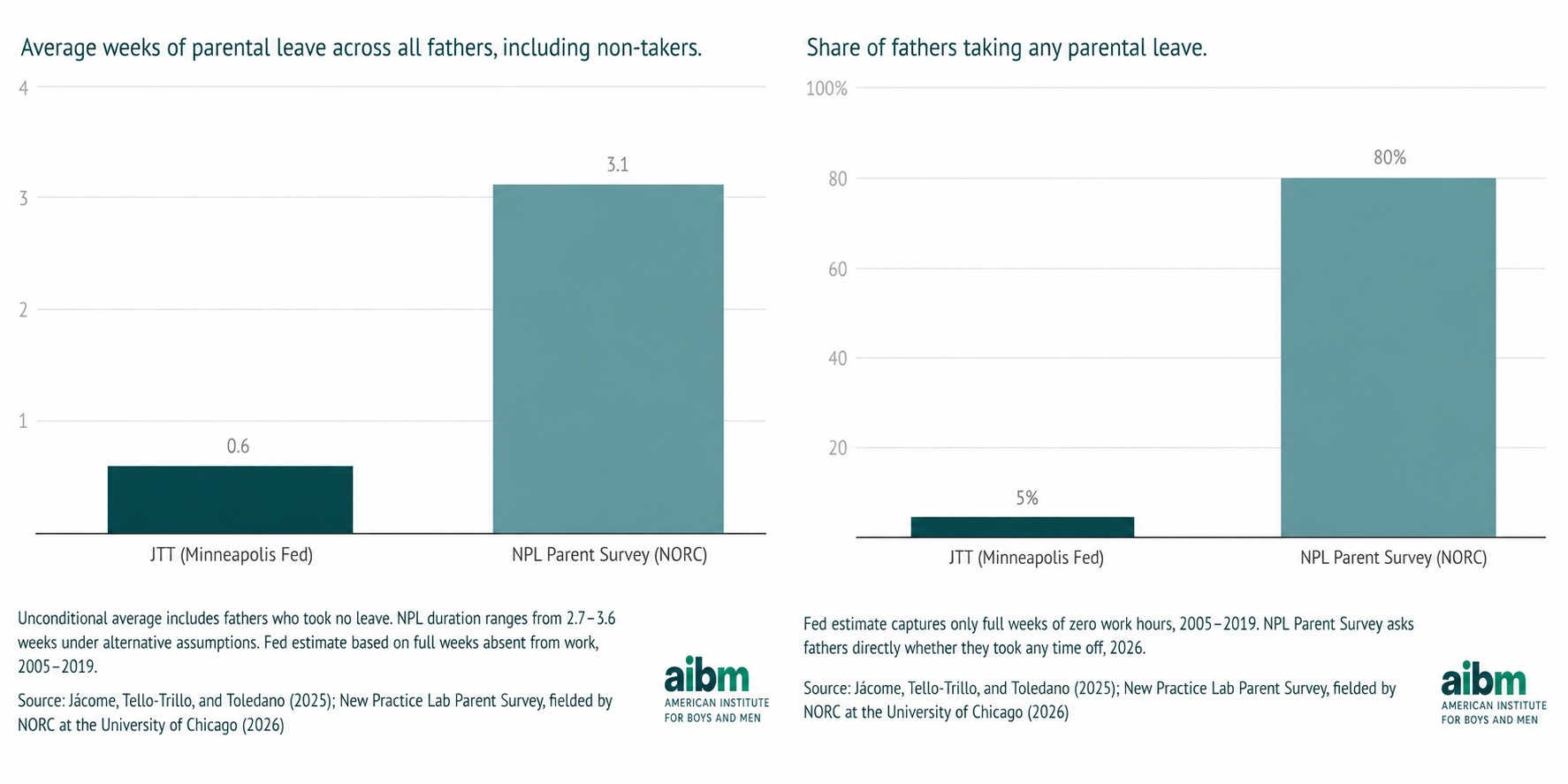
Four out of five (80%) fathers take time off when a child is born.
Dads were taking roughly two full weeks of leave nationally by 2025, and over three full weeks in states with paid leave programs. Various data sources show fathers taking much longer leave.
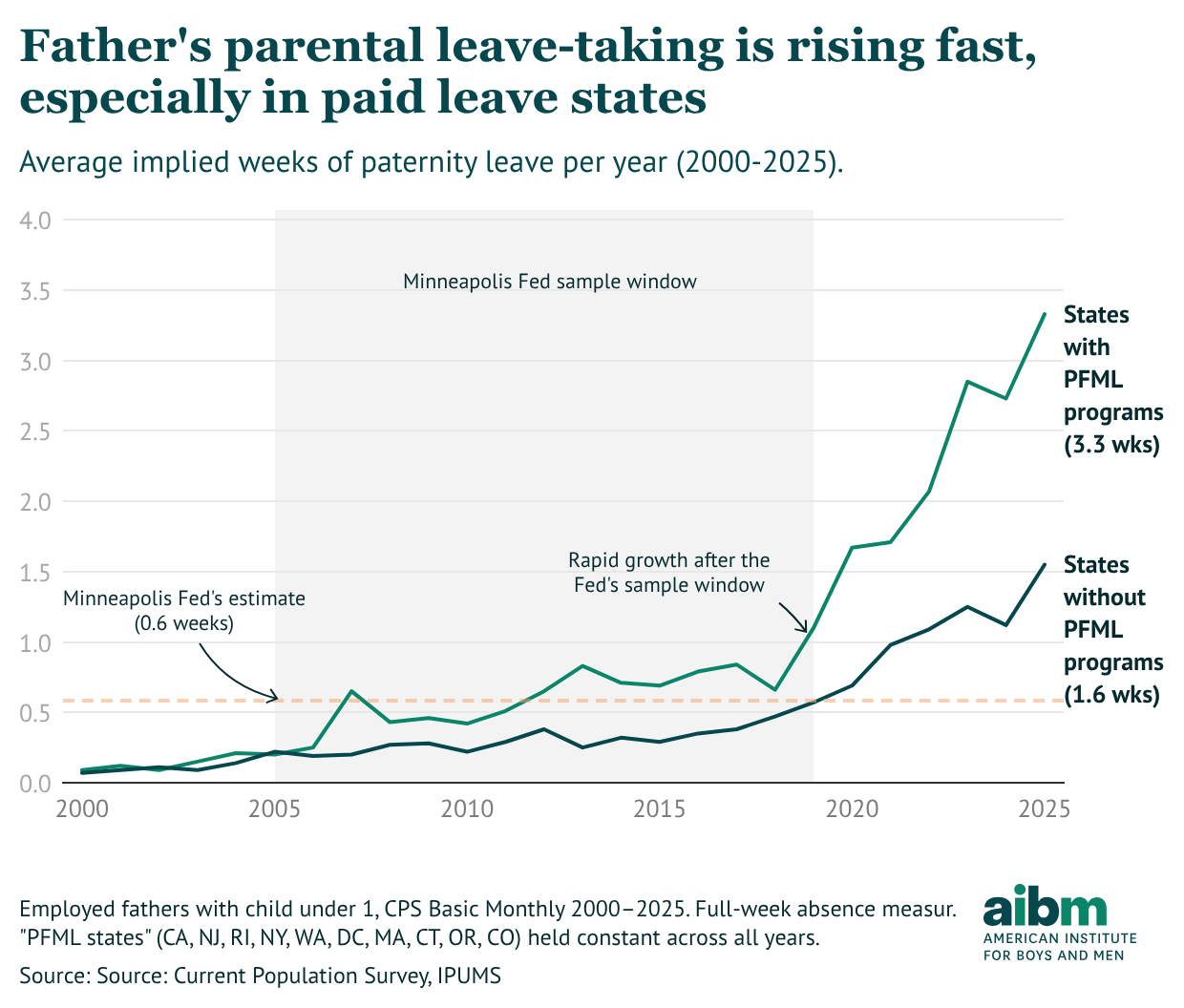
Leave-taking among fathers has roughly tripled since 2019, with the largest gains in states that enacted paid leave programs.
Fathers in states with paid leave programs are now taking roughly twice as much leave as those in states without.
Using the CPS to get more recent data, while still applying the same full-week methodology as the Fed authors, we see a big rise in recent years, especially in states with a paid leave program:
These figures are in line with the findings of the New America 2026 Parent Survey, which shows that most fathers took time off following the birth of their child, for an average of three weeks. These numbers are dramatically higher than the estimates from the Fed paper:
In our AIBM brief we also turn to administrative data from states with paid leave programs and where we were able to secure gender breakdowns. We hope to add more states to our list in future publications, but our initial analysis shows much higher rates of leave-taking among fathers, ranging from 25% in New Jersey to 75% in Washington State.
Washington State has a particularly awesome dataset that shows the timing of leave-taking quite precisely:
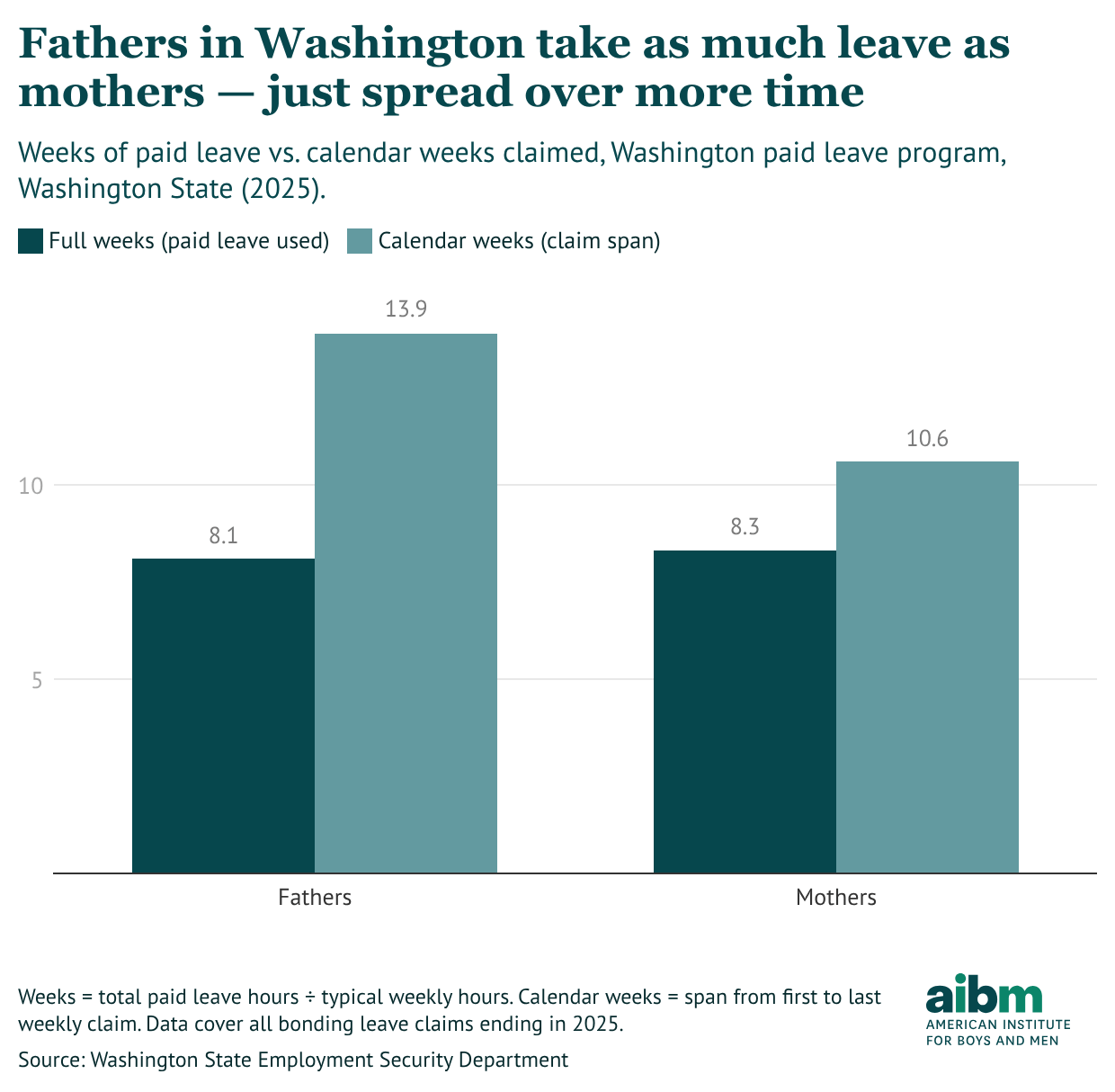
As the chart above shows, in Washington State fathers averaged the equivalent of 8.1 weeks of paid leave, but their claims spanned 13.9 weeks. That means that fathers are spreading eight weeks’ worth of leave-hours over nearly fourteen weeks; they are working some days, off others, exactly the intermittent pattern that full-week survey measures miss. The state’s admin data thus confirms that fathers in particular are undercounted: mothers take a similar amount of total leave (8.3 full weeks) but concentrate it into just 10.6 calendar weeks. Perhaps the state will prove to be an outlier on this front, but we doubt it.
To be clear, mothers are still much more likely to take leave, and to take leave for longer, than Dads. The data from the New America survey shows this clearly:
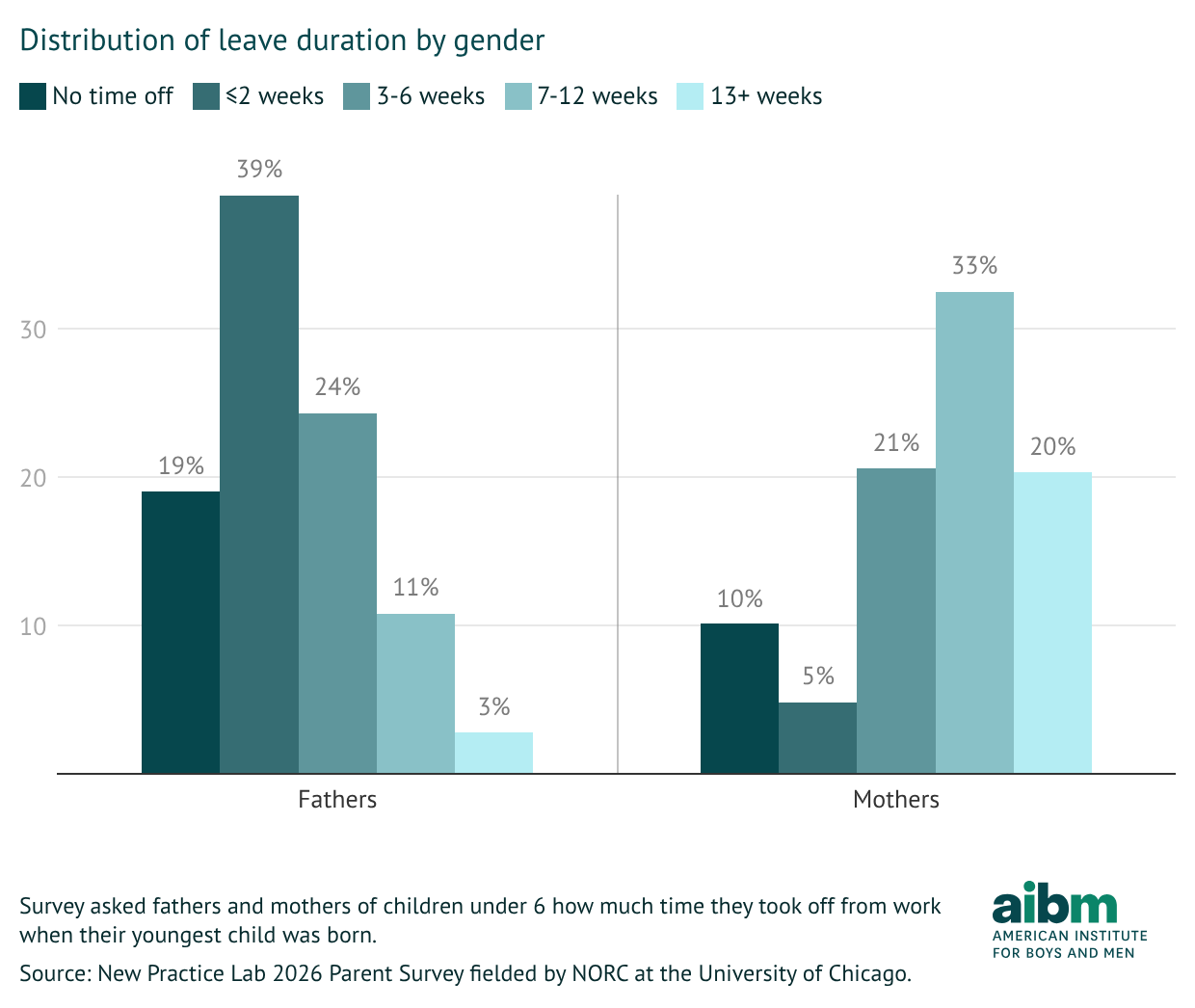
And it’s worth pointing out that these results are only for parents who were in employment at the time of the birth, and so understate gender gaps in the balance between unpaid and paid work: 92% of Dads versus 67% of Moms were employed when their youngest child was born.
But the best evidence not only from our paper but from groups like Paid Leave for All and the National Partnership for Women & Families shows a marked increase in leave-taking among fathers, especially in states with strong paid leave programs.
Fathers are taking up the opportunity for parental leave at high rates, and for substantial periods of time. And when strong leave policies are in place, both rates and durations of leave-taking increase significantly. The demand from Dads for leave is clear and strong.
Do read our whole report. But the bottom line is this: ignore the doomsayers. Parental leave policies work. For Dads, as well as Moms.
No posts
Comments
Nothing yet. Say the first thing.
Sign in to join the conversation.