
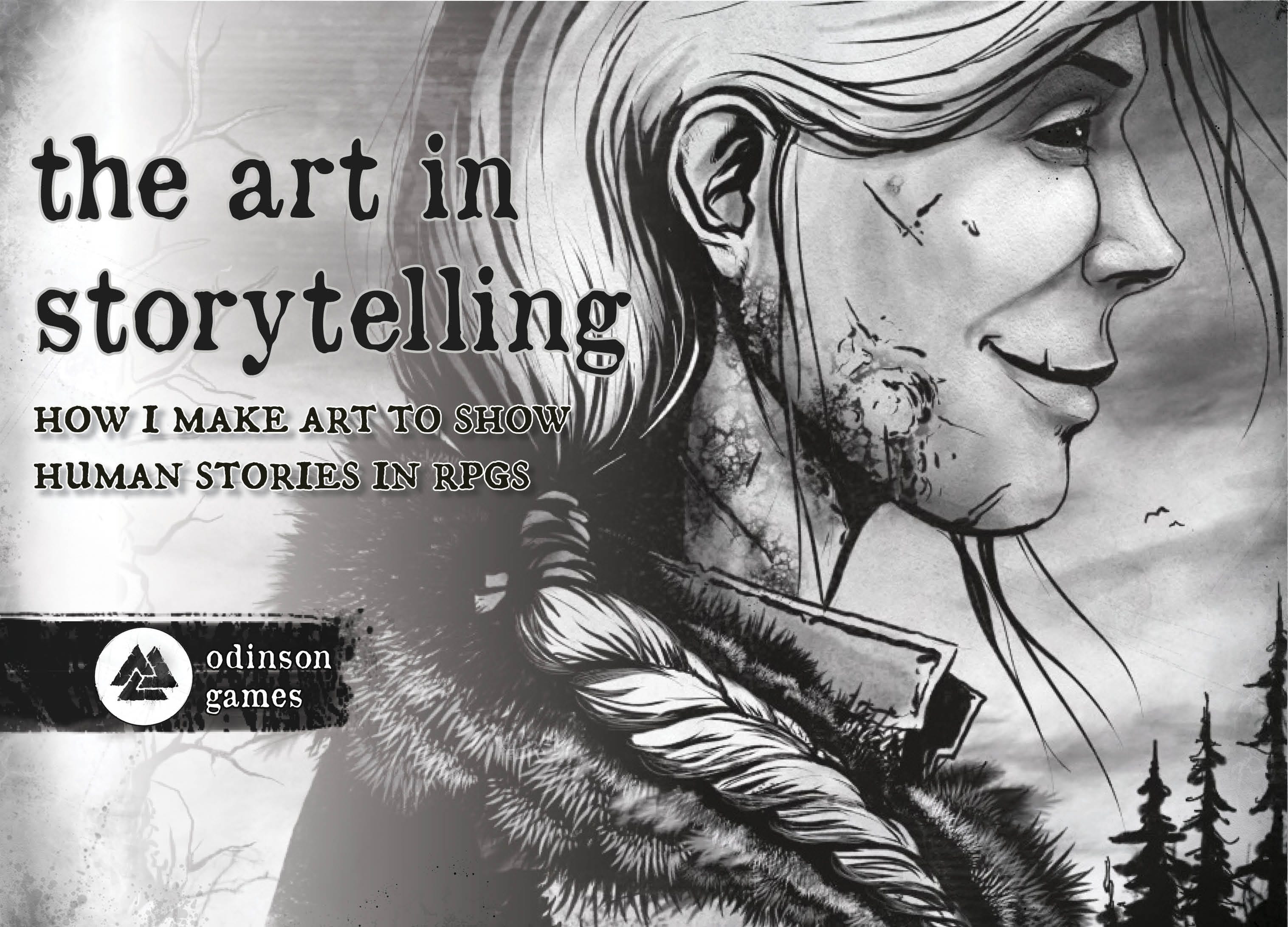
Organized religious violence is core to the Wenderweald. It’s something that has always been morbidly fascinating for me. History is rife with it, but the often slanted depiction of such acts in American media had a profound impression on me as a child.
I grew up in a town where “witches” were drowned to stave off the devil. Witchduck pond, if you're curious.
As a kid, I copied illustrations in my X-Men comics as the nightly news groused in the background about something called The Troubles over in the UK and some faraway place called Bosnia.
My first trip to NYC was a month to the day before 9/11. I spent the rest of my teen years dodging recruiters who wanted me for the next grand crusade. This, while my neighbors whispered about the house down the lane that never celebrated Christmas.
In retrospect, all this likely led me to that degree in Philosophy & Religion.
When I began imagining the Wenderweald, I knew I wanted to capture that morbid fascination of mine visually. I could write about all the complexity and nuance and horror of organized religious violence. That degree was just sitting there, after all. But I felt I could illustrate it better and more honestly.
There’s an art to depicting violence honestly. I had no interest in being gratuitous, gory, or misogynistic for shock value. There is already more than enough of that in fantasy art and gaming.
At the same time, this setting is inspired by a world where these horrors happened and continue to happen. Ignoring them would be dishonest.
The challenge was showing violence without reducing it to a cartoon morality play. I didn’t want to simply point at a crowd and say, “These are the bad guys. They burn witches.”
Much less did I want to declare that everyone in the Wenderweald is awful. There are witches born into their “gift” — witches who don’t know they’re witches or don’t want to be, like my beloved X-Men.
There are poor, witless boys drafted into the Stag Knight’s crusade like I might have been. The violence here is a tempest that rains on all those under it. But there’s character here, too, and goodness, and choice.
Art can show that better than words can tell it.
To illustrate my approach, I’ve chosen 2 pieces (probably my favorites) that show a story of religious violence and human perseverance.
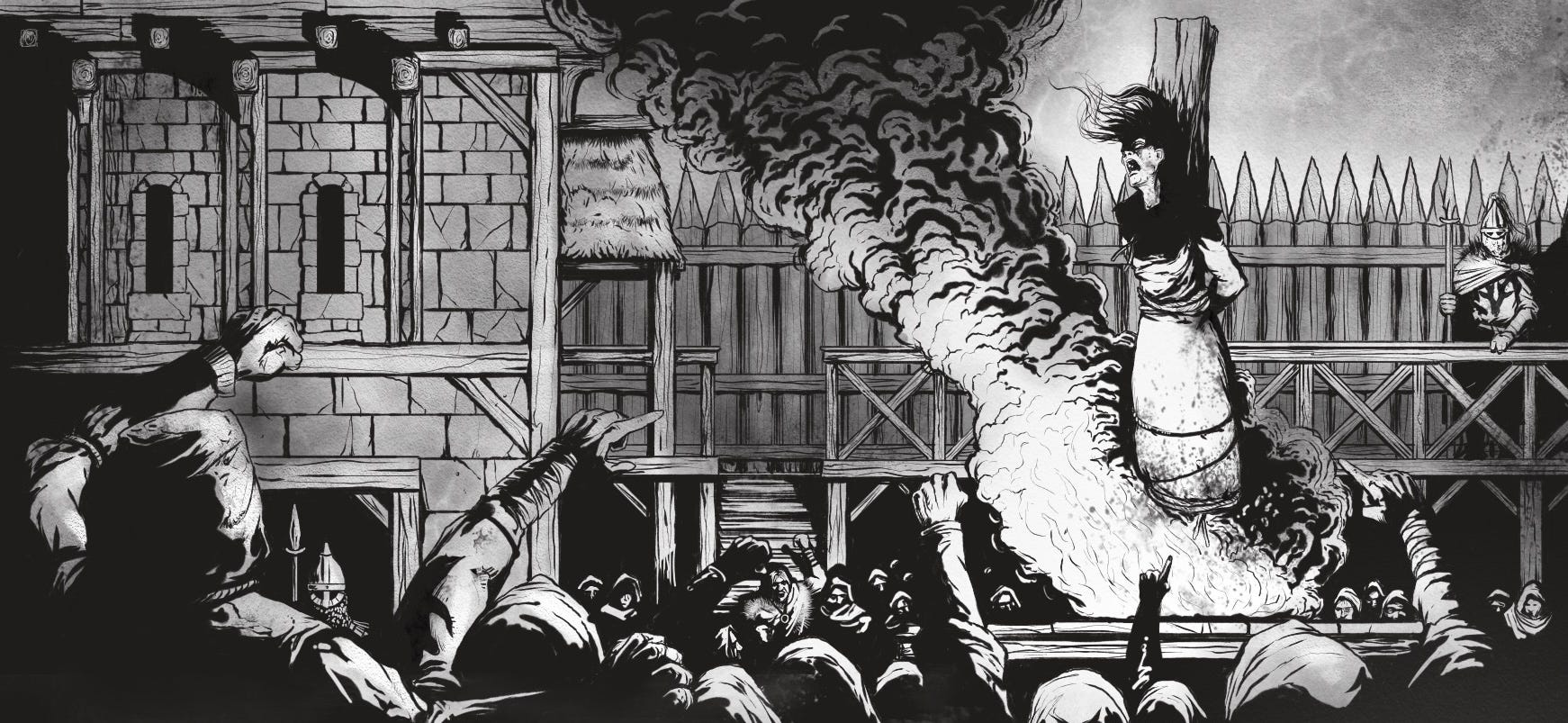
This image came to me first – it’s a story of witches, after all.
To build this scene, I contrasted the organic, flowing lines of the smoke with the rigid geometry of the architecture surrounding it. The stone walls, timber beams, handrails, and the wood-frame pyre itself dominate the composition. Everything is measured, squared, and controlled.
The burning witch is trapped within all these symbols of colonization, of control, and conformity. The town itself is built from harvested stone and felled trees. I wanted this place to feel cloistered and claustrophobic — a space separated from Nature by pieces hacked away from it. This civilization is a cage to protect the “civilized” folk within it.
I illustrated the crowd to reflect a common spectrum of humanity hidden within the organized violence.
The figures in the foreground are faceless. Their features disappear beneath hoods, shadows, and silhouettes. I deliberately obscured them because the image isn’t about individual people. It’s about the mob. About what happens when responsibility dissolves into a crowd. It’s Shirley Jackson’s The Lottery. They are eyeless, soulless, faceless things stitched into one formless dread.
Their gestures all blend together into one monstrous body of stabbing fingers and clenched fists. They have shed their individual identity in the crowd to share one identity as a herd. As with the real world, neighbors and family members shed their humanity to do such violence and then don it again when the bloody work is done.
In contrast, those in the background, the bystanders, cleave to shadows. I drew them as silent watchers in the dark. None cheer or scream save one: the hoodless figure near the stairs.
He stands by the stairs, having descended (condescended) into the crowd, to “enjoy” the ritualized act of violence and misogyny.
To draw attention to him, I broke up his silhouette with the architecture and added subtle signs of status: furs, jewelry, and bracers. Though part of the herd, he benefits from this violence as first among equals.
The guards oversee this violence, and I gave neither a shield. Their role is not to defend anyone, but to contain the mob and ensure the violence proceeds as intended and directed away from them. So long as the mob has someone to scapegoat, they maintain their positions: up high, or inside the stone keep
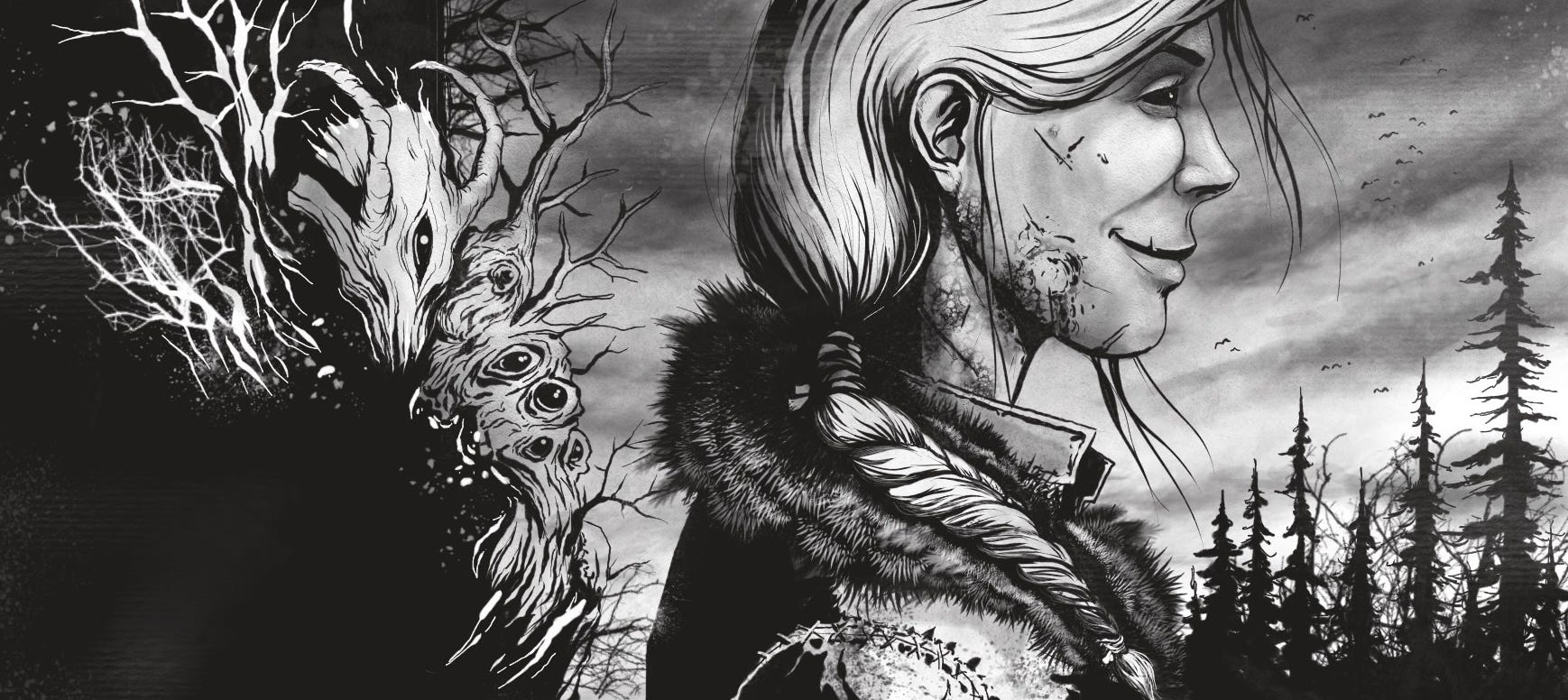
The second image tells the rest of the story.
The rigid beams and timbers of the first scene are replaced by a wychtree — a hangman’s tree animated by the soul of the hanged. What was once an instrument of execution becomes something alive.
The wychtree is a gnarled clot of knots and hollows and watchful black eyes. At its center sits a deliberately yonic form focused toward its mistress.
The awakened tree now watches over the witch, where before, as a stake, it watched her die like all the others.
For the witch herself, I had no interest in creating a fantasy pin-up. The Wenderweald is cold, wet, and hostile. Chainmail bikinis make no sense here. If you’re surviving in the wilderness, you’ll want furs, buckskin, and practical clothing. If men protect themselves with fur and armor, women would too.
More importantly, that aesthetic would undermine the story.
I wanted to depict a woman transformed by power rather than defined by her appearance. Her magic is subtle. It lives beneath the burned flesh of her neck and jaw. It stares back through her ink-black eyes like her wychtree.
The eyes represent her rebirth into the Wenderweald. They’re dark, cold, but open and full — she can see the world for what it is now.
The crowd in the first image is largely eyeless and anonymous. Here, the witch’s gaze becomes the focal point of the composition. She sees, and she remembers what her family and friends did to her.
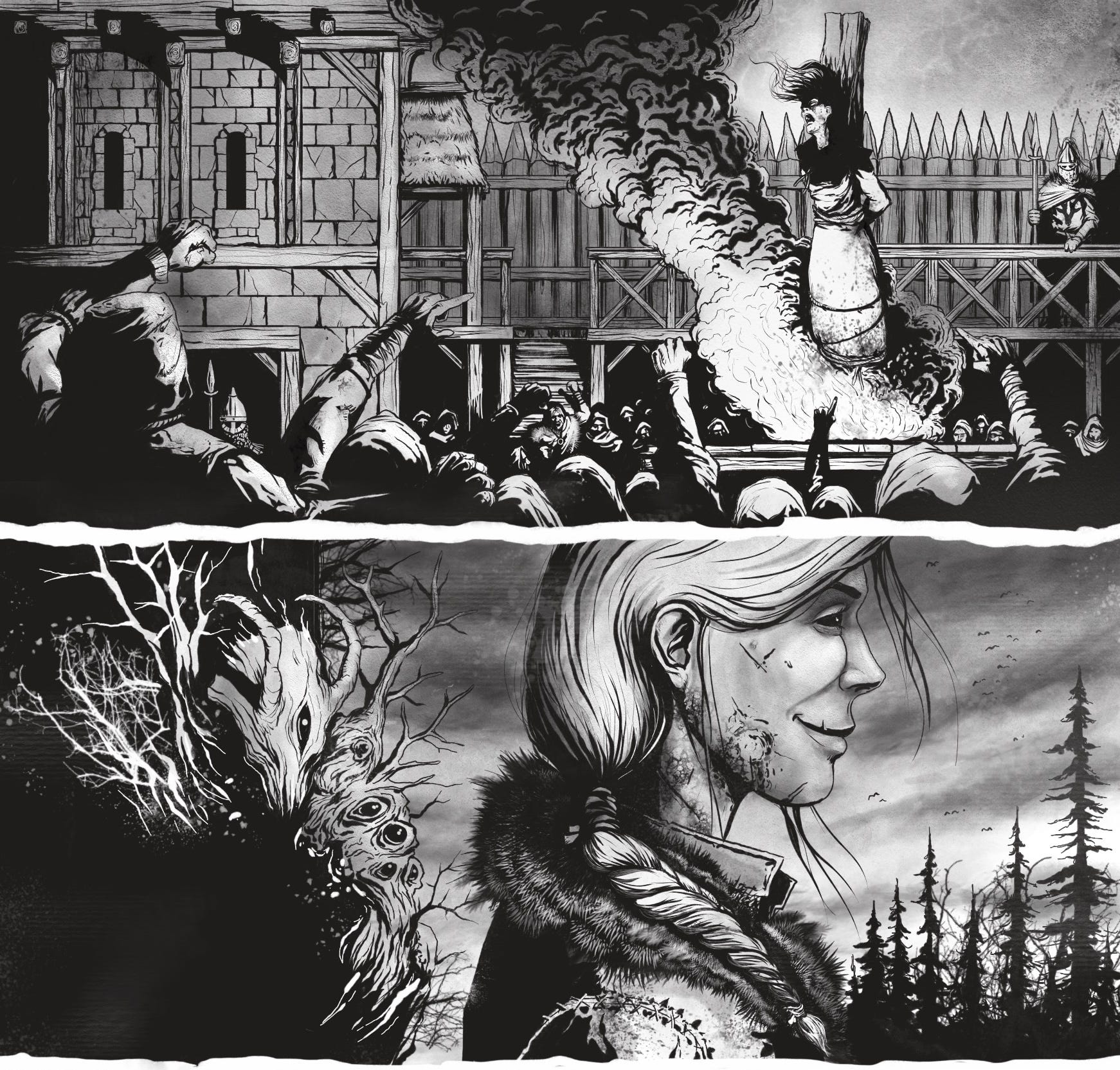
Viewed together, the images tell a story of rebirth and vengeance.
I never explicitly state that the woman survived her own execution. The evidence is visual. The burns and scars show that.
The witch in the first panel is small, distant, and overwhelmed by the world around her. The witch in the second is so large that she breaks the frame itself.
Her hair, once wild and chaotic in the heat of the pyre, is now braided and controlled. The panic of execution has become purpose.
I drew her clothing to build on this story. The furs she wears suggest that someone else paid the price for her transformation. That fool in the furs in panel 1 cheers no more.
I shifted the environment, too. The palisades and walls of civilization disappear, replaced by a dark, expansive forest. Trees no longer exist as lumber waiting to be shaped into walls, spears, and pyres. They have awakened.
The forest itself has chosen a side.
What was once passive has become active. What was once hunted now hunts.
And that, ultimately, that’s the Wenderweald. This ain’t about good or evil. It’s a story about humans trapped in their beliefs, convinced that if they do enough violence to the right people, they’ll have peace one day.
The game — the true human stories, begin here: when, despite the world around us, we make choices that define our character.
This game will be $0 — free to all — on itch.io. You can always donate if you want to support my work, but you don’t have to pay a red cent to play my game.
I had someone ask me recently why I make my games free. That’s why: I want folks to enjoy it. I want folks to find meaning and meaningful moments in my work.
See you soon, witches.
—Odinson.
Comments
Nothing yet. Say the first thing.
Sign in to join the conversation.